
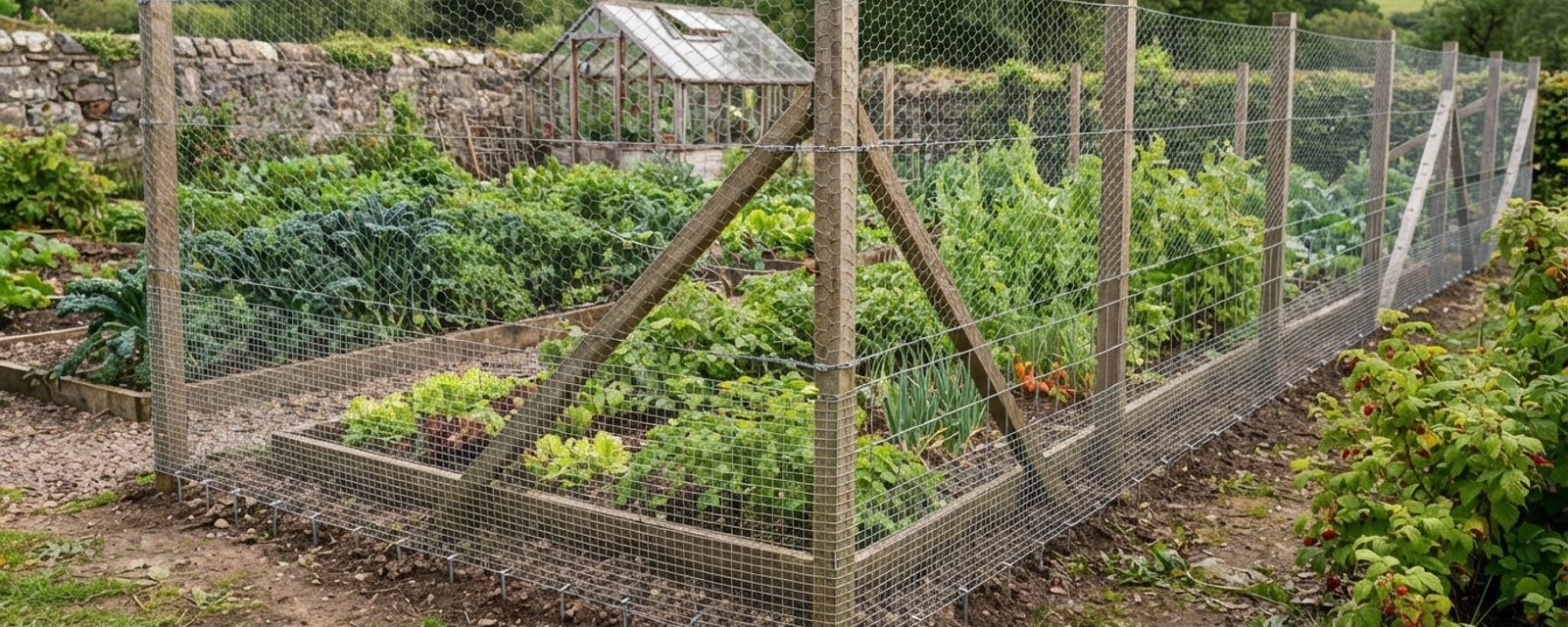
A five-foot wire fence that stops a rabbit does nothing to a deer, which simply steps over it. A fence tall enough to stop a deer still has gaps a rabbit will dig under within a week if the mesh isn't buried. Netting stretched over a fruit cage keeps birds out but is irrelevant to a slug, which never leaves the ground. And a padlocked gate that keeps every animal out will not stop a person, who can simply lift the latch and walk in.
The reason no single measure protects a plot is that each threat defeats a different physical mechanism. Deer jump. Rabbits dig. Birds fly over the top. Slugs move through gaps too small to see, at ground level, mostly at night. Theft and vandalism bypass all of it, because the "threat" can open gates, climb fences and read signs. A defence has to be matched to the specific way the threat gets in, and a real plot usually needs several defences layeredPropagating a new plant by pinning a low, flexible stem into the soil while still attached to the parent, so it roots before being cut free. Full definition → together rather than one fence assumed to do everything.
Fence and barrier specifications compared
| Threat | Barrier | Height | Mesh size | Ground-level detail |
|---|---|---|---|---|
| Red/roe deer (native, the ones to fence for in Scotland) | Wire mesh fence, heavy-duty wire in lower half | 1.8m (6ft) | Max 20 x 15cm (8 x 6in) | Bottom edge pegged to the ground |
| Muntjac deer (not established in Scotland) | Wire mesh fence | 1.5m (5ft) | Max 7.5 x 7.5cm (3 x 3in) | Bottom edge pegged to the ground |
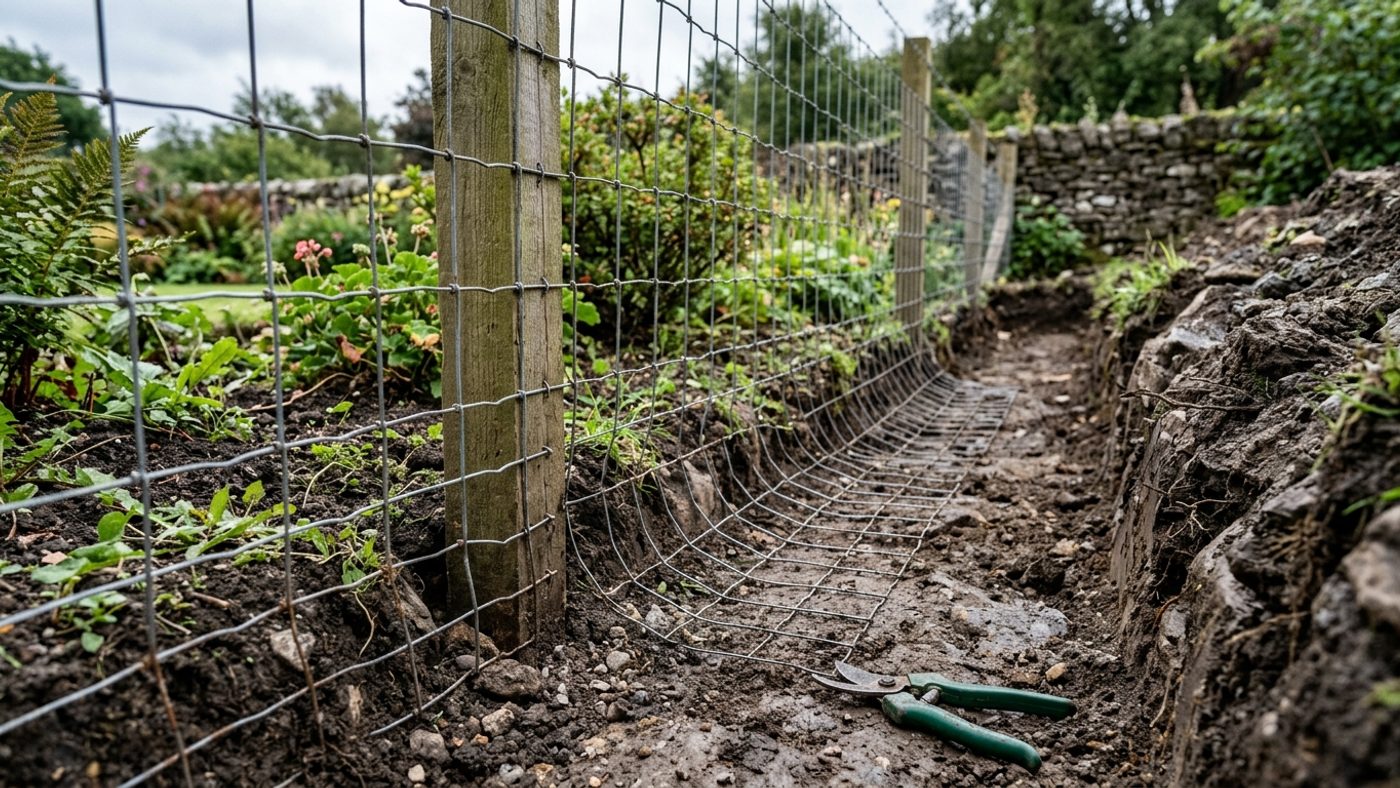
| Rabbits | Wire mesh fence | 120-140cm (48-54in) | 2.5cm (1-1¼in) | Bottom 30cm sunk below ground, lowest 15cm bent outward |
| Birds (fruit, brassicasThe cabbage family: cabbage, kale, broccoli, cauliflower, Brussels sprouts, kohlrabi, swede, turnip and more, sharing the same pests, diseases and rotation rules. Full definition →) | Netting over a cage or frame | Full enclosure, pegged to ground | See our birds and pigeons guide | Netting must reach the ground on all sides |
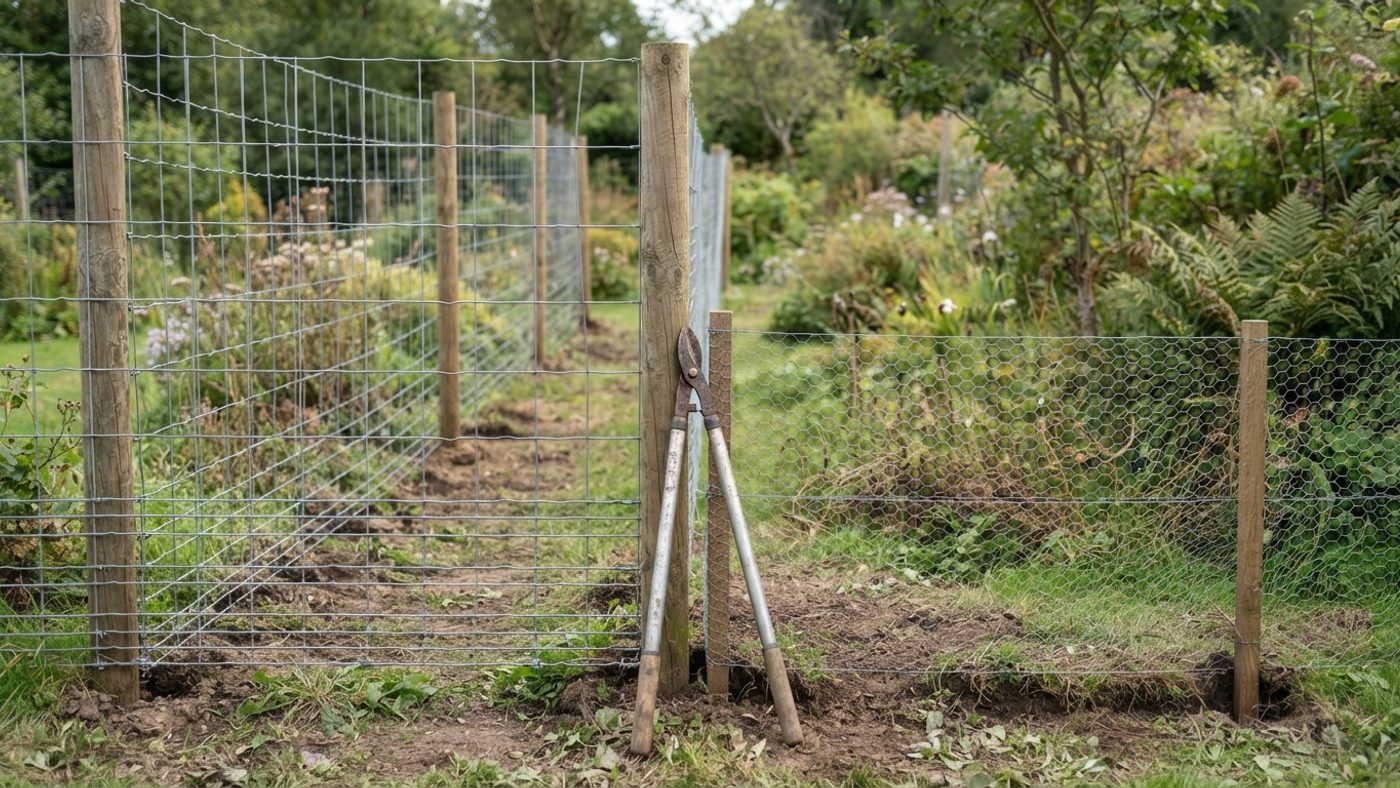
Two details in that table matter more than the headline numbers. First, for deer the mesh size and height both depend on which species you have: muntjac are smaller and squeeze through much finer gaps than roe or red deer, so a fence sized for "deer" in general without checking which species is around you is a guess. Second, for rabbits the buried, outward-bent skirt at the base is doing as much work as the fence itself, rabbits dig at the base of a barrier, and a skirt bent away from the garden stops them tunnelling under it even where the ground itself is soft.
Deer
Deer defeat a fence by going over it, so height is the entire game; the exact figures are in the table above. Scotland has four deer species: red and roe are native and found across most of the mainland, fallow have a patchy distribution, and sika, introduced from Asia in the 1860s, are now widespread. Muntjac, the smaller species most English deer-fencing advice is built around, are not established in Scotland at all: NatureScot's own position is to guard against their introduction here, not to plan around their presence. For a Scottish plot, build to the red/roe deer row in the table, not the muntjac one. The lower half of the fence should be a heavy-duty wire of the kind used for sheep or pig fencing, and the bottom edge needs pegging to the ground, because deer will lift a loose wire edge and squeeze underneath it rather than jump. A horizontal-strand fence isn't a safe shortcut either: roe deer can squeeze through gaps as narrow as 30cm between strands, so mesh, not spaced wires, is what actually excludes them.
Hedges can substitute for fencing if they are tall and dense enough that a deer cannot push through, and a ditch on the outside of a hedge or fence line adds a real extra barrier by making the jump longer. Gates are a genuine weak point: an otherwise deer-proof enclosure with a gap at the entrance is not deer-proof, so gates need to close the same barrier height and mesh as the rest of the fence.
Beyond fencing, the evidence gets thinner. Electric fencing of the type used to contain livestock is often ineffective against deer, and a startled deer can damage it by running through rather than being deterred by it. Repellent sprays based on aluminium ammonium sulphate or calcium chloride may discourage browsing but need frequent reapplication through spring and summer, and rain washes them off, which in practice means more frequent reapplication through a typically wet Scottish growing season than the label's UK-wide interval assumes. Ultrasonic deterrent devices work initially but deer habituate to the noise and the effect fades. Scattering human hair around a garden gets reported as effective by some gardeners, but there's no real mechanism behind it, human scent fades within days and rain washes it away faster still, so it doesn't work reliably in most gardens and is folklore-tier at best. Of the non-fence options, a dog patrolling the plot is the one deterrent with a reliable mechanism: deer avoid the scent and sound of a dog consistently, in a way they don't avoid a fixed device.
Before building anything at fence height, check your site's own rules. Many council and association allotment sites set their own limits on fence height, materials or what needs committee sign-off before you erect it, so a plot-holder putting up a deer-height fence without checking first risks having to take it back down. Cost is also worth budgeting for properly before you start: stock or pig-mesh fencing of the height and gauge needed for deer is a real materials cost across a whole plot boundary, and prices vary enough by supplier and site size that it's worth getting a couple of quotes rather than guessing.
Rabbits
Rabbits defeat a fence by digging, so the buried skirt matters as much as the height. A rabbit-proof fence needs mesh no larger than 2.5cm and a height of 120 to 140cm, but the section below ground is what actually stops the digging: the bottom 30cm needs to be sunk into the ground, with the lowest 15cm of that buried section bent outward, away from the plot, so a rabbit digging down against the fence line runs into wire angling away from the garden rather than a straight edge it can dig alongside. In practice, ordinary galvanised wire mesh is soft enough to bend that right angle by hand or with pliers once it's in the trench, though a stiffer stock-fencing gauge is harder work. Gates need to meet the same specification and be kept closed, since an open or gappy gate undoes the rest of the fence.
For smaller areas, a length of wire netting can protect a kitchen garden bed or vulnerable plants like lilies without fencing the whole plot, and individual plants can be protected with 90cm netting without needing to bury anything, since the threat to a single caged plant is browsing height, not tunnelling in from outside the cage. Tree guards and spiral guards protect young trunks the same way. Plastic and fabric netting on their own only give short-term protection, because rabbits gnaw through both given time, so netting is better used as a supplement to a proper mesh fence than a substitute for one. Repellent sprays share the same limitation as deer sprays: they don't give complete protection, particularly in wet weather, worth bearing in mind given how much of a typical Scottish growing season is wet. Electric fencing designed for rabbit exclusion needs a mains or battery energiser to run, a real ongoing commitment better suited to a larger plot or smallholding than a single allotment bed, where a properly buried mesh fence does the same job without power.
Birds
Wood pigeons are the bird most likely to strip a plot in Scotland, targeting brassicas and soft fruit in particular, though any garden bird taking fruit or seedlings defeats a barrier the same way: by flying over anything that doesn't have a roof. That's why netting a fruit cage or frame on all sides, including pegged to the ground, is the one control with solid backing, while scaring devices such as reflective tape, CDs and scarecrows lose effectiveness quickly once birds get used to them sitting still in the same spot. Repellent sprays sit at the weakest end of the evidence for birds, similar to their weak showing against deer and rabbits. Whatever cage or netting frame you build, size the hoops and fixings for Scottish weather as well as birds: wet snow settling on netting is heavy enough to collapse an undersized frame, and an exposed plot needs the structure properly tensioned against wind, not just pegged down as an afterthought. For the full mesh sizes and cage specifications, see our birds and pigeons pest guide.
Slugs
Slugs move through gaps too fine to see and mostly at ground level, which is why physical barriers built to stop a bird or a rabbit are irrelevant to them. Most of the traditional barrier folklore for slugs, copper tape, sharp grit, eggshells, bark mulchA layer of material spread over the soil around plants to suppress weeds, retain moisture, and improve soil structure as it breaks down. Full definition →, wool pellets, has been tested in RHS trials and found to make no measurable difference to slug damage. Nematodes are the one biological control with real backing, needing moist soil roughly 5-20°C to work, a range the Scottish growing season generally reaches from spring through into autumn, though they aren't cheap and don't distinguish slug species you might actually want in the garden from ones eating your crops. RHS's current position has in fact shifted away from treating slugs as a pest to eliminate at all, reframing them as part of garden biodiversity. For the full evidence breakdown on what does and doesn't work, see our slug deterrents guide.
Other visitors: squirrels, badgers, cats and rats
Grey squirrels, badgers, cats and rats are four more visitors worth a mention, even though this guide's specifications above are built for deer, rabbits and birds specifically. Squirrels raid soft fruit and sweetcorn and are agile enough to defeat most netting that isn't also secured at ground level, the same underlying logic as the bird section above; fine mesh sized for birds generally also excludes them. Grey squirrels sit in a different legal position in Scotland than the rest of this list too: they're an invasive non-native species linked to the decline of Scotland's native red squirrels, so any grey squirrel caught in a live trap cannot legally be released again, unlike a rabbit or bird that can simply be let go. Badgers can flatten a bed wholesale digging for worms and grubs, but there's no standard published fence specification for garden use, since they're relatively rare on most vegetable plots. They're a protected species in law regardless, so trapping or harming one is not an option; a badger-proof barrier means substantial fencing buried deeper than the rabbit specification above, and if badgers are a recurring problem it's worth contacting your local authority or the Scottish SPCA for advice specific to a protected species before acting. Rats are drawn to compost bins and stored produce rather than growing crops directly, so the practical answer is less about fencing the plot and more about denying them food and shelter: a secure, rodent-proof compost bin base, produce stored off the ground in a shed rather than left in sacks, and reporting a persistent problem to your council or site association, since rats are a shared-site issue rather than a single plot-holder's to solve alone. Cats are a different kind of nuisance again, more likely to disturb seedbeds and freshly dug soil than eat crops; there's no fence spec for this at all, and the practical answer most gardeners land on is a physical cover over bare soil and seed drills, such as netting or twiggy sticks pushed in at an angle, until seedlings are through and less inviting to dig around.
Allotment theft and vandalism
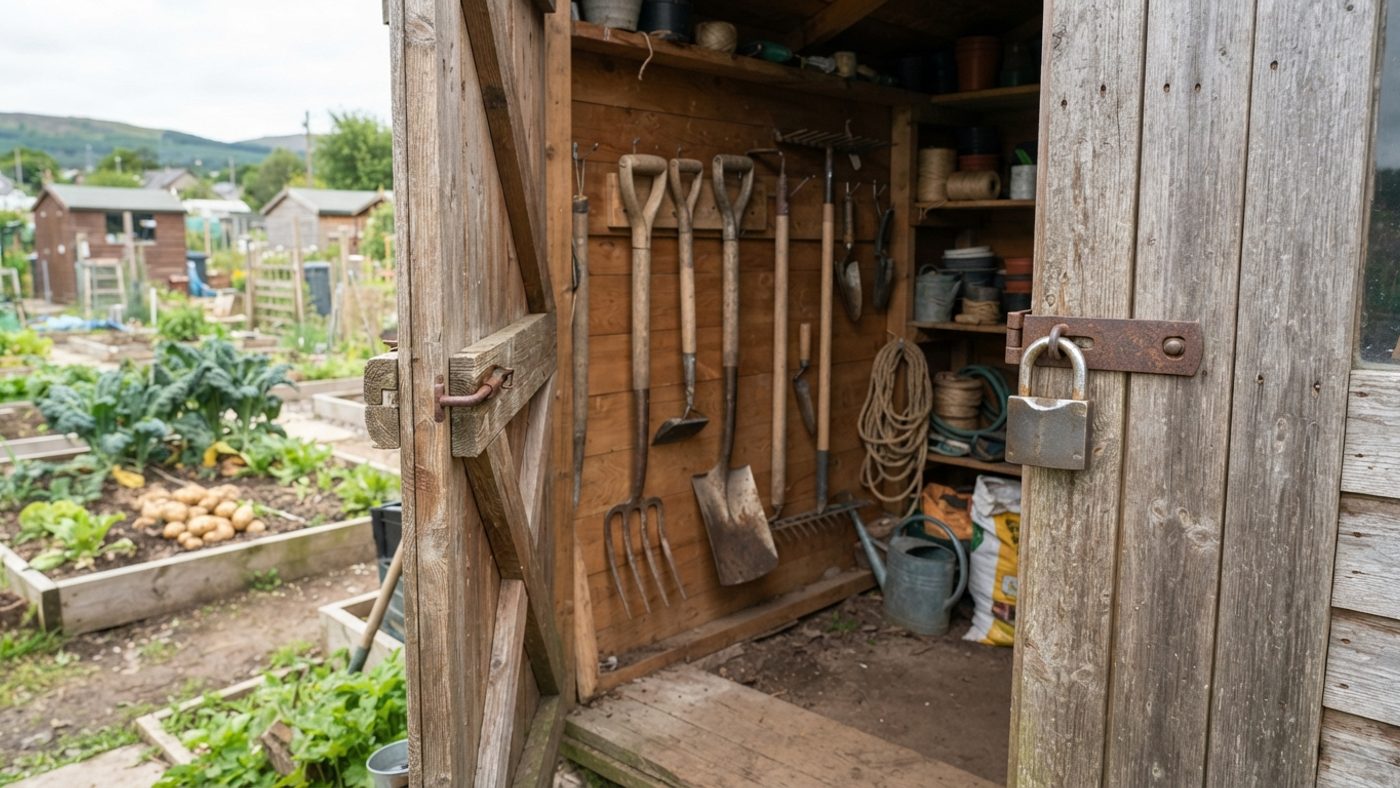
A locked gate or a low fence stops none of the animals above and does even less against a person, who can lift a latch or step over. Police Scotland's general crime-prevention advice, aimed at gardens generally rather than allotments specifically, is still directly applicable to a plot: keep boundary hedges, walls and fences low at the front of a property, so there's nowhere to hide while someone breaks in, and taller at the rear where concealment favours an intruder rather than you; choose plants with natural spikes along vulnerable boundaries, since they're hard to climb through; fit motion-sensor or timer lighting; use CCTV where practical; secure bins and other objects so they can't be used to climb over a fence; and lock tools and other valuables away rather than leaving them visible, since visible tools both invite theft and can be used to break into a shed or store. For marking property, the same advice recommends registering equipment with a DNA marking kit or UV pen using your house number and postcode, and recording serial numbers of anything valuable, so recovered stolen items can be traced back to an owner and identified as stolen if a thief tries to sell them on.
The Scottish Allotments and Gardens Society publishes advice on getting a plot, constitutions, event management and the legal position of allotments, but nothing dedicated to site security specifically, so a search for Scotland-specific institutional guidance on allotment theft comes up short. The rest of this section is plain practical advice rather than a sourced institutional recommendation: get to know your plot neighbours, since an occupied, sociable site with people around regularly is a weaker target than an empty one; don't leave anything valuable-looking on view, including seemingly disposable items like empty pots or hosepipe, which still walk; consider a shared site padlock or combination lock changed periodically if your site has one gate for everyone; raise a shared deer or rabbit fence as a site-wide, cost-split project with your allotment association rather than each plot-holder fencing separately, since the materials cost is the same whether it protects one plot or twenty; and report any theft or vandalism both to your site association or council allotment officer and to Police Scotland on 101, since a pattern of small incidents reported individually can look like nothing on its own but builds a real picture over time.
Common questions
Do I need a deer fence if I only ever see deer occasionally?
If deer can reach your plot at all, an occasional sighting usually means occasional damage rather than no risk, since deer will return to a food source once they've found it. A 1.8m mesh fence is the barrier with a real mechanism against jumping for red and roe deer, Scotland's two native species; anything shorter or relying on scent or noise deterrents alone tends to work only until the deer get used to it.
Will a rabbit fence also keep out deer, or vice versa?
No. A rabbit fence at 120-140cm is well within jumping range for any deer, and a deer fence's mesh is usually far too wide to stop a rabbit digging under or squeezing through at ground level unless it's also been buried and bent outward at the base. The two need to be treated as separate specifications, even if you end up combining them into one taller, buried fence.
Is it worth buying an ultrasonic or electronic deer/rabbit deterrent?
The evidence is weak. Ultrasonic devices work initially against deer but lose effectiveness once the animals get used to the sound, and there's no equivalent trial evidence establishing they work any better long-term for rabbits. They're not worthless as a supplement, but they shouldn't replace a properly specified fence.
What's the single most effective thing I can do against allotment theft?
There's no single fix, since theft depends on opportunity rather than one weak point. Police Scotland's own advice backs two of the strongest measures: lock tools and valuables away rather than leaving them visible, and mark equipment with a DNA kit or UV pen so anything recovered can be traced back to you. Keeping the plot and site visibly occupied helps too, on ordinary logic rather than a specific citation: an occupied site removes the easy opportunity that makes an empty one a target.
What about squirrels, badgers, cats and rats?
All four are real nuisances on Scottish plots but sit outside this guide's four main specifications. Squirrels raid soft fruit and sweetcorn and need the same ground-secured netting logic as birds; a trapped grey squirrel cannot legally be released again, given their link to red squirrel decline. Badgers are a protected species in law, so they can't be trapped or harmed. Rats are usually a compost-bin and shed problem rather than a crop one. Cats mostly disturb bare soil and seedbeds, and a simple physical cover over freshly sown ground usually solves it.
Sources
7 sources, recorded with what each was used for
- RHS: Deer: Deer fencing height and mesh sizes for muntjac vs roe/other deer, heavy-duty lower wire, pegging the base, hedge/ditch effectiveness, repellent and ultrasonic device limitations, dogs as a genuine deterrent
- RHS: Rabbits in Gardens — Deterrent Tips: Rabbit fence mesh size, height, burial depth and outward-bent skirt, gate requirements, small-area netting, repellent and electric fencing limitations
- RHS: Pigeons: Netting/fruit cages as the reliable bird protection, limited effectiveness of scaring devices, summarised here; full detail on our birds and pigeons pest guide
- RHS: Slugs and Snails: Nematode temperature window, summarised here; full evidence breakdown on our slug deterrents guide
- NatureScot: Deer: Scotland's four deer species and their distribution, and confirmation muntjac are not established in Scotland
- Police Scotland: Your home: Garden security advice: hedge height, lighting, securing bins, locking away tools and valuables, marking property with DNA kits/UV pens
- Scottish Allotments and Gardens Society (SAGS): Advice Notes: Confirms the organisation does not currently publish a dedicated allotment security advice note