
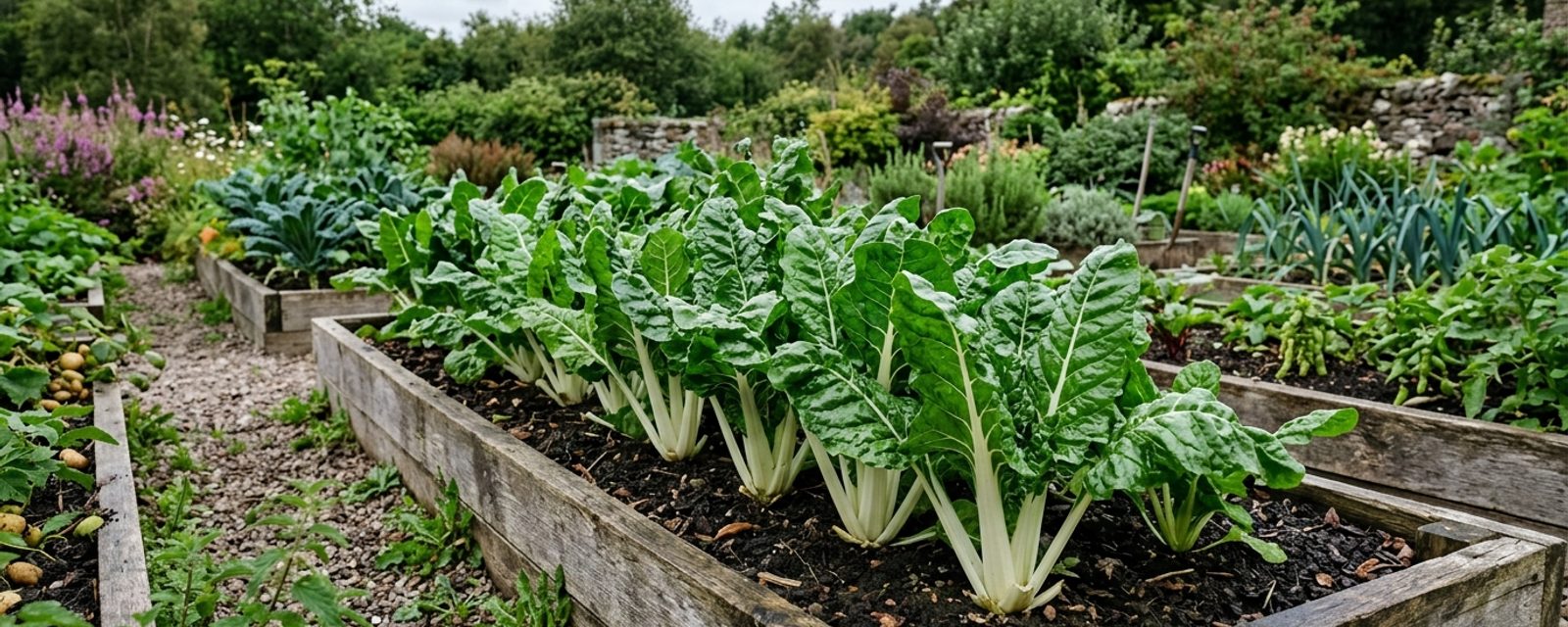
Beta vulgaris subsp. vulgaris (Cicla Group)
Chard is a hardy, forgiving leaf crop that outlasts its close relative spinach by months, not weeks — and picked right, a single plant just keeps giving.
Two sowings a year, roughly April and July, cover almost the whole growing season between them: the first crops through summer and autumn, the second overwinters for a spring harvest before it finally boltsA plant switching early into flowering and seed production, usually triggered by stress, after which leaves, roots or bulbs turn bitter or unusable. Full page →. The one choice that genuinely matters more here than elsewhere: white-stemmed varieties are the hardier, more productive choice, not just a plainer one.
Sowing
Sow outdoors April to July, or indoors in modulesA tray divided into small individual cells, each sown with its own seed or seedling, so each plant grows undisturbed roots until it's ready to plant out. Full definition → from early spring for a head start, moving seedlings out once they reach at least 5cm tall. Sowing depth genuinely varies by source: 2.5cm, 1cm and 1.5cm have all been given, a real three-way spread rather than one figure being wrong. Aim somewhere in that range rather than treating any single number as exact.
Space seedlings 30cm apart for full-size plants, or as close as 5cm if you want a cut-and-come-again baby-leaf crop instead. Rows 40-45cm apart.
Varieties: white stems are the hardier choice
This is the one place chard rewards a deliberate variety choice. White-stemmed types are named as the hardiest, most productive option for colder locations, and red-stemmed varieties are separately noted as more prone to bolting. Two independent findings pointing the same way is a stronger basis than a single source's preference, which makes white stems the safer choice over the more decorative rainbow types.
RHS also lists 'Rhubarb Chard' and 'Charlotte' with AGMThe RHS's Award of Garden Merit: a UK-wide trials award for reliable performance, not a Scotland-specific recommendation. Full definition →, plus 'White Silver', which despite being described elsewhere as an award winner carries no AGM on RHS's own page. Note: 'Bright Yellow' also holds a genuine AGM on its own individual RHS plant page, even though it's missing from RHS's general chard variety list.
★ Our pick for Scotland
Fordhook GiantAGM
Vigorous, very productive, crisp white stems
White-stemmed, the more resilient choice.
Why this one: White-stemmed chard is named as the hardiest, most productive choice for colder locations, and red-stemmed varieties are separately noted as more prone to bolting. Two sources landing on the same conclusion from different angles is a stronger basis than usual for a Scottish pick, and Fordhook Giant is the AGM variety that fits it.
Also worth considering
Bright LightsAGM
Rainbow of red, yellow and orange stems
The AGM pick if the ornamental colour matters to you, but a knowing tradeoff: coloured-stem varieties are the less resilient, more bolt-prone option.
Best Chard Varieties for Scotland → compares all named chard varieties head-to-head, with the practical detail that doesn't fit in a summary card.
Growing in containers or a flower border
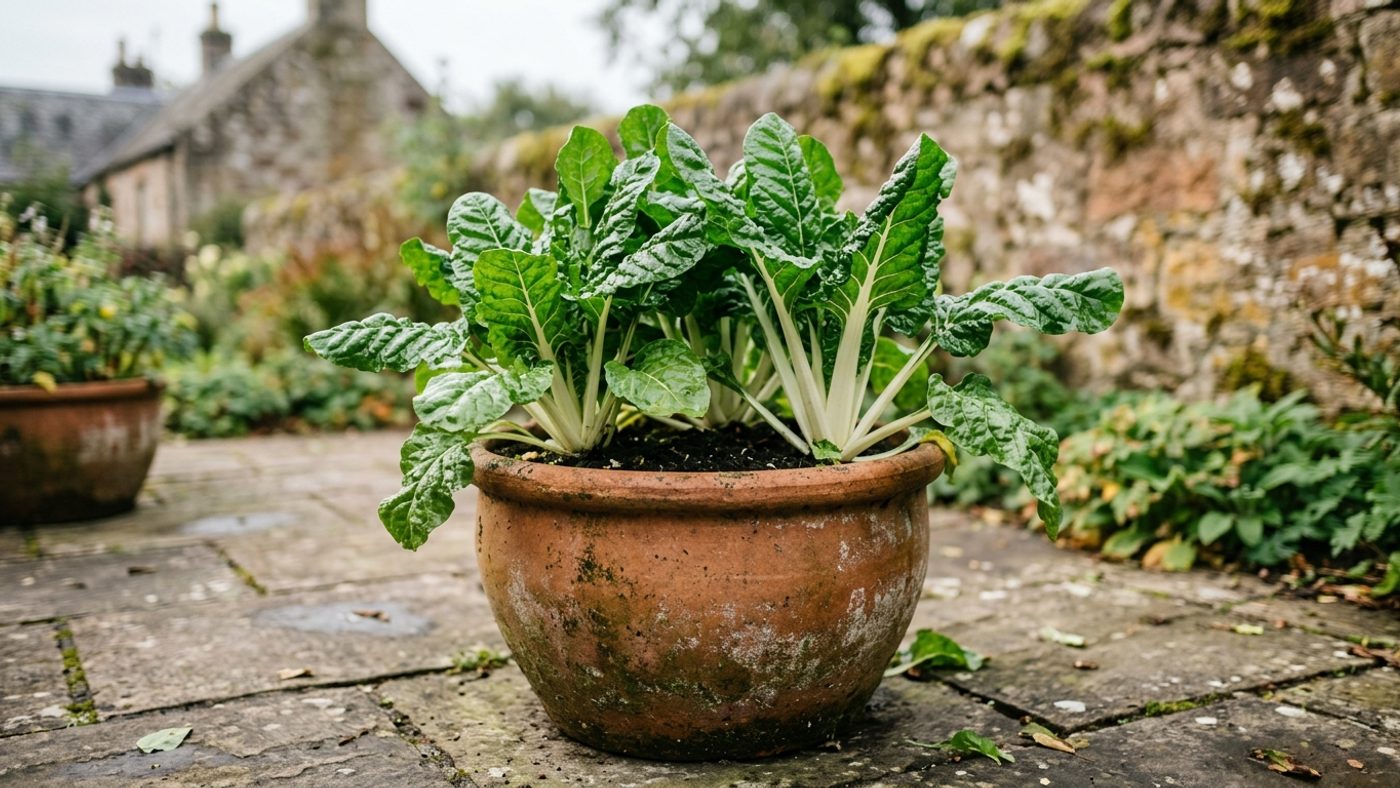
Chard doesn't need a vegetable bed. In a container at least 40cm wide and deep, filled with peat-freeCompost made without peat, which is harvested from a slow-forming, carbon-storing wetland habitat that peat extraction damages. Full definition → multi-purpose compost, it grows exactly as it would in the ground, at the same spacing. Rainbow varieties in particular are handsome enough to plant straight into a flower border rather than tucking them away: the stems hold their colour all season and pair well with late-summer flowers, so there's no need to treat this as a purely practical crop if you'd rather it earned its place decoratively too.
Edimentals: The Ornamental Edibles Worth a Spot in Your Border → covers rainbow chard alongside other edible plants that earn a place in a decorative border.
Care
Water young plants regularly until established; established plants are fairly drought-tolerant but crop better with watering through dry spells. MulchA layer of material spread over the soil around plants to suppress weeds, retain moisture, and improve soil structure as it breaks down. Full definition → to retain moisture, leaving a gap around the base of each plant to avoid stem rot. Feeding is rarely needed. If plants start to flower in hot weather, cut off the flower stems to keep leaf production going for a while longer, though flowering eventually becomes inevitable. Chard is hardy enough to sit outside over winter without protection, though a clocheA small, portable clear cover placed over an individual plant or short row to trap warmth and keep off wind, rain and pests. Full definition → can bring on mild-spell leaves and speed up spring growth.
Harvesting: two different techniques for two different results
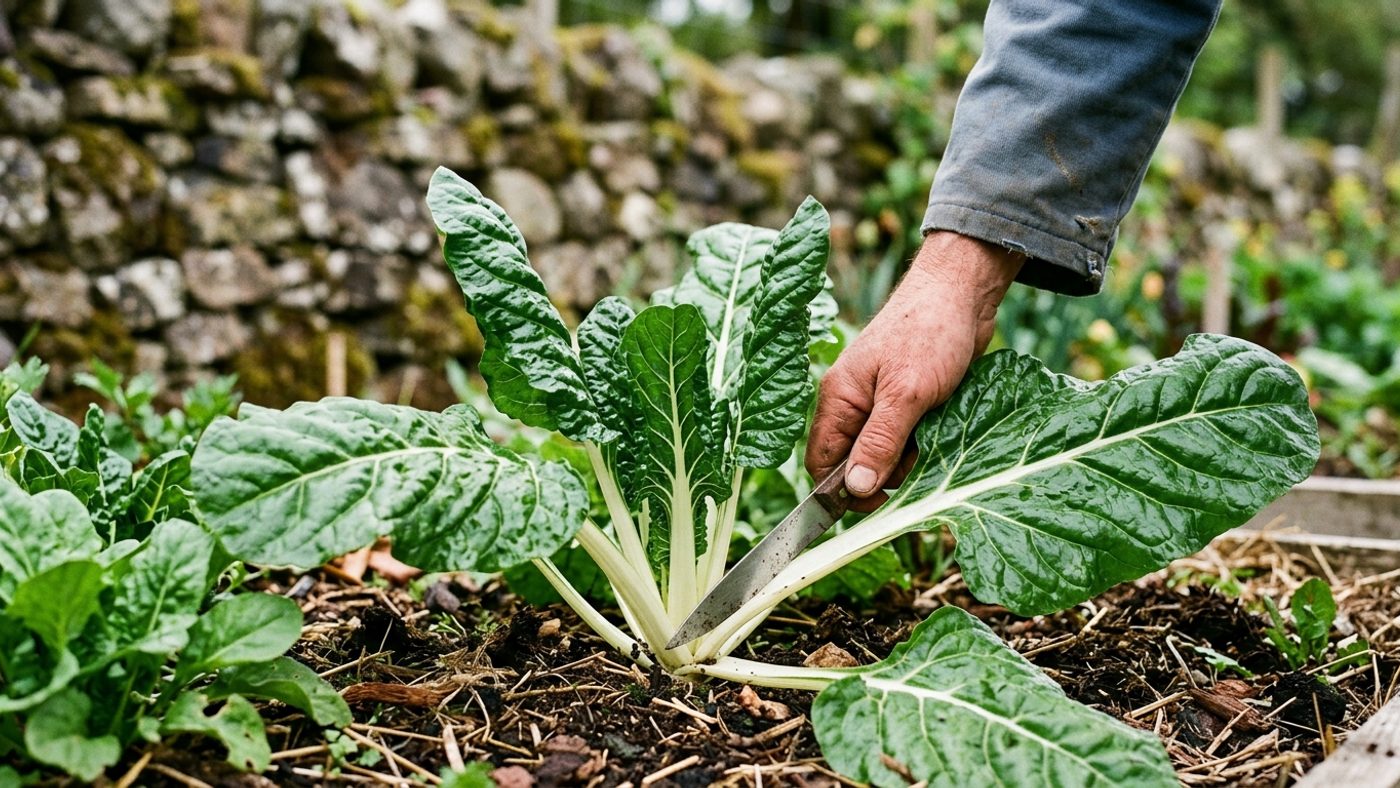
Pick outer leaves only, cutting cleanly at the base and leaving the centre to keep growing: this is the route to months of steady picking from a single plant, and the one to default to. Alternatively, on an established plant at least 20cm tall, you can cut all the leaves at once, at least 5cm above the base, and let it regrow before the next cut: a bigger single harvest with a longer wait in between, rather than a steady trickle.
Common problems
- Slugs and snails are a particular risk to seedlings, especially in damp weather.
- Downy mildew can affect chard's appearance and yield. This is a different organism from the downy mildew that affects spinach, not the same disease under a different name.
- Grey mould takes hold in damp, overcrowded conditions. Space plants properly for airflow and avoid mulching right up against the stem.
See more problems
- Beet leaf miner larvae tunnel inside leaves. Remove affected leaves as you spot them.
Common questions
Is colourful rainbow chard just as hardy as plain white-stemmed chard?
No: white-stemmed varieties are named the hardiest, most productive choice for colder locations, while red-stemmed types are separately more prone to bolting. Full sourced breakdown: <a href='/tools/garden-myths/chard/'>Chard Myths →</a>
Does chard bolt as easily as spinach?
No: a single chard sowing lasts longer and is less prone to bolting than spinach, so you can get away with fewer, more widely spaced sowings. Full sourced breakdown: <a href='/tools/garden-myths/chard/'>Chard Myths →</a>
Should I strip a chard plant of all its leaves for the biggest harvest?
No: pick outer leaves only and leave the centre rosette to keep growing, which lets a single plant keep producing for months rather than giving one bigger harvest and stopping. Full sourced breakdown: <a href='/tools/garden-myths/chard/'>Chard Myths →</a>
Does interplanting chard with leeks help protect them?
No, the opposite: a members' trial found chard cut marketable leek yield by 69%, far outweighing any pest benefit, so grow them in separate beds. Full sourced breakdown: <a href='/tools/garden-myths/chard/'>Chard Myths →</a>
Sources
4 sources, and what each was used for
- RHS: sowing depth and timing for indoor/outdoor/container routes, spacing for full-size and baby-leaf harvests, soil prep, watering, mulching, bolting cause and fix, winter hardiness and protection, two harvesting methods, leaf and stem uses, five named varieties with AGM status individually confirmed
- Garden Organic: corroborates sowing window and spacing independently; gives a shallower sowing depth (1cm) than RHS's 2.5cm, a genuine difference; corroborates the two-sowing succession pattern for near-continuous harvest
- gardenersworld.com: corroborates spacing (40cm rows) and depth is closer to RHS but still different (1.5cm), a third figure rather than resolving the disagreement; adds that red-stemmed varieties are more prone to bolting, corroborating RHS's white-stemmed hardiness note from the opposite direction; gives a concrete yield figure (6kg per 3m row); two AGM claims ('White Silver', 'Bright Yellow') that could not be verified on RHS's own page and were not used
- Teagasc: independently corroborates the March-July sowing window and the April/July two-sowing pattern; adds a genuinely useful comparison this site's own spinach page doesn't make from chard's side: a single chard sowing lasts longer and is less prone to bolting than spinach