
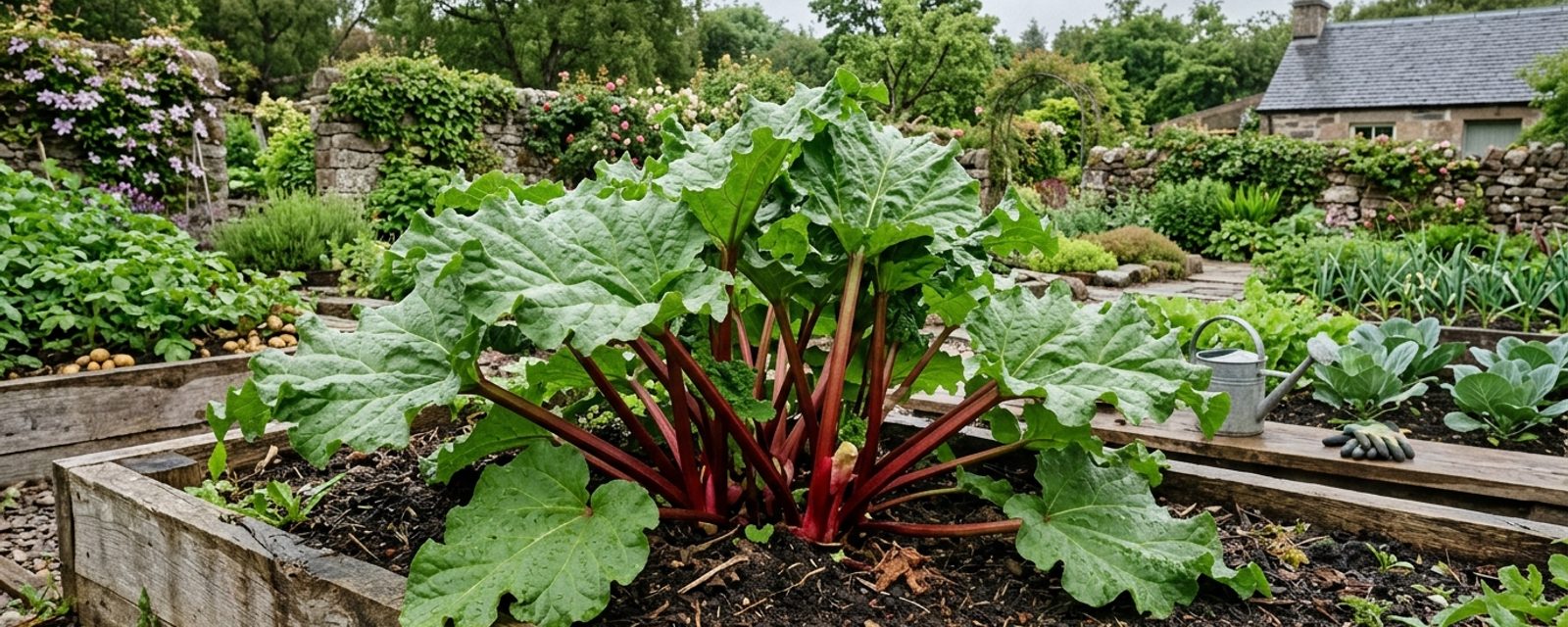
Rheum x hybridum
Rhubarb's real requirement, a properly cold winter, is one this climate meets without any effort at all, and forcingCovering plants to exclude light and speed early, tender growth in the dark, most associated with rhubarb and sea kale in late winter. Full definition → gets stems weeks earlier than anything cropping normally outdoors.
Most vegetables grown here need a warm summer Scotland doesn't reliably supply. Rhubarb runs the other way: both RHS and Gardener's World describe deliberately chilling crownsThe base of a perennial plant where roots and shoots meet, often sold and planted as a ready-made dormant plant rather than grown from seed. Full definition → for about two weeks to break their dormancy before forcing, which is exactly the cold exposure an ordinary Scottish winter already provides outdoors, for free.
Perennial Vegetables Worth Growing in Scotland → compares rhubarb against the other permanent-bed crops worth the same long-term commitment.
Planting
Buy dormant bare-rootA plant, usually a fruit tree or hedging, sold with its roots exposed rather than in a pot, and only available while dormant. Full definition → crowns, available November to March, or potted plants, available year-round though spring or autumn is preferred; growing from seed is possible but the cheapest, slowest route. Dig a hole slightly wider than the root system, and position the crown so its growing tip, where the leaves emerge, sits just above the soil surface rather than buried. Space plants 75-90cm apart, since a mature clump can reach 1.5m wide. Choose an open, sunny site with fertile, moisture-retentive soil that doesn't waterlog; on heavy clay or poor drainage, use a raised bed or a large container instead. Dig in two bucketfuls of well-rotted organic matter per square metre before planting.
The first two years
Take no stems at all in the first year after planting, and only a few in the second, so the plant has time to establish properly. Normal harvesting starts in the third year. It's a genuinely easy crop to grow, but the patience this early stage asks for pays off in a plant that can support a full harvest for years afterwards.
Varieties
Timperley Early and Raspberry Red both carry the RHS Award of Garden Merit, a UK-wide award rather than a Scottish one. Victoria doesn't, but its productivity and long track record earn it a place regardless.
RHS also lists 'Fulton's Strawberry Surprise' AGMThe RHS's Award of Garden Merit: a UK-wide trials award for reliable performance, not a Scotland-specific recommendation. Full definition →, the most compact AGM variety (0.5-1m), though it adds no early-cropping or forcing trait beyond Timperley Early and Raspberry Red. Gardener's World separately names Stockbridge Arrow (forcing-capable, no AGM), Cawood Delight (not for forcing, quality over yield) and Livingstone (a rare autumn-cropping variety), none AGM-confirmed.
★ Our pick for Scotland
Timperley EarlyAGM
Early variety, ideal for forcing, thick red stems
The earliest possible rhubarb this crop can offer.
Why this one: RHS's own pick for forcing, and independently corroborated by Gardener's World as the variety that forces well for a February harvest, weeks ahead of anything cropping normally outdoors: the earliest possible stems this crop can offer in a Scottish spring.
Also worth considering
Raspberry RedAGM
Sweet bright red stems without forcing, heavy cropper from April
RHS names this variety specifically for cropping heavily from April without needing to be forced at all, a genuinely low-effort route to an early crop for anyone who doesn't want to build or manage a forcing pot.
Victoria
Reliable old variety, very productive, greenish stems flushed red
A long-standing, widely available variety independently named as high-yielding by both RHS and Gardener's World, worth including as the traditional option many growers already know or specifically seek out, even without an AGM award.
Best Rhubarb Varieties for Scotland → compares all named rhubarb varieties head-to-head, with the practical detail that doesn't fit in a summary card.
Care
Water regularly through the first growing season, until the plant is well rooted; once established, it only needs watering in prolonged dry spells. MulchingA layer of material spread over the soil around plants to suppress weeds, retain moisture, and improve soil structure as it breaks down. Full definition → with well-rotted organic matter each spring, about 7cm deep, usually supplies enough nutrients on its own; on poor soil with slow growth, add a high-nitrogen organic feed in spring or summer. Keep mulch clear of the crown itself, since burying it risks rot. Divide large, overcrowded or weakening clumps every five years or so, between mid-autumn and early spring, making sure each new section keeps a piece of rhizome and at least one growing bud.
Cut out any flowering stems at the base as soon as they appear: they aren't stems you'd harvest, but leaving them weakens the whole plant.
Forcing for an early crop
Cover a plant with a forcing jar, tall bucket or dustbin in mid-winter, so the stems grow in the dark. Use this only on a strong, healthy plant, with an early variety such as Timperley Early for the best results. Once stems appear they grow quickly, so check regularly; they're usually ready four to eight weeks after covering.
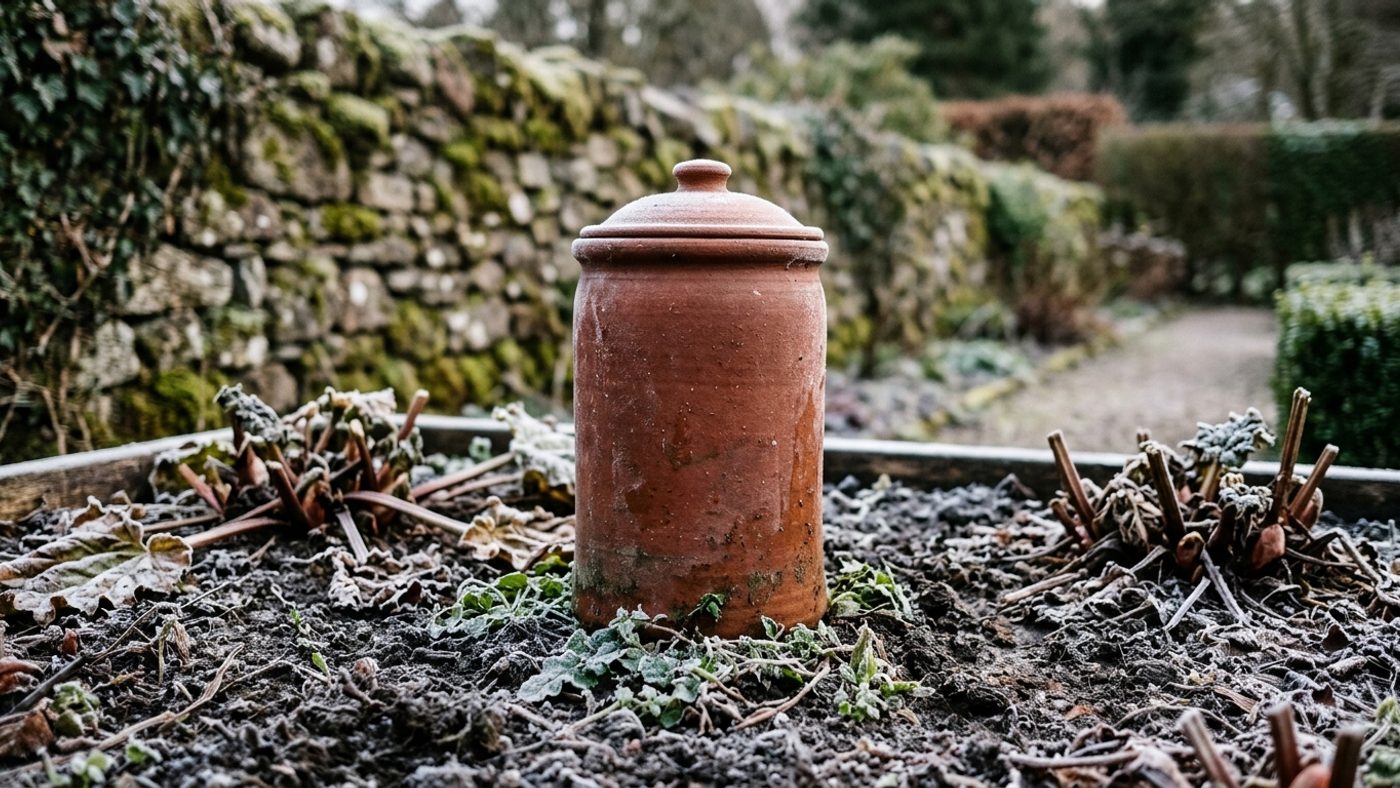
Alternatively, lift a whole root in November, leave it outside for about two weeks to chill (the cold breaks its dormancy), then pot it in peat-freeCompost made without peat, which is harvested from a slow-forming, carbon-storing wetland habitat that peat extraction damages. Full definition → compost and keep it somewhere dark at 7-16°C, only slightly moist. This route is faster, usually ready in around five weeks, but the crown is significantly weakened by it and is usually discarded after harvest rather than replanted. Either way, never force the same plant in consecutive years: let it grow and recover normally the year after forcing. For the physiology behind why forced stems come out pale and sweet, and a full method comparison, see forcing rhubarb in Scotland.
Harvesting
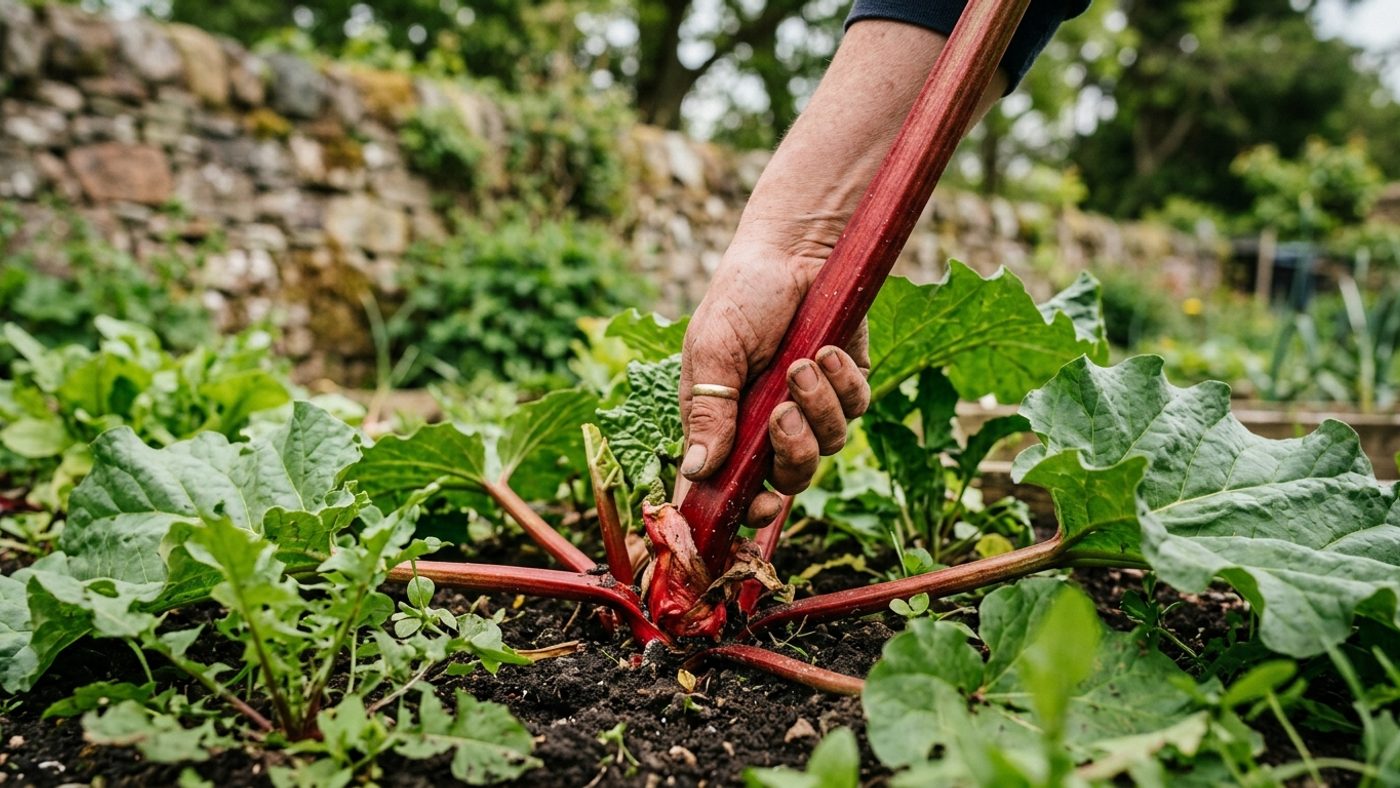
Harvest from April to late June or early July. Choose a stalk about 30cm long, hold it at the base and twist gently to ease it free; avoid cutting or snapping it, since that leaves a stump prone to rotting. Remove and compost the inedible leaf. Take only about a third of a plant's stems at once, and stop by late June or early July, taking just a few stalks beyond that point, so the plant keeps enough leaves to stay in active growth for the rest of the season.
Common problems
- Slugs and snails can damage young shoots, particularly tender ones growing under a forcing jar.
- Late frosts can damage young shoots; cover with straw or biodegradable fleeceA lightweight, breathable fabric laid or draped over plants to trap a little warmth and keep off frost, wind and some flying pests. Full definition → if freezing temperatures are forecast.
- Rot follows waterlogged, poorly drained soil. Cut out any die-back promptly before it spreads through the whole plant.
See more problems
- Split, sticky stalks often follow erratic growing conditions, sometimes late frost or an overused high-nitrogen feed.
- Honey fungus, crown rot and rust are all further risks; crown rot in particular has no real cure, so remove and destroy badly affected plants rather than trying to treat them.
Common questions
Are rhubarb stems poisonous like the leaves?
No: the oxalic acid that builds up through the season is mostly in the leaves, which aren't eaten, and the amount in the stems isn't enough to be toxic, so eat them as normal all season. Full sourced breakdown: <a href='/tools/garden-myths/rhubarb/'>Rhubarb Myths →</a>
How soon can I start harvesting after planting rhubarb?
Not in the first year, and only lightly in the second: normal harvesting starts in the third year, once the plant has had time to establish properly. Full sourced breakdown: <a href='/tools/garden-myths/rhubarb/'>Rhubarb Myths →</a>
Can I force the same rhubarb crown every year?
No: the same plant shouldn't be forced in consecutive years, and the lift-and-pot method weakens crowns so much they're usually discarded after harvest; force a plant one year, then let it recover normally the next. Full sourced breakdown: <a href='/tools/garden-myths/rhubarb/'>Rhubarb Myths →</a>
Should I remove rhubarb flower stems?
Yes, as soon as they appear: flowering stems weaken the whole plant if left, even though they're not stems you'd harvest anyway. Full sourced breakdown: <a href='/tools/garden-myths/rhubarb/'>Rhubarb Myths →</a>
Sources
2 sources, and what each was used for
- RHS: propagation routes and their trade-offs, planting method and timing, spacing and depth, soil prep, the two-to-three-year wait before normal harvesting, watering, feeding, mulching, dividingPropagating a clump-forming perennial by digging it up and splitting it into several smaller pieces, each with roots and shoots attached. Full definition → every five years, the forcing technique and its 4-8 week timeline, harvesting method and the one-third rule, four named varieties (three AGM), plant lifespan of at least 10 years, slugs, frost damage to young shoots, waterlogging-related rot, split stalks, flowering stems and why to remove them, the oxalic-acid leaf-safety note
- gardenersworld.com: independently corroborates spacing (90cm or more), the two-week chilling step before forcing, the one-third/year-three harvesting rule, and a plant lifespan of about 10 years; gives a specific forcing outcome for Timperley Early (a February harvest); names honey fungus, crown rot (no remedy) and rust as further problems RHS's own page doesn't name