
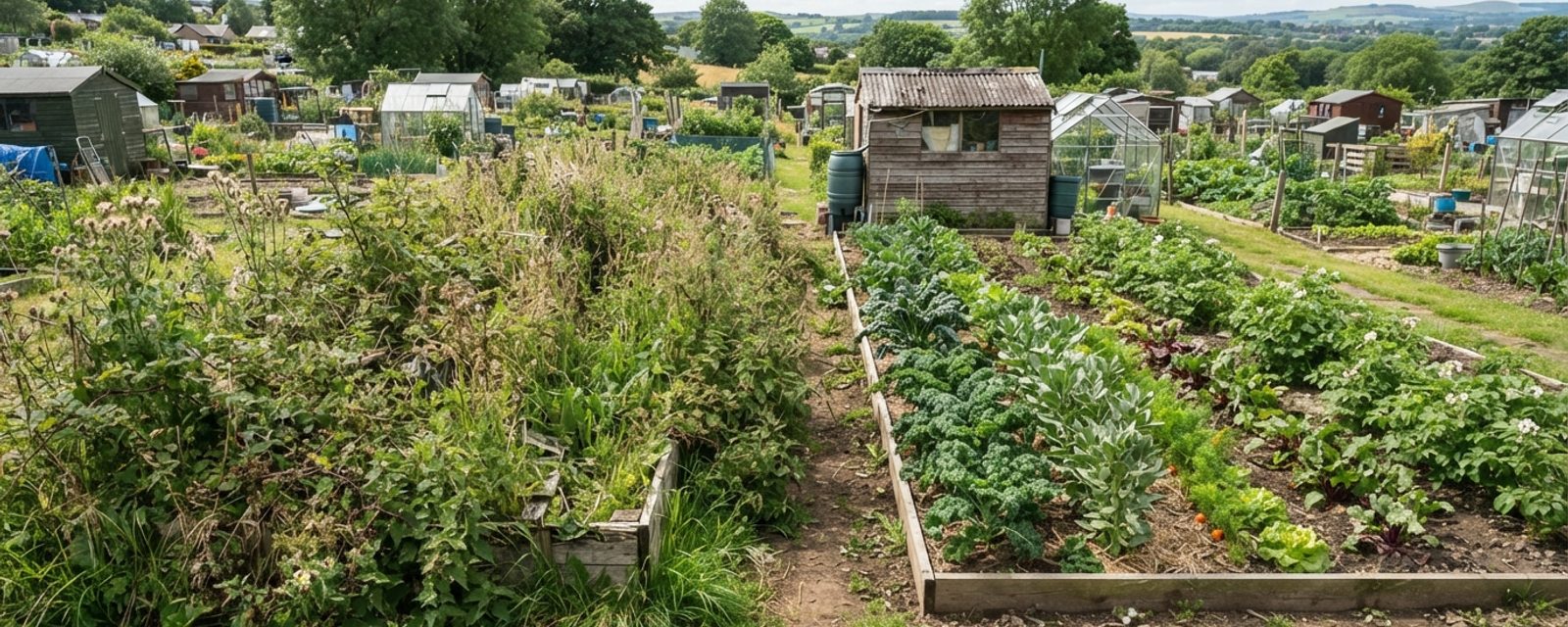
Almost every first-year allotment mistake traces back to the same miscalculation: the gap between how much a new plot holder feels capable of in March and how much time, space, physical labour and money they actually have between April and October. Nobody sets out to overcommit. Standing on an empty plot in early spring, with a full growing season stretching ahead and a head full of seed catalogue photos, the plot looks smaller than it is and the season looks longer than it is.
Every mistake below is that same miscalculation showing up in a different part of the year: too much ground cleared, too much sown at once, too little time budgeted for watering, no plan for what follows what, money spent to paper over a time problem, and finally, when the gap becomes obvious, the plot getting quietly avoided instead of triaged.
Knowing the mechanism doesn't stop it happening. Most people who keep their allotment past year one made some version of every mistake here. What separates them from people who give the plot up isn't that they avoided the trap, it's that they recognised they were in it early enough to do something about it.
If you haven't taken on a plot yet, our first allotment guide covers the groundwork.
1. Clearing and planting more ground than you can maintain
This is the most common failure mode on new plots, and it rarely looks like a mistake in April. Clearing an extra bed feels productive. Sowing an extra row feels efficient, since you're already out there with the hoe in hand. The problem isn't the clearing itself, it's that ground under cultivation doesn't stay static: every square metre you plant is a square metre that needs weeding, watering and harvesting on a schedule set by the plants, not by your diary.
What it actually looks like going wrong: by late June, weeds are ahead of the crop in at least one bed, and by the time you notice, pulling them risks disturbing the roots of whatever you planted. You start triaging on each visit, which means the same bed keeps losing out, because it's always the one that "can wait one more week." By August it's a bramble-and- bindweed patch again, except now it also has a rotting squash plant in the middle of it.
How to recover mid-season: stop trying to rescue every bed at once. Pick the two or three beds with crops closest to harvest or highest value to you, and let the rest go to weeds deliberately rather than by accident, ideally under cardboard topped with a thick mulchA layer of material spread over the soil around plants to suppress weeds, retain moisture, and improve soil structure as it breaks down. Full definition →, which suppresses regrowth over several months rather than a single season, so they don't reseed the beds you're keeping. A weeded-but-empty bed under cover costs you nothing next spring. A half-weeded bed with a struggling crop in it costs you time you don't have and usually produces less food than starting fresh next year. Cutting your losses on purpose, in July, is a completely different outcome to abandoning the plot in September, and a visibly covered, deliberately-managed bed reads very differently at an inspection than a plot that's simply been left.
2. Sowing everything in spring because that's when the enthusiasm is highest
New plot holders tend to do almost all of their sowing in April and May, because that's when the plot is exciting, the weather is improving and the seed packets are freshly bought. Most vegetable seed needs roughly 7°C of soil temperature to germinateA seed sprouting: breaking dormancy and putting out its first root and shoot, given the right warmth and moisture. Full definition →, and heavy, damp soil stays colder for longer than light, free-drainingSoil that lets water pass through quickly rather than pooling, so roots aren't sitting in wet ground after rain. Full definition → soil. That's a general pattern, not a Scottish one. It matters more here because clay and heavy soils are common on Scottish allotment sites, and a genuinely wet spring makes that slow-to-warm soil even slower: April 2024, for example, was Scotland's fourth-wettest since records began in 1836, over 60% above the average rainfall for the month. The practical upshot, whatever the exact figures: on heavy Scottish clay after a wet spring, expect the ground to stay too cold to sow for longer than the seed packet's date suggests, and check by feel or a soil thermometer rather than the calendar.
What it actually looks like going wrong: two things, often at once. Early sowings into cold, wet ground either fail to germinate or come up weak and get overtaken by slower but sturdier later sowings, so you've wasted seed and a slot in the seed tray for nothing. Then, because everything else went in during the same two-week window in May, it all matures in the same two-week window in July and August: a glut of lettuce that boltsA plant switching early into flowering and seed production, usually triggered by stress, after which leaves, roots or bulbs turn bitter or unusable. Full page → before you can eat it, more courgettes than you can give away, and nothing coming through in September.
How to recover mid-season: if early sowings failed, resow rather than replant the same variety at the same density and hope. For crops still to come, sow in small batches every two to three weeks instead of one big batch, this is called successional sowingSowing a small batch of seed every couple of weeks, rather than all at once, so crops mature in a staggered sequence instead of a single glut. Full definition →, several smaller, staggered sowings rather than everything at once, specifically to avoid gluts and keep a longer harvest window. It's a smaller fix in year one than it sounds: most fast crops (salad, radish, spring onion) can still be resown into July with a useful harvest before the season ends.
Succession Planting for Beginners: The Technique Explained → goes through the staggered-sowing intervals, catch-cropping, and how to work out your own last safe sowing date against your local frost dates.
3. Underestimating how often the plot actually needs a visit
The time cost that catches people out isn't the hour spent weeding, it's the travel and the frequency. A plot ten or fifteen minutes from home that "just" needs watering twice a week in a dry spell is, in practice, several hours a month that weren't in the original plan, on top of whatever work happens on the plot itself. People budget for the gardening; they don't budget for getting there.
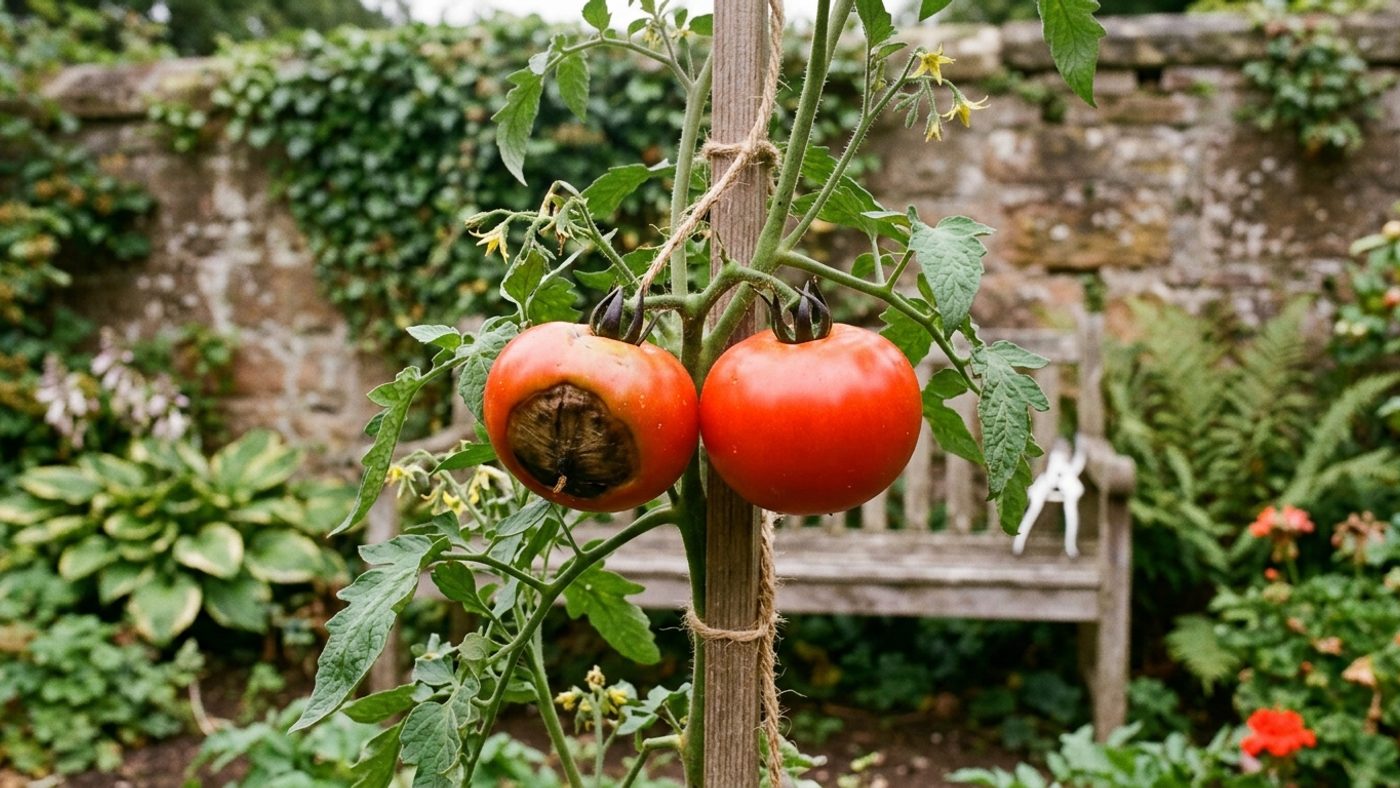
What it actually looks like going wrong: visits get skipped, then skipped again, and the gap between visits stretches from days to a week or more. Inconsistent watering, rather than simply too little water, is what causes real damage: blossom end rot, a dark, sunken patch on the base of the fruit, caused by a calcium shortage that erratic watering triggers, in tomatoes, and split roots in carrots and beetroot. A plant copes fine with a dry spell if that's a consistent pattern, but a lurch between drought and flood does more damage than either alone, and missed visits are exactly what turns an ordinary dry spell into that kind of lurch, since the plant gets nothing until the next visit, however long that takes. Leafy crops in particular show it fastest: lettuce and spinach that were fine last weekend have bolted by this one.
How to recover mid-season: rather than trying to force more visits into a week that clearly can't hold them, mulch to cut water demand, prioritise water for the crops that are genuinely water-critical at their current stage (peas and beans in flower, potatoes forming tubersA swollen underground stem or root a plant uses to store energy, which can also grow into a new plant, the classic example being a potato. Full definition →, anything about to wilt), and accept that crops which need daily attention, most container crops in particular, are a poor match for a twice-a-week schedule and are worth deprioritising rather than fighting for.
4. Never actually deciding what goes where next year
This one is invisible in year one because nothing goes wrong yet. Most new plot holders plant based on what's exciting or what's spare, not against any plan for what was grown where, and crop rotationMoving each crop family to different ground each year, on a multi-year cycle, so pests and diseases that build up in soil don't get a repeat host. Full definition → exists precisely because this catches up with you: planting the same family, brassicasThe cabbage family: cabbage, kale, broccoli, cauliflower, Brussels sprouts, kohlrabi, swede, turnip and more, sharing the same pests, diseases and rotation rules. Full definition → especially, in the same patch of ground repeatedly lets soil-borne problems build up in a way that's very hard to reverse once established. ClubrootA soil-borne fungal disease of the brassica family that swells and distorts roots, and survives in soil for years. Full definition → is the one to know: a soil-dwelling organism that infects brassica roots, causing them to swell and distort so the plant can't take up water or nutrients properly and ends up stunted or fails outright. It spreads more readily in exactly the wet, heavy, poorly-drained ground already flagged above as common on Scottish allotment clay, so the same soil that made spring sowing slow is also the soil where skipping rotation costs the most. The mistake isn't ignorance of rotation as a concept, most people have heard of it, it's that nobody actually draws the plot into sections and decides.
What it actually looks like going wrong: you won't see it this year. You'll see it in year two or three, when a brassica crop that should be thriving is stunted and swollen at the roots, in more or less the same spot you grew brassicas the year before.
How to recover before it happens: this is one mistake worth fixing before the damage shows rather than after. Before your next big sowing round, sketch the plot into three or four rough sections on paper, even a phone photo with sections marked works, and note only one thing: what family grew where this year. That single record is enough to move brassicas, potatoes, onions and roots on a step next year without needing a formal rotation plan. If you already suspect clubroot in a bed, brassica roots that are swollen, distorted and rotting rather than just small, there's no cure for that patch of ground: the spores persist in soil for up to 20 years, so the practical move is to stop growing brassicas there for as long as you can manage, ideally several years, and grow them in a different section instead. Liming acidic ground to raise the pH and improving drainage both make conditions less favourable for it, though neither clears an infected bed outright.
5. Spending money to solve a time problem
Not buying a shed, a greenhouse or raised beds in week one is genuinely good advice, and most new plot holders manage it. What catches people out instead is what happens later, once a bed is already struggling. The instinct is to buy your way out: bagged compost to rescue poor soil rather than fixing drainage, pre-grown plug plants to replace a failed sowing, netting and clochesA small, portable clear cover placed over an individual plant or short row to trap warmth and keep off wind, rain and pests. Full definition → bought in a panic after slug damage that better timing would have avoided. None of it is wasted money exactly, but none of it fixes the actual constraint, which is time, and it quietly normalises spending more each time something goes wrong instead of asking why it went wrong.
What it actually looks like going wrong: a pattern of small, reactive purchases through the season, each one reasonable on its own, that adds up to a second, unplanned budget on top of the year-one setup budget, without meaningfully changing the outcome, because the underlying issue, not enough consistent time on site, is still there.
How to recover mid-season: before buying a fix, name the actual constraint. If it's time, spending money rarely closes the gap, mulch, cover and triage do. Save the spending for the few things that genuinely buy back time, a water butt near the bed you actually visit so watering trips are shorter, a hoe that actually stays sharp so weeding takes minutes rather than an hour, rather than the things that replace a crop you didn't have time to grow properly in the first place.
6. Avoiding the plot instead of triaging it
This is the mistake that ends allotments, and it's the one that gets talked about least. Once a plot has visibly got away from someone, the natural response isn't to go and fix the worst two beds, it's to feel bad about the state of it and put off the visit until there's more time or better weather. That gap between visits then makes the plot look worse, which makes the next visit feel even less appealing. It's a straightforward avoidance spiral: the plot stops being a source of enjoyment and becomes a source of guilt, at which point staying away from it is the easier feeling to have.
What it actually looks like going wrong: weeks between visits stretch further, the plot committee's contact, if your site has inspections, starts to feel like a telling-off rather than routine, and by the time anyone acts, the amount of work needed to bring the plot back up to standard feels too large to start. This is how plots end up abandoned or handed back inside a first year, not because the person couldn't garden, but because the gap became too uncomfortable to close.
How to recover: the fix is almost never "do more," it's "do less, but go." A twenty-minute visit that only clears one path and checks on one bed breaks the avoidance pattern in a way that a mental commitment to "get it properly sorted this weekend" usually doesn't, because that weekend rarely arrives. If a site inspection or a word from a neighbouring plot holder flagged a problem, treat it as useful information about where to focus that twenty minutes, not as a verdict on the year.
7. Planting straight into bare, newly cleared ground
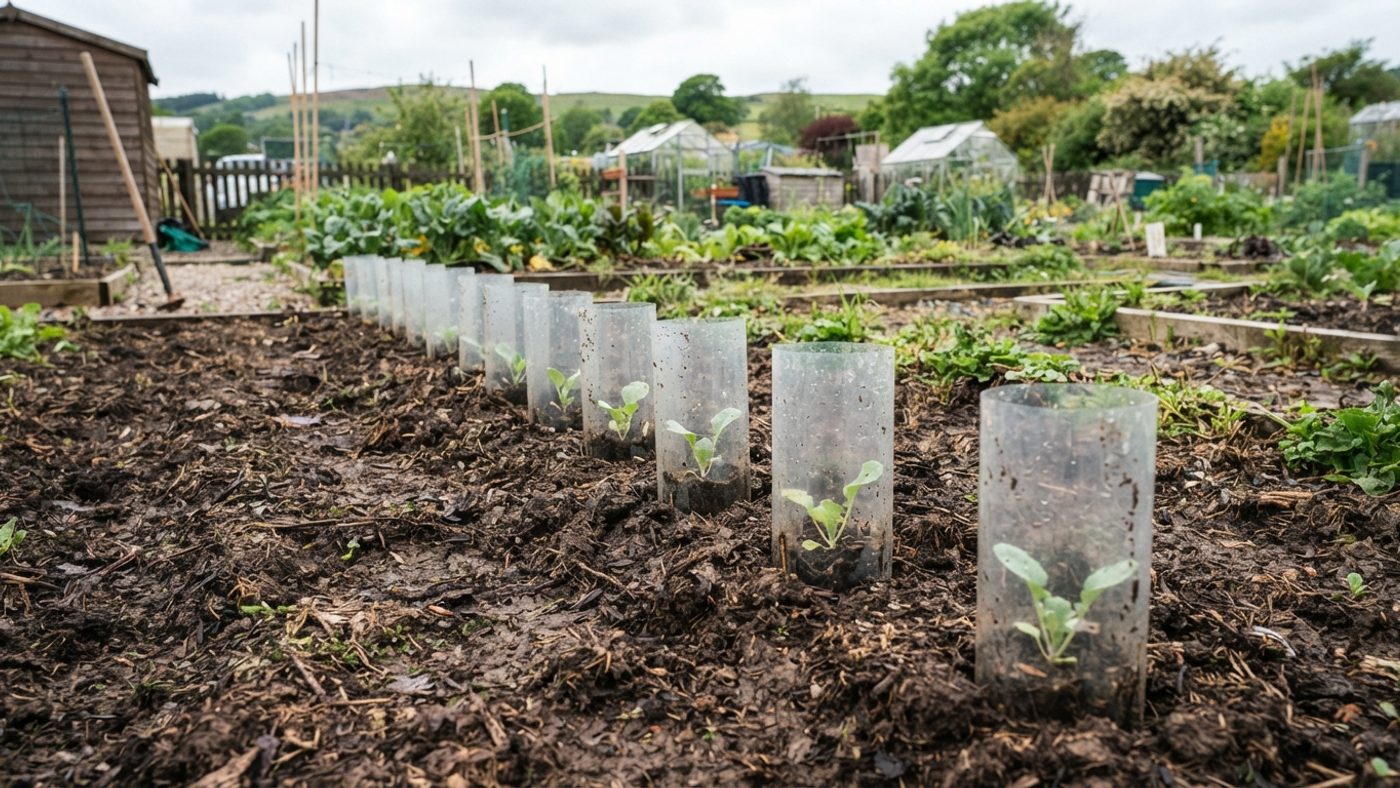
Freshly cleared ground looks ready. It isn't, not for young seedlings, and this is a different mistake to over-planting: it's about what goes into the ground you've cleared responsibly, not how much of it there is. Soft seedlings are the most at-risk stage for slug damage, particularly on mild, damp evenings when slugs are most active, and newly cleared ground with no established planting to distract them concentrates that risk onto whatever you've just sown. Scotland's generally damper conditions don't make slugs a uniquely Scottish problem, but they do mean more of the mild, damp evenings that suit slug activity, so this mistake is worth taking seriously here rather than assuming it's a minor risk.
What it actually looks like going wrong: seedlings that were fine the evening before are ragged holes and slime trails the next morning, sometimes gone entirely. It's often blamed on something else first, a cold snap, poor seed quality, because the damage is nocturnal and the culprit is rarely seen in daylight. A second and third sowing into the same bare bed can go the same way if nothing about the bed itself changes.
How to recover mid-season: stop resowing the same vulnerable seedlings into the same exposed bed and change the bed instead. Transplant sturdier pot-grown plantlets rather than direct-sown seedlings into ground with a known slug problem, use cloches or collars around individual plants, do a torchlight check on a mild, damp evening to catch and remove slugs directly, set beer traps or leave citrus peel down as a lure away from seedlings, and encourage predators like birds and hedgehogs rather than relying on any single method alone. A bed that's lost two sowings in a row to slugs needs one or two of those changes before a third attempt, not just better luck.
8. Leaving brassicas and climbing crops unprotected against birds and wind
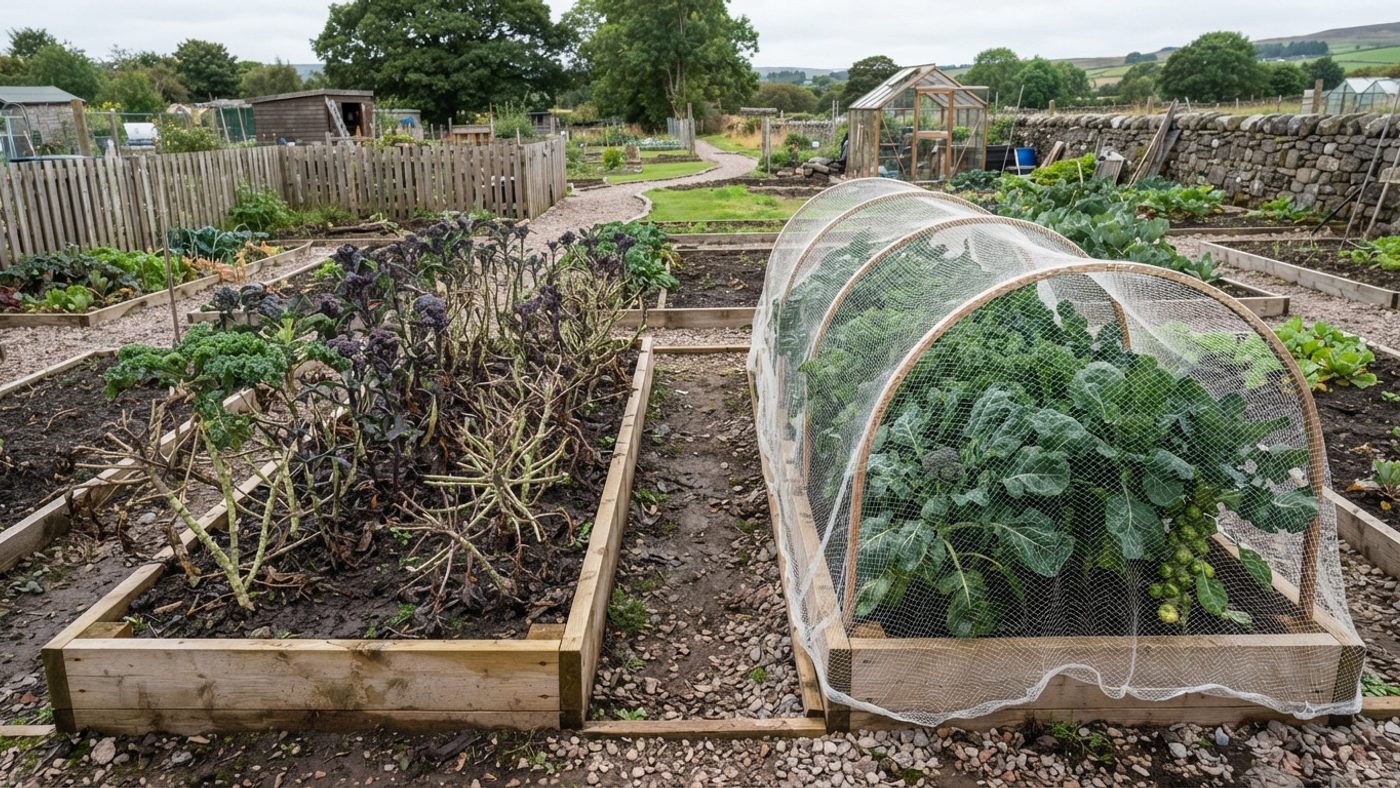
Two different threats, but the same underlying mistake: assuming a crop that's growing well doesn't need physical protection yet. Pigeons and wind don't wait for a plant to look vulnerable. Netting or a fruit cage is the only reliable protection for brassicas, since pigeons are particularly drawn to the leaves of cabbages, broccoli, sprouts and cauliflower, and scaring devices only work temporarily at best. Peas, beans and anything trained upright need physical support before they need it, not after, especially on the many Scottish allotment sites that sit open and exposed to wind with no hedge or fence line to break it.
What it actually looks like going wrong: a bed of young brassicas stripped back to ribs and stalks in a single visit, weeks of growth gone overnight with no warning signs beforehand. Separately, a row of peas or beans that was upright on your last visit is flattened or wind-whipped after a single stormy night, stems snapped at soil level where staking would have held them.
How to recover mid-season: for bird-stripped brassicas, net whatever's left immediately, this is the only protection that actually works, and resow or replace what's beyond recovery under the same netting from the start this time. For wind-flattened climbing crops, stake and tie in whatever's still upright rather than writing the row off; plants that are bent but not snapped often recover once supported. If the site is consistently exposed, that's worth factoring into what you choose to grow tall next year rather than fighting the same wind every season.
Eight mistakes at a glance
| Mistake | What it looks like once it's gone wrong | Fastest recovery move |
|---|---|---|
| Clearing/planting too much ground | One or more beds lost to weeds by midsummer | Triage: keep 2-3 beds, cover the rest deliberately |
| Sowing everything in spring | Early sowings fail in cold soil; later gluts and bolting | Resow failed crops; stagger remaining sowings by 2-3 weeks |
| Underestimating visit frequency | Watering gaps widen; bolting, splitting, blossom end rot | Mulch, prioritise water-critical crops, drop high-maintenance ones |
| No rotation record | Soil-borne problems appear a year or two later, hard to reverse | Sketch plot sections now and log what grew where |
| Spending to fix a time problem | Reactive purchases that don't change the outcome | Name the real constraint before buying a fix |
| Avoiding the plot when it's behind | Visits stretch out, plot looks worse, feels harder to start | Short, targeted visits rather than one big "proper" session |
| Planting seedlings into bare cleared ground | Seedlings vanish overnight to slugs, repeat sowings fail the same way | Switch to pot-grown plantlets, cloches or collars, torchlight checks |
| Unprotected brassicas and climbers | Brassicas stripped by pigeons; peas/beans flattened by wind | Net brassicas immediately; stake and tie in wind-damaged climbers |
Common questions
Is it normal to feel behind on my allotment in the first year?
Yes, and it's worth saying plainly: this happens to nearly everyone who takes on a plot, not just people who planned badly. The useful question isn't how to avoid it altogether, it's how quickly you notice and act once a specific bed, sowing or habit is the one causing the gap.
Should I give up a bed I've lost to weeds, or try to save it?
If a bed is already significantly behind and you're short on time, covering it deliberately (cardboard or a tarp) and starting fresh there next year usually produces a better outcome than a half-rescued bed this year, which tends to cost more time for a smaller harvest.
Why did my early sowings fail even though I followed the seed packet dates?
Seed packet dates are averages. RHS guidance notes most vegetable seed needs roughly 7°C of soil temperature to germinate, and heavy clay, common on Scottish allotment sites, stays colder for longer after a wet spring than the packet date assumes. Resowing two to three weeks later is often enough to fix it.
How do I know if I've taken on too much ground?
A rough sign is whether you can keep every planted bed weeded and watered on your realistic, not aspirational, visit schedule. If one or more beds are consistently the one you don't get to, that's the plot telling you the cleared area is currently larger than your available time.
Does missing a year of proper crop rotation ruin my plot?
Not on its own. One year without a rotation plan isn't the problem; repeating the same family in the same spot for several years running is what allows soil-borne issues like clubroot to build up. Starting a simple record now, even mid-season, is enough to get ahead of it.
Sources
9 sources, recorded with what each was used for
- RHS: Vegetable seeds — sowing guide: Soil temperature threshold for germination and the effect of heavy/damp soil on sowing timing
- RHS: Successional sowing tips: The recommendation to stagger sowings to avoid gluts
- RHS: Watering vegetables and fruit: Watering frequency, consequences of inconsistent watering, and which crops are watering-critical at which stage
- RHS: Crop rotation: Why rotation matters and the consequences of repeat-cropping the same family
- RHS: Club root: What clubroot does to brassica roots, spore persistence in soil (up to 20 years), lack of a chemical cure, liming/drainage as risk reduction
- Garden Organic: No-dig gardening: Realistic timeline for suppressing perennial weeds and mulch quantities for ground taken out of cultivation
- Met Office: A wet and dull April: 2024 Scottish April rainfall figures illustrating how a wet Scottish spring delays soil workability
- RHS: Slugs and snails: Seedling vulnerability, timing of slug activity, and recovery methods
- RHS: Pigeons in gardens — deterrent tips: Pigeon damage to brassicas and netting/fruit cage as the only reliable protection