
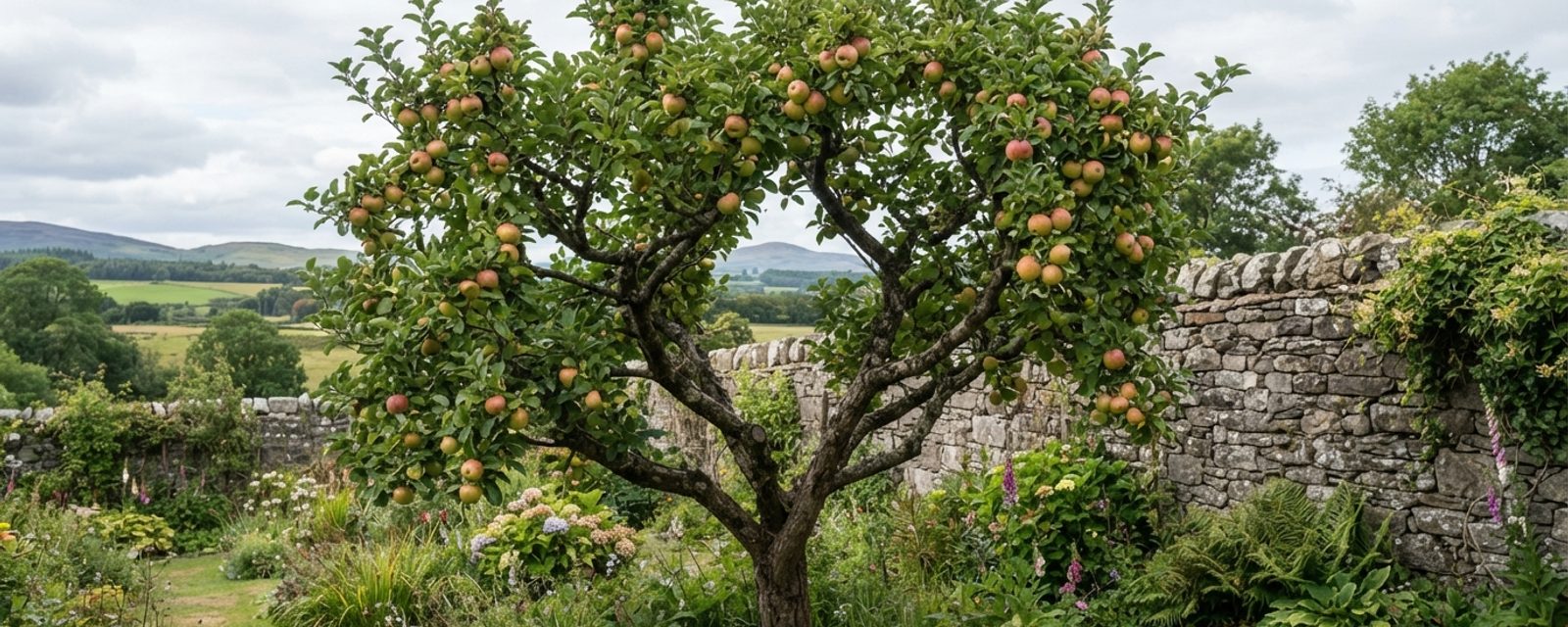
Most general fruit-pruning advice gives you a calendar: apples and pears in the dormant months, stone fruit like plums and cherries in early summer. That calendar was written somewhere with a longer dormant season and an earlier last frost than most of Scotland gets. Even the RHS's own summer-pruning guidance allows that pruning is best delayed in the north or west of the country, without saying by how much. Met Office frost records put real dates on that advice.
The technique itself doesn't change with geography: the same open, goblet-shapedA bush pruned with an open middle and outward-radiating branches, so light and air reach every part rather than a dense, shaded centre. Full definition → centre and the same clean cut above a bud work whether the tree's in Kent or Caithness. What changes is the safe window to do the work in, bounded by frost risk at one end and bud burst at the other, and that window is genuinely narrower in much of Scotland. A calendar date copied from a book written for the south of England can land you either side of it.
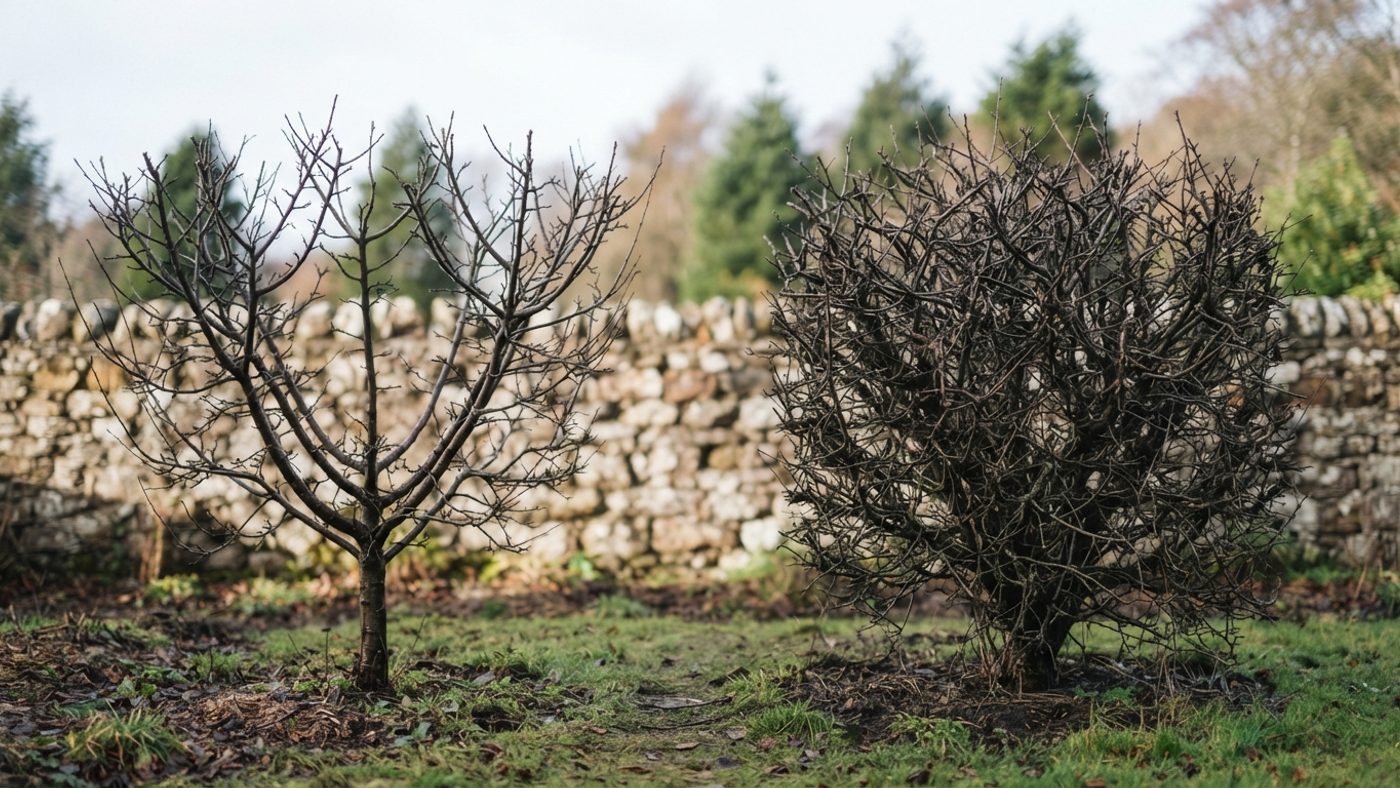
The frost data behind "delay it a bit"
Met Office air-frost records (1991–2020 averages) show why "wait a bit longer up north" undersells the real picture, and the gap tracks altitude and distance from the sea more than how far north you are.
| Area | Typical last spring frost risk |
|---|---|
| Central Belt lowland (Edinburgh) | mid-to-late April |
| Highlands lowland/coastal (Inverness) | late April |
| Northeast upland (Braemar, 339m) | late May–early June |
| Islands (Stornoway, Lerwick, Tiree) | late April |
Braemar, at 339m, has recorded air frost in every month except July, and the Met Office's own Eastern Scotland report describes the frost-free growing season there as "often as little as 3 months", the clearest single illustration of how much later frost risk clears the higher and further from the coast you are, and how little room that leaves between "safe to have finished pruning" and "the tree is breaking bud regardless." The full regional breakdown, lowland and upland, is at Scotland's frost dates.
Dormant wood itself shrugs off frost without complaint, so a hard freeze in December or January while a tree is properly dormant isn't the risk. The risk sits at the edges of the dormant window: cuts made close to bud burst, in a spring still delivering hard frosts, are exposed for longer than the same cuts made further from the coast and lower down would be, and a tree pushed into growth by a late cut has less time to harden that growth off before frost can catch it.
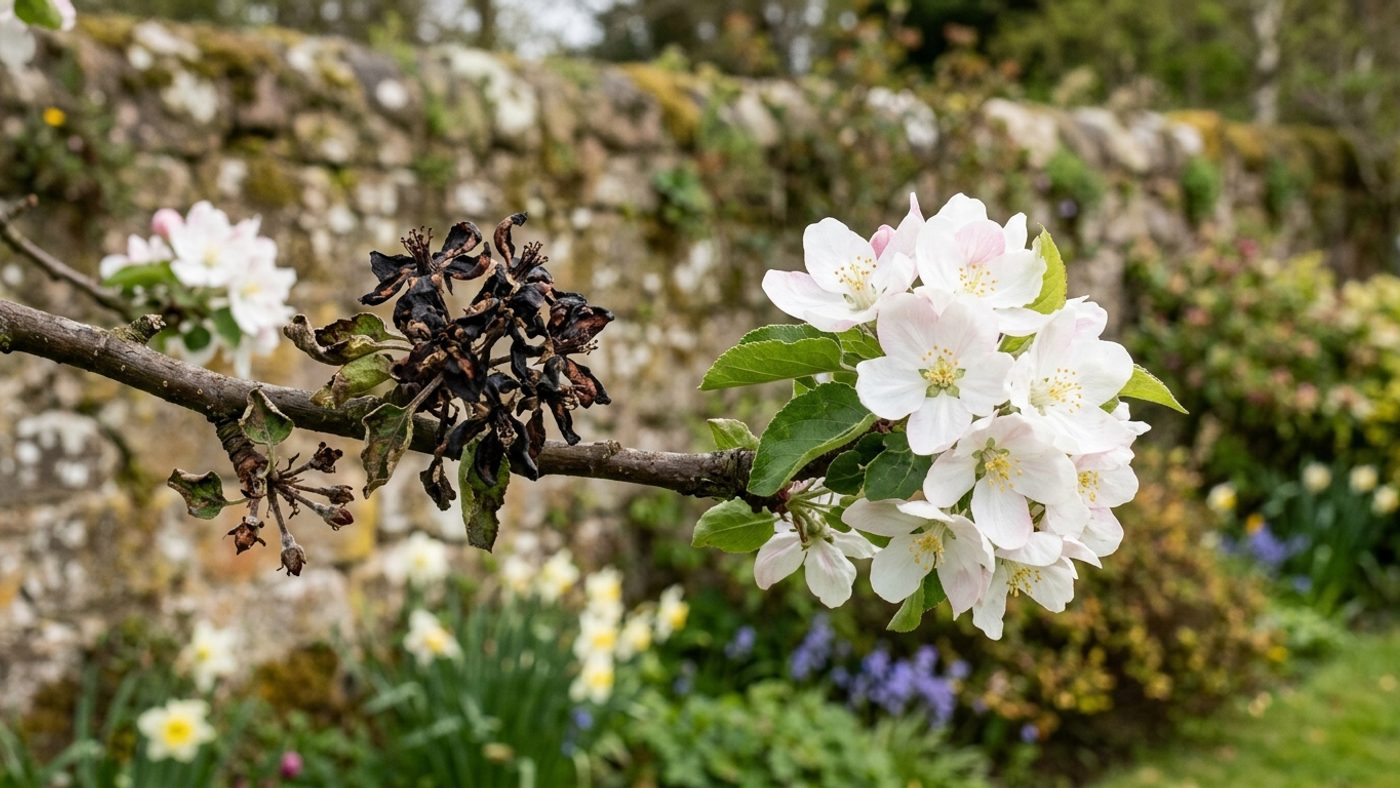
Two families, two different calendars
Fruit trees split into two groups pruned at opposite times of year for different reasons, and mixing them up is the single most common mistake in general fruit-pruning advice. Pome fruit, apples, pears, quince, carry their fruit on long-lived spurs, the short, stubby side-branches that flower and fruit repeatedly for years, and are pruned while dormant, after leaf fall and before growth restarts. Stone fruit, plums, cherries, damsons, apricots, are the opposite case: never prune them while dormant. Wounds cut in autumn and winter sit open through the months when the fungus behind silver leaf disease is most active, releasing airborne spores from September to May that infect through fresh cuts. Prune stone fruit instead in spring or summer, in dry weather, when fewer spores are about and wounds close over faster.
Take too much wood off a tree in one go and it tends to panic rather than fruit better: cutting back hard signals the tree to throw up a flush of vigorous, upright, largely fruitless regrowth to replace what was lost, instead of settling down to produce spurs and blossom. Renovating a badly overgrown or long-neglected tree, common enough with an inherited Scottish garden fruit tree, runs on the same logic but spread over more than one year so the tree isn't shocked into that response all at once.
| Situation | When | How much / cut |
|---|---|---|
| Pome fruit, established tree | Dormant: leaf fall to before growth restarts | 10–20% of canopy; shorten last season's growth on main branches by a quarter to a third, to an outward-facing bud |
| Pome fruit, renovating an old/neglected tree | Late autumn to late winter, spread over several years | Up to 25% of canopy in any one year; aim for an eventual 8–10 main branches, spaced 50–60cm apart |
| Pome fruit, trained forms (espalierA fruit tree trained flat against a wall or wire framework with horizontal tiers of branches, most often apples and pears. Full definition →, cordonA fruit tree or bush trained as a single main stem with short fruiting side-spurs, usually grown at an angle against a wall, fence or wire. Full definition →, fan, stepover) | Summer, once sideshoots stop extending and form a terminal bud | Sideshoots over 20cm cut back to about 5cm from their base; crowded spurs cut back to about 2.5cm |
| Stone fruit, young/formative | Spring, in dry weather | Shape the main framework; no dormant-season cuts at all |
| Stone fruit, established tree | Summer, dry weather (roughly June–August) | Remove crossing, weak, vertical, dead or diseased wood; thin further if the crop looks heavy enough to break branches |
Only attempt renovation on a tree with a sound trunk and main limbs still producing new growth and cropping; one that's completely outgrown its space, or where reliable fruit matters more than keeping an old specimen, is often better replaced with a young tree, whose eventual size a local nursery can help match to the space available. Removing that much wood from an established tree in one go also changes how much wind it catches, check any stake or tie on a young or newly renovated tree is still sound going into a windy Scottish winter, since a loosened root system takes longer to re-anchor than the pruning wounds take to heal.
The cut itself, and two diseases that get in through it
Whatever the fruit and whatever the season, the mechanics of a good cut don't change. Keep secateurs, loppers and saws sharp, and wipe blades with disinfectant between trees, or between cuts on a tree with visible disease, so infection isn't carried from one wound to the next. A clean cut heals faster and gives fungal disease far less of a foothold than the ragged, crushed wound a blunt or dirty blade leaves. Position the cut about half a centimetre above an outward-facing bud, one pointing away from the centre of the tree so the shoot it produces grows outward rather than back into the crowded middle, sloped so water runs off rather than pooling against it. Match the tool to the branch: secateurs for anything under about 2.5cm across, loppers or a pruning saw beyond that.
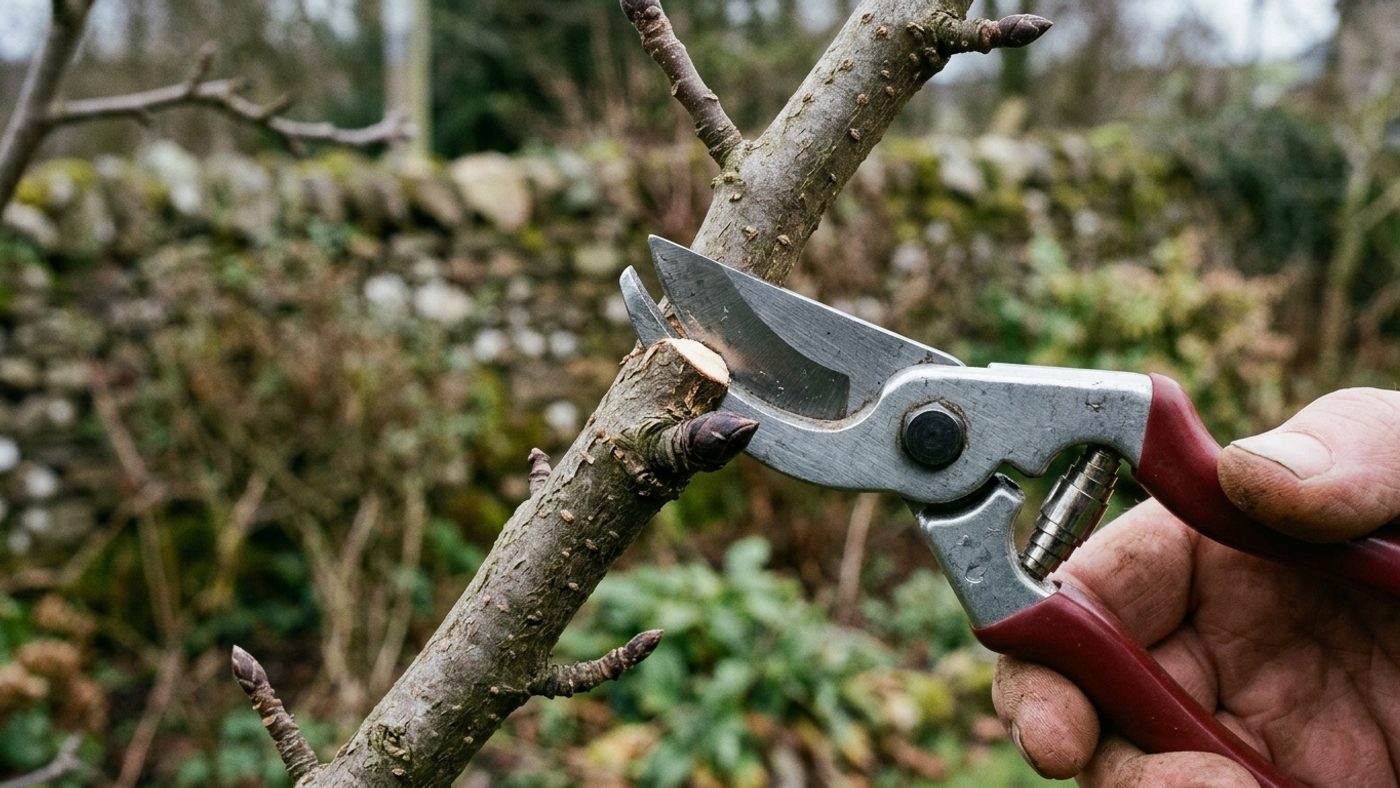
Sealing pruning wounds generally isn't necessary, sealant doesn't meaningfully speed healing. Plums and cherries are the exception: a wound sealant is sometimes used specifically to block silver leaf spores from a fresh cut, on top of, not instead of, pruning them in the right season, and it's arguably more worth doing here than in a drier part of the UK, given how much harder Scotland's summers can make it to time a cut for a long, reliably dry spell either side of it.
Silver leaf isn't the only wound-borne disease worth knowing about. Apple and pear canker gets in through pruning cuts, natural leaf scars, and frost damage, and it's markedly worse on wet, heavy or acid soils, which describes a lot of Scottish gardens. A late, hard frost that damages bark or new growth doesn't just risk that season's crop directly; it can also open exactly the kind of wound canker uses to get established, on top of any pruning cuts made nearby around the same time. Clean tools and clean cuts reduce the risk from pruning specifically, but they don't remove the frost-damage route, one more reason to keep cuts away from the edges of the frost window rather than close to it.
Reading bud burst instead of the calendar
A calendar cutoff like "early March" assumes bud burst follows fairly soon after. In much of Scotland, waiting for frost risk to genuinely clear already runs past that, into April, or May and June at altitude.
The more reliable marker is the tree itself rather than the date: finish pome-fruit pruning before buds visibly swell and show colour at the tip, whichever month that happens to fall in your own garden, rather than by a fixed date carried over from further south. In a low-lying, coastal, or sheltered garden that may still land close to the usual UK-wide window. In an upland or exposed one it can run weeks later. If you've already pruned earlier than this in a given year, it isn't a disaster, dormant wood is hardy, and the risk is only really live for the fresh new growth a cut near bud burst produces; just watch that growth for frost damage and be more cautious about timing the next year.
For stone fruit the calendar problem runs the other way: the recommended window is already spring-to-summer, so frost isn't the constraint, but a reliable dry spell is harder to guarantee across a Scottish summer, particularly on the wetter west coast, than the same window further south or east. Watch the forecast for a settled dry stretch within that broad window rather than committing to a fixed month, and resist the temptation to fall back on a "quick tidy" in winter just because the tree looks untidy and dry days are scarce, a winter cut on a stone fruit tree is exactly the opening silver leaf is waiting for, whatever else the weather is doing.
Apples, pears, plums, cherries, damsons, quince, gooseberries, blackcurrants and redcurrants each have their own growing guide on this site with variety- and rootstockThe root system and lower stem a fruit tree is grafted onto, chosen to control the tree's eventual size rather than for its own fruit. Full definition →-specific pruning detail beyond the general framework here, worth a look once you know which tree you're actually standing in front of.
Afterwards
Rake up and dispose of any prunings showing signs of disease rather than composting them; ordinary healthy prunings can go on the compost heap or be shredded for mulchA layer of material spread over the soil around plants to suppress weeds, retain moisture, and improve soil structure as it breaks down. Full definition →. A dry day makes for a cleaner job in every sense: easier footing under the tree, and for stone fruit specifically, exactly the conditions that keep silver leaf out of a fresh cut.
Common questions
Can I prune apple and pear trees in winter in Scotland?
Yes, that's the right window for them, dormant, after leaf fall and before growth restarts. The Scottish adjustment is how late that window can safely run: in an upland or inland garden, frost risk and the start of bud burst both sit weeks later than the same advice assumes further south.
Why shouldn’t I prune plum or cherry trees in winter?
Winter pruning wounds sit open through the months when silver leaf disease spreads most, releasing spores from September to May that infect through fresh cuts. Prune stone fruit, plums, cherries, damsons, apricots, in spring or summer instead, in dry weather, when fewer spores are about and cuts close over faster.
How much can I safely cut off a fruit tree at once?
For an established tree, 10–20% of the canopy in one go. Take more than that and the tree tends to respond with a flush of vigorous, upright, largely fruitless regrowth instead of settling down to fruit. A badly neglected tree is renovated the same way, just spread over two or three years rather than attempted all at once.
What happens if I've already pruned early and frost damages the new growth?
Dormant wood itself isn't at risk from frost; the risk is to the soft new growth a cut near bud burst produces. If frost catches it, it isn't usually fatal to an established tree, but it costs weeks of regrowth. Watch it for damage and time the cut later next year rather than treating one bad year as a disaster.
Sources
6 sources, recorded with what each was used for
- Met Office: Regional last-spring-frost data behind the table and the bud-burst timing discussion
- RHS: Pruning Made Easy: Pome fruit pruning amounts, the 10-20% canopy rule
- RHS: Renovation Pruning: Renovating an overgrown or neglected pome fruit tree
- RHS: Pruning Plums: Stone fruit pruning timing and technique
- RHS: Silver Leaf: Why stone fruit is never pruned while dormant
- RHS: Apple Canker: How pruning cuts and frost damage both open a route for canker