
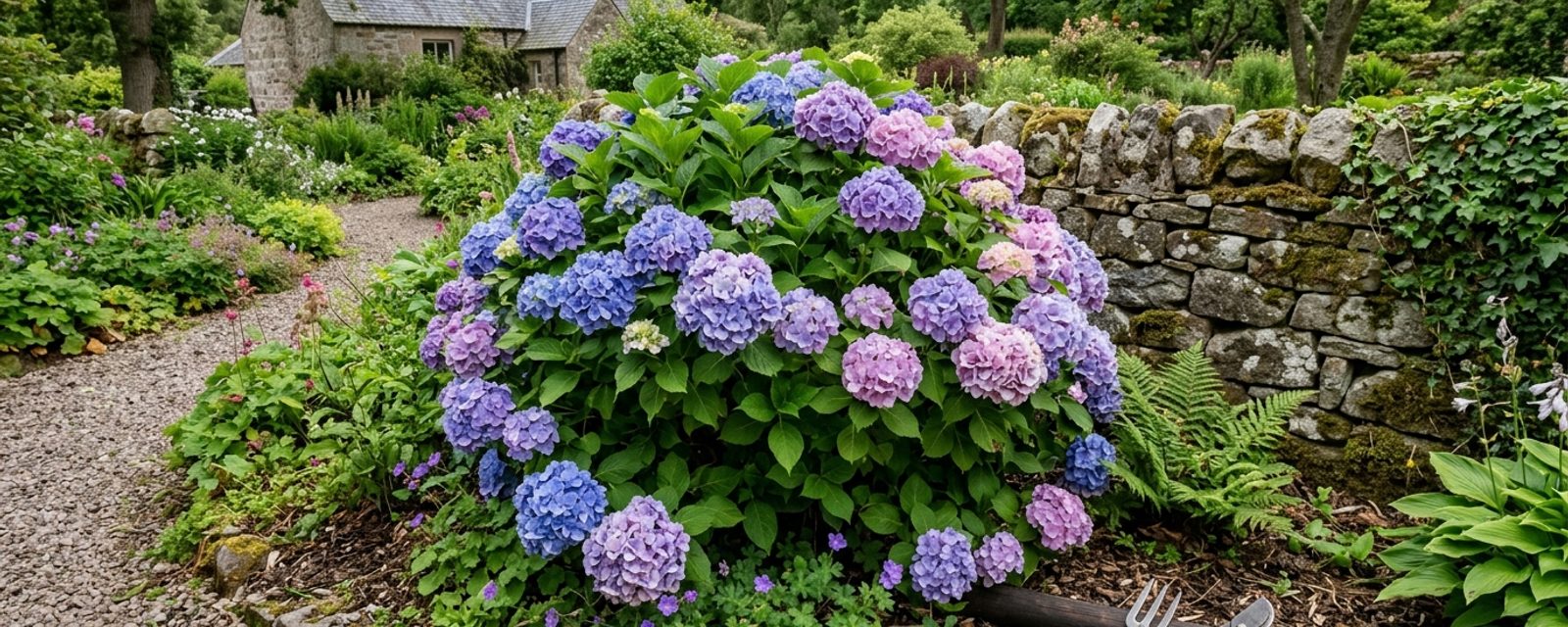
Prune a mophead hydrangea the way you'd prune a rose, hard, in late winter, cutting everything back to a low framework of short stems, and you can remove every flower it was about to produce. That's not true of every hydrangea. Some types flower on wood made fresh that same spring and want exactly that kind of hard annual cut. Others flower on wood grown the previous year, and the buds for next summer's display are already sitting, dormant, at the tips of the stems you're holding the secateurs against. Get the type wrong and the plant survives; the flowers don't.
In Scotland the stakes are higher for the old-wood types specifically, because it isn't really pruning timing that's the risk, it's frost. Those dormant buds sit exposed at the tips of last year's stems all winter and into spring, and Scotland's last frost runs weeks later than the "mid-spring" assumption most UK guidance is written around. A bud that's swelling, ready to break, is far more frost-tender than the same bud fully dormant in January, so the real question for an old-wood hydrangea in a Scottish garden isn't just when to cut, it's how much longer those buds need protecting before it's safe to assume they're through the danger.
Two flowering habits, one rule that only applies to half of them
Every hydrangea falls into one of two groups, and the group decides everything else.
Old woodWhether a plant fruits on stems grown the previous year (young wood) or on older, established branches (old wood), which decides how it's pruned. Full definition →, mophead and lacecap hydrangeas (Hydrangea macrophylla), H. serrata, and climbing hydrangea (H. anomala subsp. petiolaris), flower on stems that grew the previous year. The plant builds those stems over summer, and the buds that will open into next year's flowers form at their tips before the plant goes dormant for winter. Cut that stem back hard at any point between autumn and spring and you take the flower buds with it; the plant regrows, but it won't flower that year.
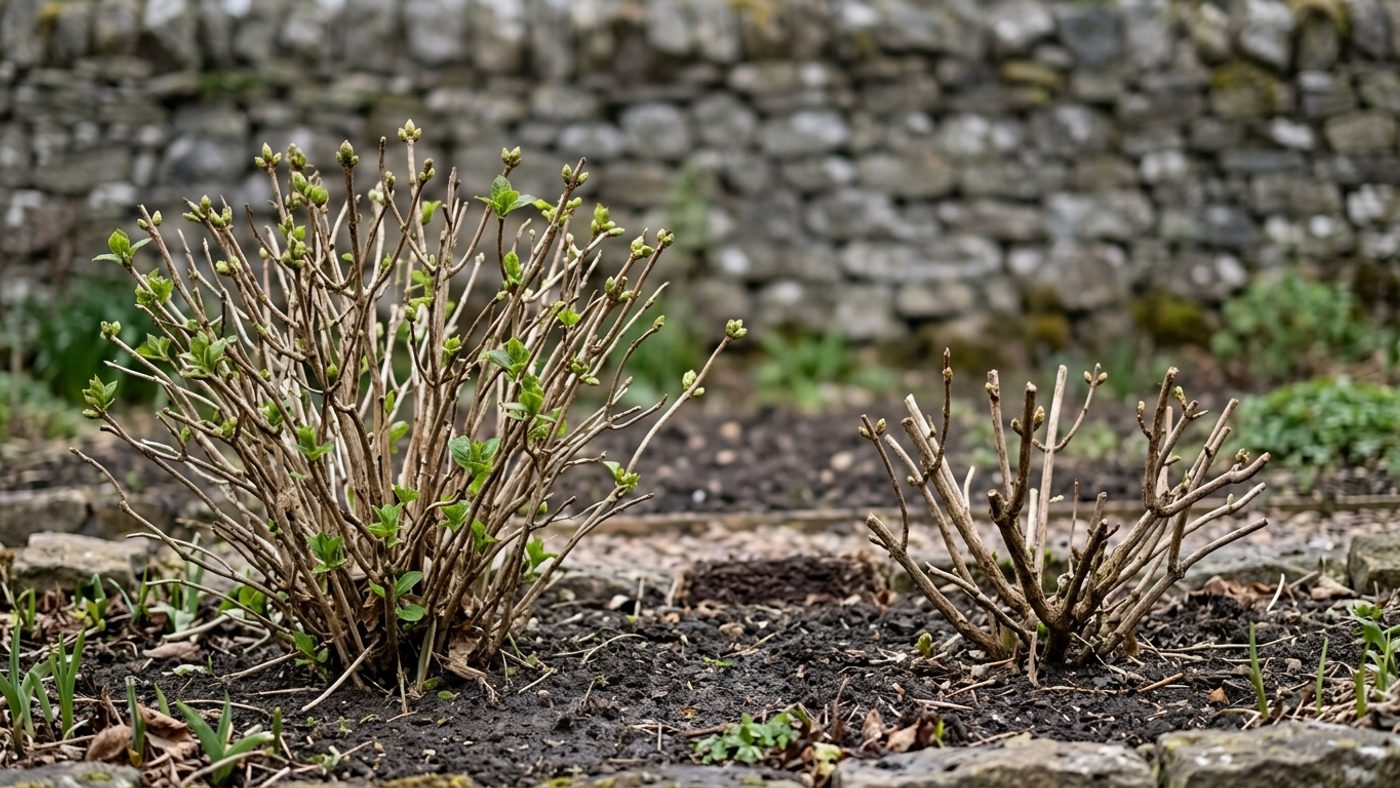
New wood, H. paniculata and H. arborescens (including 'Annabelle'), flower on stems grown fresh that same spring. There's nothing to protect over winter because the flowering wood doesn't exist yet, it's made new every year, which is exactly why these types tolerate, and actually benefit from, a hard annual cut back to a "framework", a short, low stump of stems from which that year's growth then shoots up.
Two more, H. aspera and H. quercifolia, don't fit neatly into a hard-prune-or-don't category at all, RHS guidance treats them as needing only minimal pruning, tidying dead and over-long stems rather than a structural cut of either kind.
A growing number of modern mophead cultivarsA plant variety that arose or was bred under cultivation and is kept true by deliberate propagation, rather than a naturally occurring wild species. Full definition → complicate the old-wood rule further: RHS plant records show some, such as Hydrangea 'Miss Saori', produce flowers on both old and new wood, extending the flowering period from midsummer to mid-autumn. RHS plant pages sort every cultivar into a numbered "pruning group" that tells you which regime it needs, worth checking on the label or the plant's own RHS entry if you're not certain, rather than assuming a straightforward old-wood mophead.
| Type | Flowers on | Hard annual prune? |
|---|---|---|
| Mophead / lacecap (H. macrophylla) | Previous year's stems (old wood) | No, light, on a spring-timed cut |
| H. serrata | Previous year's stems (old wood) | No, same treatment as mophead/lacecap |
| Climbing hydrangea (H. anomala subsp. petiolaris) | Previous year's stems (old wood) | No, trim after flowering only |
| H. paniculata | Current year's stems (new wood) | Yes, cut back hard every spring |
| H. arborescens ('Annabelle') | Current year's stems (new wood) | Yes, cut back hard every spring |
| H. aspera / H. quercifolia | Mixed / minimal response | No, remove dead and over-long stems only |
| Reblooming mophead cultivars (e.g. 'Miss Saori') | Both old and new wood | Check the plant's own pruning group/label |
The buds are the weak point, not the plant
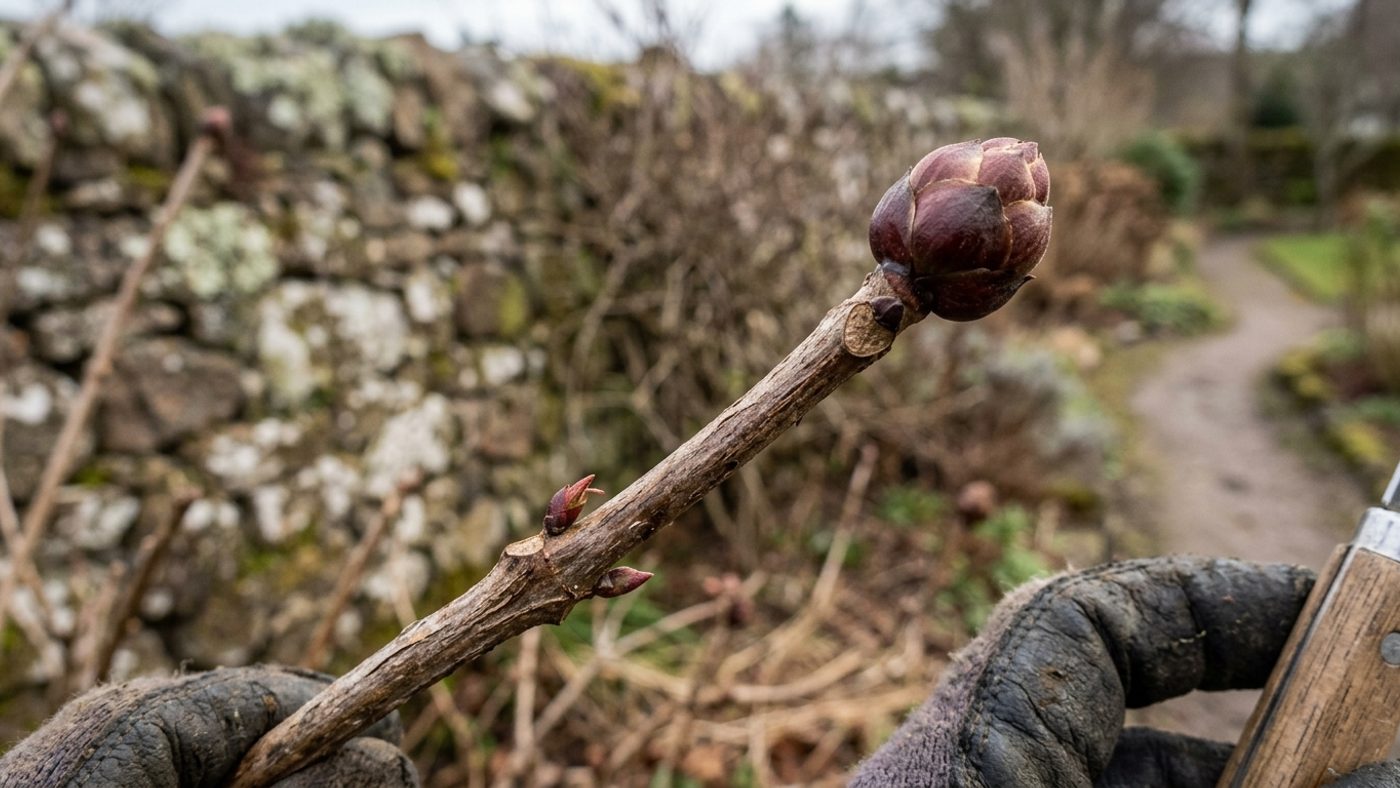
It's worth being precise about what's actually at risk, because it isn't hardiness in the usual sense. Both H. macrophylla and H. paniculata carry the same RHS hardiness ratingThe RHS's H1a–H7 scale for how much cold a plant can survive outdoors, H1a being tender indoor-only and H7 hardy anywhere in the UK. Full definition →, H5, meaning the plant itself tolerates UK winters down to -10 to -15°C without dying back. The vulnerability sits somewhere much more specific and much more common: RHS growing guidance for mophead and lacecap types states plainly that young flower buds may be susceptible to damage from late frosts, even though the shrub around them is perfectly hardy. In practice those flower buds are the fat, rounded swellings you'll see at each stem tip as spring gets going, distinct from the flatter growth buds lower down the stem, a frost that does nothing to the woody stem itself can blacken one of these.
Overfeeding makes this worse rather than better: RHS guidance warns that too much fertiliser encourages excessive soft, leafy growth, with plants less likely to develop flower buds and more at risk from frost damage, and adds that regular feeding of an established, healthy plant isn't generally needed at all.
That's also why the old faded flowerheads are worth leaving alone through winter rather than tidying away in autumn: RHS advice is to leave them on the plant, since the dead blooms offer interest well into winter and help protect the new tender growth below from frost damage. It's a genuinely functional piece of untidiness, not just a seasonal look.
Why Scotland changes the calendar here specifically
Mainstream pruning advice is built around a "mid-spring" cutoff for old-wood hydrangeas, on the assumption that frost risk has passed by then. Scotland's regional frost data shows that assumption doesn't travel well north of the border, and because it's the buds, not the plant, that are on the line, "mid-spring" being wrong by a few weeks matters more here than it would for a purely cosmetic prune.
| Area | Typical last spring frost |
|---|---|
| Central Belt lowland (Edinburgh) | mid-to-late April |
| Highlands lowland/coastal (Inverness) | late April |
| Northeast upland (Braemar, 339m) | late May–early June |
| Islands (Stornoway, Lerwick, Tiree) | late April |
The gap between a lowland garden and an upland one only a short drive away runs to three to six weeks, depending on region, Braemar, the harshest station in that record, has recorded air frost in every month except July, a useful worst case for anyone gardening at similar altitude. The full regional breakdown, lowland and upland, is at Scotland's frost dates. Local ground shape matters too, on a shorter but still real scale, alongside altitude. Met Office guidance is that low, sheltered ground into which cold air can drain overnight, a hollow, the base of a slope, a spot boxed in by a wall or hedge that stops cold air moving on, is particularly prone to frost, running a further two to four weeks later than open ground metres away. For an exposed bud already more frost-tender than the stem beneath it, a garden sitting in that kind of hollow needs to treat these regional dates as a floor, not a target.
When and how to prune, by type
| Type | When | How |
|---|---|---|
| Mophead / lacecap | Once frost risk has genuinely passed, typically mid-spring in milder Scottish gardens, later on upland or frost-pocket sites | Cut each stem back to the first strong, healthy pair of buds below the faded flowerhead |
| H. serrata | Same as mophead/lacecap | Same technique |
| Climbing hydrangea | After flowering, in summer | Cut back over-long shoots only; leave most of the plant, flowers form mainly near the top |
| H. paniculata | Early spring, every year | Cut back last year's stems to a pair of healthy buds, to a framework around 25cm high (up to 60cm for a taller plant) |
| H. arborescens ('Annabelle') | Early spring, every year | Same hard cut as H. paniculata, to a low framework of healthy buds |
| H. aspera / H. quercifolia | Spring | Remove dead, damaged and over-long stems only, no structural hard cut |
Mophead, lacecap and H. serrata
The prune here is really a deadheadingRemoving spent flowers before they set seed, which redirects a plant's energy into further flowering rather than seed production. Full definition → job with a purpose beyond tidiness: work down each flowered stem to the first strong, healthy pair of buds below the old head, removing the spent flower along with it. Because that cut is being made close to next year's flowering growth, timing it to your own region's frost window matters more than getting the calendar month right, a stem cut back in a mild April in Edinburgh is a different proposition from the same cut made on an upland site still carrying frost risk into May. If a late frost does catch new growth after pruning, cut the damaged shoot back further, to just above the first undamaged pair of buds on healthy wood, rather than leave blackened tips in place.
Climbing hydrangea
Self-clinging and shade-tolerant, it flowers mainly towards the top of the plant on the previous year's growth, so the summer prune after flowering should trim only over-long shoots and leave the bulk of the plant alone. A genuinely overgrown climber can be renovated, but not in one go: stagger drastic cutting-back over three or four years, since taking it all back at once removes several years of flowering wood at a stroke.
H. paniculata and H. arborescens
Both get the hard annual cut the old-wood types can't have, and both do it early each spring, cutting the previous year's growth back to a low pair of healthy buds. This builds a permanent low framework rather than letting the plant get taller and woodier each year, and because the flowering wood is grown fresh from that framework every spring, there's no dormant bud sitting out the winter to protect, the frost-window caution above simply doesn't apply to these two.
H. aspera and H. quercifolia
Neither wants a structural cut. Spring maintenance is limited to removing dead, damaged or over-long stems, which keeps the plant tidy without disturbing whatever flowering wood it's carrying.
Protecting old-wood buds through a late Scottish spring
Beyond timing the cut itself, a few things genuinely reduce the risk to those exposed buds. Leave the faded flowerheads on over winter, it isn't neglect, RHS guidance treats it as active frost protection for the tender growth beneath, and removing them earlier than necessary strips that cover away before it's needed. Site away from frost pocketsA low-lying spot where cold air drains and pools on still nights, making it noticeably more frost-prone than the surrounding area. Full definition → and exposed spots: RHS growing advice for macrophylla types is explicit that this reduces late frost damage to spring growth. Move containers to shelter, and keep them there longer than general UK advice assumes, a potted hydrangea can be pulled into a cold greenhouse or up against a sheltered, sunny wall for the worst of the cold, and because Scotland's frost risk to buds can run into May or even June on upland and frost-pocket sites, that shelter needs to stay in place well past the point most UK guides consider the job done.
FleeceA lightweight, breathable fabric laid or draped over plants to trap a little warmth and keep off frost, wind and some flying pests. Full definition → a young or newly-planted border hydrangea if a hard late frost is forecast on swelling buds: drape a double layer over vulnerable growth overnight at the first sign of frost. A heavier grade gives roughly 2°C of protection, which softens a light or borderline frost rather than guaranteeing safety against a hard one, remove the fleece once conditions ease.
Watch the forecast into late spring, not just early spring, because Scotland's last frost can fall weeks after England's, "the risk is over" arrives later here, treat a forecast frost through April and into May as a real threat to swelling buds, not a fluke. If frost does hit new growth, cut your losses cleanly: prune the damaged shoot back to just above the first undamaged pair of buds on healthy wood, rather than leaving blackened tips in place.
Renovating an overgrown hydrangea
An overgrown or misshapen mophead or lacecap can be renovated by cutting all the stems back to the base, but it comes at a real cost worth knowing in advance: this removes every flower for that summer, since the new stems it produces won't bloom until the following year. It's a legitimate option for a plant that's genuinely lost its shape, just not something to do on a plant that's flowering perfectly well already.
A note on flower colour
Pruning doesn't touch flower colour, but it's worth knowing what does, since it's easy to assume something's wrong when a mophead comes up a different shade than expected. Mophead and lacecap cultivars with blue-or-pink flowers tend to be blue in acid soils (high available aluminium levels), mauve in lightly acid to neutral soil conditions, and pink in alkaline conditions, with blue holding truest in soil around pH 4.5-5. If your plant's colour has drifted, it's your soil talking, not a pruning mistake, and a simple home pH test is the way to find out why.
Changing and Keeping Hydrangea Flower Colour → goes into the full mechanism, aluminium availability rather than pH alone, and which types can actually be shifted between blue and pink.
Common questions
How do I know when the frost risk in my own garden has genuinely passed?
Use the regional table on this page as a starting point, but treat it as a guide, not a guarantee. A hollow, a walled corner, or the base of a slope can run frost weeks later than open ground nearby. Watch the forecast into May on upland or frost-pocket sites, not just April.
Can I prune Annabelle or paniculata hydrangeas hard every year?
Yes, and you should. Both flower on wood grown fresh each spring, so an annual hard cut back to a low framework of healthy buds doesn't cost you any flowers — it's the normal maintenance for these two types.
My hydrangea's new growth got blackened by a late frost — what do I do?
Prune the damaged shoot back to just above the first undamaged pair of buds on healthy wood. The plant itself won't be harmed, it's hardy to H5, roughly -10 to -15°C, but you'll likely lose some flowers on the affected stems that year.
How do I tell if my hydrangea is an old-wood or new-wood type?
Check the species: mophead, lacecap, H. serrata and climbing hydrangea are old-wood; H. paniculata and H. arborescens (including 'Annabelle') are new-wood. Flower shape is a reasonable guide too — rounded pompom or flat disc-like heads are old-wood; elongated cone-shaped spikes are new-wood. Some modern reblooming mophead cultivars flower on both; check the plant's label or RHS entry for its pruning group if unsure.
Does the colour of my hydrangea flowers have any bearing on how I prune it?
No. Flower colour comes from soil pH and aluminium availability, not from pruning. A mophead that's turned a different shade than expected is a soil question, not a sign you've cut it wrong.
Sources
7 sources, recorded with what each was used for
- RHS: Hydrangea Pruning: Type-by-type pruning technique and timing, deadheading cuts, frost-damage response, renovation advice
- RHS: Growing Shrubby Hydrangeas: Frost-pocket siting advice, container frost protection, frost-tender flower buds, overfeeding/frost-risk link, soil-pH flower colour
- RHS: Hydrangea macrophylla: H5 hardiness rating and temperature range for old-wood types
- RHS: Hydrangea paniculata: H5 hardiness rating, confirming old- and new-wood types share the same whole-plant hardiness
- RHS: Hydrangea 'Miss Saori': Reblooming cultivar flowering on both old and new wood, pruning-group example
- RHS: Preventing Winter Damage: Horticultural fleece frost-protection technique
- Met Office: Regional last-spring-frost data, and the frost-pocket/cold-air-drainage note