
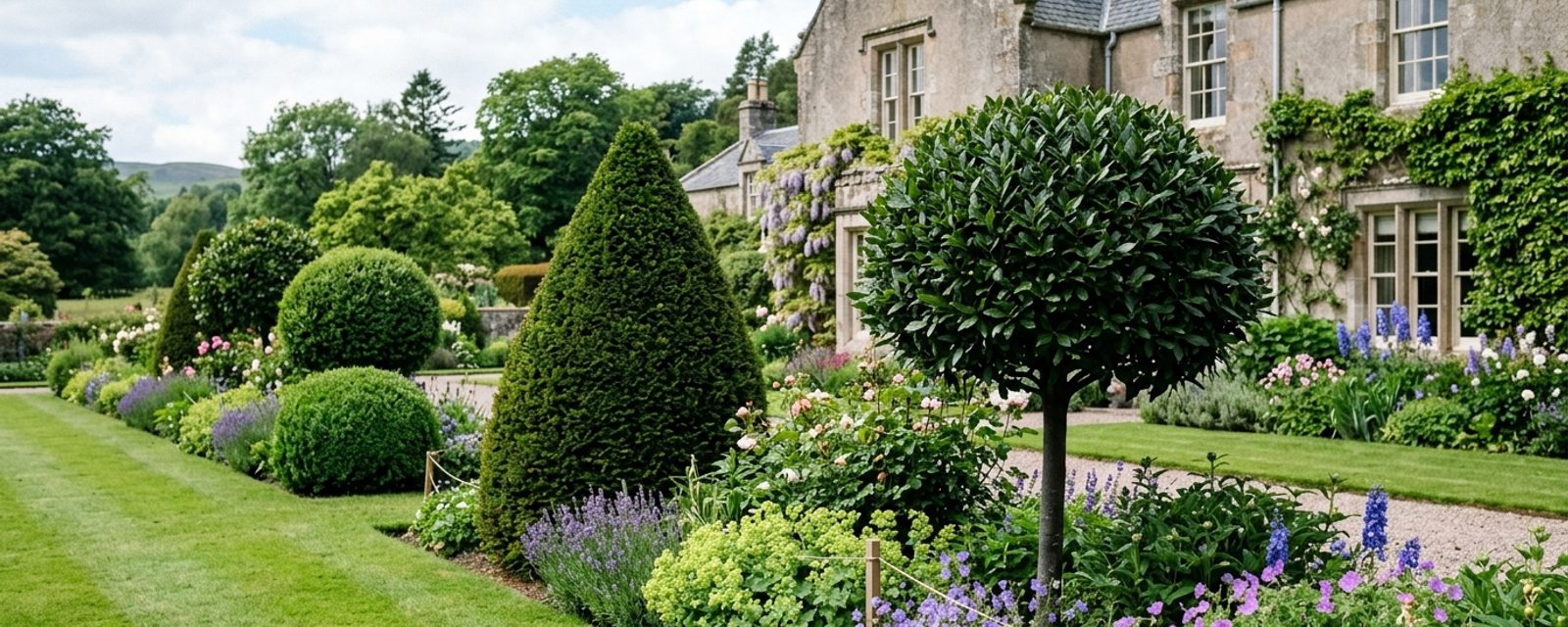
A clipped shape holds because of a decision the plant itself is forcedCovering plants to exclude light and speed early, tender growth in the dark, most associated with rhubarb and sea kale in late winter. Full definition → into, not because of any trick with the shears. Every stem tip carries a terminal bud that produces a hormone, auxin, which travels down the stem and suppresses the buds lower down, the axillary buds, from growing at all. That's apical dominance, and left alone it's why a young shrub tends to grow as one or two long leading shoots rather than a bushy mass. Cut the tip off and the auxin supply from that point stops; the suppressed buds below it start growing within days, each one now a new tip in its own right. Do that repeatedly, over the whole outer surface of a shape, and the plant answers with dozens of new growing points instead of one.
It's also why only some shrubs make good topiary subjects. A plant that reshoots readily from old, woody stems, not just soft new growth, tolerates the hard, repeated cutting a crisp shape needs; one that only carries live buds on recent growth can be cut back into bare wood that never recovers. Box, yew and bay all reshoot well from old woodWhether a plant fruits on stems grown the previous year (young wood) or on older, established branches (old wood), which decides how it's pruned. Full definition →, which is why they turn up in nearly every topiary guide rather than something more arbitrary like leaf size or evergreen habit alone.
Choosing a shape
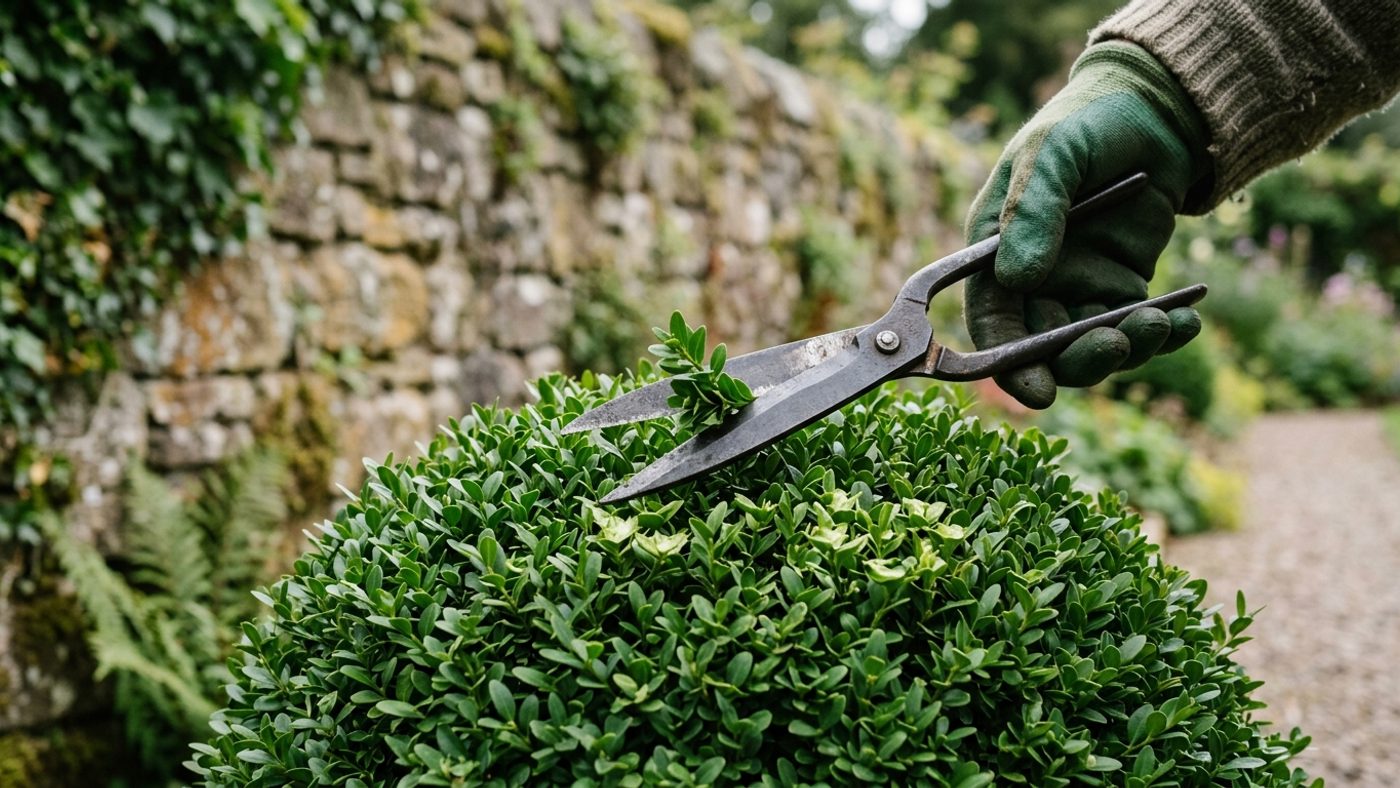
Start with a simple geometric form. A ball, cone, pyramid or cube is realistic to cut freehand and forgiving of small errors, because there's no complex silhouette to lose track of. Animal shapes, spirals and multi-tiered "cloud" forms are achievable but need a wire or cane frame as a guide, especially while the plant is still filling out, since freehand judgement on a shape with no straight lines or symmetry is genuinely difficult even with practice. A cheap frame, or even a few canes tied into a rough outline, gives a fixed reference to cut back to every time, which matters more than skill in the first few years.
For a standard, a single clear stem topped with a ball or dome, pick a plant with one strong upright shoot, tie it to a cane to keep it straight as it grows, and remove competing side shoots as they appear low down. Once the stem reaches the height wanted, stop it there and let the top third or so bush out into the head shape; that top growth is where all the later shaping happens, the bare stem below it isn't touched again.
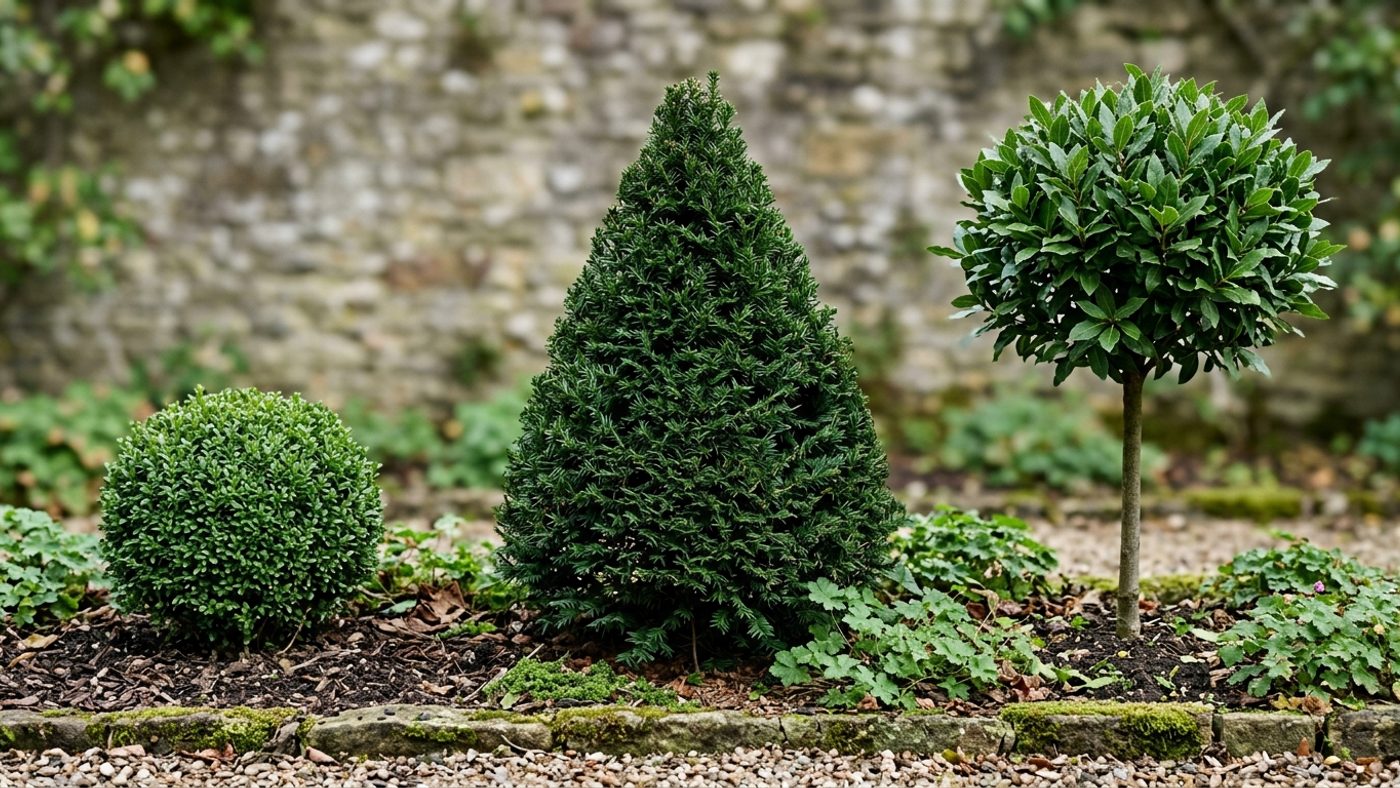
Box, yew and bay compared
The three plants suit different situations more than they suit different skill levels. All three are slow enough to hold a shape between clips, but they differ enough in growth rate, hardiness and the tool that suits their leaf size that the choice is worth making deliberately rather than by habit.
| Box (Buxus sempervirens) | Yew (Taxus baccata) | Bay (Laurus nobilis) | |
|---|---|---|---|
| Growth habitA plant's characteristic shape and manner of growth, such as upright, spreading, creeping or bushy. Full definition → | Slow, small dense leaves, best for fine detail | Vigorous once established, up to 30cm a year | Moderate, large glossy leaves |
| Clips per year | Two, sometimes three | One, or two to three for a very formal finish | One, in summer |
| Best cutting tool | Hand shears, for a clean finish on small leaves | Hedge shears or a powered trimmer for scale | Secateurs, not shears, cut leaves bruise and brown at the edges |
| Cold tolerance | Fully hardy | Fully hardy, tolerates exposure and shade | H4The RHS's H1a–H7 scale for how much cold a plant can survive outdoors, H1a being tender indoor-only and H7 hardy anywhere in the UK. Full definition →: hardy to -5 to -10°C in the ground; containers need winter protection |
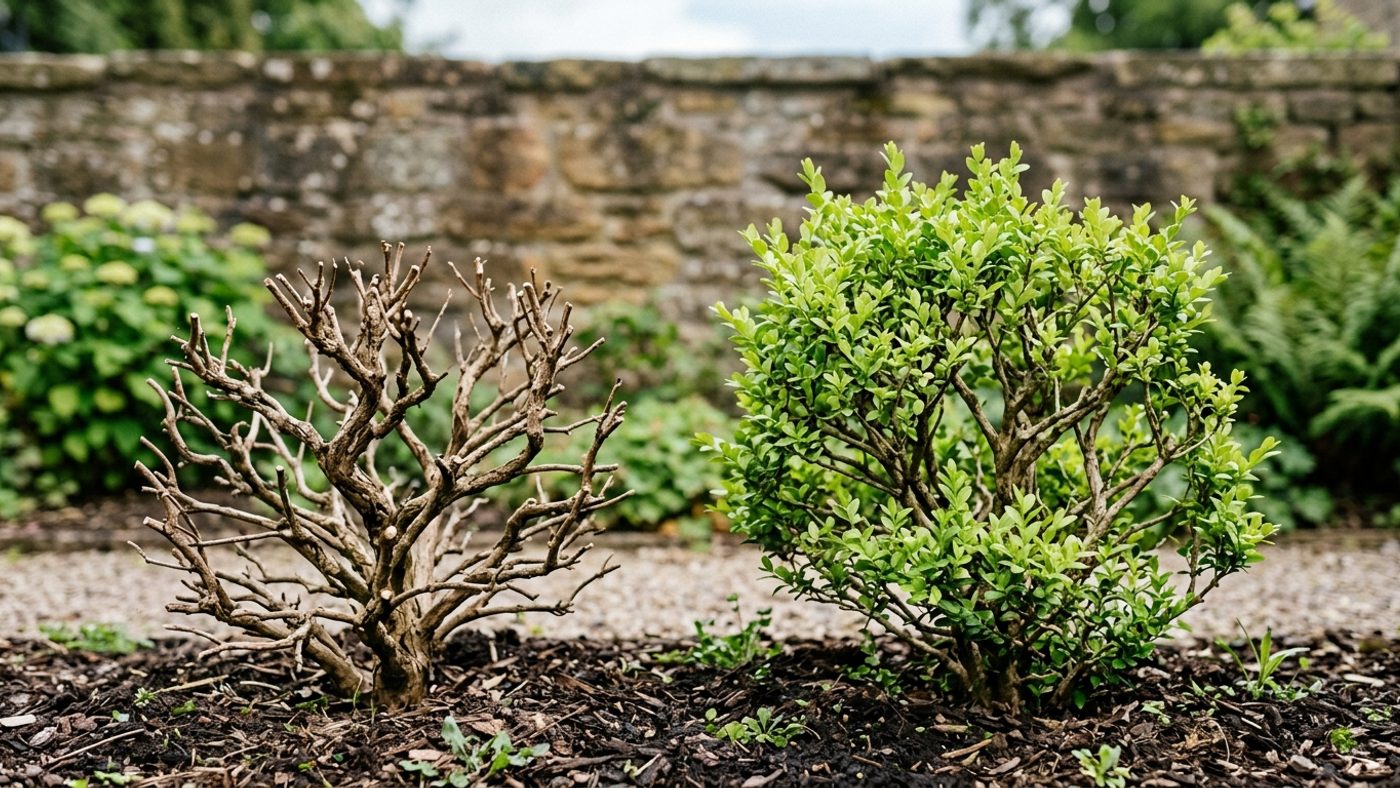
Box is the plant most people picture when they hear "topiary", small, dense, evergreen leaves that take a crisp edge better than almost anything else, which is exactly why it also shows the cut marks fastest if the blades are blunt or the trim is rushed. It grows in sun or shade, tolerates deep shade under trees, and needs reliably moist soil especially where it's in full sun. Young plants benefit from having their stems cut back by about a third in May to build a bushy base early; established, shaped specimens are usually best trimmed into their crisp finish in August, once that year's new growth has hardened offGradually getting young plants raised indoors used to outdoor conditions over 7–14 days before planting out, so cold, wind and direct sun don't shock or damage them. Full definition →, since cutting soft young growth earlier in summer leaves it more open to leaf scorch and disease. A neglected box shape can be renovated with a hard cut back to 15–30cm from the ground in late spring, though it takes a few years to fill back out.
Yew is the plant to reach for when a shape needs real scale or an unusually crisp, dark backdrop, it tolerates shade, most soils including chalk, and drought once established, though it dislikes sitting wet and can develop root rot in waterlogged ground. Established yew hedges and larger topiary forms grow vigorously, up to 30cm a year, and a single trim in summer or early autumn is enough to keep a shape tidy; formal work that needs a very crisp finish can take two or three clips over summer instead. Yew's real advantage over most conifers is that it reshoots readily from old, bare wood, which makes it one of the very few evergreens that can be properly renovated rather than just maintained: a neglected yew hedge or overgrown shape can be taken back hard, staged over three years (the top first, then each side in the following two seasons) to avoid shocking the whole plant at once, or coppiced right down to 15–20cm from the ground in early spring if it needs to start again completely. All parts of yew are seriously poisonous; wear gloves handling the clippings and never leave them where grazing animals, including livestock or pets, could reach them.
Bay is the odd one out of the three: an aromatic Mediterranean evergreen rather than a hedging plant pressed into topiary use, and the only one of the three that's genuinely frost-tender. Its RHS hardiness rating is H4, hardy through most of the UK down to -5 to -10°C in the ground, but a container specimen loses that ground insulation and is considerably more exposed to a hard frost than the same plant would be planted out, worth taking seriously in an inland or upland Scottish garden, where a normal winter night can already sit at or beyond the low end of that range; box and yew have no equivalent weak point, so bay is the one of the three genuinely worth moving under cover, into a porch or unheated greenhouse, for the coldest snap. Bay is usually trimmed once in summer, using secateurs rather than shears or a powered trimmer, its leaves are too large and glossy for a shears cut to seal cleanly, and a bruised, cut leaf edge browns visibly within days on a plant grown specifically to look tidy. Prune to a bud facing the direction new growth should take, and remove any leaf tips browned by winter cold once new growth resumes in late spring. Left unclipped, bay is a genuinely large plant, capable of reaching 7.5m, so the topiary habit isn't just decorative, it's doing real work keeping the plant to a manageable size.
Tools and technique
Clean, sharp blades matter more for topiary than for almost any other pruning job, because the cut surface is the entire visible result. A blunt or dirty blade tears rather than slices, leaving ragged, browning edges across a shape that's meant to read as a single smooth surface, and a dirty blade can also carry disease between plants, worth wiping down with disinfectant between specimens, particularly with box. Hand shears suit box and other small-leaved plants where precision matters more than speed. A powered hedge trimmer earns its place on larger yew shapes or hedges where the sheer area involved makes hand shears impractical. Secateurs are the right tool anywhere leaf size is large enough that a shears cut would slice visibly through individual leaves rather than following the natural gaps between them, which is why bay is cut with secateurs rather than shears or a trimmer.
Clip on a dry, overcast day if possible. Cutting wet foliage, especially on box, spreads fungal spores between wounds far more readily than cutting dry growth does, and hot, direct sun on a freshly cut surface can scorch the newly exposed inner leaves before the cut edges have had time to seal over and toughen. Avoid clipping into frost too: soft, newly cut growth is more exposed to cold damage than growth still protected under its outer leaf layer.
Timing across the season
Formative pruning, on a young plant that's still being trained into its shape, happens earlier and lighter than maintenance clipping on an established one: a light cut back by around a third, building a bushy base, rather than trying to cut a finished silhouette on a plant that hasn't filled out yet. Maintenance clipping on an established shape is timed to when that particular plant's new growth has matured enough not to scorch, which is why box (August) and bay (summer, once flush growth has firmed) sit later in the season than a first structural cut would. Renovation, cutting an overgrown or misshapen specimen hard back into old wood, is a different job again and is best done in the plant's dormant or near-dormant period, late spring for box and yew, so the whole growing season ahead is available to recover, rather than mid-summer when a hard cut leaves an ugly bare shape on show for months.
Aftercare after a clip
A hard clip, particularly a renovation cut, is a real check to the plant, and it recovers faster with help. Feed and mulchA layer of material spread over the soil around plants to suppress weeds, retain moisture, and improve soil structure as it breaks down. Full definition → after any hard pruning, and keep the plant well watered through the following season or two rather than assuming it can cope unaided, drought stress on top of a hard cut is what actually kills a renovated specimen, not the cut itself. Established, lightly-maintained shapes in reasonable soil need little routine feeding; container-grown plants, which have no reserve of soil nutrients to draw on, need a summer liquid feed and a fresh top layer of compost each spring to keep pace with the growth a clip is asking them to replace.
A clipped shape needs one more kind of aftercare through a Scottish winter: heavy, wet snow settling on a flat-topped or boxy shape can bend or snap branches under the weight before it has any chance to melt off. Shake or gently brush accumulated snow off a shape as it builds up, rather than leaving it to sit, and tapering the top of a hedge or larger form slightly narrower than the base helps snow shed on its own between checks.
Renovating overgrown topiary
| Plant | Cut back to | Timing | Recovery |
|---|---|---|---|
| Box | 15–30cm from ground level | Late spring | A few years to fill back out |
| Yew | 15–20cm (full coppice), or staged: top first, then each side over two further years | Early spring | Several years; uniquely among conifers, tolerates being taken right back into old wood |
| Bay | Light, staged reduction over two to three seasons rather than one hard cut | Spring | Slower than box or yew; a hard-cut specimen also has less foliage to protect its crownThe base of a perennial plant where roots and shoots meet, often sold and planted as a ready-made dormant plant rather than grown from seed. Full definition → the following winter |
Box responds well to the single hard cut because it reshoots freely from old wood; the same is true of yew, which is why it's one of the very few conifers that can be properly renovated rather than just maintained. Staging the cut over three years avoids shocking the whole plant at once, though a full one-off coppice works too if the gap in the shape can be tolerated for a few seasons. Bay is the exception: it recovers far more slowly from hard cutting than the other two, and because it's also the least cold-hardy of the three, a severely cut-back specimen going into winter with little foliage left is a real risk worth avoiding if the plant is otherwise healthy enough that a gentler, multi-season reduction is a workable option instead.
Common problems
Blunt or dirty blades cause more visible topiary damage than any pest: torn, browning cut edges that look like disease but aren't.
Beyond technique, box specifically carries two real risks. Box blight is a fungal disease causing bare patches, browning and dieback that's become particularly prevalent across the UK in recent years; it thrives in damp, shaded conditions with poor airflow, so watering at the base rather than overhead, keeping some open space around a shape rather than crowding it, and avoiding cutting wet foliage all reduce risk. Box tree caterpillar, the larva of a moth that can strip a plant of foliage and bark within weeks, has become the most common single pest query the RHS advisory service receives. It's widely distributed across England, particularly the south-east; it has also reached Scotland, Wales, Ireland and Northern Ireland, though current RHS distribution information doesn't describe it as established across Scotland the way it is across England, worth reading as "not yet as bad here" rather than "not here." Watch for the caterpillar's distinctive webbing and greenish-yellow, black-striped larvae from spring onward regardless. If either problem does take hold badly enough to give up on a box shape, yew is the RHS's own top-rated substitute for topiary use; Osmanthus and Podocarpus are its next-best picks, ahead of the more commonly sold Lonicera nitida and Ilex crenata, which the RHS's own alternatives trial found less reliable.
Away from box, the risks are smaller. One piece of reassurance on the browsing front: box and bay are both listed among plants generally resistant to rabbits, useful to know if that's what's put you off planting either in an exposed garden. Yew is essentially trouble-free plant-health-wise, though its toxicity is a genuine safety issue rather than a growing one. Bay's main problems, bay suckerA shoot that grows from a plant's roots or lower trunk, separate from the main framework, usually removed before it diverts energy. Full definition → (which causes thickened, curled leaf edges) and scale insects, are cosmetic rather than serious, and yellowing or leaf drop on a container bay is more often overwatering or cold stress than a pest at all.
Common questions
How long does it take a young plant to grow into a full topiary shape?
Several years for a simple ball or cone, longer for anything more complex. Box and bay are slower than yew, which can add up to 30cm a year once established. Training a standard’s clear stem to a workable height before the head starts filling out adds further time on top of that.
Can I turn an existing hedge or shrub into topiary, or do I need to start with a young plant?
An existing box or yew hedge can often be reshaped, since both reshoot from old wood, though an established, uneven shrub takes longer to correct than one trained from young. Bay is less forgiving of a severe reshaping cut, so it’s worth building a new shape gradually rather than cutting hard into an established, untrained bay in one go.
Is it safe to compost yew clippings?
Handle them with gloves and keep them away from anywhere grazing animals or pets could reach the pile, since all parts of yew are seriously poisonous. Once properly composted down they’re generally treated the same as other woody garden waste, but disposing of them via green waste collection avoids the question entirely if in doubt.
Why has my box topiary gone patchy or brown in patches rather than an even colour?
Check for box blight first, especially after a wet spell, since it causes exactly this pattern of bare, browning patches. Rule out simple blade damage too: a blunt shears blade tears rather than cuts, and torn leaf edges brown within days in a way that can look like disease at a glance.
Do I need a frame or template, or can I cut a shape freehand?
Simple geometric shapes, balls, cones, cubes, are realistic freehand once you’ve done a couple. Anything with an irregular silhouette, spirals, animals, multi-tiered forms, is much easier with a wire or cane frame as a fixed guide, particularly in the plant’s early years when there isn’t yet enough growth to visually judge the shape against.
Sources
11 sources, recorded with what each was used for
- RHS: Topiary: General topiary technique: plant choice, training steps, tools, timing framework, renovation, listed problems
- RHS: How Plants Grow and Thrive: Apical dominance mechanism: terminal/axillary buds, auxin suppression, why removing a growing tip triggers branching
- RHS: Pruning Hedges: Formative pruning timing for evergreens, per-species clipping frequency
- RHS: Box (Buxus sempervirens) Growing Guide: Growing conditions, formative and mature clipping timing, hard renovation pruning, aftercare, box blight/box tree caterpillar prevalence
- RHS: Yew Growing Guide: Growing conditions, clipping timing and frequency, growth rate, staged renovation and coppicing, toxicity warning
- RHS: Bay Tree Growing Guide: Hardiness, container winter protection, trimming timing and technique, mature size, pests
- RHS: Box Tree Caterpillar: Identification, damage, control options, UK distribution
- RHS: Rabbit-Resistant Plants: Box and bay listed among plants generally resistant to rabbit browsing
- RHS: Laurus nobilis: H4 hardiness rating and temperature range for bay
- RHS: Preventing Winter Damage: Brushing snow off hedges/topiary and tapering tops to shed snow
- RHS: Box Alternatives for Healthy Hedges: RHS's own trial-based ranking of substitute topiary plants for gardeners giving up on blight- or caterpillar-affected box