
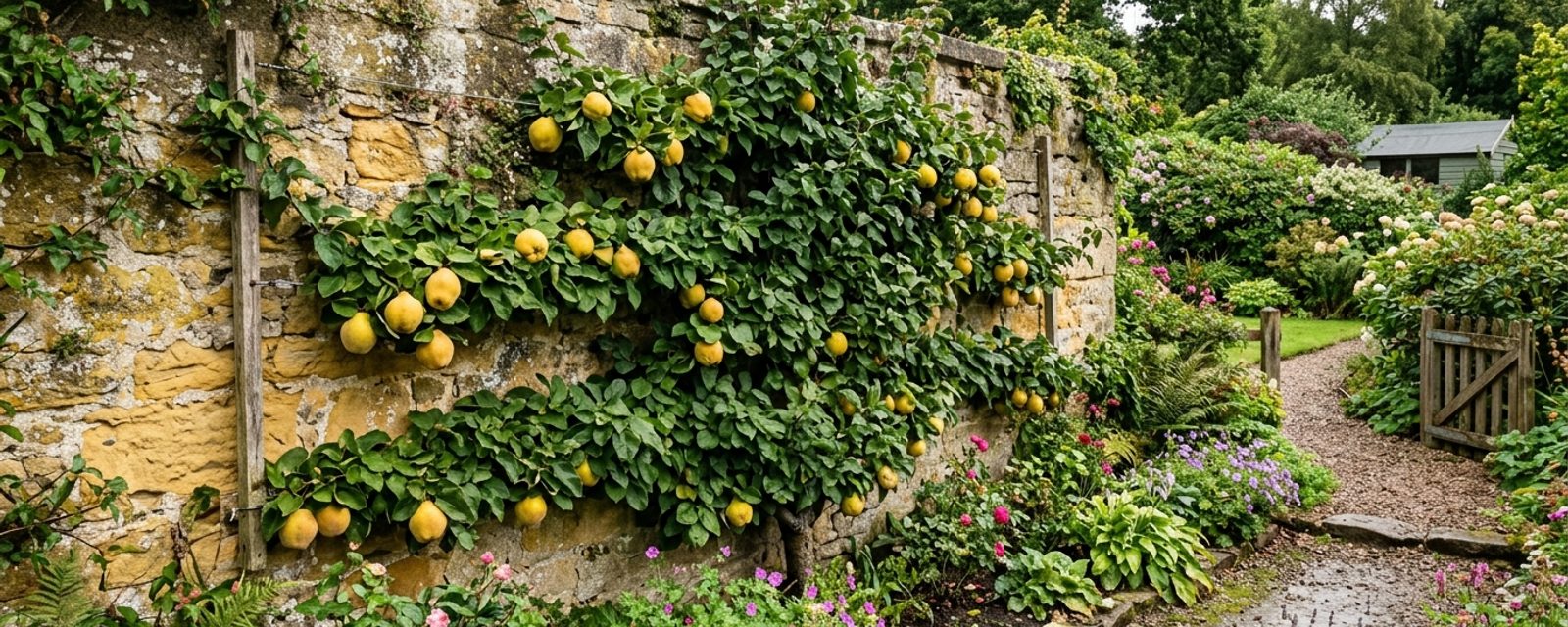
Cydonia oblonga
Quince genuinely needs a sunny wall to ripen, and a picked fruit still needs two months of mellowing before it's ready to use.
Give it that, and the tree itself asks very little else: one tree is enough, and established trees are usually robust and healthy.
Site and rootstocks
A south- or south-west-facing wall is worth training the tree against in a colder region, rather than growing it free-standing. Soil can be a range of types, but quince does best in deep, fertile, moisture-retentive ground. Trees on RHS's named rootstocksThe root system and lower stem a fruit tree is grafted onto, chosen to control the tree's eventual size rather than for its own fruit. Full definition →, Quince A (semi-dwarfingHow much a fruit tree's rootstock limits or allows its eventual size, from extremely dwarfing (smallest) through to very vigorous (largest). Full definition →) or Quince C and Quince Eline (dwarfing), reach 3-4.5m in height and spread, the same rootstock family pears are graftedJoining a chosen fruiting variety onto a separate rootstock, so the tree grows the fruit of one plant on the roots of another. Full definition → onto, since quince is the standard commercial rootstock for pears in the UK.
Grafting Fruit Trees: A Beginner's Guide for Scottish Gardens → explains what actually happens at that rootstock join, and the timing a whip-and-tongue graft needs to take.
Planting and care
Plant November to March while dormant. Water newly planted trees regularly through dry spells for the first couple of years; established trees in moisture-retentive soil shouldn't need further watering. A well-mulchedA layer of material spread over the soil around plants to suppress weeds, retain moisture, and improve soil structure as it breaks down. Full definition → tree generally needs no extra feeding. Trees typically start cropping at five to six years old, on the slower end for tree fruit, and can take 10-20 years to reach full maturity.
Pruning
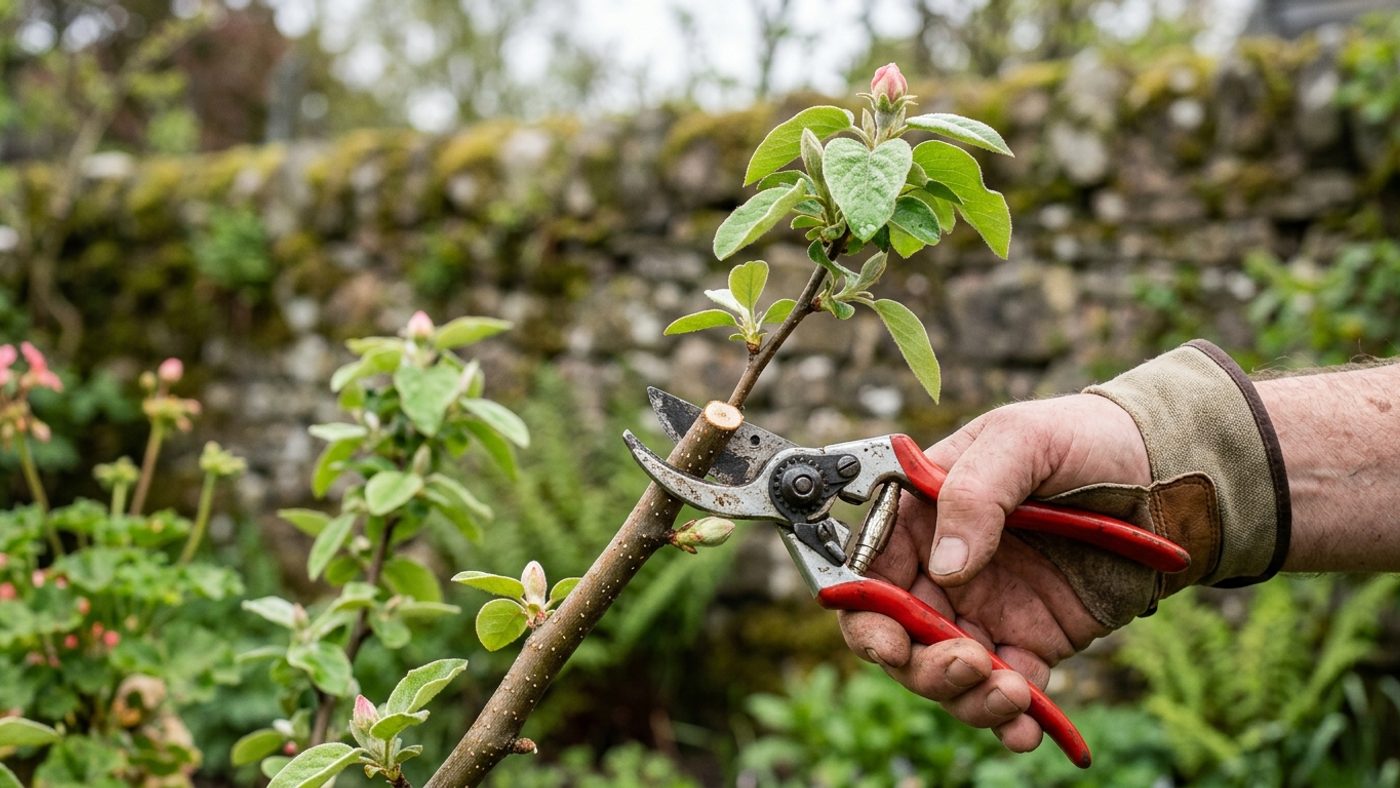
Prune a newly planted tree the way you would an apple, aiming for an open-centredA bush pruned with an open middle and outward-radiating branches, so light and air reach every part rather than a dense, shaded centre. Full definition →, goblet shape. Once established, quince needs only light winter pruning while dormant: remove dead or damaged wood and thin out congested growth. Quince is a tip-bearerWhether a fruit tree carries its fruit mainly on short side-shoots along older wood (spur-bearing) or at the tips of the previous year's growth (tip-bearing). Full definition →, fruiting at the shoot tips rather than mainly on spurs the way apples do: avoid cutting those tips off, since that's exactly where next year's fruit would have formed.
Varieties
Serbian Gold's leaf-blight tolerance comes from an actual RHS Wisley trial during a wet summer, not just a described trait.
Meech's Prolific is also named, a heavy cropper with no AGMThe RHS's Award of Garden Merit: a UK-wide trials award for reliable performance, not a Scotland-specific recommendation. Full definition → and no distinguishing trait beyond that. At least two further named varieties exist beyond these.
★ Our pick for Scotland
Serbian GoldAGM
Large, rounded, golden fruit · highly aromatic · compact · H5The RHS's H1a–H7 scale for how much cold a plant can survive outdoors, H1a being tender indoor-only and H7 hardy anywhere in the UK. Full definition →
Named directly from a real Wisley trial during 2023's wet summer, showing good leaf blight tolerance.
Why this one: RHS's own quince leaf blight page names Serbian Gold, alongside Aromatnaya, from actual observation in the quince collection at RHS Garden Wisley during 2023's wet summer: smaller lesions, little to no early leaf fall, next to susceptible cultivarsA plant variety that arose or was bred under cultivation and is kept true by deliberate propagation, rather than a naturally occurring wild species. Full definition → growing in the same conditions. The trial ran in Surrey, not Scotland, but wet-summer conditions are a genuine match for what a Scottish growing season more often supplies. Compact growth and highly aromatic fruit come on top of that, not instead of it.
Also worth considering
VranjaAGM
Large pear-shaped fragrant fruit · early cropper · H5
A long-established, traditional variety, still AGM-rated (as 'Vranja Nenadovic') and holding its own against newer names. Good flavour, ready earlier than Serbian Gold.
Best Quince Varieties for Scotland → compares all named quince varieties head-to-head, with the practical detail that doesn't fit in a summary card.
Harvesting and storage
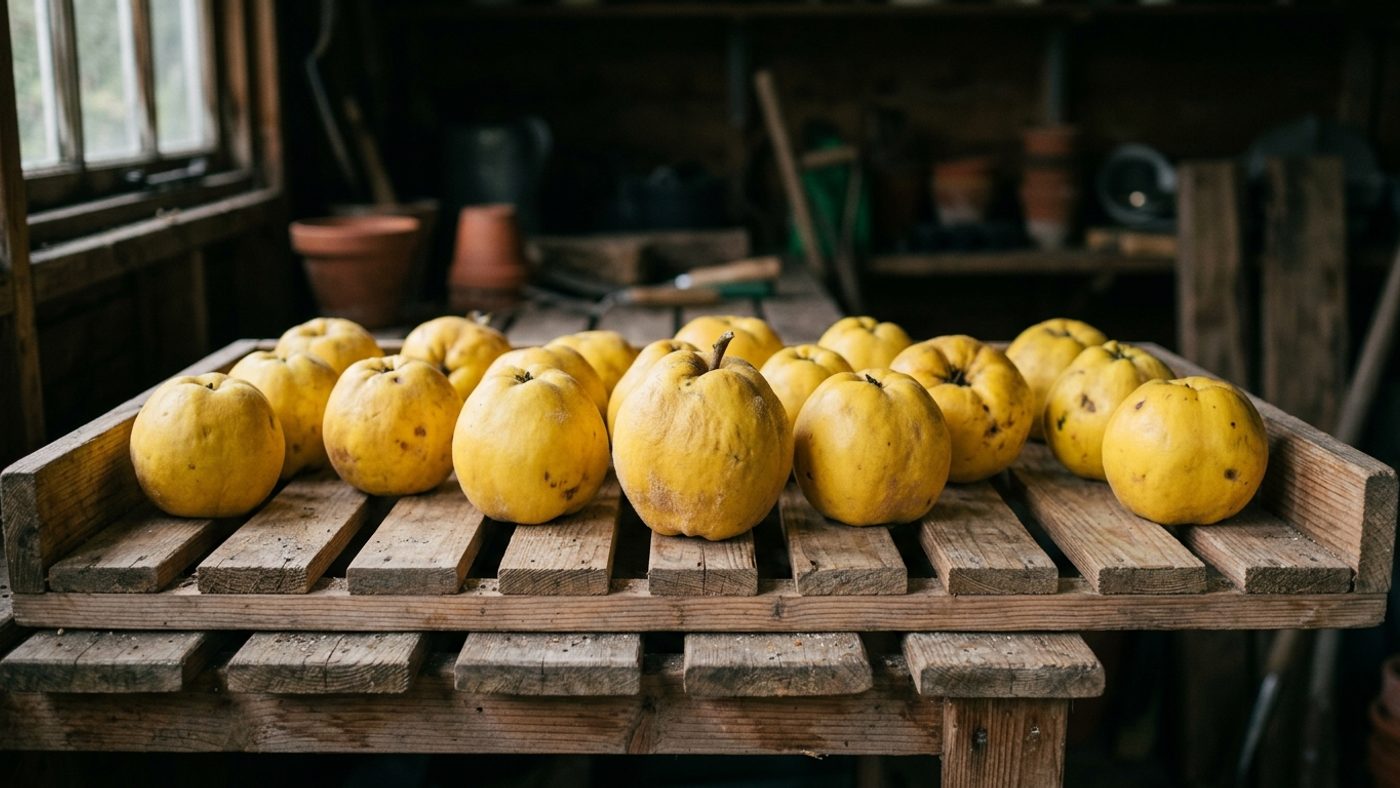
Harvest October to November, once fruit has turned from light yellow to golden. Unlike most fruit, a picked quince isn't ready to use straight away: store it for at least six to eight weeks to 'mellow', unwrapped, in a cool, dark place on slatted wooden or cardboard trays. It keeps for two to three months this way. Remove the seeds before cooking or eating the fruit, since they contain toxins.
Common problems
- Aphids distort new growth and shoots.
- Quince leaf blight causes leaf spotting and, in susceptible cultivars, early leaf drop. Serbian Gold and Aromatnaya showed good tolerance in a real RHS Garden Wisley trial during a wet summer.
- Codling moth caterpillars tunnel into ripening fruit, the same pest that affects apples.
See more problems
- Powdery mildew can affect leaves and shoots.
- Brown rot turns fruit soft and brown, spreading fast where fruit touches. Remove affected fruit promptly.
- Fireblight causes blackened, scorched-looking shoots and blossom; cut out and destroy affected wood well back into healthy growth.
Common questions
Can I eat a quince straight after picking it?
No: store it unwrapped in a cool, dark place for six to eight weeks to 'mellow' before eating or cooking with it. Full sourced breakdown: <a href="/tools/garden-myths/quince/">Quince Myths →</a>
Do I need two quince trees to get fruit?
No: quince is self-fertileA plant that can set fruit using its own pollen, without needing a second, different variety nearby to cross-pollinate it. Full definition → and produces a good crop from a single tree, unlike apples, pears or most sweet cherries. Full sourced breakdown: <a href="/tools/garden-myths/quince/">Quince Myths →</a>
Are quince seeds safe to eat?
No: quince seeds contain toxins and should be removed before eating or cooking the fruit. Full sourced breakdown: <a href="/tools/garden-myths/quince/">Quince Myths →</a>
Is quince actually realistic to grow in Scotland?
With the right site, yes. Quince is a genuinely sun-dependent fruit: sun is needed to ripen the fruit, spring flowers are frost-susceptible, and for colder regions the recommendation is to train the tree against a south- or south-west-facing wall rather than growing it free-standing. That's a real requirement to plan for, not a reason to rule quince out.
Sources
4 sources, and what each was used for
- RHS: getting started, self-fertility, rootstocks (Quince A, Quince C, Quince Eline — the same rootstock family pears use), 4 of an apparent 6 named varieties, sun and shelter requirement including the south/south-west wall recommendation for colder regions, soil tolerance, planting timing, watering, feeding, pruning (open-centred goblet shape, tip-bearing habit), harvesting and the 6-8 week storage 'mellowing' period, and named problems
- RHS: confirms AGM (as 'Vranja Nenadovic'), H5 hardiness, size and maturity timeline (10-20 years), the seed-toxicity safety note, disease susceptibility
- RHS: confirms H5 hardiness, AGM, season of use, the same seed-toxicity safety note
- RHS: the specific RHS Garden Wisley trial finding that Serbian Gold and Aromatnaya showed good leaf blight tolerance during 2023's wet summer, with smaller lesions and little to no early leaf fall compared with susceptible cultivars