
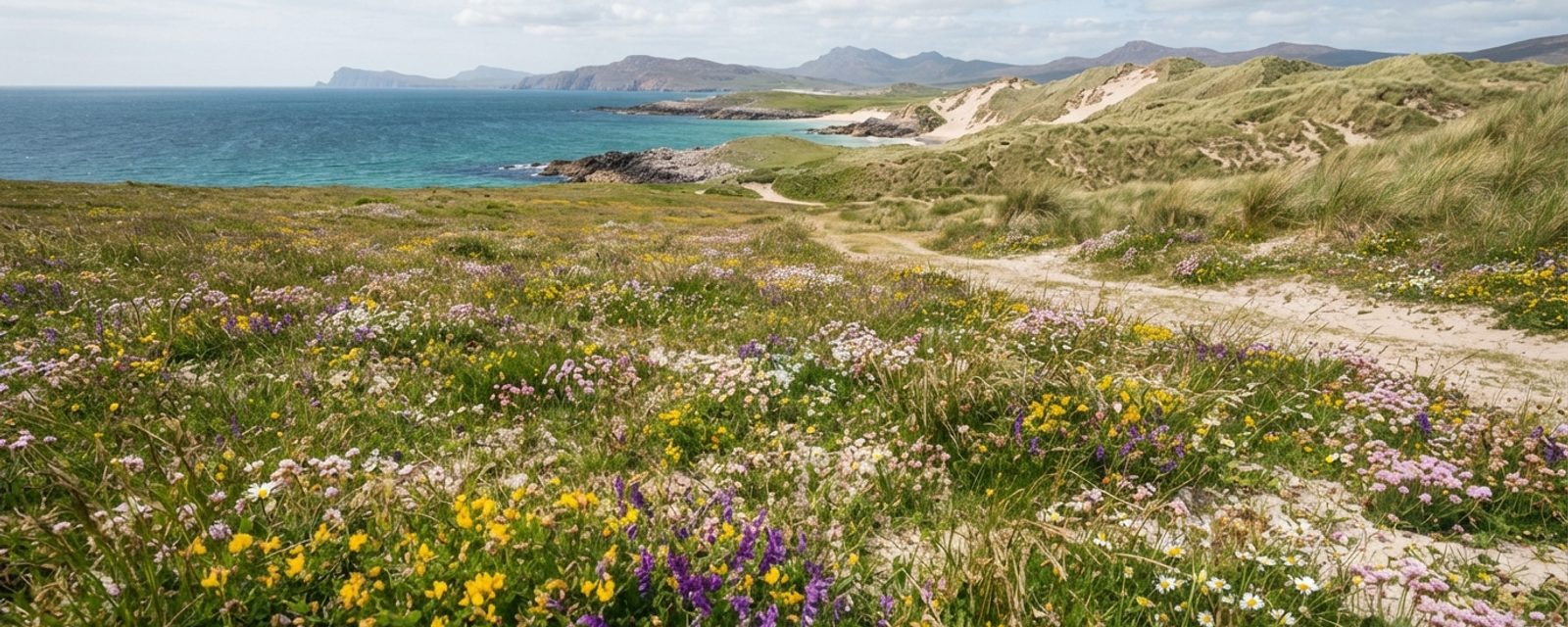
Dig a spade into most Scottish gardens and the soil fights you with acidity, Scotland's rock and its rainfall between them push the default toward peat and podzol (a naturally acidic, nutrient- leached soil common across upland Scotland). Machair breaks that rule completely. Crush enough seashell into sand over thousands of years, blow it inland off an Atlantic beach, and the result is a soil that runs the other way: alkaline, often pH 8 or higher, on ground found nowhere else in the world outside the north-west coasts of Scotland and Ireland.
Quick answer
Machair is wind-blown shell sand, naturally alkaline (pH normally above 7) rather than acidic, free-drainingSoil that lets water pass through quickly rather than pooling, so roots aren't sitting in wet ground after rain. Full definition →, low in organic matter and nitrogen, and exposed to some of the strongest average winds in the UK. BrassicasThe cabbage family: cabbage, kale, broccoli, cauliflower, Brussels sprouts, kohlrabi, swede, turnip and more, sharing the same pests, diseases and rotation rules. Full definition →, alliums and most root crops do genuinely well there once fed and sheltered; spinach, runner beans and squash struggle badly. Seaweed, not lime, is the traditional and still-recommended fertiliser. Machair is also a rare, internationally significant, legally protected habitat, so cultivation here sits inside conservation rules, not outside them.
What machair actually is
Machair is a specific, narrow habitat: a low-lying coastal plain built almost entirely from wind-blown sand that is 80–90% ground seashell by content, found on the Uists, Benbecula, Barra and Tiree in particular, with smaller stretches on Orkney, Shetland, Lewis, Harris and a few Inner Hebridean and mainland west-coast sites. Scotland holds around two-thirds of the world's machair, with most of the rest in Ireland, this genuinely is not "the islands" in general; walk a short distance inland from a machair strip and the ground reverts to the same acid peat and podzol as the rest of upland Scotland.
The shell content is what changes everything about growing on it. That much crushed seashell pushes machair firmly onto the alkaline side, the opposite problem from almost everywhere else in Scotland, where the standard advice is "add lime if you must, most of the country doesn't need it." A grower moving to machair from an acid Highland peat croft, or just gardening a plot a few hundred metres from one, needs to stop thinking about liming altogether and start thinking about what a naturally alkaline soil locks up: iron and manganese become less available to plants as pH rises, which is why crops that need them can show yellowing between the leaf veins on machair that they wouldn't show on ordinary ground. Where that shows up, a foliar feedA liquid fertiliser applied directly onto a plant's leaves rather than the soil, absorbed faster than a root feed. Full definition → or a chelated (sequestered) iron and trace-element product, applied directly to the leaves rather than the soil, gets around the lock-up more reliably than trying to add more iron to already-alkaline ground.
Past the pH, three more things define the ground: it is extremely free-draining (good news in a country known for waterlogging, bad news the moment a dry spell hits, since sand holds almost no water), it is naturally low in organic matter and therefore in nitrogen and potassium, and it sits exposed to wind: a two-year trial of vegetable growing on Benbecula's machair recorded average wind speeds roughly twice those of southern England, with little natural shelter between an open plot and the Atlantic. None of this makes machair infertile in principle, crofting communities have cropped it for centuries, and NatureScot's own account of Uist and Barra machair credits its internationally renowned condition to exactly that ongoing rotationMoving each crop family to different ground each year, on a multi-year cycle, so pests and diseases that build up in soil don't get a repeat host. Full definition → of cropped and fallow ground, plus cattle grazing it over winter, but it does mean nothing about growing on it resembles growing on a typical Scottish clay or loam garden, and generic UK growing advice written for neither an alkaline nor a wind-scoured soil will mislead more often than it helps.
Cultivation on this scale is genuinely rarer today than the historical picture suggests: modern arable cropping on machair now only really happens on the Uists, as elsewhere crofters have shifted toward year-round sheep grazing, earlier silage cuts, or artificial fertiliser instead of the traditional low-intensity rotation. A gardener starting a plot on or near machair today is, in a small way, continuing a practice that's become the exception rather than the rule even within crofting itself.
Lazy beds: the cultivation method built for this exact ground
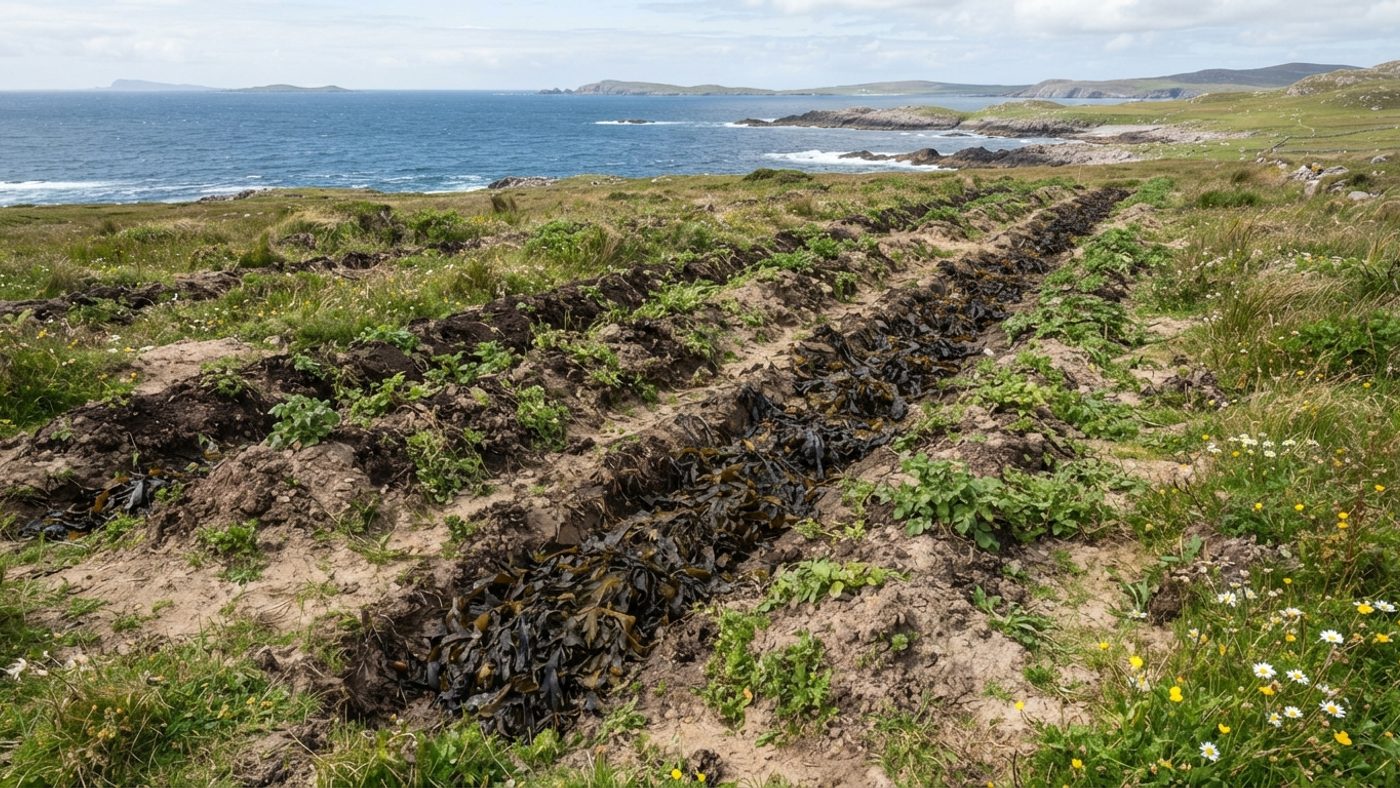
The traditional Hebridean answer to machair's specific problems is the lazy bed, known in Gaelic as feannag (plural feannagan): a raised, spade-dug ridge of turf, built directly on top of a thick layer of seaweed, with the ditches dug out on either side used both for drainage and as the source of the turf laid over the top. Seaweed was carried up from the shore in creels or on horseback and spread in strips around a metre wide, with turf dug from either side and laid over it to form the raised bed and its flanking ditches, a construction confirmed by a surviving 1934 photograph from Lochboisdale in South Uist showing exactly this pattern of long ridges under a potato crop. The method was used across the Highlands and Islands from the eighteenth to the twentieth centuries, on ground otherwise considered too poor or too wet to cultivate directly.
It suits machair specifically because it directly answers three of the soil's own weaknesses at once. Sinking a thick seaweed layer under the ridge puts fertility and organic matter exactly where the free-draining sand needs it most, rather than letting it wash straight through. Raising the bed itself keeps roots above the winter water table on ground that can flood, without needing artificial drainage. And building fertility this way, rather than through repeated chemical feeding, matches ground that was already naturally alkaline and never needed the lime a lazy bed elsewhere in Scotland's acid peat districts was often also used to work around.
A lazy bed built today on or near machair, whether on an active croft's in-bye land (the fenced, directly-worked ground attached to a croft) or a garden plot close to the shore, still works on the same principle, in the same order: mark out a strip roughly a metre wide, spread a generous layer of fresh seaweed or well-rotted manure along it, dig the flanking trenches on either side, and turn that turf over onto the seaweed to build the raised bed itself, leaving the trenches as drainage. Anyone gardening within an actual crofting tenancy should also see the guide to crofting law and growing rights, machair in-bye land and any adjoining common grazing carry their own statutory duties and rights that sit alongside, not instead of, the growing advice here.
What actually grows on machair
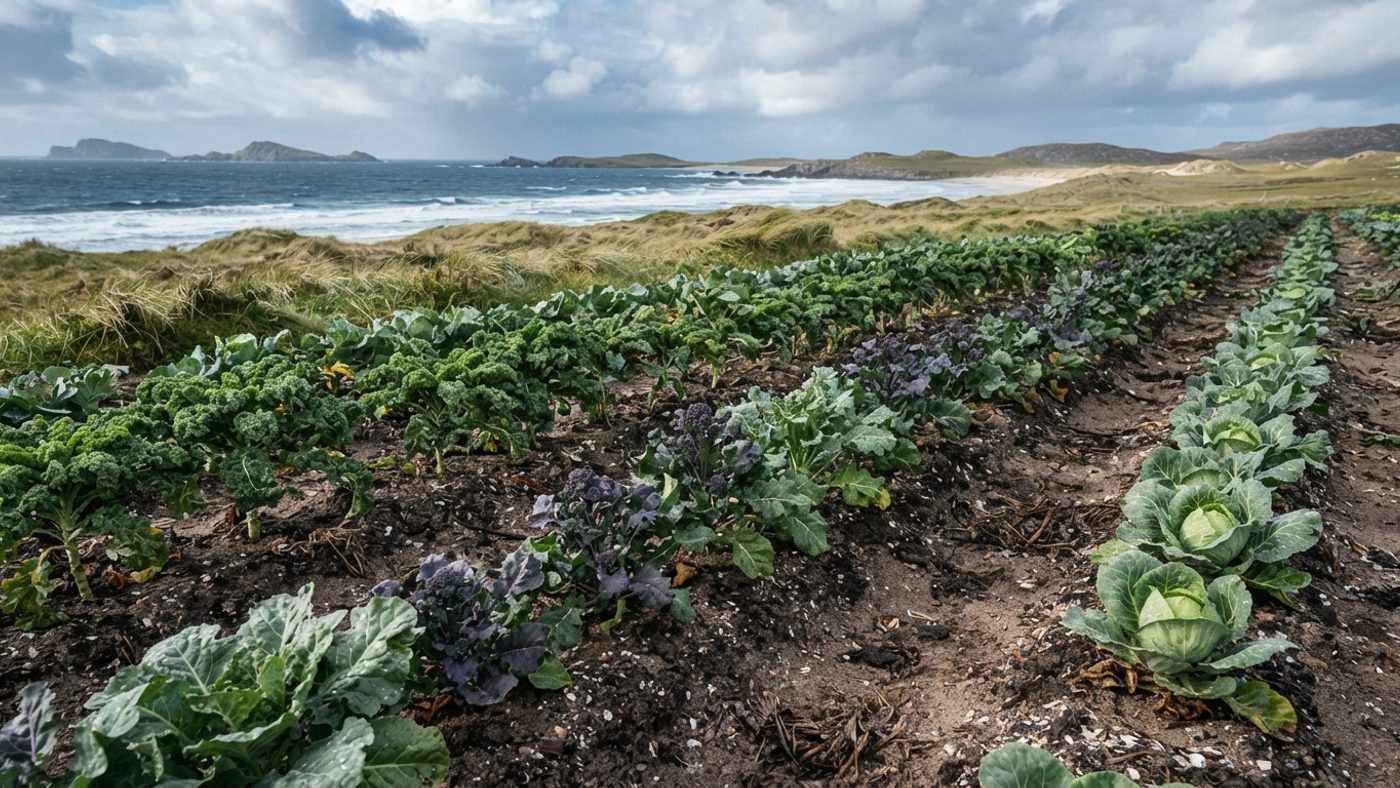
Sustainable Uist, a community sustainability group, spent 2010–2012 growing around 50 crops in 10 different ways on half an acre of machair land at Liniclate on Benbecula, specifically to test whether the common local belief that vegetables were "too difficult" to grow there held up. It did, for some crops, and didn't for others. The numbers and outcomes below all come from that one trial, on one half-acre plot, over two years, not from a wider body of research, treat them as a genuinely useful starting point for a specific site rather than a guarantee for every stretch of machair:
| Crop group | How it did on machair | Why |
|---|---|---|
| Brassicas (cabbage, cauliflower, calabrese, kale) | Thrived, once fed, watered and protected from wind | Machair's natural alkalinity actively suppresses club-root, a disease that plagues brassicas on acid soil elsewhere |
| Root crops — carrots, parsnips, swede, turnip, radish | Did well | Free drainage suits root shape and development; brassica-family roots needed no wind protection at all |
| Alliums — onions, leeks, garlic, salad onions | Did well, largely pest-free | Prefer the same well-drained, lighter soil machair provides naturally |
| Summer salads and leaves | Did well with wind protection and careful timing | Fast-growing, tolerant of the soil's low fertility |
| Spinach, spinach beet | Failed almost completely, boltedA plant switching early into flowering and seed production, usually triggered by stress, after which leaves, roots or bulbs turn bitter or unusable. Full page → before cropping | Long tap roots reach down into saline, infertile sand below the fertilised surface layer |
| Courgettes and squash | Poor outdoors | Warm-climate crops struggling against both wind and a short, cool growing season |
| Runner and French beans | Failed to set pods across repeated attempts | Delicate flowers damaged by wind; the trial also suspected insufficient pollinator activity on the plot |
| Beetroot | Did well | Tolerates moderate fertility and machair's drainage better than its spinach-family relatives |
The trial deliberately left out potatoes, on the reasoning that Hebridean crofters had already grown them successfully on machair and peat crofts for generations, the same crop the lazy bed itself was developed around. One real caution applies to potatoes on machair specifically, though: RHS guidance is direct that common scab, a disease that pits and roughens the skin, is worse on alkaline soil, so the usual advice to lime ground for potatoes elsewhere in Scotland's more acid gardens doesn't transfer here, machair's own pH is already on the alkaline side scab prefers, without any lime added at all. This is a single trial from one specific site (Liniclate, Benbecula) rather than a large-scale study, and a different stretch of machair with different exposure or drainage could give somewhat different results.
Building fertility without exhausting a naturally thin soil
The Benbecula trial found the working nutrient profile specific enough to plan around directly: naturally short of nitrogen and potassium, some phosphorus already present, and plenty of calcium and magnesium from the shell itself, but short of iron and manganese. The trial's guidance is to apply a generous seaweed dressing at the start of each season, around 8kg per square metre, which supplies most of what the crops need, then add extra potash specifically, since seaweed itself is comparatively light on it. Where seaweed isn't available, well-rotted farmyard manure at roughly half that rate is the next best option, with a general-purpose fertiliser as a last resort. Spreading beach-cast seaweed on machair this way is a genuinely old practice, not a modern substitute for one, it's a right still exercised today under crofting common-grazings arrangements. For anyone without an obvious pile washed up nearby, or unsure what's actually allowed to cut or collect and from where, the guide to seaweed as a garden feed covers sourcing and the legal detail directly. Rotating crops over a three-year cycle matters here for a reason beyond the usual pest-and-disease logic: machair's fertility is thin and built almost entirely from what's added each season, so following a hungry crop like brassicas with a light feeder such as alliums or root vegetables gets more out of a single season's seaweed or manure than growing the same demanding crop in the same patch again would.
Wind, sand and erosion: protecting the plot
Wind is the other defining constraint, and it's not a minor inconvenience given the average wind speeds already noted above. The damage isn't only physical bruising of leaves and stems, salt and sand carried on the wind actively scours and burns tender growth, moving sand at the surface can uncover newly sown seed, and the drying effect on both soil and leaves compounds machair's already fast drainage. The one upside: that same near-constant wind is exactly what keeps midges off a machair plot on a still summer evening when an inland Scottish garden would be unworkable. Traditional crofts answered the wind's downsides with a stone-walled kaleyard right next to the house; a modern equivalent is a dedicated wind fence around the growing area (mesh netting or similar, fixed at as many points as possible to resist tearing), since the Benbecula trial found a 1-metre fence's sheltering effect fades out within about 8 metres of the fence itself. Fine woven mesh crop covers do double duty, cutting wind damage on wind-tender or slower-establishing crops while also keeping off cabbage root fly and other pests. A greenhouse or polytunnel needs its own, sturdier anchoring against the same wind, covered in the guide to securing a greenhouse or polytunnel against wind, and a young shelter belt can eventually do the job a wind fence does temporarily, as set out in the shelter belt planting guide.
Watering has to work around the same free drainage that gives machair such good structure for root crops. Scotland's regular rainfall means less hand-watering overall than in drier parts of the UK, but the sand dries out fast between showers, so the general Scottish "it rains enough" assumption doesn't hold here the way it does on heavier ground; the trial's own rule of thumb is to start watering whenever a week's rainfall drops under about 12mm, checked with a basic rain gauge.
Sowing and planting-out dates need adjusting too, and testing seed-packet timings against the trial's own findings is worth doing crop by crop rather than guessing at a blanket shift:
| Crop | Standard UK guidance | What the Benbecula trial found worked |
|---|---|---|
| Summer brassicas | Sow from roughly mid-March | Add about two weeks; early April sowing, planted out by end of June |
| Root crops (carrot, parsnip) | Late March to early May | Mid-to-late June gave the most reliable results |
| Winter brassicas | Sow from roughly mid-April | May sowing, planted out roughly two weeks earlier than packet planting-out guidance |
The underlying reason is soil temperature, not the calendar: seeds like carrot and parsnip simply won't germinateA seed sprouting: breaking dormancy and putting out its first root and shoot, given the right warmth and moisture. Full definition → in cold soil, and a cold, wind-scoured machair plot reaches sowing temperature later than a sheltered inland garden even at the same latitude. It's also worth testing an actual plot's own pH directly rather than assuming a blanket "pH 8" figure applies uniformly, machair strips are narrow, and ground a short walk inland reverts to acid peat, so a plot near the boundary between the two could sit anywhere between them; the guide to identifying your soil type covers testing directly.
Machair itself is a genuinely fragile surface, not just a windy one. Farm Advisory Service Scotland is direct about this: the thin vegetated layer is easily broken by heavy vehicles (tractors, campervans) and by overgrazing, and once that layer is stripped, the exposed sand beneath erodes fast and is very slow to recover given the harsh winter weather machair sites face. Undergrazing carries its own, different risk, letting coarse grasses crowd out the wildflower diversity machair is known for. Anyone gardening on or beside machair, rather than digging a lazy bed in isolation, should treat vehicle access and any dune-edge disturbance as a genuine risk to the wider ground, not just their own plot.
Machair is a protected habitat, cultivation sits inside that, not outside it
That global rarity comes with heavy legal protection: close to 40% of Scottish machair is designated a Special Area of Conservation (SAC) and around 80% sits within a Site of Special Scientific Interest (SSSI), protections that carry real legal weight under the Nature Conservation (Scotland) Act 2004. It's an offence to intentionally or recklessly damage the protected features of an SSSI, and certain activities on designated land need NatureScot's consent before they can go ahead.
NatureScot and Farm Advisory Service Scotland are both clear that machair's biodiversity value exists because of centuries of exactly the kind of low-intensity cultivation and grazing described above, not despite it: the wildflowers, the corncrake, and species like the great yellow bumblebee (covered in more depth in the site's pollinator-friendly gardening guide) depend on machair continuing to be cropped and grazed on roughly the traditional pattern, summer grazing withheld so plants can flower and set seed, rotational cropping kept going rather than abandoned or intensified. Traditional, small-scale, rotational growing of the kind this article describes sits comfortably within that picture. What genuinely needs checking first against SSSI/SAC consent requirements, ideally directly with NatureScot, is anything that goes beyond it: new drainage works, any vehicle access across dune or machair frontage, or converting machair to a more intensive form of cultivation than the traditional rotational pattern it evolved under.
Common questions
Does machair soil need lime, like most of Scotland's gardens?
No, the opposite, and it matters beyond just wasted effort: machair's alkalinity already sits in the range that worsens potato common scab, so adding lime pushes a real potato problem further in the wrong direction. The actual gap to fill on machair is nitrogen, potassium and organic matter, not calcium.
Can I dig a lazy bed anywhere on machair, or does the conservation protection stop that?
Traditional, small-scale rotational cultivation is part of what has kept machair's habitat value intact for centuries, and isn't itself treated as a threat to it. The concern under SSSI/SAC protection is larger-scale change, new drainage, vehicle tracks, converting the ground to more intensive use, which is worth checking with NatureScot before starting, not routine crop-growing on an existing plot.
Why did my spinach bolt on machair when it grows fine in my old garden?
A Uist field trial found spinach's long tap roots reach past the fertilised surface layer into saline, infertile sand beneath, a problem specific to machair's structure, on top of the long summer daylight that already pushes spinach toward bolting anywhere in Scotland. Beetroot, a much shallower-rooted relative, did fine in the same trial.
Is machair the same as any other sandy Scottish soil?
No. Ordinary sandy soil is typically still acid to neutral; machair's alkalinity comes specifically from its shell content, which no other Scottish soil type shares at anything like the same scale.
Why do runner beans fail on machair when they're an easy crop almost everywhere else in Scotland?
Wind damages the delicate flowers before they can be pollinated, and the trial that tested this also suspected low pollinator activity on the plot as a contributing factor. Either way, it's a genuinely different failure mode from cold or poor soil, which is what usually limits runner beans elsewhere.
Sources
9 sources, recorded with what each was used for
- NatureScot: Machair: Machair's definition, geographic distribution, traditional cropping pattern, and vulnerability to sea-level rise and storms
- NatureScot: Crofting: The traditional croft cultivation pattern and the decline of arable cropping on crofts generally
- Farm Advisory Service (FAS) Scotland: Land Management for Machair: Current land management recommendations, erosion risk from vehicles and overgrazing, and indicator species
- Joint Nature Conservation Committee: Geological Conservation Review, Machair chapter: Shell-sand composition, pH, and the proportion of Scottish machair designated SAC and SSSI
- National Museums Scotland: 8 objects for spring in rural Scotland: Construction method of feannagan/lazy beds and a dated 1934 South Uist photographic record
- The Wildlife Trusts: Machair: Machair cultivation today being concentrated on the Uists, and the shift away from traditional rotational cropping
- Sustainable Uist: Vegetable and Salad Growing in Uist Machair Soils (2012), David Newman: A named-author community field-trial pamphlet rather than an institutional study, and no broader published research on vegetable cultivation on machair soil could be found; supplies the crop-outcome table, nutrient profile, seaweed application rate, wind data, and adjusted sowing dates
- RHS: Potato scabs: Common scab being worse on alkaline soil, and lime predisposing potatoes to it
- Nature Conservation (Scotland) Act 2004: The statutory basis of SSSI protection and the offence of damaging a protected SSSI feature