
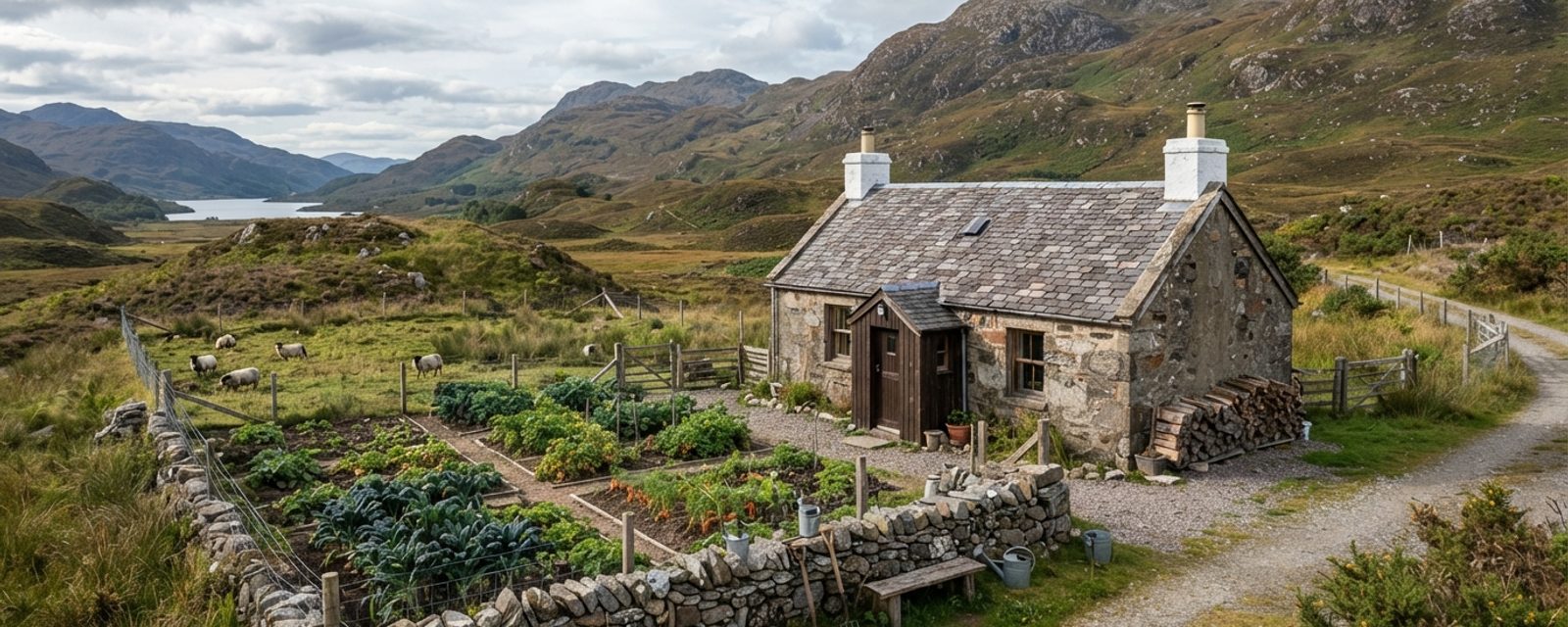
A croft isn't just a smallholding with a nicer name. It's a specific legal tenure, created by statute, that comes with rights an allotment holder doesn't have, and duties that don't apply to one either. Get the cultivation part wrong for long enough on a croft, and a regulator can legally start a formal process that ends with the croft being taken away from you and handed to someone else, something no allotment tenancy in Scotland works like.
Quick answer
A croft is a small agricultural holding, most under 5 hectares, held under statutory protection created by the Crofters Holdings (Scotland) Act 1886 and consolidated in the Crofters (Scotland) Act 1993, confined to the traditional crofting counties (plus areas added since 2010). Crofters must live on or within 32km of the croft, keep it cultivated or in "purposeful use," and not misuse or neglect it; breach that and the Crofting Commission can formally investigate, and ultimately force the croft to be let to someone else. Common grazings are shared, regulated ground a crofter usually holds a right in alongside the croft itself, and a share of that grazing can be converted to individual use through apportionment. None of this, the duties, the Commission, the common grazings, the geographic limit, applies to an allotment.
What a croft actually is, legally
The Crofters (Scotland) Act 1993, section 3, sets out what counts as a croft: broadly, agricultural land let for the purpose of crofting, or land recorded as such, within the crofting counties or the areas added to them since 2010. It typically comes as two parts: the in-bye land, the fenced, cultivable ground attached to the croft itself and worked directly by the crofter (as opposed to the shared hill ground below), and, usually, a right to graze stock on a common grazing shared with other crofters in the same township, covered separately below.
There are roughly 21,000 crofts in Scotland, 72% let to tenant crofters and 28% owned outright by owner-occupier crofters, covering more than 750,000 hectares between them and supporting around 30,000 people in crofting households. An average croft is about 5 hectares, though the range runs from much smaller up to 50 hectares or more. Crofts sit almost entirely in the traditional crofting counties, Argyll, Caithness, Inverness, Ross and Cromarty, Sutherland, Orkney and Shetland, though since February 2010 Scottish Ministers have designated parts of Highland, Moray, Argyll and Bute, and North Ayrshire as areas where new crofts can be created too, extending the system slightly beyond its historic boundary.
A crofter can hold the croft two ways: as a tenant crofter, renting from a landlord under statutory protection that goes well beyond an ordinary agricultural tenancy (security of tenure, a fair-rent mechanism, the right to assign or bequeath the tenancy), or as an owner-occupier crofter, who owns the croft outright. The Crofting Reform (Scotland) Act 2010 extended most of the same statutory duties to owner-occupiers that already applied to tenants, closing what had been a real gap, an owner-occupier crofter used to face far less regulatory obligation than a tenant on an identical piece of ground next door.
The legal framework: two Acts, not one
Two pieces of legislation do almost all of the current legal work, and crofting law has been amended repeatedly since 1886, so neither Act on its own is the whole picture.
The Crofters (Scotland) Act 1993 is the core consolidating statute, it restates and updates the crofting-tenure framework built up since the Crofters Holdings (Scotland) Act 1886 (the original Act that created crofting tenure after the Napier Commission's inquiry into Highland land grievances) and the intervening 20th-century Crofters Acts. It defines what a croft and a crofter are, sets out the statutory conditions of tenure (Schedule 2), governs common grazings, and, as amended, sets out crofters' core duties.
The Crofting Reform (Scotland) Act 2010 modernised the system on top of that base, rather than replacing it. It did four distinct things relevant here: it separated the Crofting Commission's regulatory functions from crofting development and promotion (the latter moved to Highlands and Islands Enterprise), and rebuilt the Commission's board so most members are elected by crofters rather than Ministerial appointees; it created the Crofting Register, a modern, map-based public register of crofts and common grazings run by the Keeper of the Registers of Scotland, replacing reliance on the older, non-mapped Register of Crofts; it extended statutory duties, including the duty not to misuse or neglect the croft, to owner-occupier crofters for the first time (sections 19A to 19C of the 1993 Act, as inserted by the 2010 Act); and it built the enforcement machinery the Commission now uses to act on a breach (sections 26A to 26K of the 1993 Act).
Two further Acts sit alongside these: the Crofting Reform etc. Act 2007 and the Crofting (Amendment) (Scotland) Act 2013, both making narrower changes, and, as covered below, a fifth, the Crofting and Scottish Land Court Act 2026, is now working its way into force.
A crofter's duties
Every crofter, tenant or owner-occupier, carries the same three statutory duties, set out for tenants at section 5AA and 5C of the 1993 Act, and extended to owner-occupiers at section 19C:
- A duty to be ordinarily resident on, or within 32 kilometres of, the croft.
- A duty to cultivate and maintain the croft, or put it to another purposeful use.
- A duty not to misuse or neglect the croft.
These aren't loosely worded expectations, the Act defines each one with real precision.
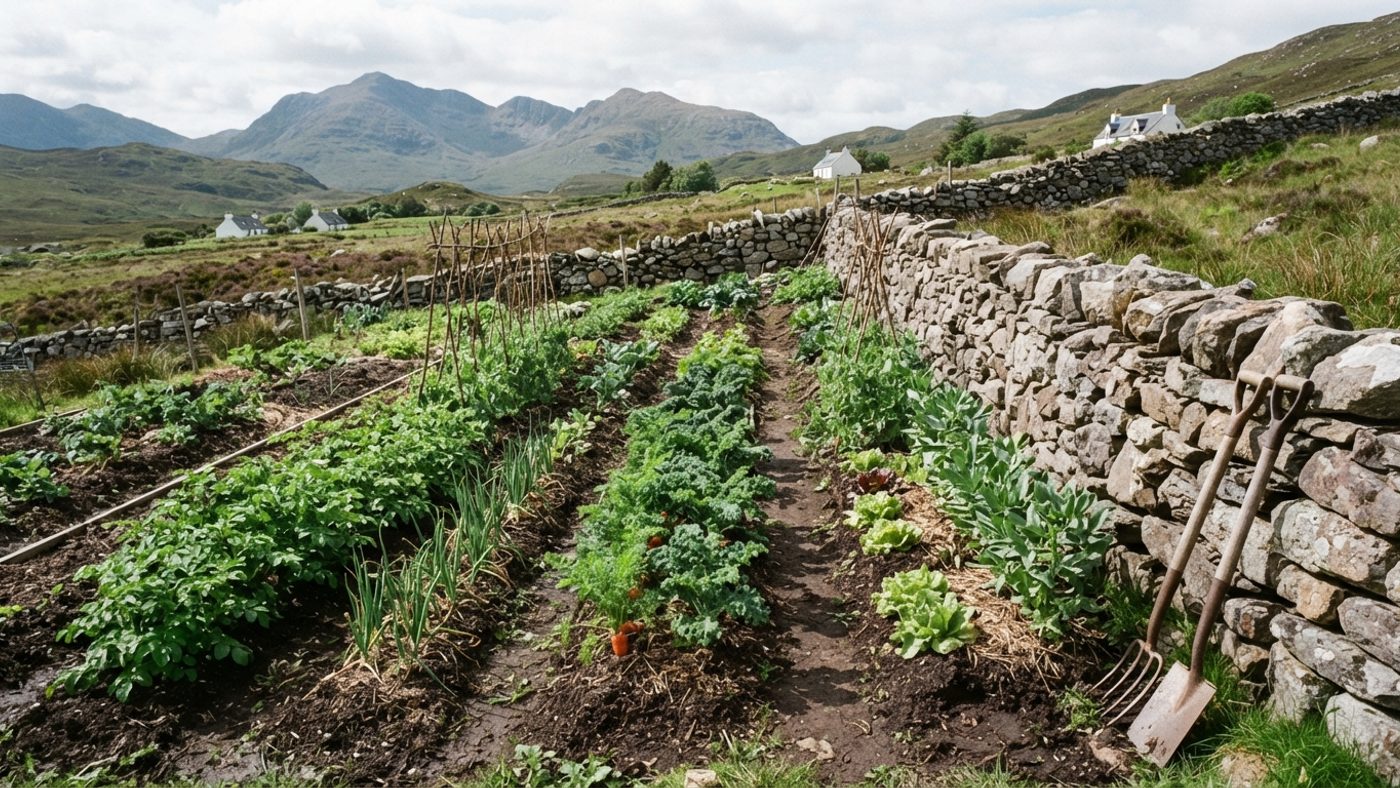
"Cultivate" is defined broadly, at section 5C(8): it includes horticulture, keeping or breeding livestock, poultry or bees, growing fruit and vegetables, planting trees, and using the land as woodland. An edible-growing crofter, someone running the croft as a market garden or smallholding rather than sheep or cattle ground, is squarely within this definition; crofting law was never written with only livestock in mind.
"Purposeful use" is the alternative to cultivation, and it's defined too, at the same section: "any planned and managed use which does not adversely affect the croft, the public interest, the interest of the landlord or (if different) the owner, or the use of adjacent land." The Crofting Commission's own guidance gives examples: a campsite, a golf course, an equestrian centre, provided the use is planned and doesn't prevent the croft returning to cultivation later. Letting land run wild with no plan behind it doesn't qualify.
"Misuse" and "neglect" are two distinct legal tests, not one vague standard, and the difference matters for anyone trying to understand where the line actually sits. Under section 19C(3) (worded identically in substance for tenant crofters), a crofter misuses the croft where they wilfully and knowingly use it for something other than cultivation or purposeful use, fail to cultivate it, or fail to put it to any purposeful use. Neglect, defined separately at section 19C(4), is a specific, external agricultural standard: the croft is not managed to meet the "good agricultural and environmental condition" (GAEC) standards, defined in the Common Agricultural Policy Schemes (Cross-Compliance) (Scotland) Regulations 2004. That instrument predates the UK's departure from the EU, but GAEC cross-compliance remains part of Scotland's current, transitional agricultural support framework as the post-CAP replacement schemes are phased in gradually, so it's still the operative reference for this test, not a piece of stale pre-Brexit law. In practice, that's a technical land-condition benchmark, not a subjective judgement call by the Commission.
One deliberate carve-out is worth knowing: section 19C(6) states that where a crofter, in a planned and managed way, engages in or refrains from an activity specifically to conserve the natural beauty, flora or fauna of the croft's locality, that isn't treated as misuse or neglect. Genuine, managed conservation work is a recognised purposeful use in its own right, not a breach waiting to be reported.
What happens if a crofter doesn't comply
The process the Commission follows (set out at sections 26A to 26K of the 1993 Act, and its own published policy and procedure) runs in defined stages, each with a statutory or policy timescale:
| Stage | What happens | Timescale |
|---|---|---|
| Report or information received | A grazings committee, grazings constable, assessor, or member of the crofting community reports suspected non-compliance; the Commission can also act on its own annual notice returns or inspections | — |
| Investigation | The Commission investigates, likely including a croft inspection; frivolous or vexatious reports are not investigated | — |
| Notice of suspected breach | If the Commission considers the duty isn't being met, it must give the crofter written notice explaining why | — |
| Representation period | The crofter can make written representations, or ask to be heard in person | 28 days from the notice |
| Commission's decision | The Commission decides whether the duty is being complied with, and notifies the crofter in writing | Within 14 days of the representation period ending |
| Appeal | The crofter can appeal a "not complying" finding to the Scottish Land Court | — |
| Undertaking opportunity | If non-compliance is found, the Commission must offer the crofter the chance to undertake, in writing, to fix it; complying ends the matter | Offered within 28 days of the notice; Commission decides within 28 days of it being offered |
| Direction to submit letting proposals | If no undertaking is given or complied with, the Commission can direct the crofter to propose new tenants (up to three proposals) | 28 days to submit; Commission decides within 8 weeks |
| Commission lets the croft | If no acceptable proposal is submitted, the Commission takes over the letting process, advertising the tenancy publicly | — |
Two things worth being direct about. First, the whole process is built around opportunities to fix the problem before losing anything, an undertaking that's actually complied with genuinely ends the matter, and every major Commission decision along the way (the breach finding itself, refusal to accept an undertaking, a direction to submit letting proposals, a decision to divide the croft) carries a right of appeal to the Scottish Land Court, usually within 42 days. This isn't a process that can end a tenancy overnight or on a single inspector's say-so. Second, it's a genuinely real process, not a theoretical power. The Crofting Commission's own 2022 policy plan states plainly that it recognises "much croft land and/or common grazing land is currently neglected because some crofters are failing to comply with their crofting duties," and that while its approach since 2014 has focused on encouraging voluntary compliance, it has invested further in a dedicated crofting duties enforcement team and intends to keep doing so.
Reporting works both ways, too: it isn't only the Commission acting on its own initiative. Grazings committees are formally obliged to report suspected non-compliance among crofters sharing their grazing, and any member of the crofting community can raise a concern directly with the Commission.
In practice, what triggers this process is rarely a single bad season, it's land visibly reverting to rushes, scrub or bracken over several years with no cultivation, stock, or stated plan behind it, spotted by a neighbour, a grazings committee, or an inspection. One thing worth being clear on: the process above concerns the croft land, not automatically the crofter's home. Many crofters separately buy the site of the croft house under the right-to-buy provisions covered below, specifically so the house sits outside whatever happens to the wider tenancy. Anyone facing this process whose house sits on unbought croft ground should get specific legal advice on their own situation, since the general duty-enforcement provisions above don't spell that out on their own.
Other core rights and processes a crofter deals with
The duties above sit alongside several other statutory rights and procedures that come up constantly in practice, each with its own name and its own process, worth knowing even in outline:
- The individual right to buy. A tenant crofter can apply to the Scottish Land Court for an order authorising them to buy the croft land they tenant, under section 12 of the 1993 Act, and separately has an outright entitlement to buy the site of the croft house itself. If landlord and crofter can't agree a price, the Land Court sets the terms. This is one of the best-known features of crofting tenure, and it has no equivalent for an allotment tenant, who has no statutory right to buy the plot from the council.
- The community right to buy. A separate right, held by the crofting community rather than an individual, lets a registered crofting community body buy the croft land, common grazings or associated land in its area, including land the owner has no interest in selling, under Part 3 of the Land Reform (Scotland) Act 2003, a distinct crofting-specific regime from the general community right to buy and asset transfer routes that apply to non-crofted land. This is the mechanism behind well-known cases like community land buyouts in the Highlands and Islands, distinct from the individual section 12 right above.
- Subletting. With the Commission's consent, a tenant crofter can sublet the croft, or an owner-occupier crofter can grant a short-term let, rather than working it themselves, a route the duties leaflet itself names as one of the short-term options for a crofter who can't currently comply with their duties.
- Assignation and succession. A tenant crofter can assign the tenancy to someone of their choosing, subject to Commission consent, or bequeath it by will. Where a crofter dies without a will, the croft passes under intestate succession rules set out in the 1993 Act and the Succession (Scotland) Act 1964, and the executor must take the necessary steps within 24 months of the death or the tenancy can be treated as vacant.
- Decrofting. This is the process of formally removing land from crofting tenure altogether, so the Act stops applying to it, typically used to convert part of a croft (commonly the house site) for a non-agricultural purpose. The Commission decides under sections 24 and 25 of the 1993 Act, and it isn't a formality: the 2026 crofting reforms limit owner-occupier crofters to one decrofting direction for a dwelling-house site.
- Consent to be absent. Rather than breaching the residency duty outright, a crofter who needs to live away from the croft, temporarily or otherwise, can apply to the Commission for consent, under section 21B of the 1993 Act. The Commission decides within 28 days and can attach conditions, including a time limit.
- Fair rent. A tenant crofter's rent isn't simply whatever the landlord sets; either party can apply to have a fair rent fixed under the Act's rent-review provisions, a protection an allotment tenant, whose rent is set by the local authority's own charging policy, doesn't have in the same statutory form.
Common grazings
Many, though not all, crofts come with a right of pasturage in a common grazing, a shared area of hill or rough ground that a number of crofters in the same township graze stock on together, rather than each crofter fencing off and managing their own separate hill ground. It's governed by its own part of the 1993 Act (sections 47 to 51A), and by a grazings committee, elected by the shareholders (or, on smaller grazings, a single grazings constable), which manages the grazing day to day under its own set of grazings regulations, typically built from a Crofting Commission template, covering things like stocking levels, drainage, fencing and use of any woodland on the ground.
More than 550,000 hectares of Scotland's total crofting land, over two-thirds of it, is common grazing rather than in-bye croft land, which makes it a genuinely large share of what "crofting land" actually means in practice, not a marginal add-on to the croft itself. A crofter's grazing right is usually expressed as a souming, a defined entitlement to graze a set number of livestock (sheep, cattle, or an equivalent) on the shared ground, rather than an unlimited right to put as many animals out as they like.
Apportionment: converting a share of common grazing to individual use
Apportionment is the specific legal mechanism for taking a defined part of a common grazing out of shared use and putting it under one crofter's exclusive control, still within crofting tenure, but no longer shared with the rest of the township. It's set out at section 52 of the 1993 Act, most often used for stock management, an agricultural building, a house site, or planting trees as woodland.
Any shareholder in the common grazing can apply, but the process is genuinely collaborative before it's regulatory: an applicant must first discuss the proposed location and extent with the grazings committee (or constable) to try to reach agreement, before the Crofting Commission gets formally involved.
The Crofting Commission uses a published set of parameters to decide how quickly an application can be approved. An application is eligible for the fast route where all of the following hold: the applicant lives on the croft or within 32km, the applicant already keeps stock (for a stock-management apportionment), the proposed use is an existing or proposed agricultural building, a dwelling-house site under 0.4 hectares, or tree-planting as woodland, nobody on the grazings committee or among the shareholders or owners objects, and the apportioned area doesn't cut off access to the rest of the common grazing or to other croft land unless a suitable alternative route already exists. An application that meets every one of these criteria, with no objection, moves faster; one that doesn't still goes through the full process, just with more scrutiny.
The full process runs through several stages: the application itself (with a detailed site map meeting the Commission's mapping requirements), public advertisement in a local newspaper with a 28-day objection period, a report from the Scottish Government's Rural Payments divisionPropagating a clump-forming perennial by digging it up and splitting it into several smaller pieces, each with roots and shoots attached. Full definition → (which the Commission's own guidance notes can take several months), and the Commission's decision. Once approved, the crofter has a firm two-year window to fence the apportioned ground, and must confirm the apportionment has taken effect, and register it, within three months, both fixed, non-extendable deadlines under the Commission's guidance. Registering a first apportionment, or a later change, costs a Registers of Scotland fee of £90 per application.
Apportionment isn't a free gain. Taking a share of common grazing into individual, exclusive use reduces the crofter's souming, their entitlement to graze stock, on what remains of the shared grazing; it's a genuine trade-off between shared and individual use, not simply extra land on top of the existing right. A refused application can be appealed to the Scottish Land Court within 42 days, the same route that applies to a breach-of-duty finding.
The Crofting Commission's role
The Crofting Commission is the dedicated regulator for the crofting system, distinct from a local authority (which regulates allotments), from Registers of Scotland (which runs the separate Crofting Register created by the 2010 Act), and from bodies covering land policy more broadly across Scotland rather than crofting tenure specifically. Its statutory job, in short, is regulating and promoting the interests of crofting, which in practice covers approving or refusing applications (assignation, subletting, apportionment, decrofting, consent to be absent), maintaining crofting records, and running the duty-enforcement process described above. One of its routine tools is the annual notice, a return the Commission issues to crofters each year to check who's living where and how the croft is being used; a crofter who doesn't return it, or whose return raises a flag, is one of the ways the Commission's own guidance says it becomes aware of a possible duty breach in the first place, separate from a report coming in from a grazings committee or neighbour.
The Commission's structure itself changed under the 2010 Act: it replaced the former Crofters Commission, moved crofting development and promotion work to Highlands and Islands Enterprise, and rebuilt its board so that most members are crofters elected by other crofters rather than Ministerial appointees, a deliberate shift toward self-regulation by the crofting community itself, echoed in the Commission's own stated policy of "encouraging crofters to understand their responsibilities and to self-regulate" before enforcement action becomes necessary.
For plain-language advice and representation outside the Commission itself, the Scottish Crofting Federation is the main member-run body for crofters, and a practical first stop for anyone new to crofting or unsure how a specific rule applies to their own croft.
A significant reform is underway right now
Everything above describes the law as it currently stands, the 1993 Act as amended by the 2010 Act, but crofting law is genuinely in the middle of change as this is being written. The Scottish Parliament passed the Crofting and Scottish Land Court Act 2026, which received Royal Assent on 18 May 2026, following a 2024 Scottish Government consultation on crofting reform. It's a substantial Act, reworking the duty-enforcement process, apportionment, decrofting, common grazings management, assignation to family members, and registration requirements, among other things, and it also merges the Scottish Land Court with the Lands Tribunal for Scotland.
Crucially, most of the Act's substantive provisions are not yet in force: Royal Assent starts the clock, but the detailed reforms require separate commencement regulations before they take legal effect, and at the time of writing no full commencement date has been confirmed. One indicator of the pace to expect: the Act itself requires the Commission to publish certain guidance (on residency-absence approvals, and on its own decision-making timescales) within two years of Royal Assent, suggesting a staged rollout rather than everything switching over at once. Until the relevant regulations are made, the duties, enforcement pipeline, apportionment process and decrofting rules described in this piece remain the current, operative law. Anyone acting on a crofting matter close to the edge of one of these provisions, particularly enforcement, apportionment or decrofting, should check the current commencement status directly against the Act's own text on legislation.gov.uk or the Crofting Commission's own updates, rather than assume either the old or the new rules automatically apply.
How this differs from an allotment
Crofting and allotments are separate legal traditions. Crofting grew out of 19th-century Highland land reform; allotments, by contrast, trace back to the 1892 Act's urban roots, giving town-dwelling working people a plot near home, a genuinely different starting problem the history of allotments in Scotland covers in full. Here's the practical legal difference today, for anyone weighing up the two or simply wanting to know which set of rules governs a piece of ground:
| Croft | Allotment | |
|---|---|---|
| Legal basis | Crofters (Scotland) Act 1993, Crofting Reform (Scotland) Act 2010, and predecessor Acts | Community Empowerment (Scotland) Act 2015, Part 9 |
| Regulator | Crofting Commission | Local authority |
| Geography | Crofting counties and designated extension areas only | Anywhere in Scotland |
| Duty to cultivate | Statutory, enforceable; sustained failure can end with the Commission forcingCovering plants to exclude light and speed early, tender growth in the dark, most associated with rhubarb and sea kale in late winter. Full definition → a new tenancy on someone else | No statutory duty to cultivate; a council tenancy agreement can set conditions, but no national legal cultivation duty exists |
| Security of tenure | Strong statutory protection; assignation and succession rights | A local authority lease, terms set by the council; no equivalent national statutory security |
| Common grazing rights | Often included, shared, regulated ground | Not applicable |
| Typical size | Around 5 hectares on average | Commonly around 250 square metres (0.025 hectares), varies by site |
| Waiting list | No national waiting-list mechanism | Statutory waiting list under the 2015 Act, with a duty to try to keep the wait under 5 years |
In practice, an allotment holder who lets a plot go to weeds for a season faces whatever their individual council's tenancy agreement says, which varies site to site; a crofter faces the same national statutory process wherever in the crofting counties they are. See community gardens vs allotments for how allotment tenancy and community growing compare more broadly.
Common questions
What actually counts as a croft, legally?
Land defined under section 3 of the Crofters (Scotland) Act 1993, broadly, agricultural land let (or held by an owner-occupier) for crofting purposes, within the traditional crofting counties or the areas added since 2010. It usually comes with in-bye land plus, often, a share in a common grazing.
Can I lose my croft for not growing anything on it?
Not immediately, and not without a defined legal process, but yes, eventually. The Crofting Commission has to investigate, give written notice, and offer a real chance to fix things before it can move toward directing that the croft be let to someone else.
Is growing vegetables enough to satisfy the cultivation duty, or do I need livestock?
Growing vegetables is enough. The statutory definition of "cultivate" in section 5C(8) of the 1993 Act explicitly includes horticulture and growing fruit and vegetables alongside livestock-keeping, cropping and tree-planting, crofting law does not require stock.
What's the difference between misuse and neglect?
Misuse is about wilfully and knowingly using the croft for something other than cultivation or purposeful use, or simply failing to use it that way at all. Neglect is a specific, external agricultural-condition test: whether the croft meets the "good agricultural and environmental condition" (GAEC) standard set in separate cross-compliance regulations. They are two distinct legal tests under section 19C, not one general standard.
Does apportioning part of a common grazing cost me my share of the rest of it?
Not entirely, but it reduces it. Taking a defined area of common grazing into your own exclusive use lowers your souming, your grazing entitlement, on the remaining shared ground, it is not simply extra land added on top of an unchanged existing right.
Is crofting law about to change?
Yes, in significant ways, but not yet in effect. The Crofting and Scottish Land Court Act 2026 received Royal Assent on 18 May 2026 and will rework the enforcement process, apportionment, decrofting and other areas. Its substantive provisions require separate commencement regulations before they take legal effect, and none had been fully confirmed at the time of writing, so the rules described here are the current, operative law for now.
Sources
14 sources, recorded with what each was used for
- Crofters (Scotland) Act 1993 (as amended, current version): Statutory definitions of croft/crofter (s.3), crofters' duties (ss.5AA, 5C), owner-occupier duties (s.19C), enforcement process (ss.26A–26K), common grazings (ss.47–51A), apportionment (s.52)
- Crofters (Scotland) Act 1993, Section 52: Apportionment mechanism, the Commission's role, conditions and review provisions
- Crofting Reform (Scotland) Act 2010, Explanatory Notes: What the 2010 Act changed: the Crofting Register, owner-occupier duties, Commission restructuring, enforcement provisions
- Crofting Commission: Duties of a Crofter: Plain-language statement of the three statutory duties, definition of "cultivate," self-regulation policy framing
- Crofting Commission: Owner-Occupier Crofter — Duty not to misuse or neglect croft: The full misuse/neglect enforcement process, timescales, appeal rights, and the Commission's 2022 policy statement on neglected croft land
- Crofting Commission: Apportionment: Apportionment definition, quick-approval parameters, process stages, post-approval deadlines, effect on souming, registration fee
- Crofting Commission: What is Crofting?: Number of crofts, tenure split, total hectarage, average croft size, crofting-household population
- gov.scot: Crofting policy page: The legislative framework and current croft/population figures
- Community Empowerment (Scotland) Act 2015, Part 9: The allotment comparison table (legal basis, waiting-list duty)
- Crofters (Scotland) Act 1993, Section 12: The tenant crofter's right to buy croft land
- Crofters (Scotland) Act 1993, Section 21B: Consent to be absent from the croft, application process and timescale
- Crofting and Scottish Land Court Act 2026, Explanatory Notes: The substantive reforms the 2026 Act makes to enforcement, apportionment, decrofting and common grazings
- Crofting and Scottish Land Court Act 2026: Royal Assent date, and confirmation that substantive provisions require commencement regulations
- Land Reform (Scotland) Act 2003, Part 3: The crofting community right to buy, distinct from the individual right to buy