
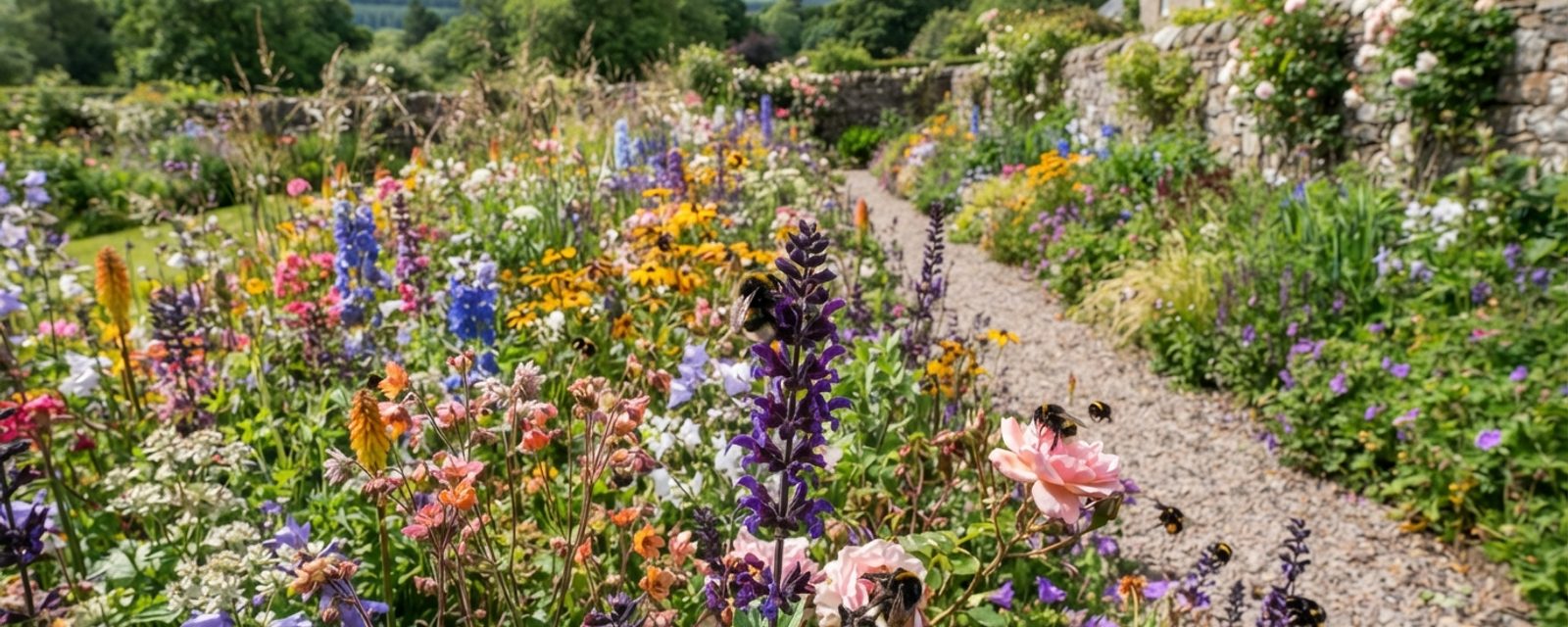
Picture a fairly typical suburban garden in central Scotland in July. The lawn is freshly mown in neat stripes. The borders are weeded down to bare soil between the shrubs. There isn't a dandelion in sight. By most measures this is a garden that's being looked after well.
Stand in it for five minutes and you'll notice something else: almost nothing is moving. No bumblebees working a border, no hoverflies hanging in the air, no butterflies drifting past. A tidy garden and a pollinator-friendly garden are often two different things, and in a lot of Scottish gardens they're actively pulling against each other. Mown grass has no flowers in it. Weeded soil has no forage in it. A garden without a single "messy" corner has nowhere for anything to nest, shelter, or overwinterKeeping a plant alive and intact through the cold months, whether left outdoors, moved under cover, or stored dormant. Full definition →. The tidiness that looks like good gardening is, from an insect's point of view, a garden with the lights off.
This matters more in Scotland specifically than the general "help the bees" messaging suggests. NatureScot runs the Pollinator Strategy for Scotland 2017-2027, and its implementation plan is explicit that this isn't just a job for farmers and land managers, it names "gardeners (even window-box gardeners)" as part of the people the strategy is asking to act, alongside schoolchildren, universities, health boards, local authorities and beekeepers. One of the strategy's own objectives is management of "flower-rich gardens and amenity areas to help sustain pollinators in urban settings." A garden with a lawn, a balcony with a window box, a shared bit of ground behind a tenement, NatureScot counts all of it as habitat, not just a nice-to-have.
What follows covers what a pollinator-friendly garden needs across the whole year, and what it actually means to rewild a section of your own garden on purpose.
What a pollinator-friendly garden actually needs
There's no single fix. A garden that supports pollinators well is doing four things at once, all year round, not just for a few weeks in June.
Flowers from March to October, not just a summer peak
The single biggest gap in most gardens isn't a lack of flowers, it's a lack of flowers outside midsummer. NatureScot's own guidance is direct about this: "the key time for your garden to be in bloom is between March and October." A garden that flowers hard in June and July and then goes quiet is only feeding pollinators for part of the season, queens, workers and late-emerging solitary bees are active well outside that window.
The RHS's research into pollinator plants backs this up from the plant-selection side: "the more flowers your garden can offer throughout the year, the greater the number of bees, hoverflies and other pollinating insects it will attract and support." Their advice is to aim for something flowering in every month, rather than planting a single big flush and calling it done.
A rough seasonal spread that covers the full window looks like this, in a slower-to-warm Scottish spring, the early end of it can run later than the dates suggest, particularly further north or at altitude:
| Season | What's flowering | Why it matters |
|---|---|---|
| Early spring (Mar-Apr) | Crocus, willow catkins, flowering currant, pulmonaria | Feeds queen bumblebees just out of hibernation, when almost nothing else is in flower |
| Late spring (May-Jun) | Comfrey, aquilegia, geranium, hawthorn | Bridges the gap before summer perennials take over |
| Summer (Jun-Aug) | Lavender, chives, scabious, knapweed, single-flowered dahlias | The season most gardens already cover well |
| Late summer/autumn (Aug-Oct) | Sedum, Michaelmas daisy, ivy, fuchsia, hebe | Critical for late broods and insects building reserves before winter |
Ivy deserves a specific mention here because it's so often pulled out as a "weed": it flowers in September and October when almost nothing else does, and it's one of the last significant nectar sources before winter.
A mix of native and non-native plants, not native-only
There's a common assumption that a proper wildlife garden has to be all-native. The RHS's own research into this doesn't support that as the best strategy. Their finding is that the best strategy for gardeners wanting to support pollinating insects is to plant a mix of flowering plants from different parts of the world, with a lean toward more plants native to Britain and the northern hemisphere than the southern hemisphere. Non-native "exotics" aren't filler, they can extend the season, especially late-summer flowering, which is exactly the gap most gardens have. A lavender bed and a bed of native knapweed aren't in competition; they're doing different jobs at different times of year.
No pesticides, or as close to none as you can manage
This one is close to a hard line across every source that covers it. Buglife's position is blunt: pesticides and insecticides are harmful to all invertebrates and the wider environment, with the potential to harm humans too, and its advice is to build habitat for natural pest control, ladybirds, ground beetles, solitary wasps, instead of reaching for a spray. The RHS takes a similar line, describing synthetic pesticides as not only toxic to more than the target organism but also energy-intensive to produce, and recommends using them as a last resort wherever possible, if at all. A single spray on a greenfly problem doesn't distinguish between the aphid and the hoverfly larvae that would otherwise have eaten it.
Loss of flower-rich habitat and nesting sites is the main driver behind pollinator decline generally, worsened by climate change shifting where species can live and by insecticides reaching nectar and pollen through treated plants. Generalist species able to use a wide range of plants are holding their numbers better than specialists, and it's the specialists with the least room to spare, such as the great yellow bumblebee, now largely confined to machair, the low-lying, flower-rich coastal grassland found on Orkney, the Western Isles, and Caithness and Sutherland, that have the least buffer against added pressure. A garden spray doesn't reach a machair meadow, but the same principle scales down: the more forgiving a generalist species is of pressure, the more a specialist depends on every garden nearby getting the basics right.
None of this is an argument for tolerating every pest problem in silence. Slugs are the complaint most Scottish gardeners actually have, not aphids, and giving up pesticides doesn't mean giving up on hostas: non-chemical slug control, barriers, beer traps, encouraging slug-eating birds and ground beetles, and biological nematode treatments all work without the same pollinator cost a blanket spray carries.
Deliberately undisturbed, "messy" corners
Flowers feed adult pollinators, but adults need somewhere to shelter, and most species need somewhere to complete their life cycle that isn't a flower at all.
- Dead stems and seedheads left standing over winter. Leave perennials uncut over winter: hollow stems shelter hibernating insects, and the seedheads themselves feed birds through the coldest months. Cutting borders back hard in October removes both the food and the shelter in one pass.
- Leaf litter left where it falls, at least in borders and under shrubs, rather than bagged and binned. Fallen leaves feed the worms and other decomposers that build healthy soil, leaf litter is a soil-building process, not just mess.
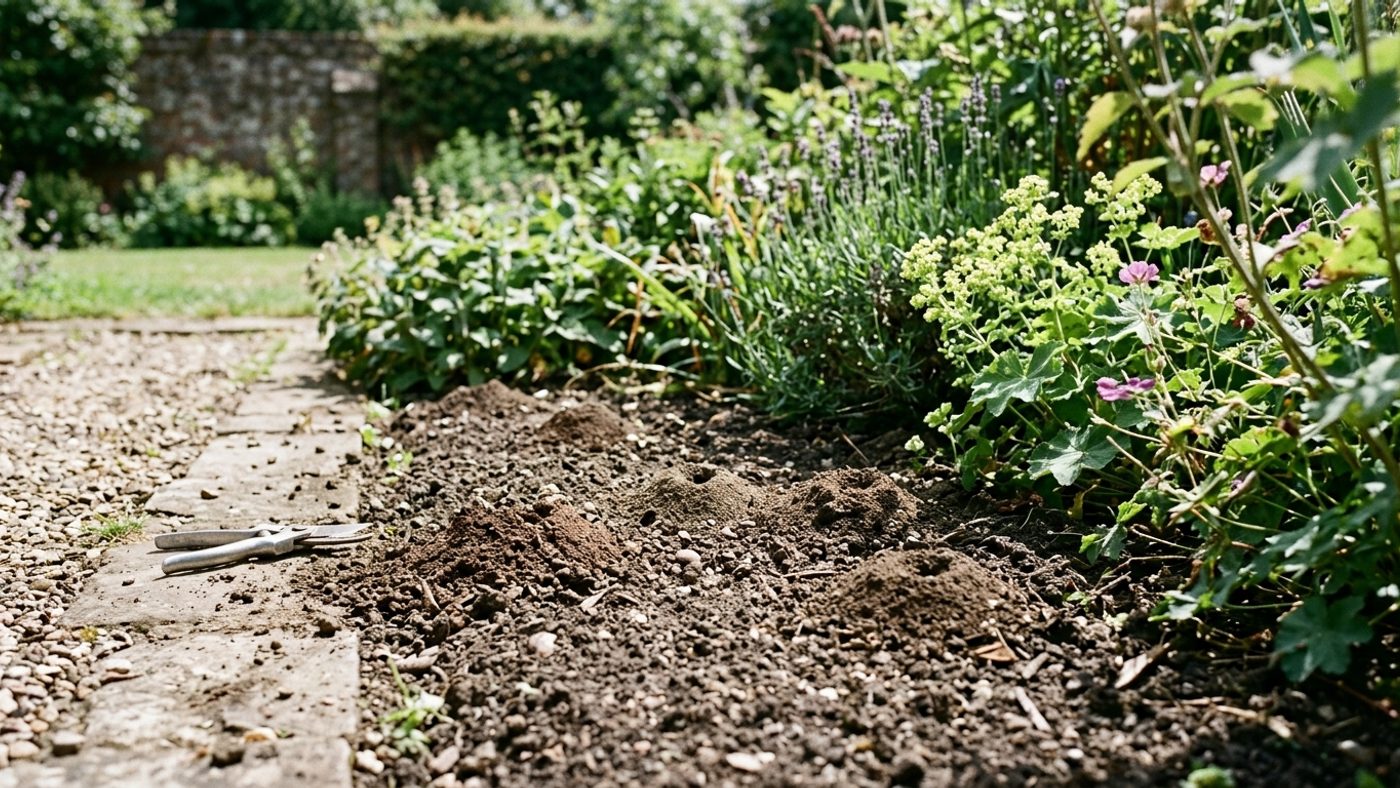
- Bare soil patches. A number of Scotland's solitary bee species, including mining bees, nest in the ground rather than in cavities, and need open, undisturbed soil to dig into, not thick mulchA layer of material spread over the soil around plants to suppress weeds, retain moisture, and improve soil structure as it breaks down. Full definition →, not a lawn, not weed-suppressant membrane. A sunny, unmulched patch of bare earth left alone is genuine nesting habitat, not neglect, and the small volcano-shaped spoil heaps a mining bee leaves behind in a lawn each spring, easily mistaken for lawn damage, are worth learning to recognise rather than treating as a problem to fix.
- Deadwood, even a small stacked pile of logs in a shady corner. Decaying wood is an increasingly rare habitat for a range of specialist wildlife, and nearly two thousand invertebrates across Britain depend on deadwood in some form, beetles that spend years developing inside rotting timber among them, a garden log pile is a small-scale version of the same habitat, not a facsimile of it. A pile built from a native species such as birch or rowan, both common in Scottish gardens and hedgerows already, needs nothing bought in.
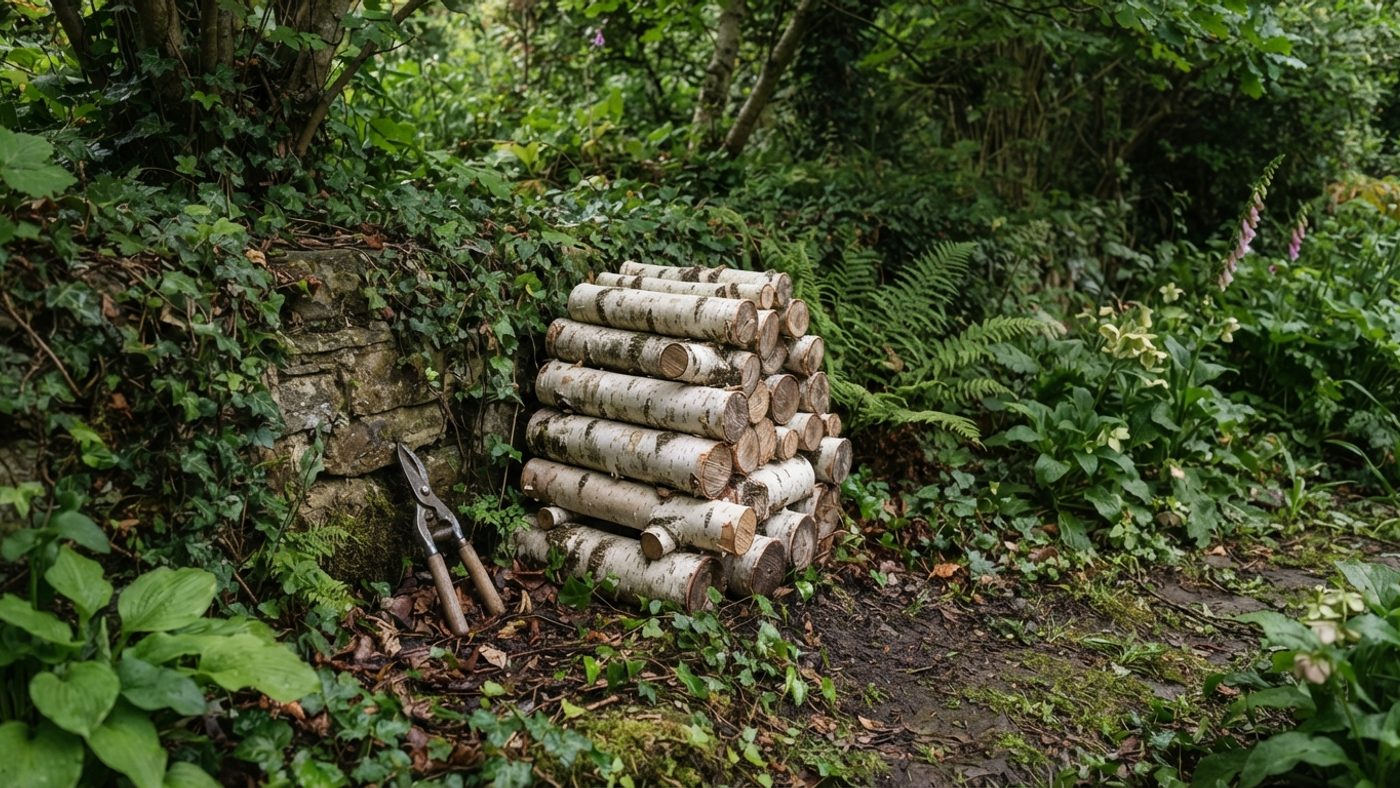
None of this needs to look wild across the whole garden, and none of it is a substitute for actual regional variety: a bare patch in a sheltered, sunny corner of a Highland garden and the same patch on an exposed coastal plot won't support quite the same range of species, but the principle holds everywhere in Scotland. A single log pile, one border left uncut till spring, and one bare patch under a hedge covers most of what's needed, even in an otherwise conventional garden.
Rewilding a section: a deliberate choice, not neglect
"Rewilding a section" of a garden means picking a defined area, a strip of lawn, the back third of a border, a corner behind the shed, and deliberately managing it less: mowing it less often, weeding it less aggressively, letting whatever wants to grow there grow. The word that matters is deliberately. This is an active decision about a bounded space, with everything outside that boundary maintained as normal.
That distinction is worth spelling out because, from the pavement, a deliberately rewilded corner and a genuinely neglected garden can look identical for the first few weeks. The difference isn't visible from a photograph; it's in the intent and the management behind it:
- A rewilded patch has a defined edge, a mown strip around it, a path, a border, something that signals "this boundary is intentional." An unmanaged garden has no edge at all; the mess simply spreads until something stops it.
- A rewilded patch is still managed on a cycle, just a much longer one, an annual cut in late summer or autumn once seeds have set, rather than a weekly mow. Total neglect has no cycle; nothing is ever cut.
- A rewilded patch is usually chosen for a reason, the shadiest, driest, or least-used part of the lawn, somewhere a mower struggles anyway. Neglect isn't chosen; it's just wherever attention ran out.
NatureScot's own pollinator pledge, the list of actions the strategy asks individuals to consider, includes leaving areas of grass unmown, or reducing the number of cuts, as one of its headline suggestions, alongside growing pollinator-friendly plants and creating shelter. That's the whole mechanism behind a rewilded lawn section: fewer cuts lets whatever low-growing flowering plants are already present in most lawns, clover and self-heal are common examples, actually flower instead of being shaved off every week, rather than requiring anything new to be sown. Letting grass grow long over summer also feeds the caterpillars of grass-feeding butterflies such as meadow brown, ringlet and small heath (all three widespread in lowland and central Scotland, less so further north or on exposed sites).
A practical way to start small: leave one strip or corner of lawn uncut from spring until whatever's flowered in it has finished setting seed, generally by late summer in the central belt and a little later in a cooler or more northerly garden, then give it a single cut and remove the cuttings. Taking the cut grass away, rather than leaving it to rot down, keeps soil fertility low, which favours flowering plants over coarse grass in future years. That single low-fertility rule is most of what separates a section that gets more flowery every year from one that just turns into rough grass.
A rewilded lawn strip is the light version of this idea: relying on whatever's already present in the turf rather than sowing anything new. Sowing a proper wildflower mix into a dedicated no-mow strip goes further, but needs its own site preparation and seed choice to establish well.
Where a pond or a bee hotel fit in
A wildlife pond and a bee hotel are two of the most effective single additions a garden can make, on top of everything above. A pond adds a whole habitat a border and a lawn can't provide on their own: a drinking and bathing source for insects and birds, breeding habitat for amphibians, and forage for dragonflies and damselflies, which hunt midges among other flying insects, part of what makes a well-stocked pond an asset rather than a liability on the midge front. A bee hotel provides nesting cavities for solitary bees specifically, the species that nest in hollow stems and drilled holes rather than the ground.
Pond design and which plants to grow around its edge, and bee-hotel construction and placement, are each covered in full in Building a Wildlife Pond and Building a Bee Hotel.
If you're only doing one thing this year beyond the plant and mowing changes above, a pond has the broadest payoff, since it supports more species groups than a bee hotel does on its own. A shallow dish of water with a few pebbles or stones sticking up above the surface, refreshed regularly, does a smaller version of the same job in the meantime: it gives bees and other insects somewhere to drink and land without drowning, no digging required. But neither a pond nor a bee hotel replaces the basics: continuous flowering, no pesticides, and at least one messy corner will do more for pollinators overall than either build alone.
Related reading on this site
- The wider hub for garden wildlife in Scotland: bats, red squirrels, dragonflies, and which common "weeds" are worth leaving.
- Bumblebees and Solitary Bees: identification, life cycle, and detailed plant and nesting-habitat advice for Scotland's bee species.
- Weeds Worth Leaving in a Scottish Garden: nettles, dandelions, clover and chickweed as forage, plus a genuinely surprising 40-year butterfly trend from NatureScot's monitoring data.
- Dragonflies and Damselflies: pond design, the no-fish rule, and which native plants to grow around the pond edge, in full depth.
- Slugs: non-chemical slug control that doesn't cost pollinators the way a blanket spray does.
- Gardening Around the Midge: managing midges directly, worth reading alongside any pond or long-grass plans.
Common questions
Will rewilding a section of my lawn attract rats or other pests?
Long grass on its own isn't a rat attractant, rats are drawn to accessible food (bins, bird feeders spilling seed, compost with cooked food in it), not vegetation height. A defined, edged patch of longer grass, cut annually, doesn't create the conditions rats need any more than an ornamental border does.
Is it too late in the year to start if I'm reading this outside spring?
No. Cutting back less this autumn, leaving stems and seedheads standing over winter rather than clearing the border, and holding off on a hard tidy-up until spring is itself a legitimate starting point, arguably the easiest one, since it's an action you take by not doing something.
Do I need a big garden for any of this to matter?
No. NatureScot's own strategy explicitly includes window-box gardeners as part of who it's asking to act, and a single well-chosen container with something in flower from spring through autumn is genuine habitat, particularly in a dense urban street where it may be one of very few flowering points nearby.
What's the single highest-impact change if I can only do one thing?
Stopping or sharply reducing pesticide use, followed closely by extending your flowering season into early spring and autumn rather than concentrating everything in summer. Both cost nothing extra and don't require any new build or planting scheme to get started.
Won't a messy corner just look neglected to my neighbours?
A visible edge does most of that work without any explanation needed. If it's still a live worry, a short, cheap wooden marker naming the patch, a "pollinator patch" or "bee bank," reads as intentional to anyone walking past far more clearly than tidiness alone ever would, and it's a genuinely common approach on allotments and shared plots specifically because a boundary can be read two ways without one.
Sources
9 sources, recorded with what each was used for
- NatureScot: Pollinator Strategy for Scotland 2017-2027 — Implementation Plan (Revised March 2021): The "gardeners (even window-box gardeners)" quote and the objective on managing flower-rich gardens in urban settings
- NatureScot: Helping Scotland's Pollinators: The strategy's objectives and general framing
- NatureScot: Pollinators, get busy, get involved!: The March-to-October flowering window and the pollinator pledge item on leaving grass unmown
- RHS: Native and non-native plants for pollinators: The finding that a mix of native and non-native plants outperforms native-only planting
- RHS: Ideas on attracting wildlife to your garden: Leaving perennials/seedheads uncut over winter, deadwood habitat, pesticide-as-last-resort advice, leaf litter
- RHS: Wildlife in gardens: Lawn-mowing reduction and its effect on butterfly caterpillars
- Buglife: Gardening for Bugs: The pesticide-harm point, deadwood invertebrate dependency, leaf-litter/long-grass framing
- Farm Advisory Service Scotland: The Great Yellow Bumblebee: The great yellow bumblebee's range, restricted to machair in Orkney, the Western Isles, and Caithness and Sutherland
- RHS: Why pollinators matter: Habitat loss, climate change and insecticides as the main drivers of pollinator decline