
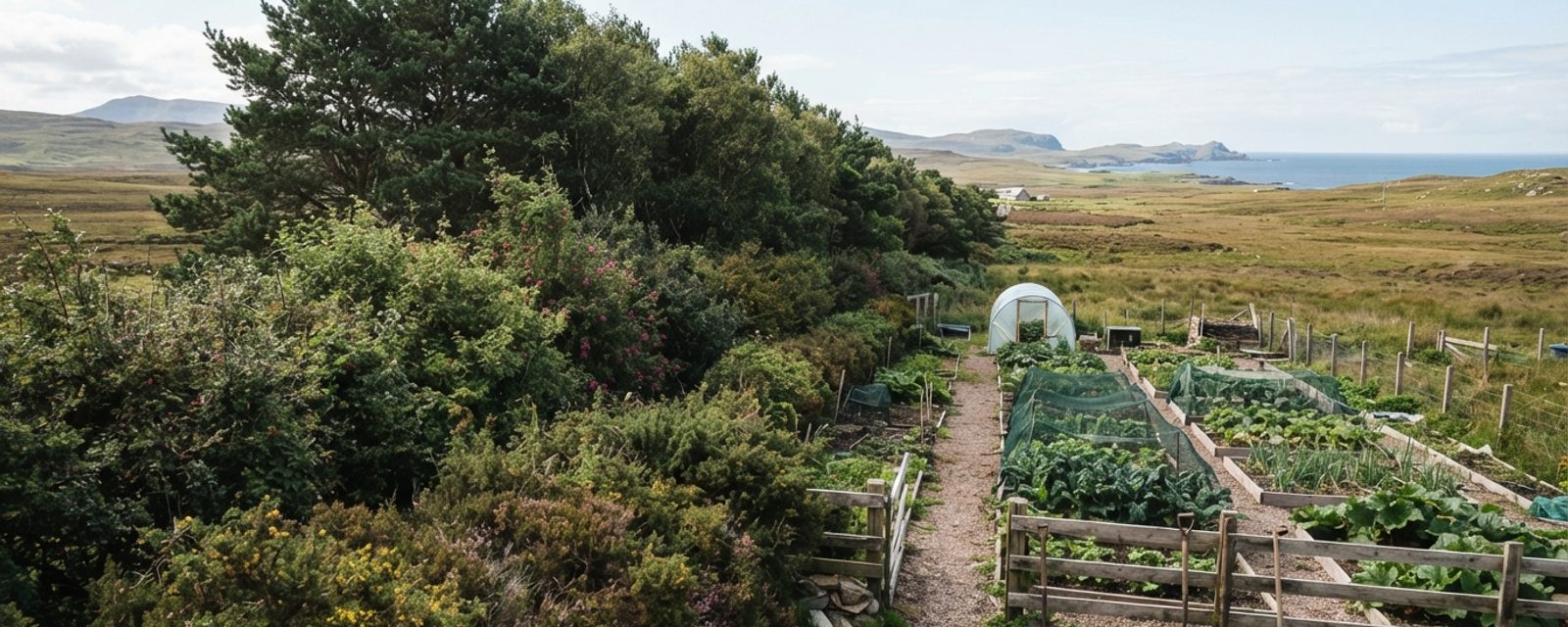
Wind doesn't just make a garden feel cold, it does mechanical work on every plant it touches. Moving air exerts drag in proportion to the square of its speed, so a rise from a breezy 15mph to a blustery 30mph doesn't double the force on a shrub's canopy, it roughly quadruples it. On a single garden hedge that force is a nuisance to be filtered at the boundary. Across a whole exposed plot, sustained wind is closer to a structural load: it strips moisture from leaves faster than roots can replace it (desiccation), it drives fine salt spray deep inland on coastal and island sites, it rocks root plates loose in wet ground, and it does all of this for hour after hour, day after day, not just in the odd named storm.
That distinction, a chronic, sustained load rather than an occasional gust, is why a genuinely exposed coastal or island plot needs something different from a boundary hedge. A single-row hedge filters wind at one line and relies on the rest of the garden absorbing whatever gets through. A shelter belt is a deeper structure, typically three or more staggered rows, often including actual trees rather than shrubs alone, built to reduce wind energy progressively through its depth and protect an entire garden, croft, or plot behind it, not just the ground immediately downwind of the boundary.
If what you actually need is species advice for a single-row or double-row boundary hedge on a windy but not severely exposed site, see our companion piece, Hedge Planting: How to Choose the Right Species for a Scottish Garden. This article assumes you're planting at a bigger scale than that, for whole-plot shelter on genuinely severe coastal or island exposure. That same filtering-versus-solid-barrier physics governs a single hedge too; what changes at belt scale is depth, height, species range, and the area you're actually trying to protect.
Testing the theory: does wind really beat cold on exposed Scottish sites?
Here's what the Met Office's long-term climate averages actually show for two genuinely exposed island stations, set against an inland Scottish site known for cold rather than wind.
| Location | Annual mean wind speed at 10m | Annual air frost days | Annual mean minimum temperature |
|---|---|---|---|
| Stornoway Airport (Outer Hebrides) | 11.90 knots (~13.7mph) | 22.15 days | 6.17C |
| Lerwick (Shetland) | 14.73 knots (~17.0mph) | data not published | - |
| Braemar (Aberdeenshire, inland) | data not published | 97.8 days | 3.25C |
1991-2020 long-term averages. The pattern is fairly clear even from this limited comparison: the island stations have a fraction of Braemar's frost days, while their wind speeds are sustained year-round averages, not storm-day peaks. One caveat worth being honest about: these stations' published figures don't include gale-day or gust-frequency data, so it isn't possible to say how much of the wind load comes from extreme storm events versus the grinding, everyday mean, and the comparison above covers two island stations, not a mainland west-coast one, so a site in Argyll or Wester Ross should be read as broadly similar rather than identically measured.
What the data does support directly, for Hebridean and Northern Isles conditions specifically: cold is a real but secondary and comparatively occasional stress, while wind is close to a constant, structural one. That has direct, practical design consequences.
What "design for wind first" actually changes
If cold were the dominant threat, the priority would be hardiness zone and frost-pocket siting: sheltering tender specimens in a warm microclimateThe local growing conditions in one specific spot that differ, sometimes substantially, from the wider area's average climate. Full definition → and accepting some wind exposure. Where wind is dominant, the priorities largely reverse:
- Species selection is driven by wind and salt tolerance first, strict hardiness ratingThe RHS's H1a–H7 scale for how much cold a plant can survive outdoors, H1a being tender indoor-only and H7 hardy anywhere in the UK. Full definition → second. A shrub or tree that's hardy to a low temperature but has soft, thin foliage or a shallow root plate will still fail on an exposed coastal site, regardless of its frost rating.
- Design is about depth and permeability, not a single filtering line. One row, however wind-tolerant the species, can only do so much work; a windbreak significantly reduces wind on its leeward side to a distance of roughly ten times its height, so a belt that reaches 6m tall shelters roughly 60m of ground behind it, while a 3m belt only covers about 30m. Height and depth, not just the belt's presence, are what determine how much of a plot is actually sheltered.
- Establishment strategy matters more, for longer. Young trees and shrubs are at their most vulnerable to wind and salt damage before they've built the root plate and bark toughness to withstand it, so the outer, most exposed rows need either faster-establishing nurse planting (a quick-growing species set in the outer rows to take the first years of damage while slower, longer-lived species establish behind it) or temporary artificial windbreak support while the permanent structure gets its foothold.
Row structure: how a shelter belt is built
RHS guidance on windbreaks and shelterbelts sets out the core structural logic: filtering 50-60 percent of the wind, rather than blocking it solid, is what keeps the belt effective rather than turbulent. Structurally, the recommendation is three or four staggered rows, with the tallest trees planted at the centre and shorter trees or shrubs at the front and back, so the profile rises gradually from the windward edge rather than presenting a single hard face to the prevailing wind.
| Element | RHS guidance |
|---|---|
| Number of rows | Three or four, staggered rather than aligned |
| Profile | Tallest trees at centre; shorter trees/shrubs front and back |
| Large tree in-row spacing | 2-4m apart |
| Shrub/smaller tree in-row spacing | 30-90cm apart |
| Wind reduction | 50-60% filtered through a semi-permeable structure |
| Sheltered distance | Effective to roughly 10x the belt's height on the leeward side |
| Orientation | Face the prevailing wind (south-west in most of the UK) |
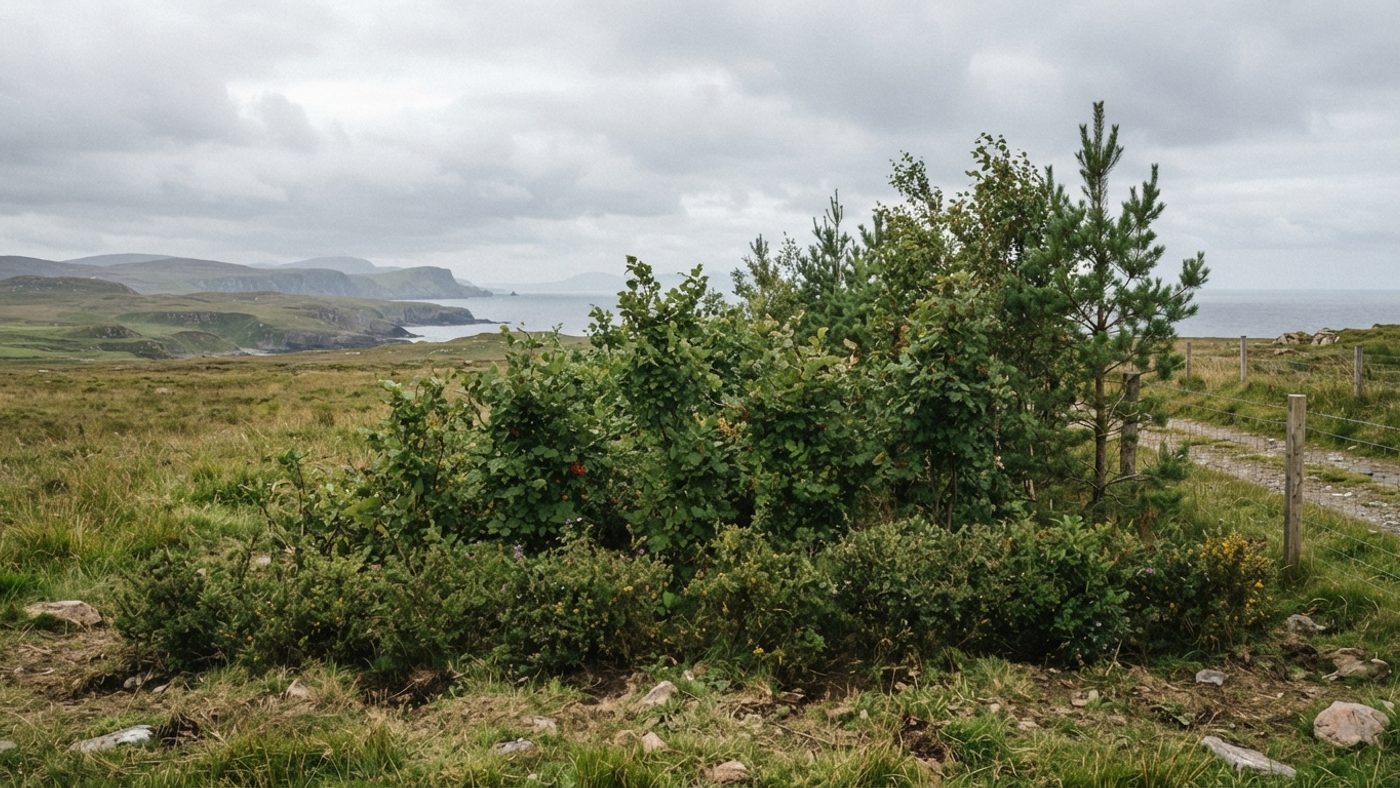
South-west is a reasonable default for most of Scotland's west-coast and island sites, which face the Atlantic. It's less reliable on Scotland's east coast, where north-easterly winds off the North Sea, often carrying haar (coastal fog) in spring and summer, are frequently the more damaging direction for an Aberdeenshire, Angus, or Fife garden, worth checking against your own site's actual weather rather than assuming south-west applies everywhere in Scotland.
For a croft-scale or whole-garden plot on genuinely severe exposure, that staggered, graded profile matters more than it does for a domestic hedge, because you're relying on the belt's own depth to progressively knock the wind down rather than expecting the rest of the garden to do any of that work. On a small island or an exposed headland, exposure often isn't confined to one quarter the way a single "prevailing wind" figure implies, so before planting it's worth walking the site through a full winter, or at minimum checking which boundaries actually take the worst of the weather, rather than assuming the textbook south-westerly direction applies unchanged.
The Woodland Trust's general woodland design guidance is a useful cross-check at the planting-density end: for edge planting intended to double as a windbreak, they recommend a shrub component of roughly 20-30% of the species mix (hazel, hawthorn, blackthorn are their examples), planted mainly around the site's perimeter to form a graded edge, with typical tree densities in new woodland creation running from around 1,000 to 1,600 trees per hectare depending on spacing (roughly 2-3m between trees). That's a general UK woodland- creation figure rather than a coastal-specific one, so treat it as a planting-density sanity check rather than a Scottish finding in its own right.
Species for shelter-belt scale on severe exposure
This is a different question from single-hedge species choice, because a shelter belt is expected to include genuine tree-scale planting in its central rows, not just shrubs. RHS's own recommended windbreak species give a starting list that's genuinely suited to this scale:
| Species | Role in the belt |
|---|---|
| Elaeagnus x ebbingei | Fast-establishing evergreen shrub, useful as nurse planting |
| Hawthorn (Crataegus monogyna) | Tough and wind-firm, tolerating wetter ground than most windbreak species without rocking loose, a practical match for peaty, poorly drained croft land common across Highland and island Scotland; suits shrub/small-tree rows |
| Italian alder (Alnus cordata) | Vigorous, wind-tolerant tree for central rows |
| Sea buckthorn (Hippophae rhamnoides) | Genuinely salt- and sand-tolerant, good on the most exposed windward edge |
| Small-leafed lime (Tilia cordata) | Suits more sheltered inner rows once the belt is established |
This list is aimed at a garden-scale planting, drawn from RHS's home-gardening guidance. Forestry and Land Scotland's own farm and forestry-scale shelterbelts, like the case study below, are planted at a scale and often with a species mix (commercial forestry tends to lean on conifers) that this RHS list doesn't cover, worth knowing if your plot is genuinely at that larger scale rather than garden or croft-garden sized.
A shelter belt several metres deep also casts real shade and competes for root space with whatever's growing behind it, so site it with that trade-off in mind: keep vegetable beds, a greenhouse, or a polytunnel far enough back (or on the sunnier side) that they aren't shaded out by the very structure meant to protect them, and expect some root competition in the first few metres immediately behind the belt.
Neither Forestry and Land Scotland's shelterbelt guidance nor the Woodland Trust's general planning material names a coastal or island-specific species list for shelter belts, a genuine gap in the published guidance. What follows instead directly from the wind-and-salt mechanism above: on the outermost, most exposed row, prioritise species with proven salt tolerance and a naturally low, wind-firm growth habitA plant's characteristic shape and manner of growth, such as upright, spreading, creeping or bushy. Full definition → (sea buckthorn is the clearest example in the RHS list); reserve less wind-hardy or more upright species for the sheltered inner rows once the outer structure is established; and treat strict frost-hardiness rating as a secondary filter, applied after wind and salt tolerance rather than before.
Establishment: gap-filling, nurse planting and getting through the vulnerable years
The outer, windward rows of a shelter belt take the heaviest load precisely while they're least able to withstand it, newly planted stock hasn't built the root plate or bark toughening that mature specimens rely on. Two practical consequences follow directly from that.
Expect and plan for gaps. There's no single reliable figure for how many young plants are lost on a severely exposed outer row in the first two to three growing seasons, but it follows directly from the same wind/salt/wind-rock mechanisms covered above that losses there run higher than on a sheltered site. Treat the initial planting as a first pass rather than a finished structure, and budget for a follow-up gap-filling round rather than treating early losses as a failure to fix later.
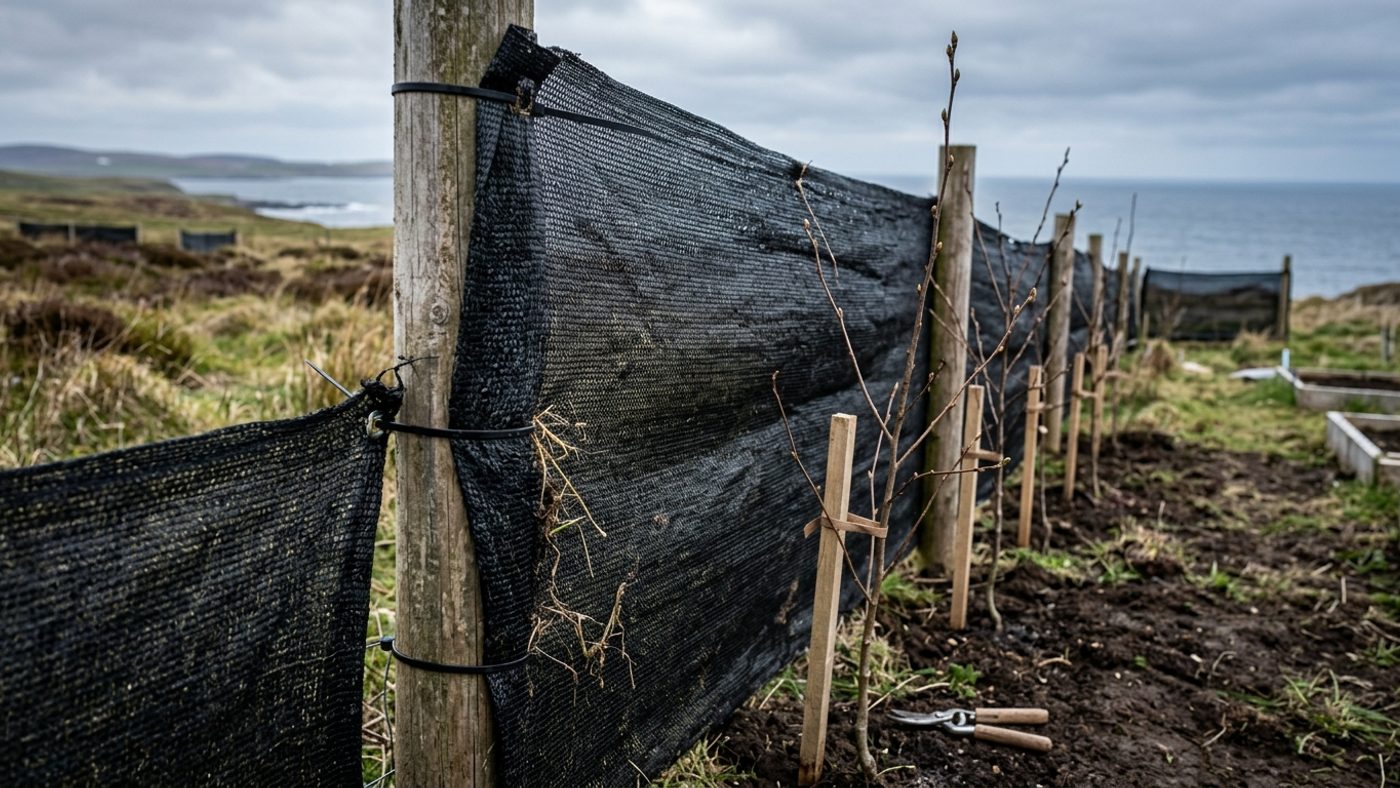
Consider temporary artificial support for the outer row. Artificial windbreak netting or professional-grade strapping can be used to provide immediate protection while living rows establish, standard practice precisely for the situation a severely exposed belt creates, where the permanent structure needs several years before it can do its own job.
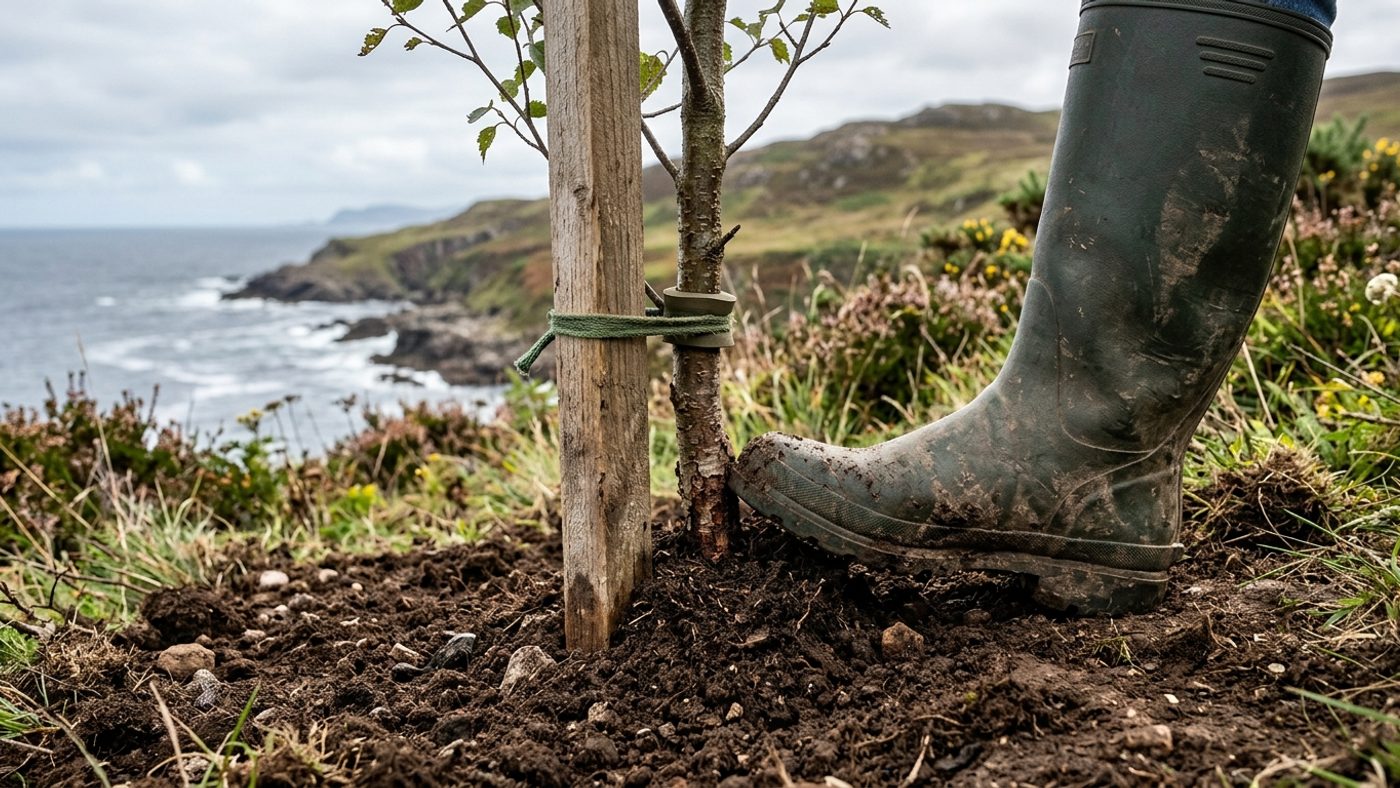
Plant in the dormant season. As with a boundary hedge, bare-rootA plant, usually a fruit tree or hedging, sold with its roots exposed rather than in a pot, and only available while dormant. Full definition → and root-wrapped stock goes in between November and March, while the plant is dormant, giving roots a full winter and spring to establish before summer wind and moisture stress arrive. On an exposed site this timing matters more, not less, than on a sheltered one.
Check drainage before planting, not after. Wind rocks a root plate loose fastest in ground that's already wet, and much of the peaty, poorly drained ground common on Highland and island croft land makes that worse. Where drainage is genuinely poor, raised or mounded planting positions for the outer rows reduce how much a young root plate is sitting in standing water through winter, or lean on a wet-tolerant species like hawthorn there rather than fighting the ground. Machair and shell-sand ground, found along many Hebridean coastlines, is the opposite problem: free-drainingSoil that lets water pass through quickly rather than pooling, so roots aren't sitting in wet ground after rain. Full definition → and alkaline rather than waterlogged, a different establishment challenge again and worth checking with a local nursery or grower familiar with that ground before ordering stock.
Guard against grazing. On any croft, farm, or rural site, deer and rabbits will strip bark and browse young shoots as readily as wind and salt will damage them, so tree guards or fencing around the outer rows are a standard establishment cost, not an optional extra, a whip that's lost its bark to browsing fails for the same practical reason as one that's failed to root against the wind.
MulchA layer of material spread over the soil around plants to suppress weeds, retain moisture, and improve soil structure as it breaks down. Full definition → and keep a weed-free strip. A ring or strip of mulch around each young plant, kept weed-free through the first two growing seasons, cuts competition for water and nutrients from vigorous grass growth, which establishes faster than young trees on most Scottish ground left untended.
Maintenance: different from hedge trimming
A boundary hedge is maintained by regular trimming to a fixed line and height. A shelter belt is maintained structurally instead: checking for wind-rock and re-staking or re-firming young trees after storms, thinning selectively as the belt matures so the central rows don't outcompete and shade out the shrub layer, and replacing losses in the outer rows as they occur rather than waiting for an annual trim. Thinning is the main long-term job, since an untended belt naturally thickens over years as the shrub layer fills in beneath maturing trees.
Funding and support
For genuinely croft or farm-scale shelter belt planting in Scotland, Forestry and Land Scotland's shelterbelt guidance points to Scottish Forestry's Forestry Grant Scheme, which offers woodland creation support options that can apply to shelterbelt planting, administered through Rural Payments and Services. Their published case study, a 92.23-hectare farm at Killochries Fold, Inverclyde, which committed 4.55 hectares to shelterbelt planting for year-round livestock shelter under the Small or Farm Woodland option, is farm-focused rather than domestic-garden scale, but it's a useful indicator of the scale and funding route available if your plot is large enough to qualify.
Common questions
How many rows does a shelter belt actually need on a really exposed island site?
RHS guidance sets three or four staggered rows as the baseline structure for an effective shelter belt. On the most severely exposed sites, err toward four rather than three, since the outer row(s) will take the heaviest losses in the establishment years and a thinner structure has less redundancy to absorb that.
Can I get away with a single row of trees as a shelter belt?
Not really, by definition: a single row is a hedge or screen, not a shelter belt, and the whole point of the belt structure is that wind reduction depends on depth and a graded profile, not just a filtering line. If a single row is genuinely all your plot allows, see our hedge planting guide for species suited to that scale instead. A narrower strip, say 4-5m along one boundary, can still take two staggered rows rather than the full three or four: a smaller version of the same structure, and a real step up from a single row, even if it won't filter wind as thoroughly as the full RHS profile.
How long before a shelter belt actually starts protecting the garden behind it?
Expect a partial effect within a handful of years, once the fastest-establishing outer-row species (nurse planting like Elaeagnus x ebbingei) has taken hold, and the belt's full, designed effectiveness only once the central rows reach real height, likely a decade or more on a severely exposed site, since growth itself is slower under sustained wind stress. Artificial windbreak support in the interim is standard practice for exactly this reason.
Is a shelter belt actually necessary on an exposed Scottish site, or is that overkill for a garden?
It depends on the scale you're protecting and how severe the site actually is. For a single flower border or vegetable bed, a hedge or a smaller windbreak structure is usually proportionate and cheaper to establish. On the very worst sites, an open Orkney or Shetland croft, or an unsheltered headland where even a multi-row belt struggles to get going, a shelter belt of living plants may not be achievable at all in the short term, and the traditional local answer has often been a solid turf or stone dyke, or a sunken, walled garden, rather than trees; several of these can be built alongside young planting as an interim windbreak while a belt establishes over years.
Do I need permission to plant a shelter belt in Scotland?
This isn't something with a clear published rule to cite, so treat this as a prompt to check rather than a definitive answer: if you're planting at a scale that might later involve felling or forestry-scale management, or if you're seeking Forestry Grant Scheme funding, contact Scottish Forestry before you plant, since grant eligibility and any future management obligations are easier to plan for in advance than to retrofit.
Sources
6 sources, recorded with what each was used for
- RHS: Windbreaks and Shelterbelts: Windbreak permeability/wind-reduction figures, row structure, spacing, positioning guidance, and recommended species
- Scottish Forestry: Planting Shelterbelts: The benefits-of-shelterbelts framing, the Killochries Fold farm case study, and the Forestry Grant Scheme funding route
- Met Office: Location-Specific Long-Term Averages, Stornoway Airport: Annual mean wind speed, air frost days, and minimum temperature figures for the Outer Hebrides
- Met Office: Location-Specific Long-Term Averages, Lerwick: Annual mean wind speed figures for Shetland
- Met Office: Location-Specific Long-Term Averages, Braemar: Air frost days and minimum temperature as an inland cold-climate comparison point
- Woodland Trust: Planning and Designing a Woodland: General UK woodland-edge/windbreak shrub-mix percentage and planting-density figures, noted as UK-wide not Scotland-specific