
The plants that come off worst to deer are rarely the ones a gardener is watching in high summer. Winter is when deer browsing pressure tends to bite hardest, because natural forage has thinned out and deer will try plants they'd otherwise ignore: "when food is short, deer will try most plants." A hosta bed that sailed through July untouched can be stripped back in February, and a shrub border that looked deer-proof all growing season can suddenly show bark rubbed raw or shoots browsed to stubs once the surrounding land stops offering much else. That mismatch between when the damage appears and when a gardener is paying attention is worth planning around, not reacting to after the fact.
There's a second seasonal pattern worth knowing about, separate from feeding pressure: male deer rub their antlers on young stems and saplings to remove velvet and mark territory, a habit that shows up as "fraying" damage to trunks and can happen well before winter proper sets in. Between winter browsing and this territorial rubbing, deer damage in a Scottish garden isn't a single-season problem, it's two different mechanisms on two different clocks, which is one reason deer are harder to plan against than most garden pests.
Identifying deer damage
Scotland has four deer species: red and roe, its two native species, widespread and abundant, alongside fallow and sika, both established through historic introductions and escapes and more concentrated around their historic release areas. Sika can also hybridise with red deer, which is one reason NatureScot manages deer numbers rather than leaving populations unchecked. Deer-in-gardens advice written for England is usually built around muntjac, the smallest and most urban-adapted species; muntjac aren't established in Scotland, so red and roe, the two widespread natives, are the more realistic starting assumption for a Scottish garden. A neighbour, local ranger service, or nearby estate is often a faster way to confirm which species is actually local than guessing from a map.
Deer damage has a distinct signature that separates it from rabbits or squirrels:
- Browsing — Shoots and tips nipped off, leaving a ragged, torn edge (deer have no upper incisors, so they tear rather than cut cleanly the way rabbits do)
- Fraying — Bark rubbed from young tree trunks in tatters, caused by males scraping antlers to shed velvet, mainly in summer
- Thrashing — Woody stems and low branches whipped and broken, a male behaviour associated with the rut
- Bark-stripping — A separate, winter-specific damage type: deer eat tree bark outright once other food has become scarce; growth above the damaged point often dries and dies
Often the deer themselves are never seen, most feeding happens between dusk and dawn, and the damage pattern is the only evidence a gardener gets.
What's folklore and what actually works
As with foxes, badgers, and squirrels, deer deterrents split sharply between things people swear by and things with any real evidence behind them. Grading them honestly:
| Method | Grade | What the evidence shows |
|---|---|---|
| Human hair hung in bags | Weak/unproven | RHS is blunt that it "does not work in most gardens" |
| Sirens, flashing lights, streamers | Temporary at best | British Deer Society: "may work for a short time, but deer soon adapt and ignore them" |
| Ultrasonic devices | Temporary at best | RHS: potentially effective initially, deterrent effect likely fades with familiarity |
| Commercial repellent sprays | Some evidence, high maintenance | RHS: "may discourage deer" but need frequent reapplication, including after rain |
| A resident dog | Genuine deterrent | RHS: deer "keep well away from dogs" |
| Deer-resistant plant choices | Real but probabilistic | Shifts the odds, doesn't guarantee anything (see below) |
| Physical fencing | Genuine exclusion | BDS: "the only real defence against deer is a properly constructed fence" |
Soap bars and blood meal are two other folk remedies repeated widely online, but they don't appear in either RHS's or the British Deer Society's deer guidance.
Deer-resistant plants: shifting odds, not a guarantee
RHS maintains a survey-based list of plants deer tend to leave alone, with some varieties showing a 20% or lower chance of damage in their survey data. That figure is from a UK-wide survey of the gardening public, not a Scottish trial, so treat it as a general steer rather than a Scotland-specific ranking. RHS is explicit that it's a probability shift, not protection: "a type of plant undamaged in one garden may be a favourite in another," and damage patterns shift with the time of year. Plants nearer the house and human activity are also less often damaged, for whatever reasons deer have for staying cautious close to people.
The British Deer Society's own list of plants deer tend to avoid includes several plants common in Scottish gardens: birch, foxglove, lavender, potentilla, spiraea, hydrangea, and rosa rugosa all appear on their list of plants that go untouched when other food is available. Its list of vulnerable plants runs the other way and includes bluebell, camellia, clematis, hosta, fuchsia, and, unsurprisingly for anyone growing them, roses. The two organisations don't fully agree with each other: RHS names holly among the plants it sees heavily damaged, where the British Deer Society lists holly as one deer tend to avoid, worth knowing if a holly hedge is doing the job in one garden and not another nearby.
Both organisations land on the same conclusion: plant choice reduces risk, it doesn't remove it, and a plant list is a way to load the odds, not a substitute for exclusion where damage risk is already high.
The genuine answer: fencing, sized to the deer, not the garden
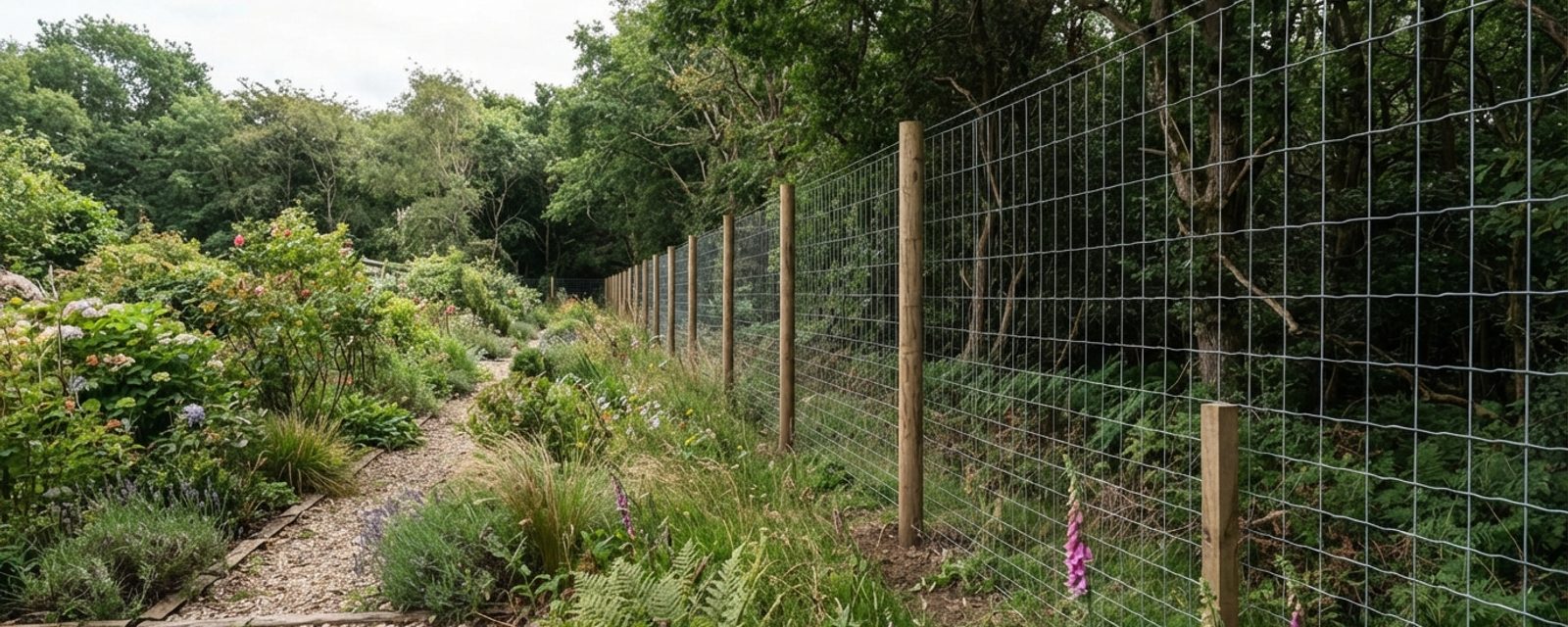
Unlike rabbits, foxes, or badgers, deer aren't primarily diggers or squeezers, although the British Deer Society does warn that deer will exploit any gap at a fence's base, so the bottom edge still needs to be dug or turfed in properly. The defining fact about deer is that they jump, and different species clear different heights. That makes fence height the single most important spec decision, and it varies genuinely by species rather than being a single "deer-proof" number.
| Deer species | Minimum fence height | Minimum mesh size |
|---|---|---|
| Roe deer | 1.8m | 200 x 150mm |
| Fallow deer | 1.8m | 220 x 200mm |
| Sika deer | 1.8m | 220 x 200mm |
| Red deer | 1.9m | 220 x 200mm |
| Muntjac (not established in Scotland) | 1.5m | 75 x 75mm |
These figures come from the British Deer Society's minimum fencing specification. RHS's own figures for the same job are close but slightly rounder, 1.8m for the larger deer species generally, with a maximum mesh size of 20 x 15cm, broadly consistent with the British Deer Society's roe/fallow/sika figures above.
A few practical points that matter for garden fencing specifically, not just forestry-scale deer fencing:
- Mesh gaps matter as much as height. RHS is specific that horizontal strands of plain or barbed wire aren't a substitute for proper mesh, because roe deer can squeeze through gaps as small as 30cm, a fence that's tall enough but loosely strung with wide gaps still fails.
- Avoid lightweight plastic mesh. The British Deer Society warns it isn't robust enough for the job and deer can become tangled in it, a welfare problem as well as a fence-failure problem. A deer found injured or trapped in fencing or netting is a Scottish SPCA matter, not something to free or treat yourself.
- The base is a weak point. A fence that's correctly specified at the top but has a gap or soft ground at the bottom will still be breached, both RHS and the British Deer Society flag the base as somewhere deer will find and exploit any weakness.
- Young trees and shrubs need their own protection even inside a boundary fence, at least until established: netting guards or stakes, sized to the deer species locally present.
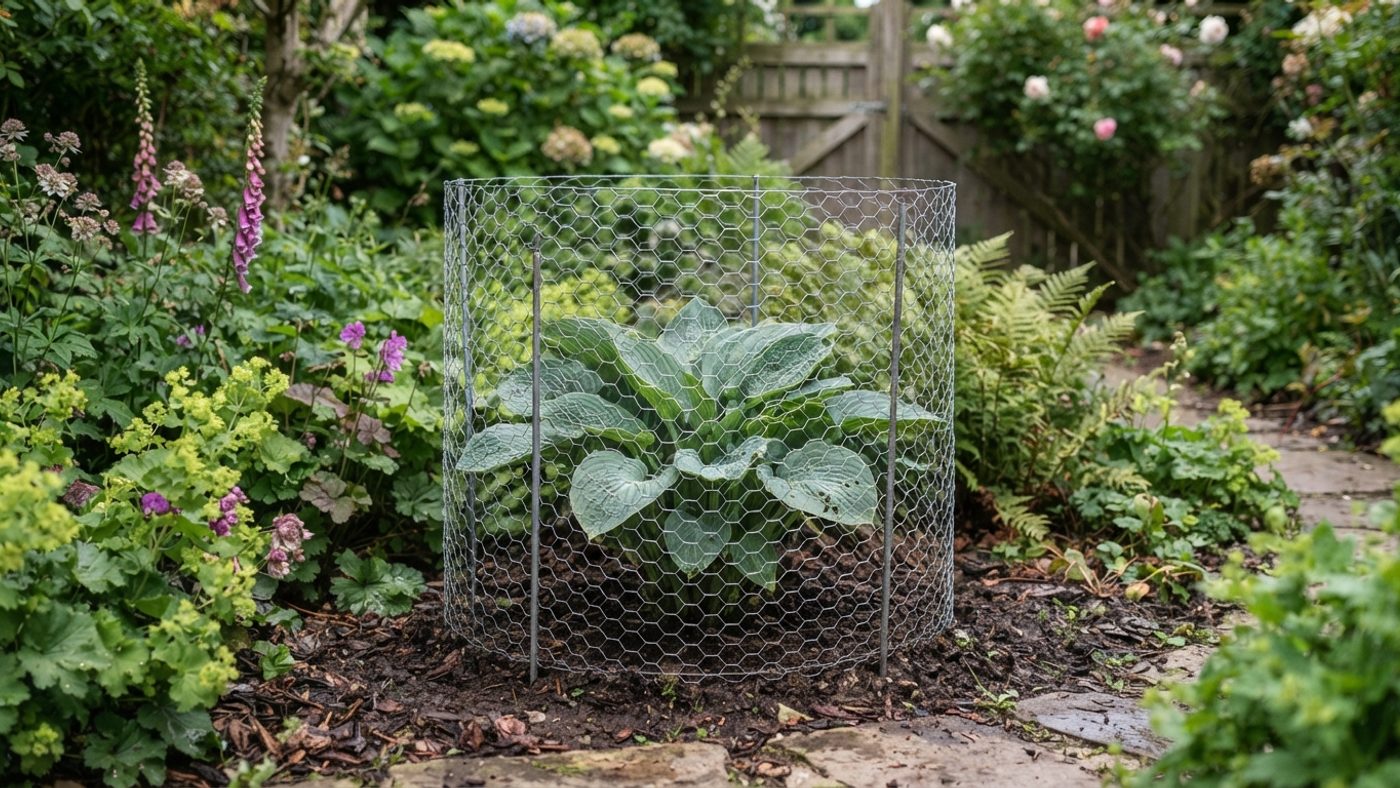
- A handful of vulnerable perennials don't need a full perimeter fence. For a few prized plants, hostas are the classic case, the British Deer Society's own cheaper alternative to plastic tree tubes works just as well at plant scale: an individual netting cage, or simply piling cut branches ("brash") around the plant while it's vulnerable, both listed as genuine options rather than a compromise.
- Full exclusion fencing is a real capital cost, not a weekend DIY job, particularly at 1.8-1.9m runs around a garden boundary. Get more than one local contractor's quote for the actual perimeter involved rather than working from a rough per-metre figure, since ground conditions and gate requirements swing the total significantly. It's also worth a quick check with the local council before starting work, since boundary rules can vary by area and a fence this tall is well above the height of an ordinary garden fence.
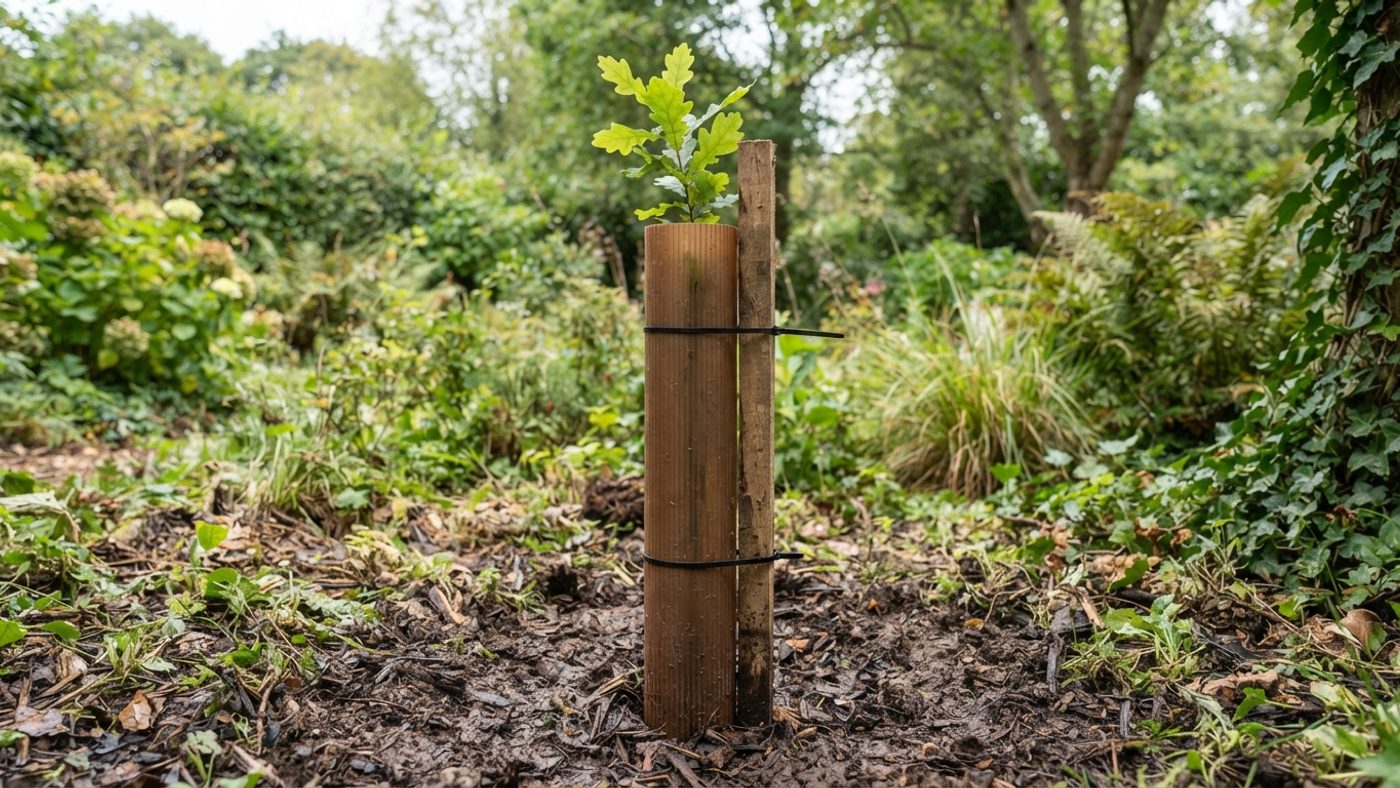
Tree and shrub guards need less height than a boundary fence: 1.6m is rated for fallow deer, while 1.2m suits roe and muntjac.
Skip electric fencing for this job. RHS is direct about it: an electric fence "is often ineffective against deer and may be damaged if deer are startled and try to run through it," the same panic-and-crash failure mode that makes lightweight plastic mesh a bad choice above. A tall, dense hedge with a ditch on the outside can work as a barrier instead of a built fence, according to RHS, provided it's solid enough that deer can't push through it.
Scotland's legal position
NatureScot is Scotland's nature agency and holds statutory responsibility for the conservation, control, and sustainable management of all wild deer species in the country. Its deer material, though, is built around landscape-scale management, cull data, deer management groups, licensing for professional deer managers, incentive schemes for reducing high roe and sika numbers in specific regions, rather than advice aimed at an individual garden owner. Its deer guidance doesn't cover garden fencing, repellents, or plant choice. For land-management-scale deer questions it's the right body; for "how do I keep deer off my roses" it isn't the source to go to.
The relevant law is the Deer (Scotland) Act 1996. Section 26 gives an occupier of arable land, improved pasture, land being reseeded for agriculture, or enclosed woodland the right to take or kill deer that are causing, or are reasonably believed likely to cause, serious damage to crops, pasture, or stored produce, either personally or through a written authorisation to specific other people. That right doesn't apply during the close season for each species and sex, when killing deer is restricted regardless of any damage they're causing, Section 5 of the Act gives Scottish Ministers the power to fix those seasons by order rather than setting fixed dates in the Act itself. In practice, though, this section is built for agricultural ground: arable fields, improved pasture, enclosed woodland, not domestic gardens, and lethal control isn't a realistic or appropriate response for an ordinary garden in any case. For a garden, the practical and legal path is exclusion: fencing, plant choice, and the deterrents graded above, not the occupier's rights under Section 26.
If you're dealing with other garden wildlife
Deer aren't the only visitors testing a Scottish garden's defences. If browsing damage sits low, under about 50cm, and looks cleanly cut rather than torn, that's more likely rabbits, see Keeping Rabbits Out of a Scottish Garden. For guidance on the other common pressures, see Foxes and Badgers in a Scottish Garden and Red Squirrels in Your Garden.
Common questions
What height of fence keeps deer out of a garden?
It depends on the species. Roe, fallow, and sika deer need a minimum of 1.8m; red deer need 1.9m. Mesh gap size matters as much as height, the British Deer Society specifies gaps no larger than 200 x 150mm for roe deer, rising to 220 x 200mm for fallow, sika, and red deer, and the fence base needs to be dug or turfed in so deer can't exploit a gap underneath.
Do deer really avoid gardens with dogs?
Deer keep well away from dogs, making a resident dog one of the few non-fencing deterrents with a clearly stated effect, though it's not a substitute for exclusion fencing where damage risk is high.
Are deer-resistant plants actually deer-proof?
No. Both RHS and the British Deer Society describe deer-resistant plant lists as reducing the odds of damage, not eliminating it. RHS is explicit that when food is scarce, as it typically is over winter, deer will try plants they'd normally avoid, and that a plant left alone in one garden may be a favourite in the next one over.
Why does deer damage seem to appear suddenly in winter?
Natural forage thins out over winter, so deer widen what they're willing to eat, and distinct from browsing on shoots and leaves, this is also when deer will eat tree bark outright, something they mostly leave alone the rest of the year. It's worth checking fencing and vulnerable plants before winter sets in rather than after the damage appears.
Is it legal to remove or cull deer causing damage in a Scottish garden?
The Deer (Scotland) Act 1996, Section 26, gives occupiers of arable land, improved pasture, or enclosed woodland a limited right to take or kill deer causing serious damage to crops, subject to close seasons and other conditions. That provision is built for agricultural ground, not domestic gardens, and isn't a realistic or appropriate route for an ordinary garden, exclusion fencing and plant choice are the practical response.
Sources
6 sources, recorded with what each was used for
- RHS: Deer: Fence heights and mesh sizes by species, deer behaviour, seasonal browsing/fraying/bark-stripping behaviour, repellent evidence, electric fencing and hedge-with-ditch effectiveness, tree guard heights, list of plants heavily damaged by deer
- RHS: Deer-resistant plants: Survey-based deer-resistant plant data and caveats on variability, proximity effects, and seasonal food scarcity
- British Deer Society: Deer in gardens: Damage identification, minimum fencing specification table by species, mesh material warning, tree-guard heights, vulnerable and deer-resistant plant lists
- NatureScot: Deer in Scotland: Scotland's resident deer species, sika/red hybridisation, NatureScot's statutory role, confirmation its guidance is landscape/population-management focused
- Deer (Scotland) Act 1996, Section 26: Occupier's right to take or kill deer causing serious damage to crops on agricultural land, and its restriction to arable/pasture/enclosed woodland
- Deer (Scotland) Act 1996, Section 5: Statutory basis for close seasons, which restrict the Section 26 right