
A soil's identity comes down to two things you can actually measure: the relative proportions of sand, silt and clay particles packed into it, and how much organic matter is mixed through that mineral base. Sand grains are coarse and irregular, leaving wide gaps water runs straight through. Clay particles are microscopic and flat, packing so tightly there's barely room for air, let alone drainage. Silt sits in between, fine enough to hold moisture but coarse enough to avoid clay's worst stickiness. Organic matter changes the picture again: it binds fine particles into looser crumbs, holds water a sandy soil would otherwise shed, and opens air pockets a heavy clay lacks on its own. Every soil-type name in common use, clay, sand, silt, loam, chalk, is shorthand for where a patch of ground sits on those two measurements, and a simple hand test can place your own ground on that scale in about a minute.
That texture scale answers one question: how this ground feels and drains right now. It doesn't answer a second, separate question that matters just as much on a lot of Scottish ground: what's happened to this soil over thousands of years of rainfall and drainage, sitting under whatever's grown on it before you. That second question is answered by soil profile, not texture, and it's the one that puts a name like podzol or peaty gley on far more Scottish gardens than the standard clay-sand-silt-loam-chalk list accounts for on its own. Both are worth knowing, and testing for them takes two different, equally simple methods.
Testing texture by hand
Take a small handful of soil, damp but not dripping wet, and work it between your fingers and palms. What it does next places it on the texture scale.
The ribbon test
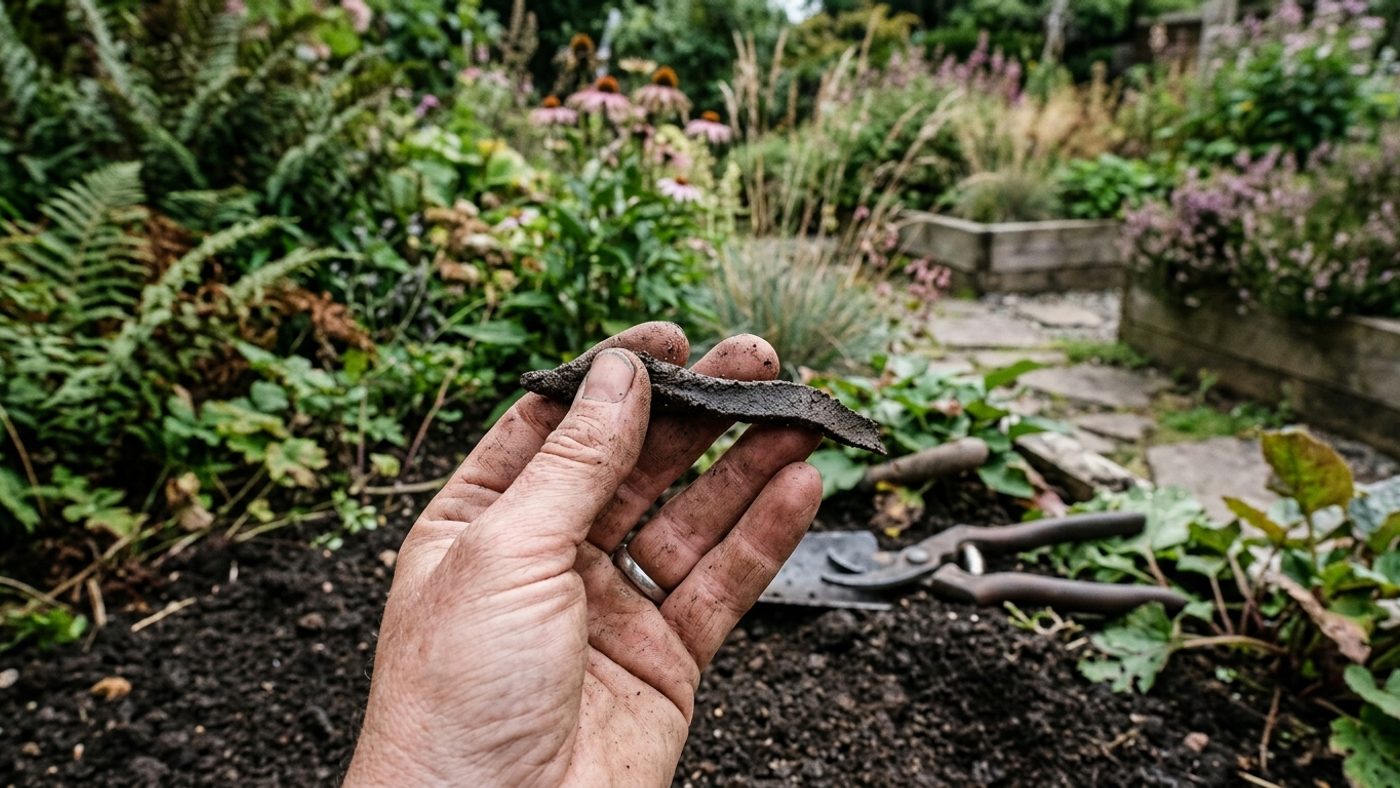
Roll the sample into a ball, then squeeze it gently between thumb and forefinger, pushing it up and out to form a flat ribbon. Sandy soil has a gritty feel, you can feel individual grains, and it falls apart rather than holding a ribbon at all. Clay has a smearing, sticky quality when wet and rolls easily into a long, shiny ribbon that holds its shape. Silt feels slightly soapy and slippery rather than gritty or sticky, and doesn't clump into a ribbon easily. Loam, a workable mix of all three, holds together loosely without either the grit of sand or the stickiness of clay.
The vinegar test, for chalk
Chalky or lime-rich soil doesn't always announce itself by feel alone, it can be light or heavy depending on what else is mixed through it, but it does have a reliable chemical tell: drop a little vinegar onto a soil sample, and if it fizzes or froths, that's free calcium carbonate, chalk or limestone, reacting with the acid. Chalky ground is often shallow and free-drainingSoil that lets water pass through quickly rather than pooling, so roots aren't sitting in wet ground after rain. Full definition →, and may show visible white stone fragments through the topsoil. A positive result on a western or island coastline is worth a second look before assuming chalk, though, for a reason covered further down.
| Soil type | Feel test | Drainage | Fertility |
|---|---|---|---|
| Clay | Sticky when wet, smears, rolls into a shiny ribbon | Slow | Rich in nutrients |
| Sandy | Gritty, falls through fingers, won't hold a shape | Fast | Low, nutrients wash out quickly |
| Silt | Slightly soapy and slippery, doesn't clump | Fairly well drained | More than sand, less than clay |
| Loam | Holds a loose shape, neither gritty nor sticky | Well-drained | Fertile |
| Chalky | Often gritty, visible white stone; froths with vinegar | Free-draining, often shallow | Low |
That Chalky row is included for completeness rather than because it's a common Scottish result: true chalk geology is rare here, and a fizzing vinegar test on the west coast more often points somewhere else entirely, covered below.
The jar test, for a more exact split
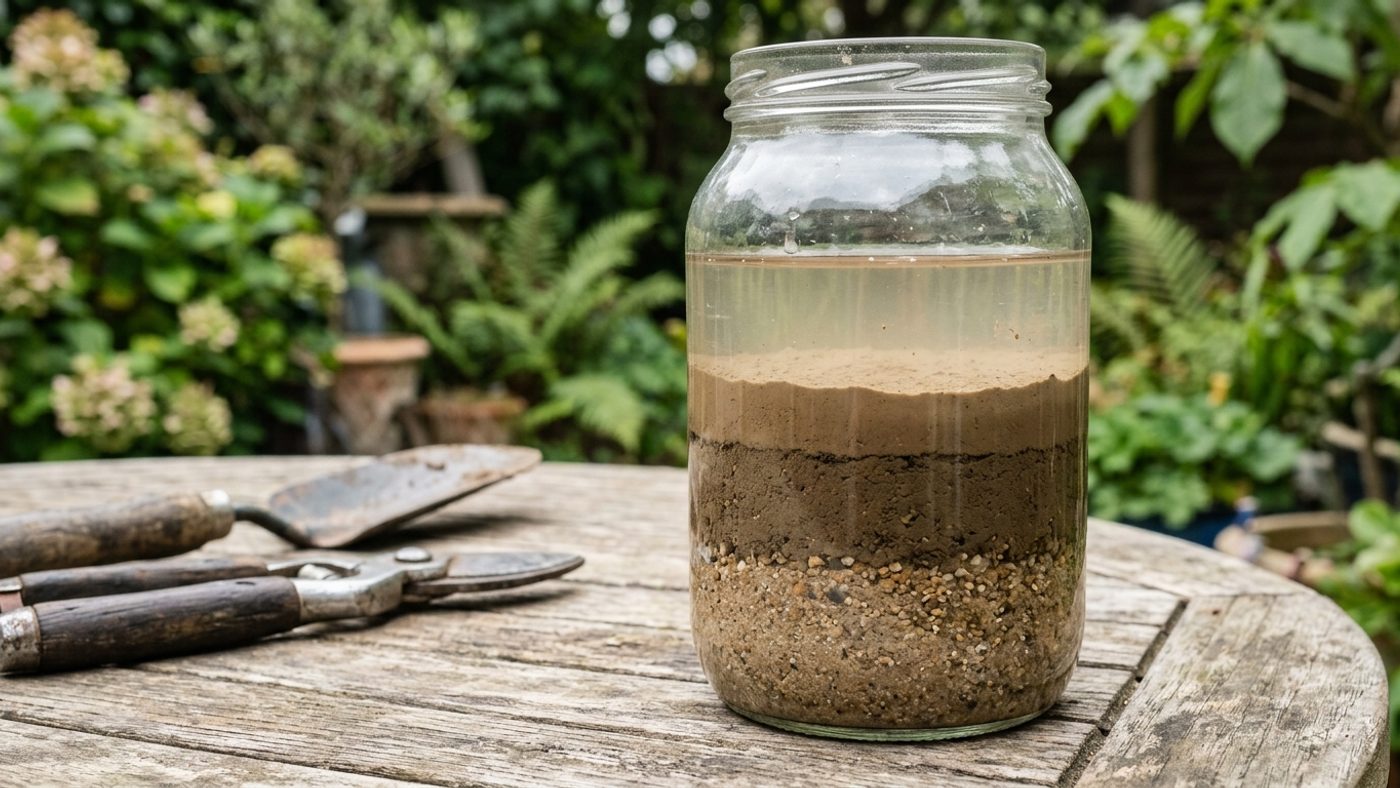
A hand test is enough for most gardening decisions, but a jar test gives an actual visual breakdown. Break up a sample, remove stones and debris, and half-fill a straight-sided jar with soil, then top it up with water and shake thoroughly until nothing is left clumped together. Left to stand, the particles settle out by weight: the coarsest sand drops first, silt settles out over the following while, and the finest clay takes far longer, sometimes a day or more, to fully clear from the water above it. What's left is a set of visibly distinct layers you can measure with a ruler and compare against each other, sand at the bottom, silt above it, clay on top. Measure each layer's height, divide it by the total height of all three layers combined, and you've got a rough percentage split for your own soil, not just a single-word verdict.
The soils most identification guides skip
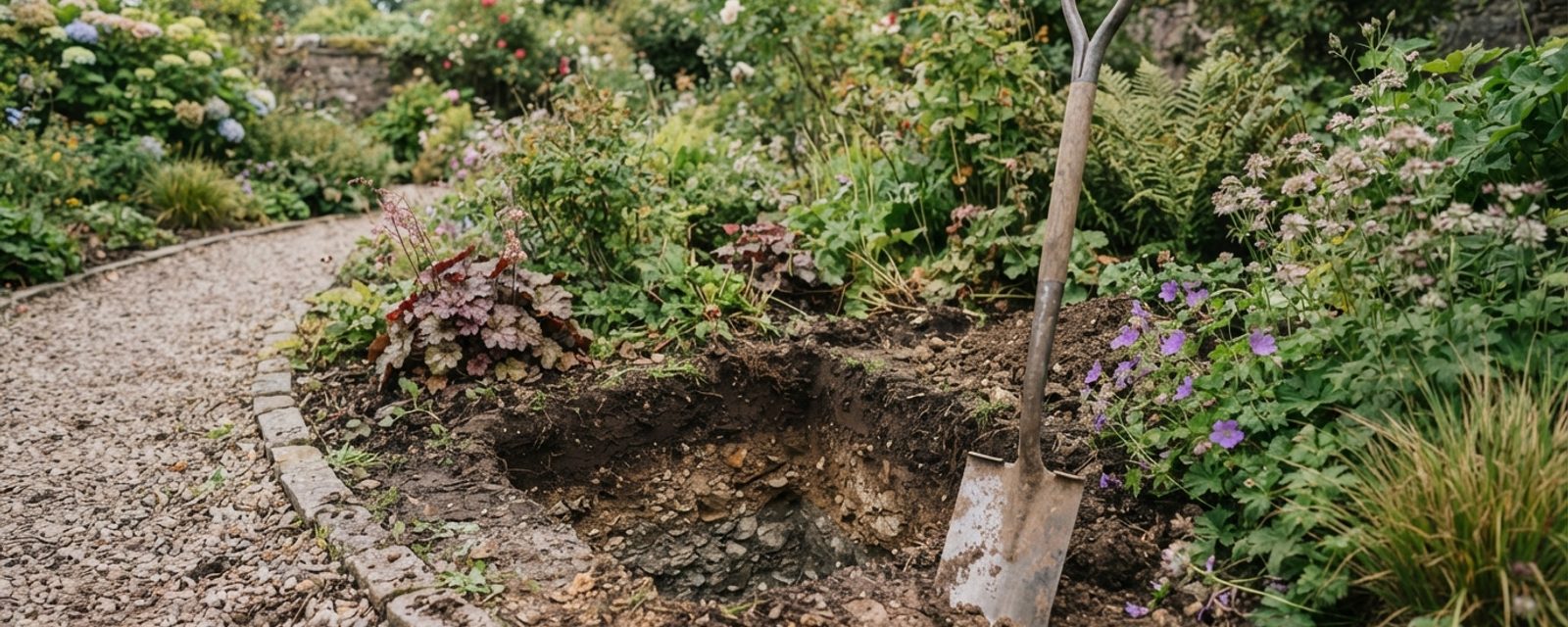
Profile is what's happened to a whole column of soil over time: whether it's stayed waterlogged, whether it's been leached by rainfall, how much organic matter has built up and whether it's broken down or simply accumulated. Scotland carries a disproportionately large share of certain profile types, and naming them changes what a gardener needs to do far more than the texture result alone does. Check for them with a spade rather than your hands: dig a hole about 30cm deep at the edge of a bed and look at the colour bands down the side of it.
Brown earth
Uniformly brown, crumbly soil all the way down, with no sharp colour change between layers. This is the profile closest to what most general gardening advice quietly assumes: moderately acid, free-draining, behaving like an ordinary garden soil once its texture is known. It dominates Scotland's Central Belt lowlands, where a large share of the country's gardens actually are, even though it covers a smaller share of Scotland's total land area than the profiles below.
Podzol
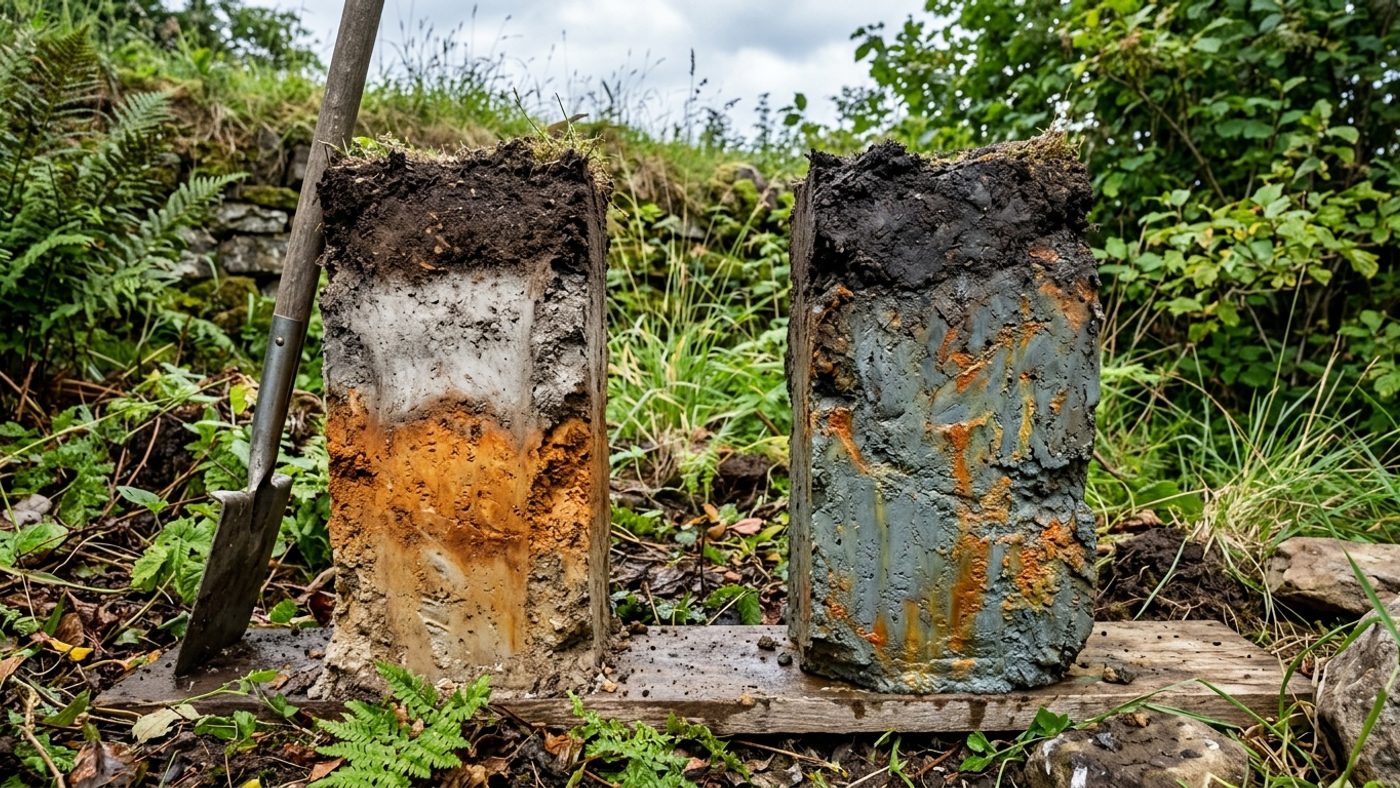
A pale, ash-grey band sitting just under the topsoil, with a bright orange-rust coloured band beneath it. That grey layer is mineral-poor, stripped by rainwater carrying iron and aluminium down to the rusty band below, and it's usually acid. A podzol is often reasonably free-draining once you're through the leached layer, but that layer itself can be low in nutrients and slow to support root growth, worth pairing regular feeding with the pH correction below. It's concentrated in the Highlands and Southern Uplands; see the table below for its share of Scotland's land, which is a far higher share than in Europe as a whole.
Gley
Grey ground mottled with patches of green or blue rather than a clean, banded profile, the colour pattern left by periodic or permanent waterlogging, where a lack of oxygen changes how iron compounds in the soil are coloured. A gley doesn't drain the way the leaching that forms a podzol needs; the two conditions rarely coexist in the same profile. This is the profile the working rule "don't dig or walk on it wet" (covered in full in improving clay soil) applies to most directly, whatever its texture turns out to be.
Peaty gley
The combination: a dark, fibrous, peaty layer sitting over grey, mottled ground below. Waterlogged and acid at once, and slow to warm up in spring since wet ground holds more heat-sapping water than dry ground does. Peaty gleys and podzols together with blanket peat dominate much of the Highlands and Southern Uplands, especially toward the west.
Peat
Black, spongy, fibrous material, still recognisably plant matter in places, running at least 50cm deep with more than 60% organic content. It forms where waterlogging slows decomposition faster than fresh plant material can pile up, holding enormous amounts of water and staying acid and slow to warm as a result. Peat is counted separately from the peaty gleys and peaty podzols above, which carry some peat character without meeting peat's own depth and organic-content thresholds.
Rankers, and other thin upland soils
Not every upland soil fits neatly into podzol, gley or peat. Officially, a ranker is any soil more than 10cm thick with bedrock close beneath it, thin by definition rather than by any particular colour, and it comes in podzolic, gley and peaty variants as well as a plain mineral one. This is the ground on exposed ridges, summits and thin-soiled hillsides across the Highlands and Southern Uplands, wherever weathering and shelter haven't had enough time or cover to build up a full profile. Dig down and you hit rock or loose scree within a spade's length, sometimes well short of it. Texture and drainage still matter on ground like this, but depth is usually the real limiting factor: a plant that would cope fine with a podzol's acidity or a gley's wet feet can still fail simply because there isn't enough soil for its roots to get into.
| Profile | What you'll see if you dig down | Roughly how much of Scotland | What it means for the garden |
|---|---|---|---|
| Brown earth | Uniform brown, crumbly, no sharp colour change | Dominant in the Central Belt lowlands | Behaves like ordinary free-draining garden soil |
| Podzol | Pale grey band under the topsoil, orange-rust band beneath it | About a quarter of Scotland's land | Acid; often free-draining below the leached layer, but that layer can be nutrient-poor |
| Gley | Grey, mottled with green or blue, no crisp banding | About a fifth of Scotland's land | Periodically or permanently waterlogged |
| Peaty gley | Dark, fibrous peaty layer over grey, mottled ground | Counted within the peat and gley shares above | Waterlogged, acid, slow to warm in spring |
| Peat | Black, spongy, fibrous, at least 50cm deep | Close to another quarter of Scotland's land | Very high organic matter, holds enormous amounts of water |
| Ranker | Thin soil, often well under 30cm, over rock or scree | No single figure quoted; common on upland ridges and summits | Rooting depth, not texture or drainage, is usually the limiting factor |
Where these actually turn up
The table above already shows how much of Scotland's land each profile covers; what it doesn't show is where. This isn't an even spread. The Highlands and Southern Uplands are dominated by peaty soils, peat, peaty gleys and peaty podzols, especially toward the wetter west, and podzols in general skew toward higher altitude and heavier rainfall wherever they occur. The Central Belt, where most Scottish gardens actually sit, is mostly mineral soil, brown earths and similar, closer in behaviour to what general gardening advice assumes without any adjustment. A garden in an upland or western part of the country is considerably more likely to be sitting on a podzol, gley or peaty ground than the same-sized plot in Edinburgh, Glasgow or the wider Central Belt, but none of it is postcode destiny, a free-draining pocket can turn up on a hillside and a waterlogged gley can turn up in an otherwise easy lowland garden. A new-build garden is its own separate case again: much of that ground has been stripped, moved and recompacted during construction, so it may not match its area's natural profile at all until it's had years to settle. Dig your own hole rather than assume from the map, and dig it in an established bed if you can rather than in freshly delivered topsoil. The same land-area figures above also explain why ground can stay unworkable for weeks past the local frost date on heavy, peaty or gley soil, covered in planting bare-root trees.
Chalk, and Scotland's real alkaline ground
Chalk soil, in the sense most general UK gardening advice means it, chalk downland geology, is barely present in Scotland at all. Limestone is rare across most of the Scottish mainland; genuine calcareous rock turns up only in specific western pockets, parts of Skye, Kishorn, Assynt and Durness among them. Where naturally alkaline, lime-rich ground does show up more widely, it's usually coastal machair rather than chalk: low-lying ground built from wind-blown sand that's partly crushed shell, chemically the same calcium carbonate that makes chalk soil lime-rich elsewhere. It's best developed on the Uists, Tiree and Barra, and also found on Orkney, Shetland, Lewis, Harris and a scatter of other western and northern coastal sites. If your soil froths under vinegar and you garden on one of those coasts, that shell-derived alkalinity is the far more likely explanation than chalk bedrock underneath you.
Reading your own plot
Before testing anything, look at what's already growing. Thriving heather, rhododendrons or camellias, or the reverse, ericaceous plants looking chlorotic and disappointing, are a free hint at acidity that costs nothing to notice; it's a hint, not a substitute for the tests above, since plenty of ordinary garden plants tolerate a wide enough range to give nothing away.
A real garden can combine a result from each test: a sandy podzol drains fast but sits acid and nutrient-poor at depth; a clay gley drains slowly and stays waterlogged regardless of what the surface texture test alone would suggest. Test more than one spot if the garden isn't flat, a slope, a low corner or a spot near a wall can all sit on noticeably different ground from the rest of the plot even a few metres away. Between the ribbon test on a handful of topsoil and a single spade-depth hole dug at the edge of a bed, most gardens can be placed on both scales in under ten minutes.
What to do with the result
Identification is the first step, not the fix. A heavy clay or gley bed needs drainage before anything else, covered in full in improving clay soil. Acid ground, common across podzols, peaty gleys and peat alike, may or may not need correcting depending on what you're growing, covered in soil pH testing and adjustment. Knowing which soil you're actually standing on is what makes either of those next steps worth doing properly rather than guessing at a generic fix.
Common questions
What's the quickest way to find out my soil type?
Take a small handful of moist soil, roll it between your palms, and see what it does. Gritty and won't hold a shape at all means sandy; smooth, sticky and rollable into a shiny sausage means clay; a soapy, slippery feel that won't clump means silt; something in between that holds a loose shape without stickiness means loam. It takes about a minute and needs nothing but your hands.
What's the difference between a gley and a podzol?
Drainage, mainly. A podzol is acid but usually free-draining once you're past its leached surface band, pale grey under the topsoil with a rusty orange layer beneath. A gley is periodically or permanently waterlogged, shown by grey ground mottled with green or blue rather than a crisp banded profile. Both are common in Scotland, but they need almost opposite treatment: a podzol mainly needs feeding and pH correction, a gley needs drainage before anything else.
Can my garden have more than one soil type in it?
Yes, and it's common rather than unusual. Texture (clay, sand, silt, loam) and profile (podzol, gley, peat, brown earth) are two separate classifications, so a plot can genuinely be a sandy podzol in one bed and a clay gley in a low-lying corner a few metres away, particularly anywhere the ground isn't flat. Test more than one spot before assuming the whole garden matches your first result.
Is peaty garden soil the same as the peat in a bag of peat compost?
Related, not identical. Both are the same waterlogged organic material, decomposed plant matter built up faster than it can break down, but a garden growing on natural peat or peaty gley sits on that material in situ, still forming and still waterlogged, while bagged peat compost has been cut, dried and processed. A garden on genuine peat behaves very differently from a border simply mulchedA layer of material spread over the soil around plants to suppress weeds, retain moisture, and improve soil structure as it breaks down. Full definition → with peat-based compost.
Does Scotland have chalky soil?
Barely, and not in the English downland sense. True chalk geology is essentially absent in Scotland; limestone outcrops exist only in a few specific western areas such as Skye, Assynt and Durness. Where genuinely alkaline, lime-rich ground does turn up, it's more often coastal machair, sand blown ashore that's partly made of crushed shell, found on the Uists, Tiree, Barra and other western and northern coasts, rather than chalk bedrock.
Sources
6 sources, recorded with what each was used for
- RHS: Soil Types Explained: Hand-feel identification of clay, sandy, silt, loam and chalky soils; the vinegar test for free calcium carbonate; drainage and fertility characteristics of each texture type
- gov.scot: The Scottish Soil Framework: Podzol/peat/gley shares of Scotland's land area against Europe as a whole, their concentration in the Highlands and Southern Uplands especially in the west, and the Central Belt's mineral-soil dominance (figures reused, not re-derived, from the planting-bare-rootA plant, usually a fruit tree or hedging, sold with its roots exposed rather than in a pot, and only available while dormant. Full definition →-trees and improving-clay-soil articles)
- RHS: Acidifying soil: Poor growth or chlorosis in ericaceous (acid-loving) plants such as rhododendrons and camellias as an indicator that soil is not acid enough, used here for the reverse: strong ericaceous growth as a free clue that ground is already acid
- Scotland's Environment Web (Scottish Government / James Hutton Institute / SEPA partnership): Scotland's Soils Glossary: Practical colour/appearance definitions of podzol (grey leached layer, orangey-brown subsoil), gley (greyish with greenish/blueish mottling from waterlogging), peat (organic accumulation from waterlogged decomposition), brown soil (brown mineral topsoil and subsoil) and ranker (shallow soil over bedrock, thin by definition)
- British Geological Survey: The Limestones of Scotland: Limestone being rare across most of the Scottish mainland, with genuine calcareous/limestone deposits confined to specific western areas (Skye, Kishorn, Assynt, Durness)
- NatureScot: Machair: Machair's composition (low-lying coastline, sand partly consisting of shell fragments, strong winds) and its distribution on the Uists, Tiree, Barra, Orkney, Shetland, Lewis, Harris and other western/northern coasts