
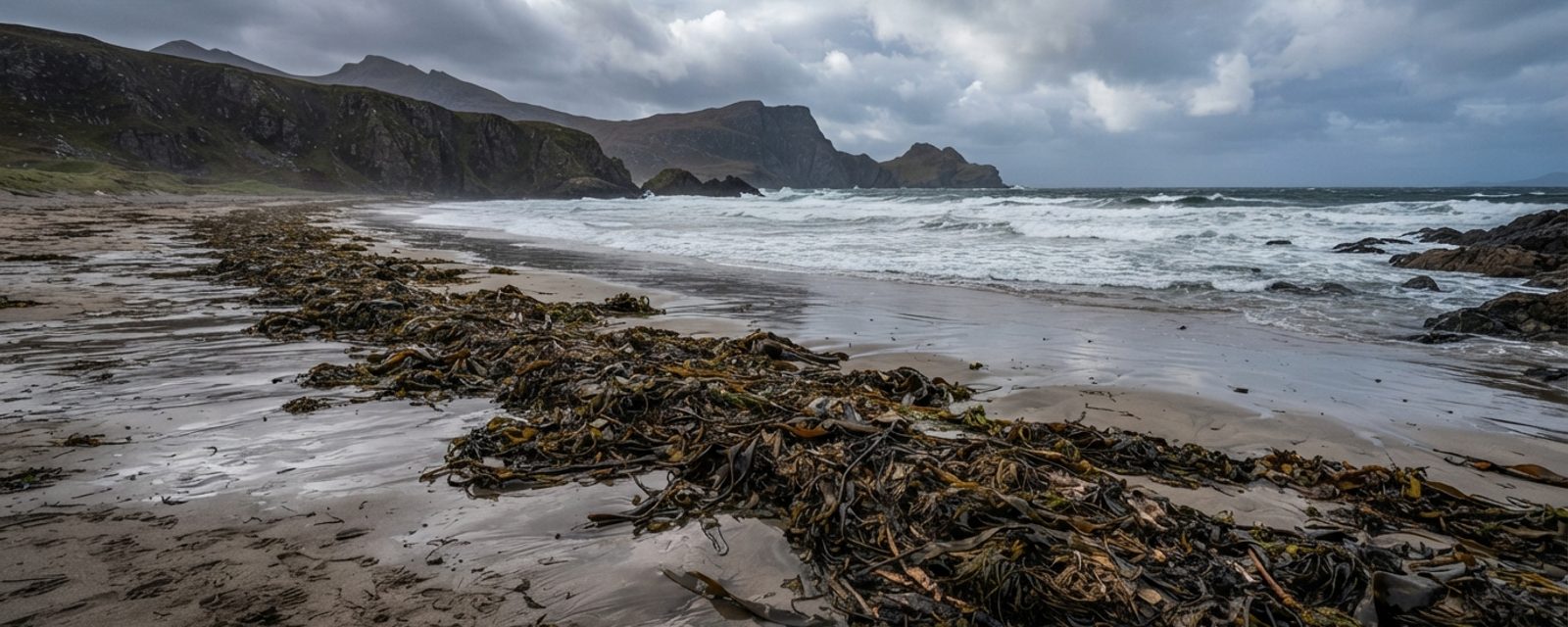
After a big autumn storm, the tideline on a west coast beach can be knee-deep in seaweed, ropes of kelp, tangled wrack, whole fronds torn loose and dumped in a dark, salty ridge along the sand. It's a familiar sight anywhere from the Solway to Shetland, and it's tempting to see it as a skip's worth of free fertiliser sitting there for the taking. Some of that instinct is sound: crofters have gathered storm-cast seaweed to spread on their land for centuries, long before "biostimulant" was a word on a bottle. But before filling the boot, it's worth knowing what seaweed feed actually does for a garden, which form suits which job, and what the law and the tideline's own ecology actually allow.
What seaweed feed actually does for plants
Seaweed is not a complete fertiliser, and treating it as one is the most common mistake gardeners make with it. It contains nitrogen, potassium, phosphate and magnesium, but the levels vary by species, season and how the product was processed, so raw or lightly processed seaweed carries no guaranteed, standardised nutrient content the way a bagged general fertiliser does. Nitrogen in particular runs low compared with a conventional feed, this is not the product to reach for if a plant needs a straightforward nitrogen boost.
What it does supply well is trace elements: iron, manganese, zinc, copper and boron, all present in useful amounts and all frequently missing from more mainstream fertilisers such as Growmore or fish, blood and bone. Most garden soil already holds adequate levels of these micronutrients, so the trace-element case for seaweed is real but easy to overstate for an already-decent soil.
The more distinctive effect is the growth-regulator content: some seaweed products contain natural plant hormones, including cytokinins, which act as a growth stimulant rather than a nutrient source in the conventional sense. This is the basis of seaweed's reputation as a "biostimulant," it can encourage root development and general plant vigour independently of the raw nutrients it supplies, a different mechanism from feeding with something like a tomato feed or blood, fish and bone.
Seaweed is salty, which puts some gardeners off, but the salt is not usually present in large enough amounts to damage crops or soil, and what's there leaches out readily with Scotland's rainfall. The realistic summary: seaweed feed is a genuinely useful trace-element and biostimulant tonic, best used alongside a proper feeding programme rather than instead of one.
Liquid concentrate, meal, and raw seaweed, how each is actually used
Seaweed reaches the garden in three broadly different forms, and each does a different job.
Liquid seaweed concentrate
Made by extracting seaweed in water rather than boiling it down, liquid seaweed is diluted before use and applied as a foliar spray or soil drench, most usefully during active growth from roughly March to September. Because leaves take up a foliar feedA liquid fertiliser applied directly onto a plant's leaves rather than the soil, absorbed faster than a root feed. Full definition → quickly, this is the form to reach for when a plant needs a fast tonic, after transplanting, during a dry spell, or when growth looks sluggish, rather than as a slow, structural soil improvement. Fortified versions have added nitrogen, phosphorus and potassium with a guaranteed ratio printed on the label; plain seaweed extract does not, and should be treated as a supplement, not a primary feed.
Seaweed meal
This is fresh seaweed that has been crushed and dried, sometimes further processed into a powdered extract by boiling and evaporating. It behaves like a slow-release soil additive rather than a quick tonic: worked into the soil surface or added as a base dressing before planting, it releases its nutrients and trace elements gradually rather than in the fast pulse a liquid feed gives. A calcified form, made from naturally calcified seaweed beds, functions as a liming material with added nutrients, and suits acidic soil that also needs a nutrient boost.
Raw or fresh seaweed as mulch
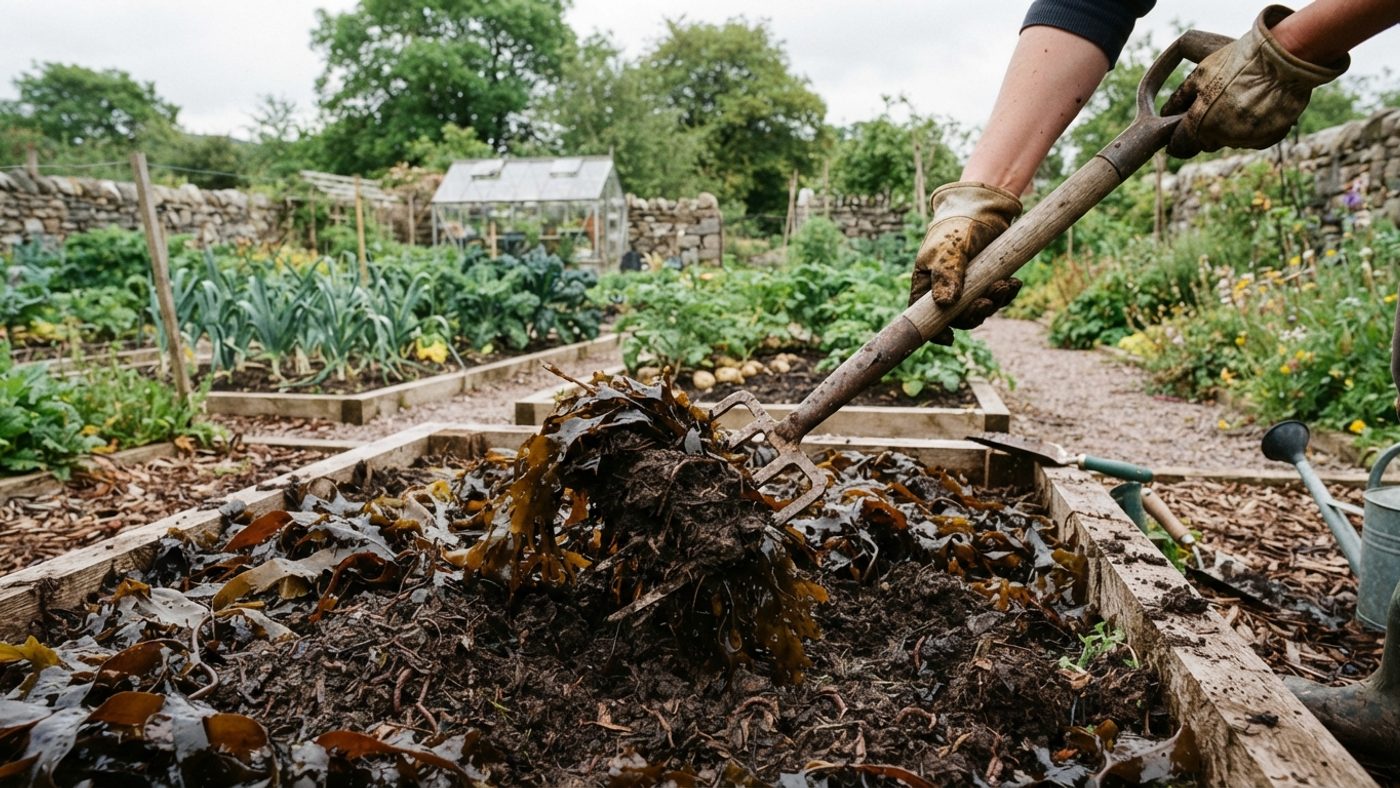
Freshly gathered seaweed can go straight onto the garden without composting first. Dug into the top one or two spades' depth of soil, at up to a barrow load per square metre, it's best applied over winter or spring so it has time to break down before the growing season. This is essentially the old crofting method: storm-cast weed was traditionally piled up for several weeks before spreading, which concentrates the nutrients and reduces the volume to handle, rather than digging it in straight from the beach, a technique still worth using today. Raw seaweed also makes a reasonable compost bulking material, but on its own it turns slimy and gelatinous as it breaks down, so mix it with something woody or fibrous, prunings or shredded paper, to keep the heap workable. This is the cheapest and most direct route from tideline to soil, but it's also the form with the least predictable nutrient content, since nothing has been measured or standardised.
| Form | What it is | Best for | How to apply |
|---|---|---|---|
| Liquid concentrate | Water-extracted, diluted before use | Fast tonic: transplant shock, dry spells, sluggish growth | Foliar spray or soil drench, March–September, per label dilution |
| Seaweed meal | Crushed, dried (sometimes calcified) | Slow-release soil conditioning, base dressing before planting | Work into soil surface or rake in when soil is workable |
| Raw/fresh seaweed | Unprocessed, straight from the shore | Bulky soil improvement, mulchA layer of material spread over the soil around plants to suppress weeds, retain moisture, and improve soil structure as it breaks down. Full definition →, compost bulking | Dig in 1–2 spades deep, up to a barrow load per m², winter–spring; mix with woody material in a compost heap |

Foraging your own seaweed in Scotland, the real legal picture
This is the part worth getting right, because "it washed up on the beach" doesn't automatically mean it's free to take in any quantity, from anywhere, by any method.
Who actually owns the beach
Crown Estate Scotland owns roughly half of Scotland's foreshore, the strip of land between mean high water and mean low water, with the rest in private, estate or local authority ownership. That ownership is what the rules below actually hang off: Crown Estate Scotland's licensing policy governs Crown foreshore, with environmental advice feeding into it separately, rather than a single blanket "Scottish seaweed law."
Storm-cast seaweed for the garden: broadly fine
Collecting a reasonable amount of seaweed for personal use, filling a few bags from a tideline, not stripping a beach, does not require a licence. Crown Estate Scotland's own stated policy is content for such collection to proceed for small quantities appropriate to personal use, while asking people to be mindful of the environmental sensitivity of taking anything from the wild. This sits within a much older legal category: storm-cast material washed ashore, of negligible value and easily carried away by hand, and effectively abandoned by its original owner, falls under a long-recognised public right of beachcombing on the foreshore. A gardener filling a couple of tubs after a storm is squarely inside that tradition, not testing its edges.
Cutting living seaweed is a different act, legally and ecologically
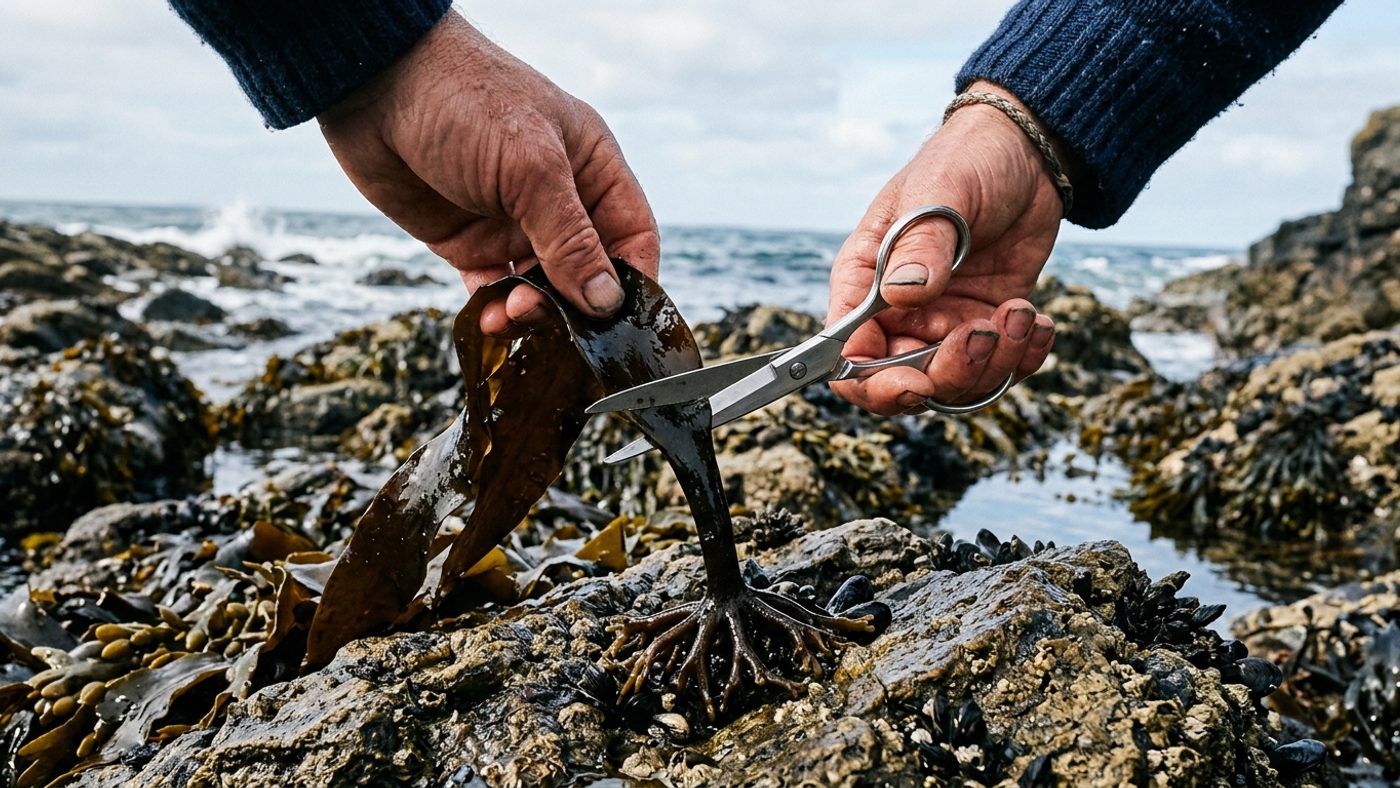
Storm-cast material and living seaweed still attached to rock are treated differently. Cutting seaweed directly off the shore is generally accepted as personal-use foraging too, but the accepted technique matters: cut fronds rather than tearing them, and leave the holdfast, the root-like structure that anchors the plant, attached to the rock, so the plant can regrow. Ripping out the holdfast kills that individual plant outright, which is one reason mechanical harvesting methods that remove the whole plant, holdfast included, are now largely banned in Scottish waters; hand-cutting and hand-gathering are not affected by that restriction.
When a licence is actually required
A licence from Crown Estate Scotland is needed specifically when seaweed is being hand-harvested from Crown foreshore or seabed for any form of monetary or other reward, in other words, once it stops being for your own garden and becomes commercial. Before granting a licence, an environmental risk assessment has to confirm the harvesting won't pose an unacceptable risk, and the policy is not to licence harvesting at all within designated conservation areas unless that risk has been ruled out. Larger proposals, above roughly 90 to 100 tonnes wet weight a year, go through a separate options process with two application windows a year, in March and September. None of this touches someone gathering seaweed by hand for their own vegetable beds; it exists to manage seaweed as a commercial resource. Separately, removing seaweed or kelp from the seabed using a vessel or mechanical equipment counts as a licensable marine activity under the Marine (Scotland) Act 2010, a different regime again from the foreshore rules above, but again, not one that applies to a person on foot with a bucket.
Crofting rights, private beaches, and protected sites
Crofters have a distinct legal footing here: the Crofters (Scotland) Act 1993 gives crofters the right to reasonable use of seaweed under Common Grazings regulations, a right still actively used today largely for spreading beach-cast weed on the machair of the Western Isles, around 317 hectares across the Uists and Berneray were recorded as treated this way between 2011 and 2013 alone. Away from Crown foreshore or crofting land, a beach may be privately owned, and the general advice is that anyone harvesting or taking seaweed should seek the landowner's permission as good practice, even where it isn't strictly required. And if the stretch of coast in question is a Site of Special Scientific Interest, cutting or removing seaweed can count as an "operation requiring consent," check before assuming a favourite spot is unrestricted, since SSSI status isn't always obvious from the beach itself. It's also worth using common sense about where to gather from: avoid marinas, harbours or anywhere near an obvious outflow, regardless of what the licensing rules say.
Why it's worth taking a little, not a lot
Even where taking seaweed is entirely legal, the tideline itself is doing real ecological work. Kelp beds are a genuine marine habitat, nursery ground for fish and shellfish, and classed as a Priority Marine Feature, a nationally important habitat under Scotland's marine planning policy, in some areas, and the strandline where storm-cast weed piles up shelters invertebrates such as sandhoppers, which in turn feed breeding and wintering shorebirds like oystercatchers and ringed plovers. Stripping an entire stretch of tideline removes that food source and habitat in one go, even though no licence was required to do it. The practical version of "take what you need, leave the rest" holds here just as it does with any other foraged material: a bucket or two for the beds is a different act, ecologically, from clearing a beach.
Common questions
Is it legal to take seaweed from a Scottish beach for my garden?
Yes, in reasonable quantity. Crown Estate Scotland, which owns roughly half of Scotland's foreshore, treats personal-use collection of small quantities as not requiring a licence. A licence is only needed for commercial harvesting, where the seaweed is taken for money or other reward.
What's the difference between liquid seaweed feed and seaweed meal?
Liquid seaweed is a diluted, water-extracted concentrate applied as a foliar spray or soil drench for a fast tonic effect during active growth. Seaweed meal is dried and crushed seaweed worked into the soil as a slower-release conditioner. Neither is a complete, high-nitrogen fertiliser on its own.
Can I dig fresh seaweed straight into the garden without composting it first?
Yes. Fresh seaweed doesn't need to be composted before use, it can be dug directly into the soil, up to a barrow load per square metre, ideally over winter or spring so it has time to break down before the growing season. Traditionally it was piled up for a few weeks first to concentrate the nutrients and reduce the bulk, which is still worth doing if you've gathered a large amount.
Does seaweed feed contain enough nitrogen to replace a general fertiliser?
No. Seaweed feed runs low in nitrogen compared with a conventional fertiliser and its nutrient content isn't standardised the way a bagged feed is. It's better treated as a trace-element and growth-stimulant supplement alongside a proper feeding programme, not a replacement for one.
Is it better to take seaweed washed up on the beach, or cut it fresh from the rocks?
Storm-cast seaweed is the simpler and more clearly unrestricted option, it falls under the long-standing public right to beachcomb. Cutting living seaweed is also generally accepted for personal use, but the fronds should be cut, not torn, leaving the holdfast attached to the rock so the plant can regrow.
Sources
7 sources, recorded with what each was used for
- RHS: Seaweed products: Nutrient content, growth regulators, product types, application methods and rates
- Crown Estate Scotland: Licensing of wild seaweed harvesting: Foreshore ownership, personal-use exemption, commercial licensing thresholds and process
- NatureScot: Seaweed harvesting: Ecological role of kelp/seaweed, landowner permission advice, SSSI consent, mechanical harvesting restrictions
- Scottish Outdoor Access Code: Guidance on foraging: Land Reform (Scotland) Act 2003 context, cutting-not-tearing technique, beachcombing’s legal definition
- gov.scot: Wild seaweed harvesting, strategic environmental assessment: Historic crofting use as fertiliser, the pile-to-concentrate technique, Crofters (Scotland) Act 1993 and machair spreading figures
- legislation.gov.uk: Marine (Scotland) Act 2010, Part 4: The marine licensing regime and its relevance to vessel/mechanical seaweed removal
- The Wildlife Trusts: Beaches and strandlines: Strandline invertebrate communities and the shorebird species that depend on them