
Day length is a function of latitude, not temperature or weather, and that's the fact that makes Shetland and Orkney genuinely different from the rest of Scotland, not just a few degrees colder or a bit further from everything. Lerwick sits at roughly 60°N, Kirkwall at just under 59°N, both closer to the Arctic Circle (66.5°N) than they are to London. Around the winter solstice, the sun clears the horizon in Shetland and Orkney for barely six hours, and even then it never climbs far above the rooftops.
Quick answer
Around the winter solstice, Shetland gets about 5 hours 49 minutes of daylight and Orkney about 6 hours 11 minutes, over an hour less than Edinburgh and nearly two hours less than London. At that light level outdoor sowing, transplanting and active growth aren't realistic, so late November to mid-January is best treated as a maintenance and protection period, not a slow growing season. Day length recovers fast once the solstice passes.
It's also a genuine gradient rather than an on/off switch: Caithness, Sutherland and the Western Isles sit at intermediate latitudes and see a milder version of the same effect, with everything below becoming progressively less extreme moving south from Shetland and Orkney.
How short, exactly
Sunrise, sunset and total daylight on the 2026 winter solstice, 21 December:
| Location | Sunrise | Sunset | Daylight |
|---|---|---|---|
| Lerwick, Shetland (60.15°N) | 09:08 | 14:57 | 5h 49m |
| Kirkwall, Orkney (58.98°N) | 09:04 | 15:15 | 6h 11m |
| Edinburgh (55.95°N) | 08:42 | 15:40 | 6h 58m |
| London (51.5°N) | 08:03 | 15:53 | 7h 49m |
Kirkwall gets roughly 22 minutes more daylight than Lerwick on the solstice itself, and both trail Edinburgh by well over an hour and London by around two hours, not a rounding difference, but two fewer hours of usable light every single day for weeks either side of the solstice.
It's worth being precise about what those numbers mean. "Daylight" is sunrise to sunset, sun above the horizon, which isn't the same as useful light for plant growth or outdoor work. Civil twilight, the extra time either side of sunrise and sunset when it's still light enough to work outdoors without artificial light, adds a further hour and forty minutes or so on top of the sunrise-to- sunset figure in Lerwick and Kirkwall, stretching the outdoor working window to a little over 7 hours. But the sun itself sits low on the horizon throughout, even at midday, delivering weak, glancing light rather than anything close to summer intensity. Persistent winter cloud cover, common in both island groups, cuts into even that reduced total on a typical day, so six hours is a best-case ceiling, not a guarantee.
For the opposite extreme, Shetland's nearly 19-hour June days, the "simmer dim", see growing under the simmer dim, which covers the same three locations at the summer solstice.
What six hours of weak winter light rules out
The Gulf Stream keeps both island groups' winters relatively mild for the latitude, milder in fact than many inland mainland Scottish gardens, so light, not cold, is the real bottleneck through the darkest stretch of the year in Shetland and Orkney:
- Sowing outdoors is pointless. GerminationA seed sprouting: breaking dormancy and putting out its first root and shoot, given the right warmth and moisture. Full definition → depends on soil temperature and, for most crops, adequate light for seedlings to establish, neither is present. Nothing sown outdoors in late December in Lerwick or Kirkwall will get enough light to grow away; it will sit, and since these winters, like most of Scotland's Atlantic-influenced coast, tend to be wet rather than hard-frozen, more likely rot in cold, waterlogged soil than simply stall in frozen ground.
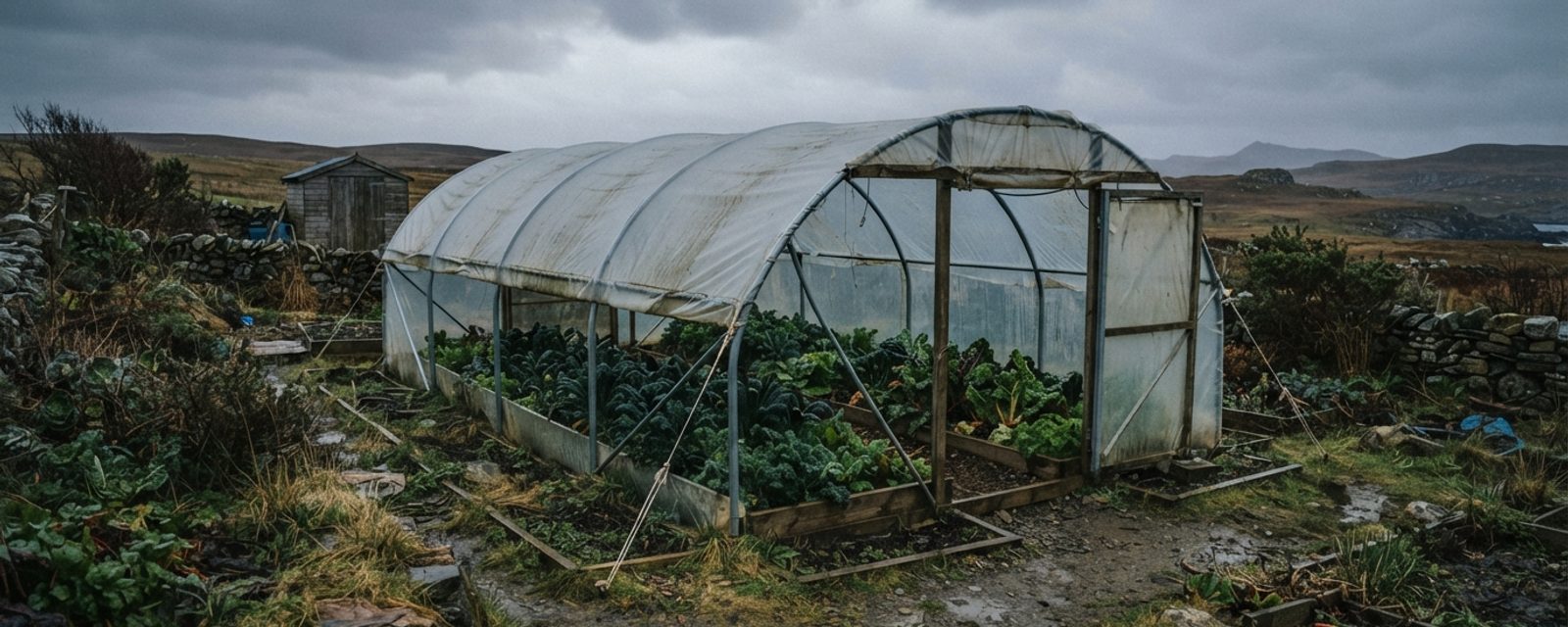
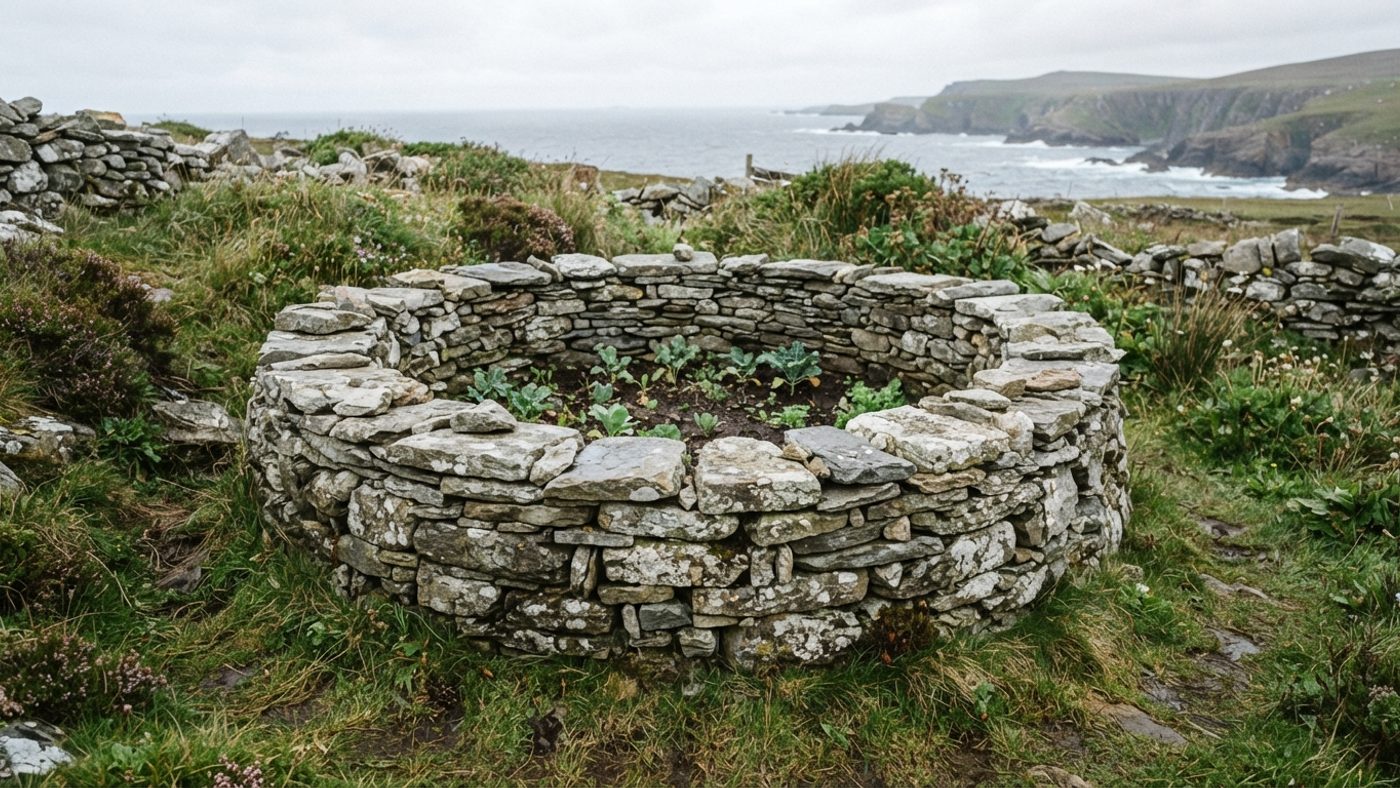
- Transplanting is best avoided. A plant put out to establish new roots needs enough light afterwards to recover and photosynthesise. At six hours of weak, low-angle light, recovery is slow to non-existent, and the plant is also exposed to wind and salt-laden air off the Atlantic and North Sea while it isn't actively growing, a real, near-constant stress in both island groups, and part of why traditional Shetland "plantie crubs" (small circular stone enclosures used to raise seedlings under shelter) exist, and why a polytunnel there is chosen as much for wind and salt protection as for any warmth it holds.
- Photosynthesis, and therefore growth, is minimal. The RHS notes that when light drops below what a plant needs, the result is weak, pale, spindly growth because the plant can't produce the food it needs to function, that's the general mechanism, and at six hours of low-intensity midwinter light in the far north, most edible crops are close to that threshold, if not under it. Growth effectively pauses rather than continues slowly.
- Working outdoors before or after the light window means working in the dark, in practice, with sunrise around 09:00 and sunset around 15:00, anyone with a working day either side of daylight hours is gardening, if at all, by torch or floodlight, in December and into January.
None of this means nothing can be done, it means the darkest six or so weeks around the solstice are a genuine pause point, not just a slow patch. The realistic approach is to treat late November through mid-January as a season for maintenance, protection, and forward planning rather than active growing. As a rough working trigger, once daylight climbs back above roughly 7 hours, mid-to- late January in Kirkwall, around the very end of January in Lerwick, hardy sowings under cover become worth attempting again; full outdoor sowing still wants to wait considerably longer, closer to the last-frost timing on the frost date calculator.
Undercover growing at six hours: what a polytunnel or greenhouse can and can't do
What a polytunnel, greenhouse, or cold frame buys, according to RHS greenhouse guidance, is protection from wind, frost, and waterlogging for whatever's already growing or dormant while the short day plays out, for an already-established Shetland or Orkney garden through the darkest months, that's crops already in the ground or in pots, not seedlings being started from scratch (the LED grow lights guide covers supplementing light for seed-starting specifically, including monthly sunshine-hour comparisons for Edinburgh and Lerwick).
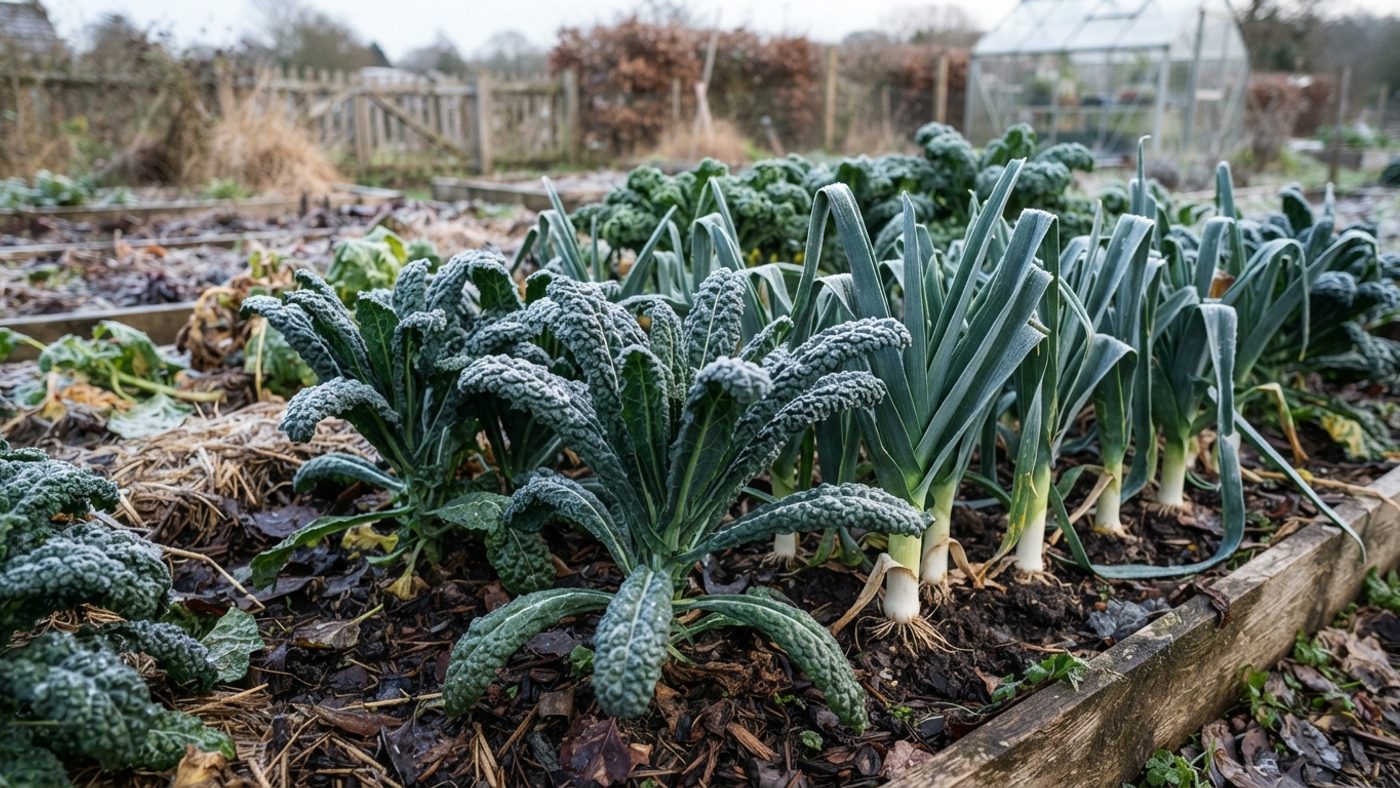
RHS guidance for unheated structures through the darkest months centres on hardy, already-established crops rather than tender vegetables making active growth: hardy lettuce cultivarsA plant variety that arose or was bred under cultivation and is kept true by deliberate propagation, rather than a naturally occurring wild species. Full definition →, pea shoots, overwinteringKeeping a plant alive and intact through the cold months, whether left outdoors, moved under cover, or stored dormant. Full definition → broad beans and peas, and potted herbs moved inside to keep cropping a little longer. Kale, leeks, and chard, well-established far-north overwintering choices in the open ground given the wind shelter above, share the same tolerance for cold and low light. Heated glass changes the temperature equation, but the RHS is direct that heating is rarely cost effective, and heat without light doesn't solve the fundamental problem: a heated greenhouse in Lerwick in January is still only getting six hours of weak sun.
A polytunnel or greenhouse isn't the only option, either: for a smaller plot, horticultural fleeceA lightweight, breathable fabric laid or draped over plants to trap a little warmth and keep off frost, wind and some flying pests. Full definition →, clochesA small, portable clear cover placed over an individual plant or short row to trap warmth and keep off wind, rain and pests. Full definition →, or windbreak netting give a lighter version of the same wind and cold protection at a fraction of the cost and effort, and suit a crofter or allotment grower who doesn't want to commit to a full structure.
Practical measures that do help, the RHS advises: keeping glazing clean (a genuinely dirty greenhouse roof in a low-light location is losing light it can't afford to lose), adding insulation such as bubble wrap to hold what warmth there is, anchoring a polytunnel's cover and frame securely against wind and salt-laden gusts rather than relying on the structure alone, and using a windowsill, ideally south- or west-facing, for potted plants that would otherwise sit in a dim corner. None of this adds daylight hours; it makes better use of the ones that exist, and protects what's already growing until day length itself starts recovering after the solstice.
The mechanism behind why some crops tolerate this and others don't, long-day, short-day, and day-neutral responses to changing day length, is covered in the day length and photoperiod guide; the short version is that most edible crops grown through a Shetland or Orkney winter are there because they're hardy enough to sit through low light and cold rather than because day length itself is triggering useful growth.
The light and mood angle
Shetland's own answer to the dark isn't a gardening one, but it's worth knowing: Up Helly Aa, Lerwick's fire festival, is held on the last Tuesday of January, deliberately timed into the depths of winter darkness as a community response to exactly the conditions this article describes, rather than a coincidence of the calendar.
NHS inform names reduced light exposure in winter as the leading theory behind seasonal affective disorder (SAD): a lack of light in the winter months affects mood, sleep and appetite, with symptoms typically starting in autumn and peaking in December, January and February. Far-north gardeners are living through more weeks of that reduced daylight than gardeners further south.
NHS inform notes that light therapy has mixed evidence but may be more effective if used first thing in the morning, worth knowing given that "first thing in the morning" doesn't arrive until roughly 09:00–09:15 in Lerwick and Kirkwall around the solstice, later than almost anywhere else in the UK. Getting outside during the brief daylight window each day, weather permitting, does double duty as garden time and light exposure at once.
The recovery is faster than the decline feels
High-latitude day length changes faster per week near the equinoxes than it does further south, which is also why Shetland builds up to those near-19-hour June days so quickly once spring gets going. Lerwick's daylight stretches from 5h 49m at the December solstice to roughly 18h 55m by midsummer, a gain of about 13 hours across the year, averaging a little over half an hour a week across the whole stretch, though that's a rough average across the year rather than a steady weekly rate: the real week-to-week gain is slower in the depths of winter and considerably faster around the spring equinox. The six-hour window is real, and it is temporary.
Common questions
How many hours of daylight does Shetland get in December?
Around the winter solstice on 21 December, Lerwick gets about 5 hours 49 minutes of daylight, with sunrise around 09:08 and sunset around 14:57.
Does Orkney get more daylight than Shetland in winter?
Slightly. On the winter solstice, Kirkwall (Orkney) gets about 6 hours 11 minutes of daylight against Lerwick's (Shetland) 5 hours 49 minutes, a difference of roughly 22 minutes, reflecting Orkney's marginally lower latitude.
Can you grow vegetables outdoors in Shetland or Orkney in December and January?
Not effectively. At six hours or less of weak, low-angle daylight, there's rarely enough light for outdoor sowing, transplanting, or active growth. The realistic approach is to treat the weeks around the solstice as a maintenance and protection period, with sowing and planting concentrated into the weeks either side of it as day length recovers.
Does a greenhouse or polytunnel fix the daylight problem in the far north?
No. An unheated structure protects plants from wind, frost, and waterlogging, but it doesn't add daylight hours. It's most useful in winter for hardy, already-established crops like hardy lettuce, pea shoots, kale, leeks, and overwintering broad beans and peas, rather than for pushing tender vegetables through active growth.
Is seasonal affective disorder worse in Shetland and Orkney because of shorter days?
NHS inform names reduced light exposure generally as the leading theory behind SAD, with symptoms peaking in December, January and February. Gardeners in the far north are exposed to more weeks of reduced daylight than those further south, but there is no specific data measuring whether that translates into worse SAD outcomes there than elsewhere in Scotland.
Sources
6 sources, recorded with what each was used for
- US Naval Observatory: Sun/Moon rise-set data, Kirkwall, 21 December: Kirkwall sunrise/sunset/daylight figures
- US Naval Observatory: Sun/Moon rise-set data, Lerwick, 21 December: Lerwick sunrise/sunset/daylight figures
- US Naval Observatory: Sun/Moon rise-set data, Edinburgh, 21 December: Edinburgh comparison figure
- RHS: How plants use light for growth: The mechanism of light intensity, seasonal variation, and minimum light requirements for growth
- RHS: Vegetables in greenhouses: Realistic winter greenhouse crop choices and the heated-versus-unheated framing
- NHS inform: Seasonal affective disorder (SAD): The light-exposure theory of SAD, seasonal symptom pattern, and light-therapy evidence framing