
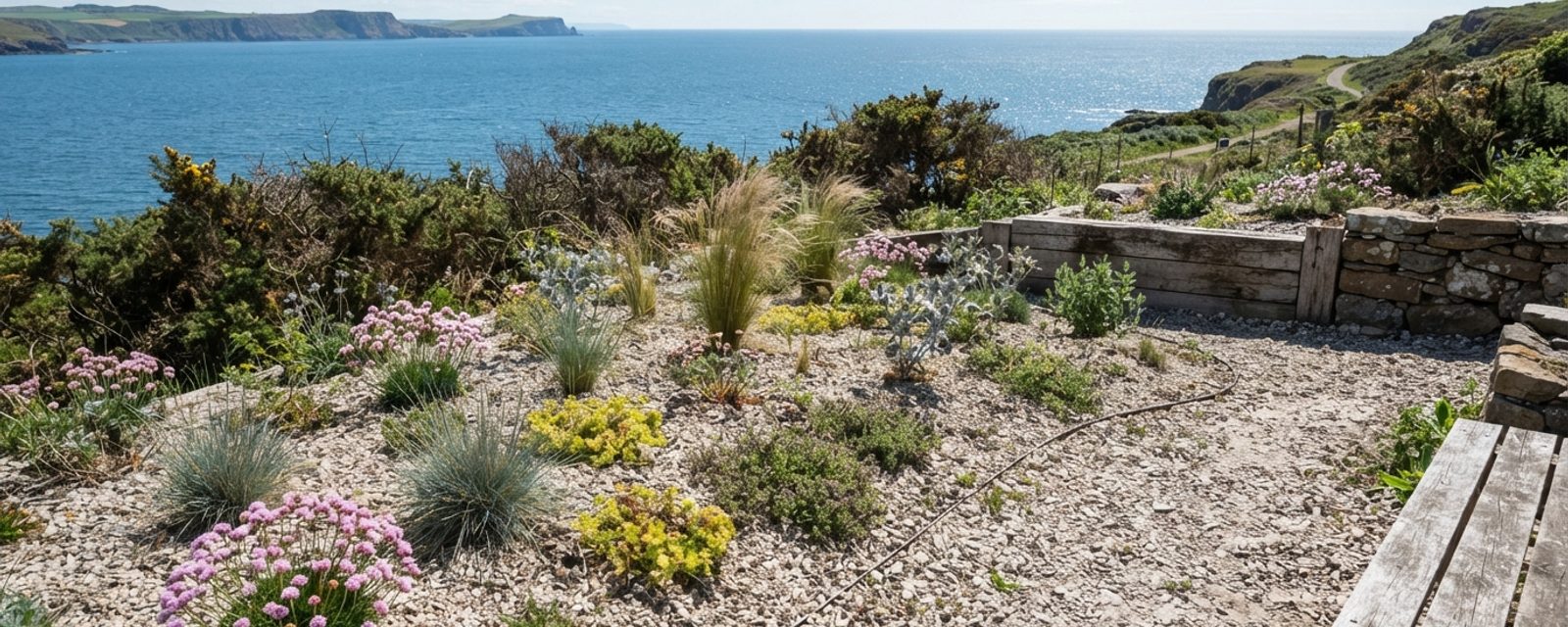
Scotland's weather runs on a prevailing westerly airflow: moist air arrives off the Atlantic and hits high ground almost as soon as it makes landfall on the west coast, the Highlands' western seaboard, Argyll, the mountains behind the Hebrides. ForcedCovering plants to exclude light and speed early, tender growth in the dark, most associated with rhubarb and sea kale in late winter. Full definition → upward over that terrain, the air cools, its moisture condenses, and it drops as rain before it ever reaches the other side of the country. By the time what's left of that air mass descends over Aberdeenshire, Angus, Fife or the Lothians, most of its moisture has already fallen on the hills behind it.
Quick answer
Meteorologists call this orographic rainfall, and the drier zone it leaves on the far side of high ground is the rain shadow. Dunstaffnage, on the Argyll mainland, gets more than double Edinburgh's annual rainfall, and it's a stable, geography-driven split rather than a passing weather pattern, so it's worth planning around directly: drainage, polytunnel ventilation, blight pressure, and raised-bed decisions all shift depending on which coast a garden sits on.
Quick version: what changes by coast
| Decision | West coast | East coast |
|---|---|---|
| Drainage | Design it in from the start: grit, raised paths, French drains where ground is worst | Fix it site by site as problems show up; retaining moisture matters as much as shedding it |
| Polytunnel/greenhouse | Ventilate hard and often against ambient humidity | Ventilate mainly against heat and a still, closed microclimateThe local growing conditions in one specific spot that differ, sometimes substantially, from the wider area's average climate. Full definition → |
| Blight risk | Structurally higher background pressure; airflow and resistant varieties matter more | Lower background pressure, but a closed, still structure still needs venting |
| Raised beds vs in-ground | Drainage advantage counts for more | Drought sensitivity counts for more |
| Water butts | Mainly for overflow/runoff control | Size to bed area; dry-spell reliance is real |
Each row is explained in full below, with a link to the relevant guide.
How much of a gap, in actual millimetres
| Location | Coast | 1991–2020 average annual rainfall |
|---|---|---|
| Edinburgh (Royal Botanic Garden) | East | 728mm |
| Aboyne, Aberdeenshire | East | 800mm |
| Lerwick, Shetland | North | 1,252mm |
| Tiree, Argyll and Bute (island) | West | 1,275mm |
| Dunstaffnage, Argyll and Bute (mainland) | West | 1,728mm |
Dunstaffnage sits on the Argyll mainland, close to Oban, not an exposed outer island, and still receives well over double Edinburgh's rainfall. That's the scale of difference a west-coast rain shadow produces even without going as far out as Tiree or the Outer Hebrides, and it's before accounting for the wettest upland ground further into the Highlands, which climbs higher still. The same mechanism reaches the south-west too, Dumfries and Galloway sits on the same Atlantic-facing side of the country and carries a similarly wet reputation, so this isn't a Highlands-only pattern. Edinburgh and Aberdeenshire's figures, by contrast, are far closer to what a drier lowland-England garden deals with than to the west of their own country.
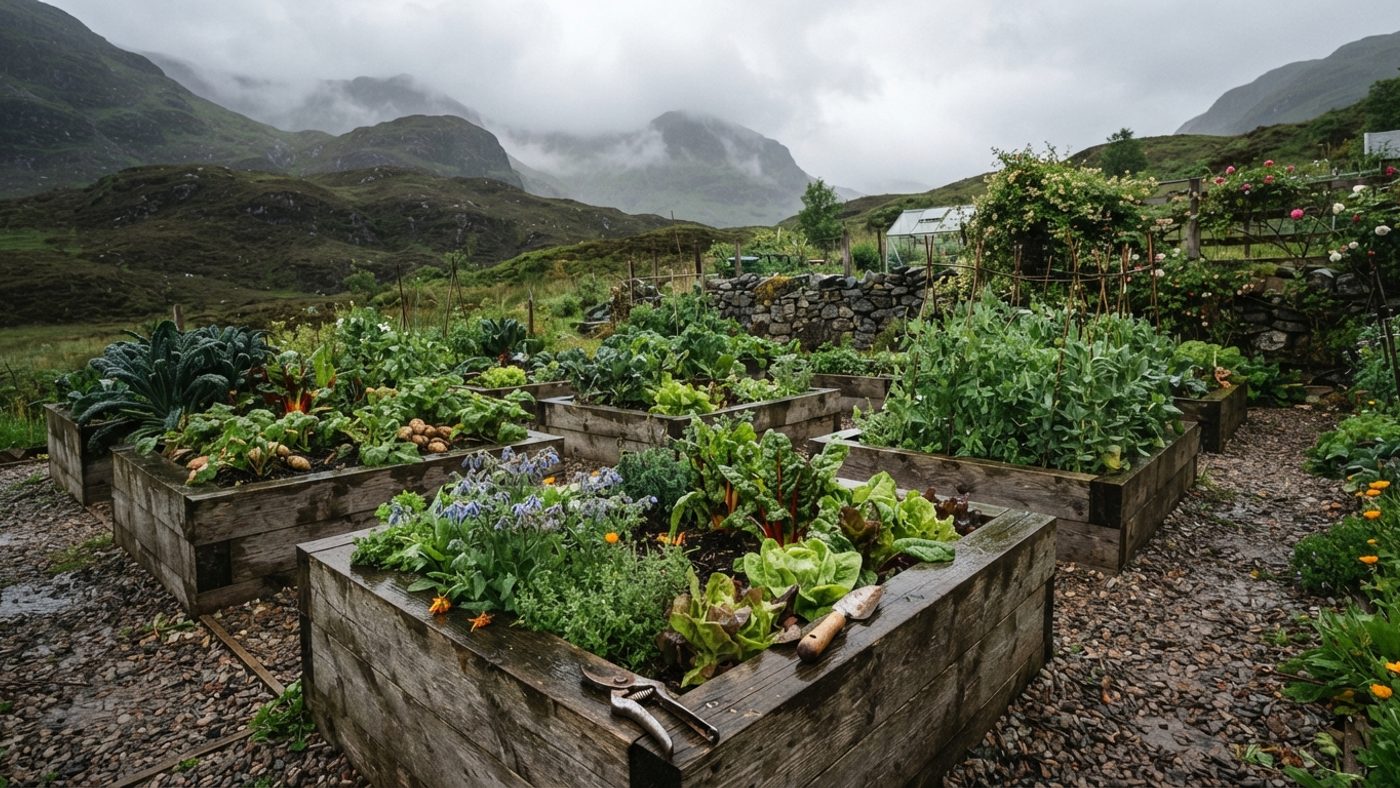
Rain isn't the only figure that splits by coast:
| Metric (1991–2020 average) | Edinburgh (east) | Dunstaffnage (west) |
|---|---|---|
| Annual sunshine hours | 1,449 | 1,227 |
| Winter (Dec–Feb) mean minimum temperature | 1.3°C | 2.7°C |
Less sun on the west coast means foliage takes longer to dry after rain. The higher winter minimum temperature on the west points the same way as the site's frost-dates data toward a milder winter there than on the drier east; the frost dates page has the full regional breakdown, including how that plays out for the length of the growing season.
Drainage strategy: work with what your coast gives you
On the west coast, drainage is usually the first constraint to design around, not an afterthought. Sustained higher rainfall means soil stays saturated for longer after any given downpour, and heavy clay or compacted ground struggles to shed that volume before the next spell arrives. The practical response is to build in free drainageSoil that lets water pass through quickly rather than pooling, so roots aren't sitting in wet ground after rain. Full definition → from the outset: generous grit or coarse sand worked into planting holes and beds, raised paths to keep foot traffic off saturated soil, and a realistic assessment of whether a French drain is worth the effort on the worst-affected ground. See the allotment drainage guide for the construction detail.
The west's persistently wet ground also tends to push soils more acidic: NatureScot links Scotland's higher-rainfall ground to greater mineral leaching and peat build-up over time, especially at altitude. In practice that makes west-coast growers more likely to need lime before brassicasThe cabbage family: cabbage, kale, broccoli, cauliflower, Brussels sprouts, kohlrabi, swede, turnip and more, sharing the same pests, diseases and rotation rules. Full definition → go in, to keep clubrootA soil-borne fungal disease of the brassica family that swells and distorts roots, and survives in soil for years. Full definition → risk down, than growers on the drier, less-leached east. The Scottish soil types page covers testing and liming rates in more depth.
On the east coast, drainage matters less as a default design problem and more as a site-specific one, a heavy clay pocket or a low corner that collects water will still need addressing, but it's not the first assumption to reach for the way it is further west. Free-draining sandy or loam soils are more common on the drier east, and the more pressing planning question is often the opposite one: retaining enough moisture through a longer dry spell rather than shedding excess. Wetter soil also takes longer to warm up in spring than drier ground, so a west-coast plot is more likely to want a slightly later start to direct sowing than a comparable east-coast one, on top of whatever the season length itself gives.
A garden that's already flooded needs different, more urgent advice than drainage planning, root-damage symptoms and immediate fixes matter more at that point than prevention, on either coast. Slugs and snails are, per RHS, generally well suited to damp, mild conditions wherever they occur in the UK, and the west coast supplies more of both than the east does, so it's a reasonable expectation that slug pressure runs higher there in practice; check foliage more often in a prolonged wet spell.
Polytunnel and greenhouse siting: the same structure, different problems
A polytunnel or greenhouse in Argyll and one in the Lothians are dealing with different climates, even though the buying decision and the basic ventilation principle stay the same on both. The polytunnel vs greenhouse comparison covers that decision; here's how the pressure on ventilation differs by coast.
On the west coast, the starting problem is volume: more rain means more ambient humidity finding its way in around doors and vents, and wetter, less sunny local air (see the sunshine-hours figures above) means a tunnel or greenhouse takes longer to dry out between wet spells. Wind exposure compounds this on the more open parts of the west and the islands, worth anchoring a structure securely against on top of everything else, but even on a sheltered west-coast site, humidity management inside the structure needs to be treated as a constant task, not an occasional one. Still, damp, sheltered ground on the west coast has a well-known nuisance of its own for anyone working outside it: midges thrive in exactly those conditions, so evening and still-air gardening sessions are a bigger practical consideration there than on the drier, breezier east.
On the east coast, the structure is more likely to run dry and warm than damp, which shifts the ventilation problem toward heat and light management rather than moisture control, particularly in a still, sunny spell. The lower rainfall doesn't remove the need for good airflow, since a closed structure builds its own humidity regardless of how dry the air is outside, but the balance of what's being managed shifts.
Ventilation and blight pressure under cover
Growing tomatoes under cover reduces how many wind-blown blight spores arrive in the first place, but a humid polytunnel lets any spores that do get in develop fast once they're inside, so ventilation does more work under cover than the general "growing under cover helps" framing suggests. That pressure runs higher by default on the west coast, where the ambient air feeding the structure is wetter more of the time: a west-coast tunnel needs more deliberate, regular venting to avoid trapping the humid conditions blight favours. An east-coast tunnel builds its own humidity too if left closed and still, just without wetter ambient air adding to it.
Blight pressure: a genuine west-coast risk factor, not a fixed calendar date
Potato and tomato blight (Phytophthora infestans) needs prolonged surface wetness, several hours of it, not a passing shower, before it can infect a plant, and once conditions are humid enough, the RHS notes it spreads rapidly through a crop. That threshold is met more often on the west coast simply because sustained wet spells happen more often there, raising the background pressure across a season without changing how the disease itself behaves. There's no fixed calendar date to watch for in Scotland either way, conditions on the ground matter more than the time of year.
There's no fungicide available to gardeners once blight takes hold, which makes prevention, resistant varieties, good airflow, and watching foliage closely through any prolonged wet spell, the only real lever, and a bigger one on the west coast than the east. The potato blight and tomato blight pages cover resistant varieties and the full control picture, including the Hutton Criteria, a blight-risk forecasting model developed at Scotland's James Hutton Institute that flags periods of warm, humid weather likely to trigger an outbreak.
Raised beds vs in-ground: the same choice, weighted differently by coast
A raised bed's main advantage, better drainage than the surrounding ground because it isn't sitting in whatever water table the native soil has, matters more on the west coast, where waterlogging risk is the more constant background problem. Its main disadvantage, drying out faster than ground-level soil and needing more watering through a dry spell, matters more on the east coast, where dry spells are both more frequent and less broken up by rain.
A raised bed's drainage strength lines up with the west's core problem, and its drought sensitivity lines up with the east's core problem, in each case working against what that coast needs least. Neither pull is decisive on its own: plenty of west-coast gardens do fine in-ground on naturally free-draining or sloped ground, and plenty of east-coast gardeners still choose raised beds for accessibility or soil-quality reasons that have nothing to do with rainfall. As a starting lean, though, it's a real one. The raised bed vs ground growing guide covers the full construction and cost comparison.
Other planning implications worth weighing by coast
Water butts and irrigation. A west-coast garden is less likely to need supplementary watering through summer, which makes water-butt capacity more about managing overflow and runoff than about banking a resource for a dry spell. An east-coast garden, especially one with raised beds, is more likely to depend on stored rainwater actually being there when a dry stretch runs long, so sizing water-butt capacity to the bed area, not just to what's convenient to fit against a wall, matters more here.
MulchA layer of material spread over the soil around plants to suppress weeds, retain moisture, and improve soil structure as it breaks down. Full definition → and soil structure. On the west coast, mulch's main job is often protecting soil structure from repeated heavy rain, stopping surface capping and erosion, and keeping organic matter from washing away, more than retaining moisture that's already abundant. On the east coast, mulch does more conventional double duty: suppressing weeds and holding onto moisture between the rain that does fall.
Crop choice. Crops that tolerate, or actively prefer, damper ground and don't need a long dry spell to ripen well suit the west coast better than crops that sulk in wet soil or split their fruit after heavy rain following a dry stretch. The damp garden crop picks cover varieties suited to consistently wet ground; on the drier east, that particular constraint eases, which is part of why Angus and Perthshire, sitting on the drier, sunnier side of the divide, are Scotland's traditional soft-fruit heartland: raspberries and strawberries ripen better for the extra sunshine and lower splitting risk than a wetter west-coast site would give them.
Common questions
Does the east/west rainfall divide apply everywhere on each coast, or just near the sea?
As a general pattern it's strongest close to the west coast and the hills immediately behind it, and fades further east, but it isn't a precise line: inland glens and higher ground anywhere in Scotland can be wetter than their nearest coastal town. Use the coast comparisons here as a planning lean, not a guarantee for one specific site; a site's own aspect, altitude and shelter still matter.
Is west-coast rain worse for blight than east-coast rain, or just more frequent?
The mechanism is identical everywhere; blight needs several hours of continuous surface wetness to infect, regardless of location. What differs is how often that condition is met: sustained wet, humid spells happen more often on the west coast simply because it rains more there, which raises the background risk pressure across a season without changing how the disease itself behaves.
Should I always choose a raised bed if I garden on the west coast?
Not automatically. A raised bed's drainage advantage suits the west coast's wetter default, but a naturally free-draining or sloped plot may not need it, and raised beds bring their own construction cost and faster drying-out in any dry spell that does occur. It's a lean worth weighing, not a fixed rule.
My garden is inland, not on either coast, which set of guidance applies to me?
Go by the direction your prevailing weather comes from rather than straight-line distance to the sea. The rain-shadow mechanism means a site still on the Atlantic-facing side of Scotland's hills sits in the path of the same wet airflow that drives the west-coast figures, even well inland; a site on the far side, in the airflow's shadow, leans toward the drier eastern pattern instead. Local altitude and shelter can still shift either case.
Sources
9 sources, recorded with what each was used for
- Met Office: Edinburgh, Royal Botanic Garden long-term averages (1991–2020): East-coast annual rainfall, sunshine hours, and winter mean minimum temperature figures
- Met Office: Aboyne, Aberdeenshire long-term averages (1991–2020): East-coast (Aberdeenshire) annual rainfall figure
- Met Office: Dunstaffnage, Argyll and Bute long-term averages (1991–2020): West-coast mainland (Argyll) annual rainfall, sunshine hours, and winter mean minimum temperature figures
- Met Office: Tiree long-term averages (1991–2020): West-coast island annual rainfall figure
- Met Office: Lerwick long-term averages (1991–2020): North/Shetland comparator annual rainfall figure
- RHS: Potato and tomato blight: Blight infection mechanism (prolonged surface wetness required, rapid spread under humid conditions) and the no-fungicides-for-gardeners point
- RHS: How to make a raised bed: Raised bed drying-out-faster and water-butt guidance
- NatureScot: Scotland's soils: Rainfall/leaching link to Scottish soil acidity and peat distribution
- RHS: Slugs and snails: The damp-mild-climate link to slug and snail activity