
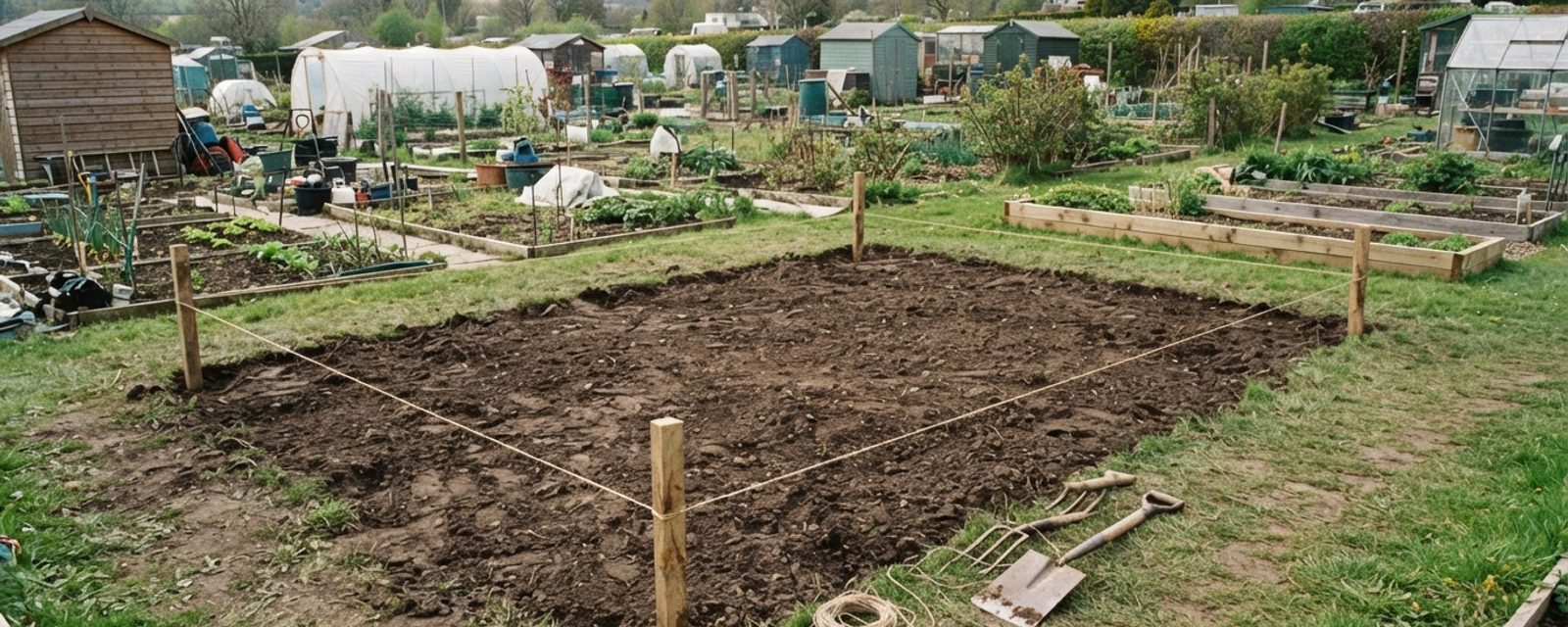
Almost every allotment site in the UK traces back to the same basic mechanism: a local authority holding land, and a statutory duty (in various forms, in various decades) obliging that authority to let plots to residents who want to grow their own food. That's why, whichever nation you're in, the first stop for anyone wanting a plot is not a private landlord or a gardening charity but the council. Private and community-run allotment associations exist too, some lease land from the council and manage their own waiting lists, others own their site outright, but the legal duty that created the allotment system in the first place sits with local government.
The system's oldest working part is also its strangest-looking: plots are still commonly described in rods, poles, or perches, three names for the same unit (1 rod = 1 pole = 1 perch = roughly 25 square metres). A "full plot" of 10 rods works out at about 250 square metres, roughly the size of a doubles tennis court, and that figure turns up on both sides of the border, in Scottish statute and in English council rent schedules, even though the underlying law is different in each case. The unit has survived because nobody has needed to replace it: plot sizes were fixed by custom generations ago, and area is area, whatever it's called.
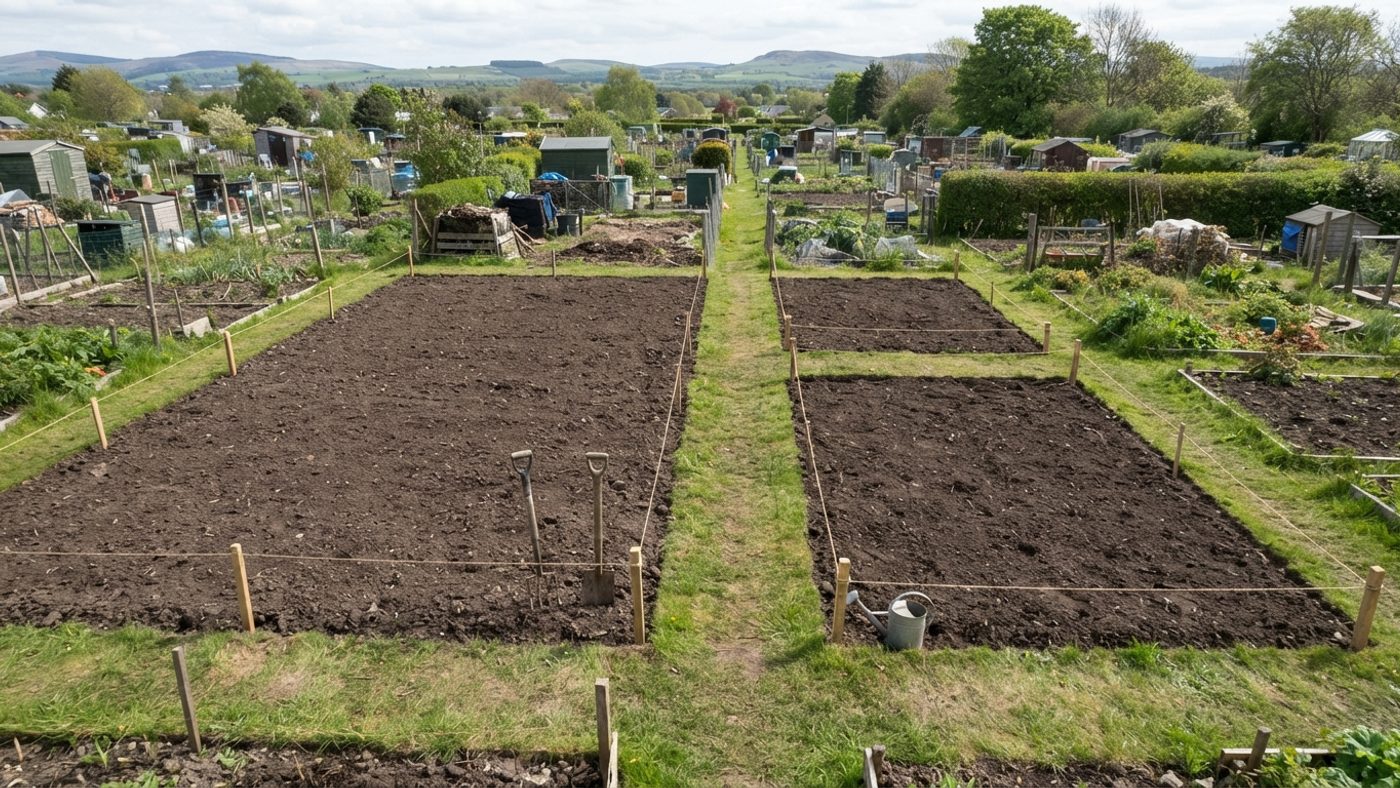
Finding your local allotment service
- Search your council's website for "allotments." In England, Wales, and Scotland alike, this is normally run through the environment, parks, or community services department, not a central government body.
- Check for a separate association if the council doesn't run sites directly, or runs only some of them. Many self-managed sites (societies leasing council land, or fully independent associations) run their own waiting lists and rules, sometimes with shorter queues than the council-run sites nearby.
- Register on the waiting list. Most councils use an online form; a few still require a paper application or an in-person visit. You'll typically need proof of address, since most sites (though not all) restrict plots to local residents.
- Expect to wait. How long depends entirely on where you live, see below.
Eligibility and cost
Eligibility requirements are minimal and mostly about geography, not means-testing: councils commonly require the applicant to live within the local authority area, and some sites narrow that further to a smaller radius around the specific site, check the site's own rules rather than assume the whole council area counts. There's no UK-wide minimum age, though a small number of sites set one for the named tenant.
Rent is charged annually, scales with plot size, and varies widely by council, there's no national rate anywhere in the UK. Scotland comes closest to a shared standard: councils there must set rent using a statutory "fair rent" method that weighs the services provided against the tenant's ability to pay, rather than setting whatever figure they like. Two real examples of what that looks like in practice:
| Runnymede (England) | Edinburgh (Scotland) | |
|---|---|---|
| Full plot, annual rent | £220-£250 (£22/rod, rising to £25 from April 2026) | £170 (2026 rate) |
| Concession | 50% for state pension age (reducing to 25% from April 2026) | 50% for students, unemployed, or state pension age |
| Extra cost | Refundable key deposit | — |
Most sites charge some form of refundable deposit alongside rent, the amount and what it covers (a shed key, general good-condition assurance) is set locally, so ask when you apply rather than assume.
Before you sign: plot size, cultivation duties, and notice periods
A tenancy agreement for an allotment plot is a real legal agreement, and it comes with obligations most first-time holders don't expect. Once you have a plot, our companion piece on allotment rules covers the day-to-day detail (structures, animals, selling produce, subletting) in full; the points below are the ones worth knowing before you even sign.
- Cultivation requirements. Nearly all agreements require you to keep the plot "in good cultivation," broadly, actively growing something on most of it, not left to grass and weeds. Sites carry out periodic inspections, and a plot that fails repeated inspections can have its tenancy terminated; in Scotland, that termination still has to come with the statutory minimum notice below, even for a breach as clear-cut as failed cultivation.
- Notice periods. Termination notice varies by circumstance. Under Scotland's Community Empowerment (Scotland) Act 2015, a council must give at least one month's notice to end a tenancy for breach of the agreement (such as failed cultivation), but a full year's notice if it's ending the tenancy to dispose of or repurpose the land, and in that case Scottish Ministers must approve the change and the tenant is due compensation of at least one year's rent for the disturbance.
- Subletting. Under the same Act, Scottish allotment tenants cannot sublet their plot, and can only transfer (assign) it to someone else with the local authority's consent.
- Plot size on offer. In Scotland, if you don't specify a smaller area when you apply, the standard offer a council must make to satisfy your request is around 250 square metres, you can ask for less, but you can't demand more.
Half-Plots and Plot-Sharing: Getting an Allotment When Full Plots Aren't Available → covers what asking for that smaller area actually looks like in practice, and the legal side of sharing one plot informally between two people.
Scotland's law vs England and Wales's law
Scotland's allotment system runs on entirely separate legislation from England and Wales, diverging on the wait-time cap, rent-setting, subletting, and termination compensation, set out in full in the table below.
Councils in Scotland also have a duty, under section 119 of the same Act, to prepare and publish a food-growing strategy, a plan for how they will identify land, including but not limited to allotments, for growing food across their area. It's a separate duty from the waiting-list and provision duties above, but the three work together: the strategy is meant to be the mechanism by which a council plans its way toward meeting demand, not just react to it plot by plot.
The Scottish Allotments and Gardens Society (SAGS) is the national membership and advocacy body for Scottish allotment holders, a useful port of call for the policy side of a plot, once you have one. For the fuller detail on Scottish allotment law and SAGS's role, see our dedicated guide to allotments in Scotland.
| Scotland | England & Wales | |
|---|---|---|
| Governing law | Community Empowerment (Scotland) Act 2015, Part 9 | Small Holdings and Allotments Act 1908 (plus Allotments Acts 1922 and 1950) |
| Waiting-list duty | Councils must "establish and maintain" a waiting list (s.111) | No statutory duty to maintain a list; provision duty is triggered by demand shown a different way (see below) |
| Duty to provide plots | Duty activates automatically once the waiting list under s.111 reaches 15 people (if the council owns no allotments) or 1 person (if it already owns any); no petition needed (s.112) | Councils "shall provide a sufficient number of allotments" where demand is shown (s.23); demand can be formally triggered by a written request from just six local electors or council-taxpayers |
| Statutory wait-time cap | A person cannot remain on the waiting list for more than a continuous 5 years (s.112) | No statutory cap found in the 1908 Act; wait times are determined locally and, in high-demand areas, can run well beyond five years |
| Plot size unit | Standard offer of approximately 250 square metres unless a smaller size is requested (ss.109-110) | Traditionally measured in rods/poles/perches; a full plot is commonly 10 rods (~250 square metres), though this is convention rather than a fixed statutory figure |
| Rent rules | Regulations must set a "fair rent" method that accounts for services provided, their cost, and the tenant's ability to pay (s.115(3)(b)) | No national rent formula; each council or association sets its own rent (e.g. Runnymede Borough Council charges £22 per rod/year, with pensioner concessions) |
| Subletting/assignment | Subletting prohibited; assignment only with authority consent (s.130) | Governed by individual tenancy agreements, which typically prohibit subletting |
| Termination notice | One month for breach; one year (with Ministerial approval) for disposal or change of use, plus minimum one year's rent compensation (ss.126, 133) | Set by individual tenancy agreements; historically protected by statutory compensation provisions in the 1922 and 1950 Acts |
Only Scotland's cap is a hard number written into statute (s.112(1)(b)), England and Wales's demand-triggered duty (s.23 of the 1908 Act) has no equivalent time limit, part of why waits in high-demand English cities can run considerably longer than five years with no statutory backstop forcingCovering plants to exclude light and speed early, tender growth in the dark, most associated with rhubarb and sea kale in late winter. Full definition → action. It's also not just a ceiling: s.112(1)(a) separately requires the council to take reasonable steps to keep the waiting list itself at no more than half its total allotment stock, an ongoing management duty rather than a one-off number to hit. Worth knowing, though: the 2015 Act doesn't spell out what happens if a Scottish council breaches the five-year cap, there's no stated penalty, compensation, or complaints route written into Part 9 itself. In practice, a breach of any statutory council duty is something to raise first through the council's own complaints procedure, and from there, if unresolved, with the Scottish Public Services Ombudsman, the standard escalation route for any Scottish public body, not a right created by Part 9 specifically.
Common questions
How long is the waiting list for an allotment?
It varies enormously by council and by site, smaller or less central sites can have plots available within months, while city sites are typically much longer. Edinburgh's council-run allotments, for example, are described by the council's own allotment service as in "extremely high demand," with waiting lists at most sites significantly exceeding available plots. See the table above for how Scotland's five-year statutory cap compares with England and Wales, where there is no equivalent limit.
Can I get an allotment if I don't own my home?
Yes. Allotment tenancies are separate from your housing tenure, renters are just as eligible as homeowners. Most councils only ask that you live within the local authority area or within a set distance of the site.
Are there discounts for pensioners or people on low incomes?
Many councils and associations offer reduced rent for tenants of state pension age, people with disabilities, or those on certain benefits, but this is set locally rather than guaranteed nationally. Check the specific council's or association's fee schedule when you apply.
What does "5 rods" or "10 poles" actually mean?
Rod, pole, and perch are three names for the same traditional unit of roughly 25 square metres. A 5-rod plot (about 125 square metres) is often offered as a "half plot," and a 10-rod plot (about 250 square metres) as a "full plot." In England and Wales this is convention rather than a fixed legal figure, councils are free to set their own plot sizes. Scotland is the exception: the 250 square metre standard offer is written into the 2015 Act itself (ss.109-110), so it's a legal default there, not just a habit carried over from custom.
What happens if I can't keep up with cultivation?
Sites run periodic inspections, and a plot left uncultivated for an extended period can have its tenancy ended, freeing it up for the next person on the waiting list, in Scotland, with a minimum of one month's written notice. If you're struggling with the workload, most sites would rather you ask about reducing to a smaller plot, or a half-plot, than let the tenancy lapse.
Sources
6 sources, recorded with what each was used for
- Community Empowerment (Scotland) Act 2015, Part 9: Waiting-list duty (s.111), demand-activation and 5-year wait cap (s.112), plot size (ss.109-110), rent regulations (s.115), food-growing strategy (s.119), subletting (s.130), notice periods and compensation (ss.126, 133); commencement date of s.112 (1 April 2018) confirmed directly
- Small Holdings and Allotments Act 1908, s.23: England & Wales statutory duty to provide allotments where demand exists, and the six-elector request mechanism
- Runnymede Borough Council: Allotments: Real-world example of rod-based plot sizing, per-rod rent, and pensioner concession in an English council
- Edinburgh Outdoors (City of Edinburgh Council): Rent an allotment: Real-world Scottish rent figure, concession terms, and demand description
- gov.scot: Part 9 Community Empowerment (Scotland) Act 2015 — Allotments, guidance for local authorities: Confirms the guidance document's scope for local authorities implementing Part 9
- Scottish Public Services Ombudsman (SPSO): Practical (not statutory) complaints-escalation route for a breach of Part 9 duties