

There's a downpipe round the back of most Scottish houses doing nothing but shedding water straight into a drain. If yours is one of them, the case for putting a butt under it is straightforward: Scotland gets more rain than most of the rest of the UK, so a butt here fills back up quickly and is far less likely to sit empty through a dry spell than the same butt further south.
The other reason people end up thinking hard about their water butt is less cheerful: seedlings that damped off, the fungal collapse that rots a seedling's stem at soil level, often overnight, and a nagging suspicion that the rainwater used to water them was somehow to blame. That suspicion is worth taking seriously, but not in the blanket way it usually gets repeated: the real risk isn't rainwater itself, it's a specific, avoidable failure in how the butt was kept. The chemistry question, hard tap water versus soft rainwater, pH, chlorine, which plants actually need rainwater, has its own answer here; Garden Organic recommends fixing a butt to a downpipe on sheds, greenhouses and roofs as standard practice for reusing rainwater either way.
A basic diverter-and-butt setup is a straightforward DIY job with a hacksaw, a drillA shallow, straight groove made in prepared soil for sowing seed into, at a set depth so germination and rows are even. Full definition → and an afternoon rather than a job that needs a tradesperson, kits are sold as a single package with the fittings and step-by-step instructions included, and both butts and diverter kits are widely available at garden centres and hardware stores.
Sizing: how big a butt do you actually need
Use these figures as a starting point to size against, rather than an exact number to hit:
| Reference point | Figure |
|---|---|
| Rainfall off a small shed roof, per year (RHS example, drier part of England) | 2,500-3,500 litres |
| Equivalent in standard 240-litre butts | Roughly 10-15 butts' worth over a season |
| Typical off-the-shelf butt size | 100-300 litres |
| A full 200-litre butt, water alone | 200kg |
A butt also refills faster here than the same size would somewhere drier, so it's less likely to run dry mid-season. If one butt isn't enough for what you actually need, a greenhouse full of trays, or a vegetable bed that wants regular watering all summer, the straightforward fix is to link a second (or third) butt to the first with a connector kit rather than hunting for one oversized tank. This also spreads the weight, which matters more than it sounds (see positioning, below). A butt can also run low exactly when it matters most, during a dry spell that coincides with a holiday, see holiday watering systems for why a rainwater-fed drip kit still needs checking before you go, not just set up once and trusted.
The downpipe diverter
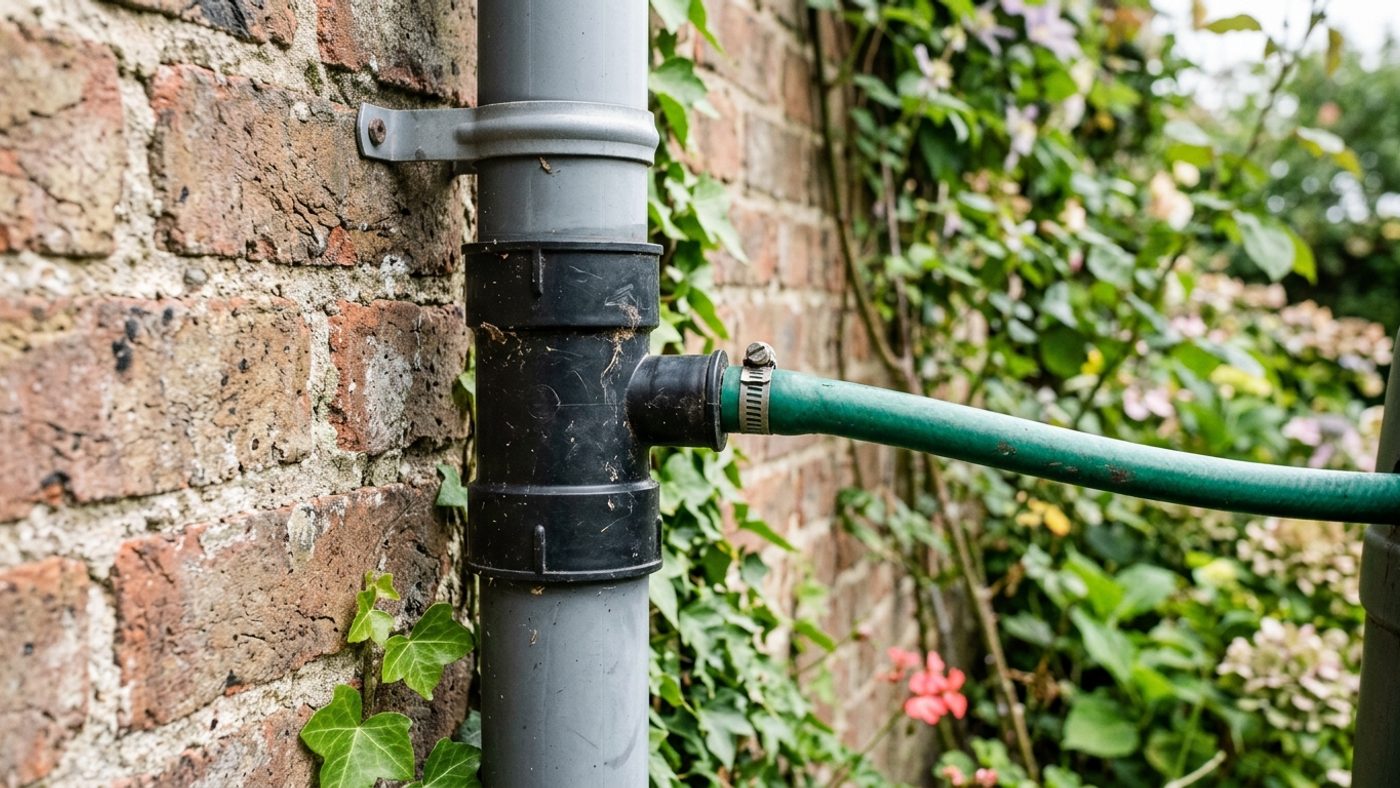
A diverter is what lets you add a water butt to an existing downpipe without re-plumbing your guttering: a small plastic fitting, roughly fist-sized, that's cut into the downpipe and redirects a portion of the flow sideways into the butt via a short hose, while letting the rest continue down and away as normal. Most diverter kits include a built-in filter or mesh at the inlet to catch leaves and debris before they reach the butt, worth checking it's fitted and clear, since a blocked or missing inlet filter is often the first place debris gets into the water, before it's even reached the lid.
Get the diverter's height right and the butt fills without the gutters backing up; kits come with instructions for how far down the pipe to cut the fitting in, since positioning it wrong is the main reason a butt either fills too slowly or overflows before it's needed. Once the butt is full, the overflow has to go somewhere, most diverter kits route it back into the downpipe or out to a soakaway (a drainage pit that lets excess water disperse into the ground rather than pool on the surface), carrying excess water away during heavy rain rather than letting it pool round the base. Worth checking where that overflow actually goes before committing to a spot, a soakaway or drain that copes with sustained heavy rain, not just a light shower.
Positioning: stable ground versus a handy tap
A full water butt is heavy, a 200-litre butt holds 200kg of water before you've added the tank itself. It needs to sit on ground that's firm and level, not soft soil or a slope. RHS advice is to use a proper stand or bricks, checked level, both so the butt doesn't topple and so a watering can fits under the tap.
That requirement pulls in a different direction from where you'd ideally want the water: often near a greenhouse, cold frame, or vegetable bed rather than wherever the downpipe happens to be. There's no way around this tension entirely, the butt has to go where the downpipe and a stable base coincide, but a short length of hose from the tap, or a second linked butt positioned nearer the beds, can close the gap without moving the whole structure.
If there are children or pets around the garden, a fitted, secure lid is a real safeguard against open standing water, on top of keeping the water itself cleaner.
Keeping the butt hygienic, and what actually causes the seedling risk
Rainwater itself isn't the problem behind that common damping-offA fungal disease that kills seedlings at soil level, usually caused by overwatering, poor airflow, or reused unsterilised compost or trays. Full definition → worry. RHS guidance on damping off is specific about what is: an open butt that lets in leaves and other organic debris can become a source of the fungi that cause it, because that debris is exactly the kind of decaying organic matter the pathogens live in. RHS's own advice on collecting and storing rainwater backs this up directly: cover the butt with a close-fitting lid "to prevent rain-borne spores of plant diseases from entering the water butt, and to discourage algal growth", the same lid doing both jobs at once. A covered butt, kept clear of leaves and kept clean, avoids that route almost entirely.
The same logic shows up in advice aimed at growers more generally. Utah State University Extension's guidance on damping-off states the underlying principle directly: use clean water for irrigation, and don't use pond water or runoff that could have been in contact with contaminated soil. An open water butt full of last autumn's leaves is closer to that pond-water scenario than most gardeners realise; a lidded one with clear guttering and a working inlet filter feeding it is not. Uncovered, stagnant water is also a general breeding ground for bacteria, not just plant pathogens, which is the other reason to keep the lid on and to wash your hands after handling the sediment at the bottom of a butt.
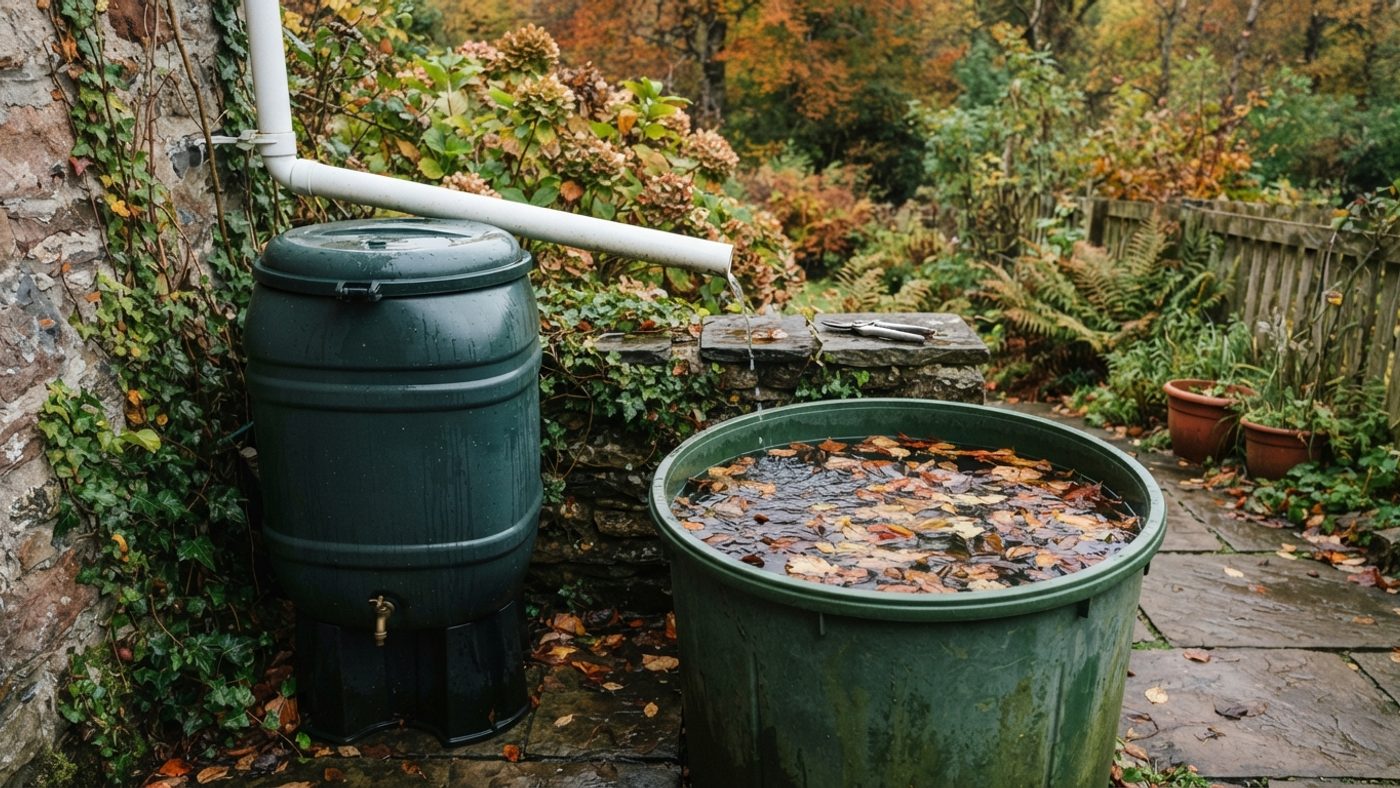
So the practical fix doesn't require giving up rainwater for the garden:
- Fit and use the lid that comes with the butt, it also keeps out wildlife and cuts down algal growth.
- Keep the guttering and diverter filter clear of leaves and moss, since debris upstream ends up in the water.
- Clean the butt out roughly once a year, RHS advice is warm water and a little washing-up liquid, rather than letting sediment build up indefinitely.
Watering seedlings specifically
For seed trays and pots, the most vulnerable stage, before roots are established, RHS's own recommendation is to use mains water where you can. If you're using rainwater, its condition is that the butt must be covered, precisely to avoid the debris route above. If you're ever in doubt about a particular butt's cleanliness, it's been open, it's had leaves in it, you can't remember the last time it was cleaned, mains water for that one tray costs nothing and removes the question entirely.
None of this means abandoning the water butt for the rest of the garden. A covered, reasonably clean butt is fine for established plants, containers, and anything past the seedling stage; the extra caution is specifically for young, vulnerable growth in trays and pots, not a reason to distrust rainwater generally.
Winter care
A butt left full and untouched over a hard frost is a genuine risk anywhere hard frosts are a regular winter feature, which describes inland and upland Scotland especially: water expands as it freezes, and a plastic butt, tap or diverter can crack under that pressure. In those areas, the safer routine is either to drain the butt down before the coldest stretch, disconnect the diverter so the downpipe runs freely over winter, or fit an insulating jacket if the butt needs to stay in use. A cracked butt or split tap discovered in spring, once it thaws, is a more expensive fix than the ten minutes it takes to check before the first hard freeze.
Maintenance, ongoing
A water butt isn't a fit-and-forget object. Beyond the annual clean and winter check above:
- Check the lid is still seated properly after windy weather, a gap is enough to let leaves back in.
- Watch the tap or outlet for sediment build-up; a slow or blocked tap is usually the first sign the bottom of the butt needs attention.
- Glance at the guttering and diverter filter once or twice a year, especially in autumn, since that's where debris accumulates before it ever reaches the butt.
None of this is arduous, and on a butt that's going to be doing real work through most of a wet Scottish year rather than sitting empty, it's worth the ten minutes it takes.
Common questions
Is rainwater from a water butt actually dangerous for seedlings?
Not inherently. The risk comes from an open butt collecting leaves and organic debris, not from rainwater itself. A covered, reasonably clean butt is safe to use for most of the garden; for the most vulnerable seed trays, mains water removes the question entirely.
How often should I clean my water butt?
Roughly once a year is the standard advice, empty it and scrub it out with warm water and a little washing-up liquid, with a check on the lid, diverter filter and guttering a couple of times a year in between.
Can I connect more than one water butt together?
Yes. Linking a second butt with a connector kit is the usual way to add capacity, and it's often more practical than trying to fit one oversized tank on a single stable base.
Do I need to worry about my water butt freezing in winter?
Anywhere hard frosts are a regular feature, inland and upland Scotland especially, yes, a hard frost can crack a full plastic butt, tap or diverter. Draining it down, disconnecting the diverter, or fitting an insulating jacket before the coldest stretch avoids the damage.
Is a water butt safe to have in a garden with children or pets around?
It needs a secure, properly fitted lid, the same lid that keeps debris and pathogens out also keeps a butt full of water from being an open hazard.
Sources
4 sources, recorded with what each was used for
- RHS: Collecting, storing and reusing water: Sizing example (litres per year off a small roof), diverter/filter setup, positioning on firm level stands, the lid-and-spores/algae quote, annual cleaning method, linking multiple butts
- RHS: Damping off, causes, symptoms and control: The core recommendation to use mains water for seedlings in pots/trays, and to keep a water butt covered if using rainwater
- Garden Organic: Watering guide: Confirms water butts fixed to downpipes as the standard way to reuse rainwater
- Utah State University Extension: Damping-off: The clean-water-for-irrigation principle (avoid pond water or runoff that has touched contaminated soil); cited specifically as US extension guidance, not UK-specific