
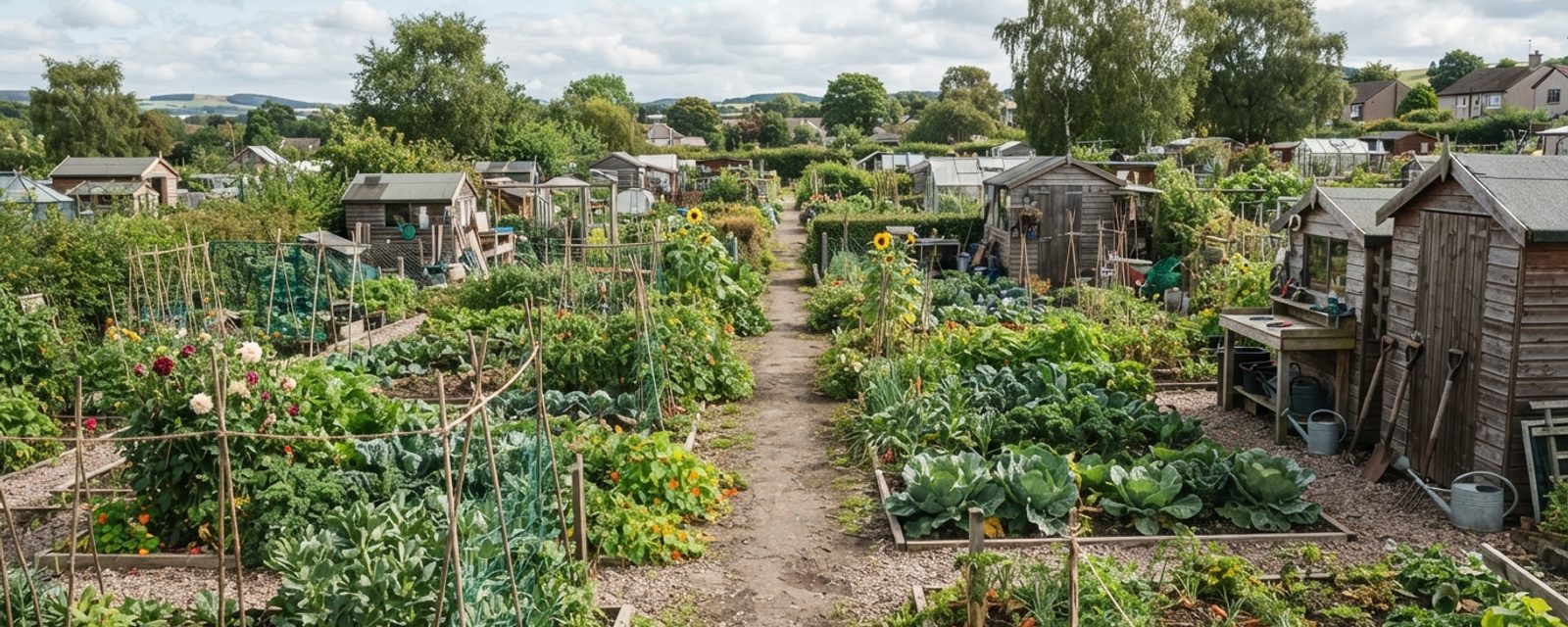
Scotland's allotment movement began in the same reforming decades that produced crofting law, but it grew out of a different problem in a different place: overcrowded industrial towns, not the Highland land question. The 1892 Allotments (Scotland) Act gave town councils the power to provide plots for the "labouring population," and two world wars turned that legal framework into a genuine mass movement, with Edinburgh alone running well over 5,000 plots by 1941. Edinburgh's council archives and academic researchers have documented its allotments in detail; Glasgow, Dundee and Aberdeen have left much thinner records.
Urban roots: the 1892 Allotments (Scotland) Act
The earliest documented example predates any legislation. Edinburgh had "Patriotic Society Allotment Gardens" near Dean Church by 1851, recorded on a town plan from that year. The legal framework came four decades later with the Allotments (Scotland) Act 1892, which obliged a town council to provide allotments if six or more ratepayers requested them. Edinburgh built its own regulations on that Act, confirmed by the Secretary of State for Scotland on 22 May 1913, with a further amendment in 1924.
Crofting and allotments: a clarification, not a lineage
It's worth being direct about a question that comes up often: did crofting give rise to allotments, or vice versa? No documented link exists between them, and treating one as the ancestor of the other misrepresents both.
Crofting is a specific legal tenure created by the Crofters Holdings (Scotland) Act 1886, confined to the statutory Crofting Counties, Argyll, Caithness, Inverness, Ross and Cromarty, Sutherland, Orkney and Shetland, and rooted in Highland and Island land-rights disputes. Historic Environment Scotland's own history of crofting makes no mention of allotments at all. Every source on Scottish allotment history, meanwhile, traces the movement to towns and cities: the 1892 Act's "labouring population" of urban ratepayers, wartime food shortages, and the Scottish National Union of Allotment Holders founded in 1917. The two traditions share an era and a broad reforming spirit, both are, in their own ways, about ordinary people gaining a foothold on land they didn't own, but one is not the origin of the other. They ran in parallel.
The First World War and its aftermath
Food shortages during the First World War turned allotment-holding from a modest civic provision into something closer to a civic obligation. Edinburgh's numbers grew sharply: by the end of the war, the total stood at somewhere between 3,000 and 3,400 plots, covering roughly 194 to 200 acres, depending which of two close but not identical wartime figures is used.
Part of what's now Warriston Allotments dates from this period: in 1917, Edinburgh's Lord Provost's Committee decided to use land at St Marks Park to grow food, in what is now a 63-plot section of the site.
The end of the war didn't hold the numbers. Edinburgh's allotments fell from around 3,000 to roughly 1,900 by 1930, according to the academic geographer Caitlin DeSilvey's research on the city's allotment history. Into that decline came a Depression-era bridge to the next crisis: the Scottish Allotments Scheme for the Unemployed (SASU), which in 1932 alone helped more than 2,000 people nationally, distributing around 3,000 tools, 18,000 seed packets, 16 tons of manure and 30 tons of seed potatoes. In Edinburgh, 74 arable acres across Granton, Warriston, West Mains and Saughton had been allocated as unemployed allotments by 1934. Warriston Allotments itself was established on 3 May 1932, when 155 unemployed people took up plots under the scheme.
The Second World War: Dig for Victory in the cities
Edinburgh's wartime peak dwarfed its WWI numbers: 5,543 allotments were in use in the city by 1941, a figure that appears independently in two separate accounts drawing on wartime Scotsman reporting. Around 300 acres were reportedly under cultivation at the height of the war.
The city requisitioned public space wherever it could. The Meadows carried 512 emergency allotments, plots that, remarkably, weren't fully cleared until March 1966, and were still being photographed as late as 1964. Plots also appeared at Balgreen Park, Bruntsfield Links, Joppa Quarry, Craigentinny Golf Course (partly converted), Holyrood Park, Blackford Hill and Inverleith Park. The Edinburgh Garden Allotments Committee was set up in 1940 specifically to coordinate this wartime food production drive.
The Scotland-wide total at the wartime peak is genuinely unresolved between sources. A peer-reviewed academic account, Hannah Connelly's, drawing on national allotment records, puts the WWII peak at 83,000, falling to 22,000 by 1954; a separate account puts the peak at "close to 70,000"; and the Scottish Allotments and Gardens Society's own history states 77,000 at the end of WWI and 90,000 at the end of WWII. None of these three figures agree. The peer-reviewed 83,000/22,000 pairing is the most rigorously sourced of the three, but the other two numbers exist in the record too, and no single national total can be stated with confidence.
Outside Edinburgh, the wartime record thins out considerably. No wartime plot-count or acreage statistics survive for Glasgow. What is known is that Glasgow's Kirklee site, run today by the Kelvinside Allotment Association near the Botanic Gardens, has been in use "with a few interludes" since the First World War, with a nearby Julian Avenue site dating from before the Second World War, though this comes from the association's own account of its history rather than an independently dated record. Dundee has no documented Dig for Victory episode, statistic or named site in the surviving record. Aberdeen offers only a single, uncorroborated newspaper detail: an "On the Allotments" column in the Aberdeen Evening Express dated 23 May 1918, describing plots "looking well."
Post-war decline
Peace brought a rapid retreat from allotment-growing nationally: from a wartime peak of 83,000 plots in 1943, the national total fell to 22,000 by 1954, a low point that took decades to recover from. Edinburgh's own numbers by the early 1960s stood at 110.3 acres including 1,508 Corporation plots.
Edinburgh sites closed steadily through the 1950s:
| Site | Closed |
|---|---|
| West Mains | 1951 |
| The Meadows (wartime plots) | 1952 |
| Ladywell Road, Corstorphine | 1955 |
| Robb's Loan | 1955 |
| Bruntsfield Links | 1955 |
| Niddrie Mains | 1956 |
| St Leonard's / Salisbury Green (established 1926) | mid-1960s |
St Leonard's took the longest to go: its plotholders and the University of Edinburgh, which wanted the land for student accommodation, fought over the site for years before it finally closed.
One piece of the decline is a genuine legislative oddity. On 26 October 1950, Parliament passed the Allotments (Scotland) Act, which required a full year's notice before a plotholder could be evicted, on the very same day as the Housing (Scotland) Act, whose section 63 allowed a council to give just two weeks' notice where the land was needed for housing. The two laws pulled in opposite directions on the same day, and the Edinburgh site closures through the rest of the decade suggest housing pressure had the practical upper hand. One dispossessed Edinburgh plotholder, Victor Webb, later became an activist with the Scottish Allotments and Gardens Society (SAGS); his papers are held at the University of Glasgow Archives and Special Collections, deposited by SAGS in November 2000.
Scotland's allotment law was eventually rewritten for the modern era by Part 9 of the Community Empowerment (Scotland) Act 2015, which requires local authorities to keep a list of people waiting for a plot and sets a legal duty to take reasonable steps to stop anyone remaining on that list for more than five years, a duty that Edinburgh's own waiting-list numbers, covered next, have struggled to meet, even though the law arrived decades too late to help the plotholders of the 1950s.
SAGS's own institutional history traces back to the Scottish National Union of Allotment Holders, founded during the First World War in 1917 to answer the U-boat blockade's food shortages. Exactly when SNUAH became today's SAGS is unresolved, one page on SAGS's own site gives 1946, another gives 1931, but the founding story itself is solid on both accounts.
The modern revival: waiting lists and historic sites still growing
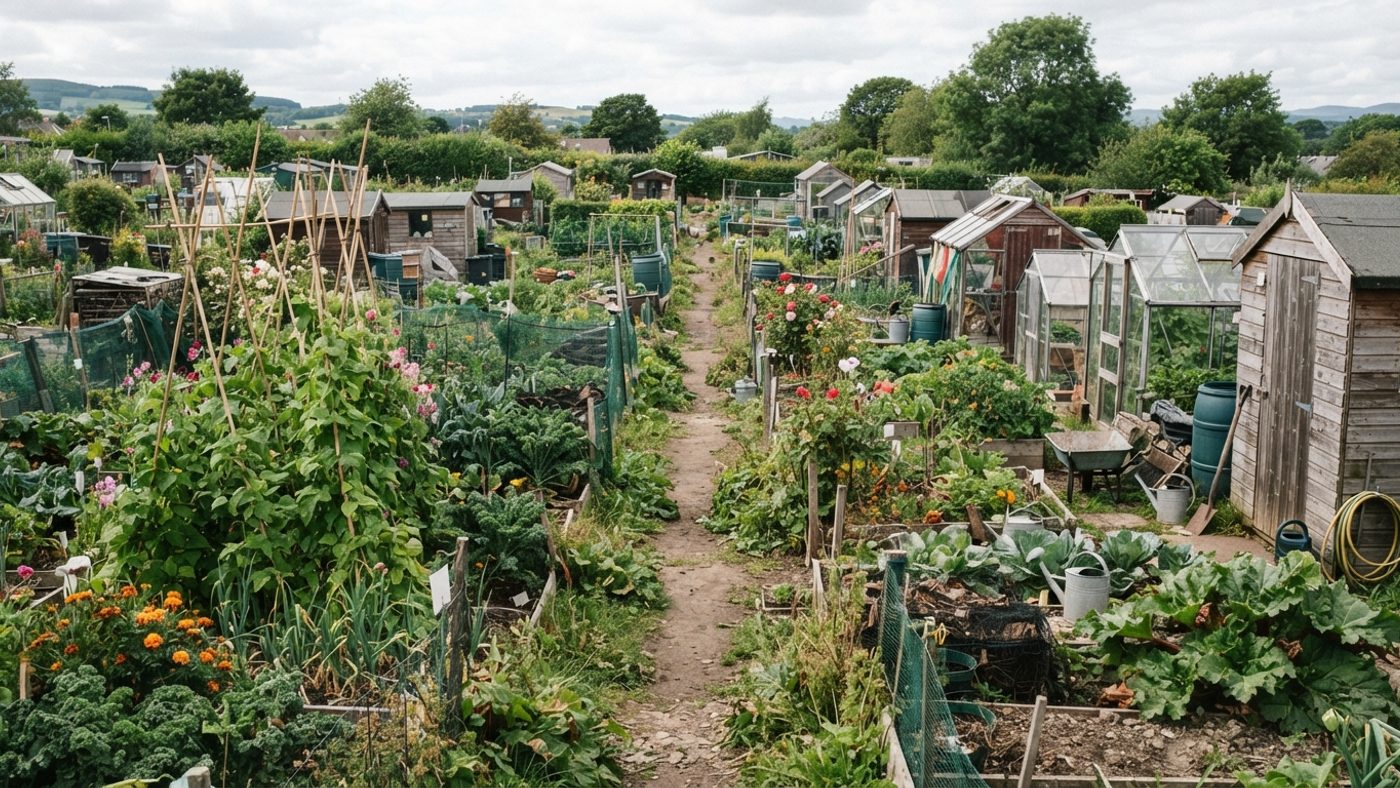
Allotments have come back into demand sharply in recent decades. The City of Edinburgh Council's own strategy document points to several converging factors behind the shift: rising concern about health and nutrition, growing awareness of climate change, and the popularity of "lifestyle" gardening and cooking television programmes, all feeding a renewed interest in growing your own food. Edinburgh's council records give the clearest picture of how sharply that demand grew. In 1998, the city's waiting list stood at 417 people for 1,065 plots. By 2016, according to the City of Edinburgh Council's own Allotment Strategy 2017–2027, that list had grown to 2,510 people chasing 1,488 council-operated plots, 1,724 plots in total across 44 sites when other ownership is included. Annual turnover was only around 8%, meaning an average wait of five to ten years, already at or beyond the five-year limit Part 9 of the 2015 Act sets, with demand concentrated in particular postcodes: EH6 Leith alone accounted for 547 people, 19% of the entire list, and EH3 Inverleith a further 314.
More recent, unconfirmed press reports describe the Edinburgh waiting list passing 6,000, even 6,500, with only around 100 plots turning over each year, implying waits that could stretch to 50 or 55 years on current turnover, and individual plotholders reportedly waiting since 2010. If accurate, that would put Edinburgh far outside its own statutory five-year limit; either way, the direction matches the council's own 2016 figures.
| Year | Edinburgh allotment figure | Notes |
|---|---|---|
| 1892 | Allotments (Scotland) Act passed | Gave councils power to provide allotments on ratepayer request |
| 1913 | Edinburgh's own allotment regulations confirmed | Reproduced in the council's 2017 Allotment Strategy, Appendix 2 |
| End of WWI | ~3,000–3,400 plots, ~194–200 acres | Two close but not identical figures from separate sources |
| 1930 | ~1,900 plots | Down from the WWI peak |
| 1941 | 5,543 plots in use | Corroborated by two independent accounts of wartime Scotsman reporting |
| 1954 | National low point (22,000 plots, Scotland-wide) | Down from a wartime national peak of 83,000 in 1943 |
| Early 1960s | 110.3 acres, 1,508 Corporation plots | Edinburgh only |
| 1998 | Waiting list: 417 people for 1,065 plots | Council's own Allotment Strategy document |
| 2016 | Waiting list: 2,510 people for 1,488 council plots | Council's own Allotment Strategy document; ~8% annual turnover |
Glasgow's current picture is harder to pin down with the same precision. No single authoritative city-wide waiting-list figure exists; press and campaign sources describe waits ranging from over five years to eleven or twelve years depending on the site. Glasgow's own Food Growing Strategy 2020–2025 sets a target of nobody waiting more than five years, matching the statutory duty under the 2015 Act, but that's a target, not a reported outcome, and the city-wide figures that would show whether it's being met aren't published in the way Edinburgh's are.
Some of Scotland's oldest allotment ground is still under cultivation. Warriston Allotments in Edinburgh, the 1932 unemployed-scheme site with a section dating to 1917, still operates today. In Glasgow, Kirklee Allotments, run by the Kelvinside Allotment Association near the Botanic Gardens, has been growing food on the same ground since roughly the First World War.
For anyone reading this history and wanting a plot of their own, the practical reality of those waiting-list numbers is worth knowing going in. The guide to getting an allotment covers how the application and waiting-list process actually works, and once a plot does come through, the allotment rules guide and the piece on surviving your first year on a plot are worth reading before you start digging.
Common questions
Did Scottish allotments grow out of crofting?
No, and the confusion is understandable since both movements were about ordinary people gaining a foothold on land in the same reforming decades. But crofting is a legal tenure specific to the Highlands and Islands, created for a completely different dispute over land rights, while allotments were a response to overcrowded industrial towns further south and east. Neither historical record mentions the other.
How many allotments did Edinburgh have during the Second World War?
Nearly three times its pre-war low: from around 1,900 plots in 1930 up to 5,543 by 1941, as the city requisitioned parks, golf courses and public open ground for food production under wartime pressure.
Why did Scottish allotment numbers collapse after the war?
Post-war housing need took priority over allotment land. Council sites across Edinburgh closed through the 1950s as land was reclaimed for housing, and a legislative quirk on 26 October 1950 saw Parliament pass both a law protecting plotholders from short-notice eviction and a housing law allowing exactly that kind of short-notice eviction, on the same day. Scotland-wide, allotment numbers fell from a wartime peak of 83,000 (1943) to just 22,000 by 1954.
How long is the waiting list for an allotment in Edinburgh today?
The council’s own 2017–2027 Allotment Strategy recorded 2,510 people waiting for 1,488 council-run plots in 2016, with an average wait of five to ten years. More recent press reporting puts the list above 6,000, though that figure hasn’t been confirmed against a council document.
Are any wartime or Depression-era allotment sites still in use?
Yes. Warriston Allotments in Edinburgh, established in 1932 under the Scottish Allotments Scheme for the Unemployed with a section dating to 1917, still has plots in cultivation today. Kirklee Allotments in Glasgow’s West End has been growing food since around the First World War.
Sources
8 sources, recorded with what each was used for
- City of Edinburgh Council: "Cultivating Communities" Allotment Strategy 2017–2027: The 1913 regulation date, 1998/2016 waiting-list figures, postcode breakdown, turnover rate, and 44-site totals
- Community Empowerment (Scotland) Act 2015, Part 9: The waiting-list duty, the 5-year target, the food-growing strategy duty, and the repeal of the 1892/1922/1950 Acts
- Allotments (Scotland) Act 1892: The six-ratepayer threshold that founded Scottish allotment law
- Historic Environment Scotland: "A Quick History of Crofting": Confirming crofting's separate legal origin, with no allotment connection
- Hannah Connelly, Wellcome Open Research (2019): The national wartime peak and 1954 low, the 1950s closures, and the 1950 legislative contradiction
- Caitlin DeSilvey, Cultural Geographies (2003): Edinburgh's 1930 decline and the Warriston case study
- Scottish Allotments and Gardens Society: About: The 1917 founding of the Scottish National Union of Allotment Holders and the Scottish Allotments Scheme for the Unemployed figures
- British Newspaper Archive Blog: Digging for Victory and Beyond: The 23 May 1918 Aberdeen Evening Express 'On the Allotments' column