
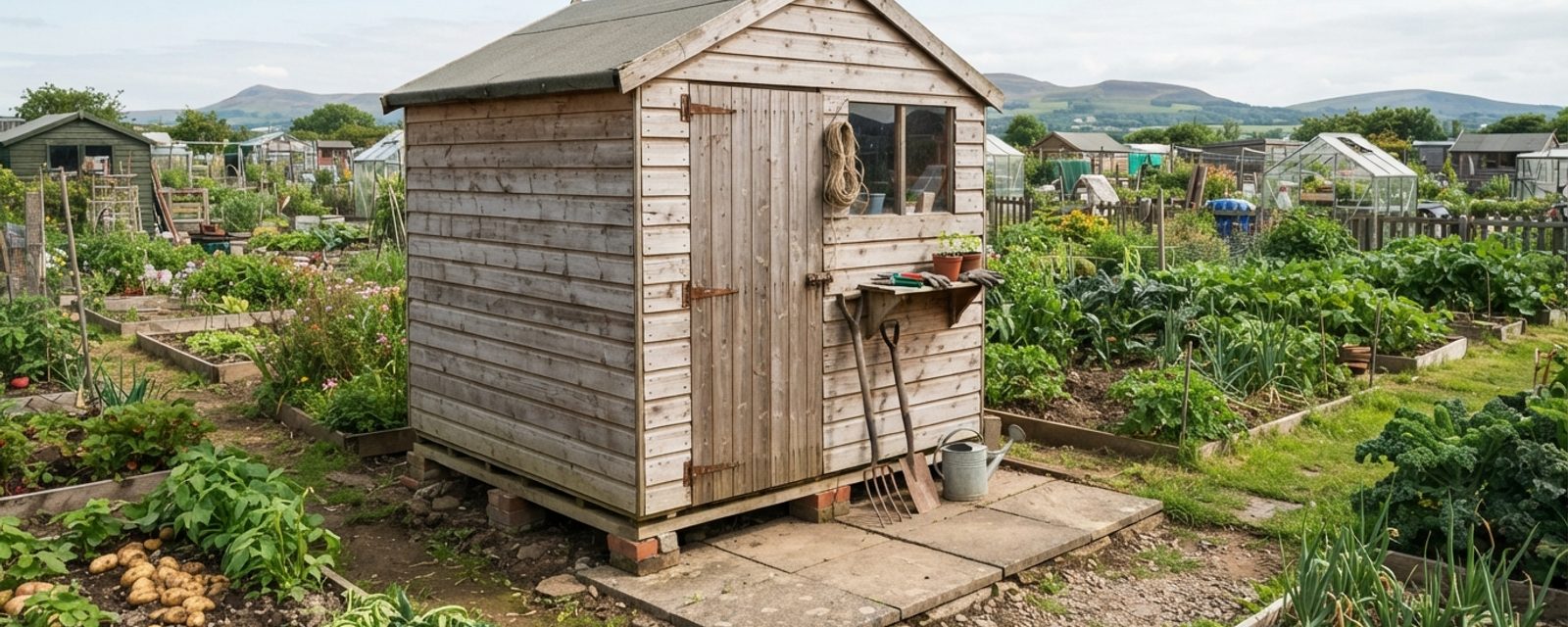
A shed fails in three predictable ways, and all three come down to physics rather than bad luck. Damp gets in from below, because timber sitting on bare earth or unbedded slabs draws up ground moisture and never fully dries out between rains. Mice get in because a mouse can squeeze through any gap wider than about the diameter of a pencil, and a shed wall meets its base, its door and its roof at dozens of such gaps. And stored seed, fluid chemicals and metal tools all degrade in an unheated space over winter for reasons that have nothing to do with cold itself and everything to do with the moisture that cold air carries and then dumps as condensation on a colder surface. Choosing a good site, building a proper base, and storing things sensibly all come down to closing the specific gaps those three mechanisms exploit.
Choosing and siting the shed
Where it goes and why
A shed's biggest structural enemies are standing water and wind uplift, a strong gust getting underneath a roof or wall panel and lifting it rather than just pushing against it, and siting deals with both before a single board goes up. Level, well-drained ground matters more than looks: a shed sited in a dip where rainwater collects will feed damp into the base year-round regardless of how good the base itself is. That's worth taking more seriously on an exposed or persistently wet Scottish plot than it would be somewhere drier and more sheltered, since a site choice that's merely suboptimal in a drier climate has less rain to compound the mistake.
Airflow around the shed helps timber dry out after rain, so leaving a gap to fences and hedges rather than pushing the shed hard against a boundary is worth doing where plot space allows. A small gutter and downpipe along the roof edge, directing runoff away from the base rather than letting it sheet straight off onto the ground the shed stands on, deals with the same problem from the roof down rather than the ground up. Anchoring matters more on an exposed plot too: without solid ground fixings, felt or metal roofing can lift in strong gusts, the same siting logic of drainage, wind exposure and orientation that applies to siting a polytunnel.
The base: the part nobody sees and everyone regrets skimping on
The base is where most of a shed's long-term problems start or get prevented, because it's the interface between the timber structure and the ground moisture beneath it. Hard freeze-thaw cycles can also lift and crack an unbedded slab or paving over a few winters, a second reason a properly bedded base outlasts one just laid on the ground.
The standard approach: excavate the site to a level surface, lay a compacted hardcore or gravel sub-base for drainage, then either bed paving slabs on top or pour a concrete pad, with a damp-proof membrane between the base and the timber floor to stop residual moisture wicking upward. Raising the shed's floor bearers on treated timber battens, rather than laying the floor flat on the slabs, adds an air gap underneath that lets the underside of the floor dry out rather than sitting permanently damp.
Shed material changes how much this matters. A timber shed is by far the most common choice on an allotment and takes best to this base-and-membrane treatment, but it's also the material most vulnerable to the damp the base is built to stop. Metal and resin/plastic sheds resist rot outright, at the cost of their own problems, metal condenses more readily on the inside in cold weather, and thin resin panels flex and can crack in hard frost, but still benefit from the same level, well-drained base.
| Base option | What it involves | Best suited to | Trade-off |
|---|---|---|---|
| Compacted gravel/hardcore only | Excavate, lay and compact hardcore or gravel, level | Small, light sheds; temporary siting | Cheapest and quickest, but least stable long-term and least effective at stopping rising damp without a membrane on top |
| Paving slabs on compacted base | Hardcore sub-base, slabs bedded on sand/mortar, DPM under the shed floor | Most allotment sheds | Good balance of cost, durability and DIY feasibility; needs the base level or the frame racks over time |
| Concrete pad | Excavated, shuttered, poured and cured concrete slab | Larger or permanent sheds, heavier storage | Most durable and most resistant to damp, but highest cost and labour, and least reversible if the plot lease ends |
| Raised timber bearers | Treated bearers raised on paving slabs or piers, with an air gap underneath | Any base type, as the layer directly under the floor | Improves airflow and drying under the floor regardless of which base sits beneath it |
Roof damp-proofing follows the same underlying logic as the base: block bulk water while still letting trapped moisture vapour escape. A breathable membrane laid under the roofing felt does this, it stops rain getting through but doesn't seal moisture vapour inside the roof void the way felt alone can. Treating exposed timber with a preservative before assembly, and re-treating annually, slows rot in a climate that keeps timber wet for long stretches at a time. A shaded, damp roof also grows moss and algae readily, which holds moisture against the felt and shortens its life, so a yearly brush-off is worth doing alongside the preservative re-treat.
The planning-permission question, and why it's murkier than it looks
mygov.scot's guidance on garden shed permitted development is not automatically the rulebook for an allotment shed, even though it's the first thing most searches turn up. Its rules on building a shed, garage or greenhouse at your house set out genuine, specific thresholds: most such structures count as permitted development needing no planning permission, provided the shed sits at the back of the house, the shed plus any other outbuildings don't cover half or more of the ground behind the home, overall height stays under 4 metres, height drops to 2.5 metres if the structure is within 1 metre of a boundary, and eaves height is capped at 3 metres. Nowhere on that page is an allotment mentioned, and the thresholds are written for a dwellinghouse's private residential grounds, a legally distinct category of land from an allotment plot.
The actual legal mechanism covering allotment sheds in Scotland sits elsewhere: the Community Empowerment (Scotland) Act 2015. Section 115 of that Act requires every local authority to set its own allotment site regulations covering "buildings or other structures that may be erected on allotments, the modifications that may be made to such structures and the materials that may or may not be used." In other words, there's no single national size limit for an allotment shed in Scotland, each council sets its own rules for its own allotment sites, and those rules are what actually govern what can be built. The Act also gives the local authority real teeth: it allows a council to remove a structure erected without complying with its regulations and recover the cost from the tenant, and separately gives a tenant the right to remove structures they built or brought onto the plot before their lease ends. The practical upshot is straightforward even if the legal picture is layeredPropagating a new plant by pinning a low, flexible stem into the soil while still attached to the parent, so it roots before being cut free. Full definition →: before building or buying a shed for an allotment plot, get the site's own regulations from the local authority or site association rather than relying on national householder guidance, because that guidance was never written with allotments in mind and a shed built to its thresholds could still fall foul of the site's own rules. The wider rules governing allotment tenancies are set out in the allotment rules guide.
Organising the inside
An empty shed is the easiest one to organise well, so before adding storage it's worth taking everything out, sweeping thoroughly, and checking the structure itself for damage or early rot while the walls and floor are visible. That inspection is also the point to catch small problems, a lifted felt edge, a soft floorboard, while they're still cheap to fix.
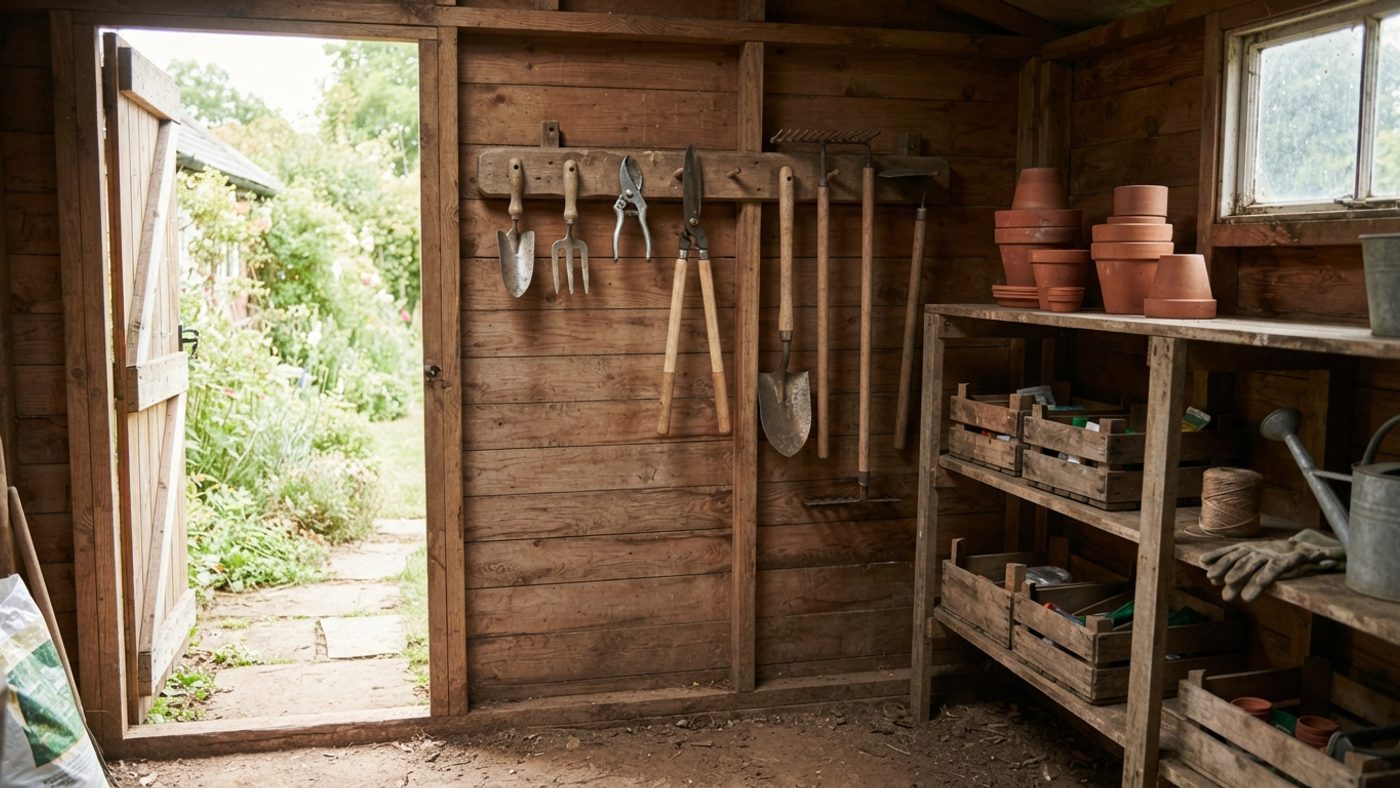
Wall and ceiling space does more useful work than floor space in a shed this size, because floor space is what determines whether a wheelbarrow or bag of compost fits through the door at all. Fitting a tool rack to a wall and hanging or clipping hand tools onto hooks and nails frees the floor for bulkier items. Long-handled tools, spades, forks, rakes, do better in a dedicated rack that holds them upright and off the ground than propped in a corner, where they tend to fall, block the doorway, or sit in whatever damp collects at floor level.
Shelving is worth choosing for the job rather than for what happens to be to hand: heavy-duty metal racking suits pots, tools and heavier stored items, while lighter wooden shelving suits more delicate storage. Baskets or crates keep loose items like netting and fleeceA lightweight, breathable fabric laid or draped over plants to trap a little warmth and keep off frost, wind and some flying pests. Full definition → from becoming a tangled heap, and a repurposed cabinet or cupboard is a reasonable way to contain smaller odds and ends that don't have an obvious home on a shelf or hook. Before buying any storage unit, measure the shed's doorway rather than just its floor area, a unit that fits the space inside is no use if it can't get through the door to begin with.
Two organising habits are worth building in from the start rather than retrofitting later. First, security-mark tools, mowers and power tools with a house number and postcode, since marked equipment is both less attractive to thieves and easier to identify if recovered, and fit a lock strong enough to be a genuine deterrent rather than a token one. Second, don't let the shed become storage for things nobody actually uses, a mousetrap or bait box placed in a shed works far better in one that isn't already stuffed with cardboard, old pots and half-used bags that mice can nest in undisturbed. Anything genuinely surplus is better rehomed via a site noticeboard, Freecycle or eBay than left to accumulate.
Metal tool blades left dirty and damp over winter rust, so a quick oiling pass, wipe spade, fork and hoe blades clean of soil, then wipe over with a light coating of oil, before the shed gets shut up for winter keeps edges usable and stops surface rust taking hold by spring.
Winterising: damp, mice, and what the cold actually does to what's stored
Why damp and mice are really the same job
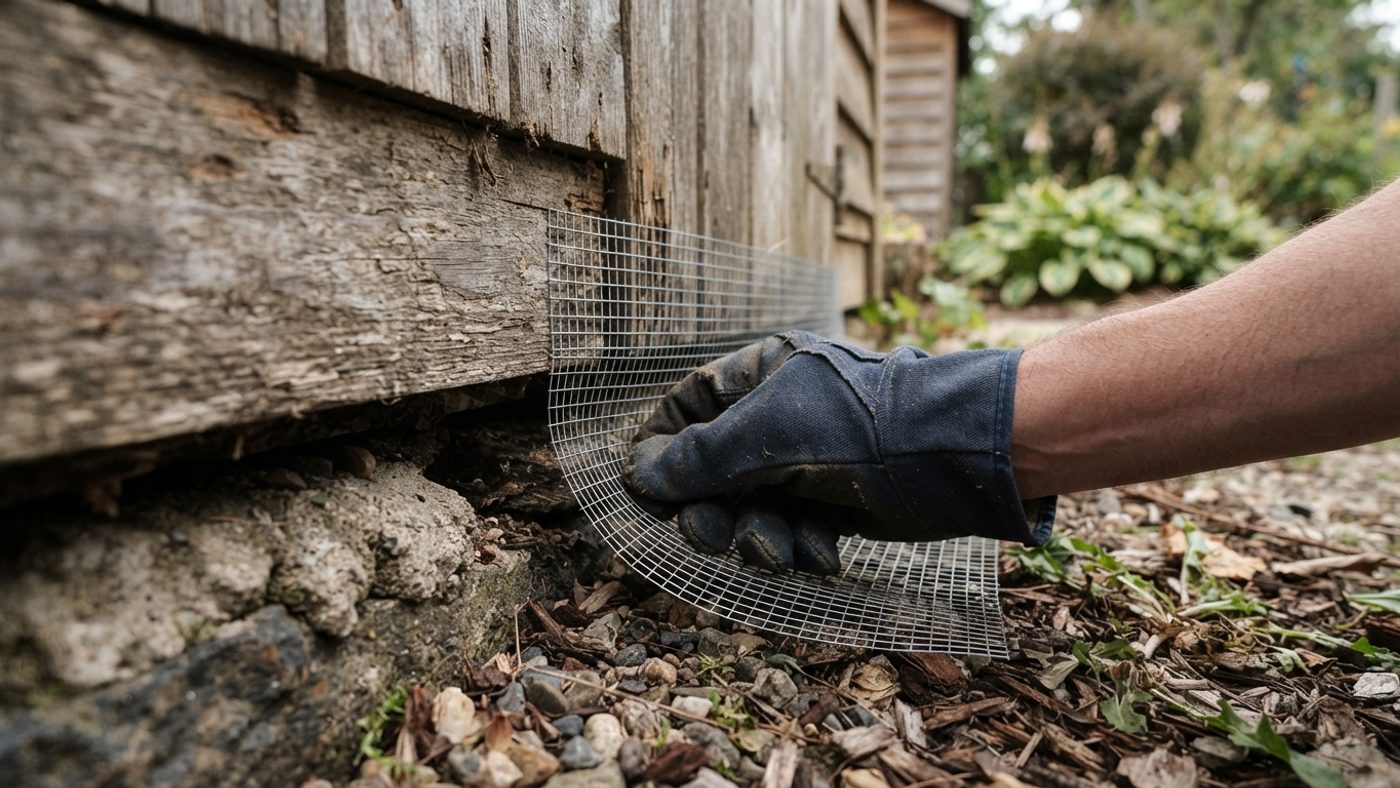
Do the base edge, door frame and any pipe entry in one autumn pass, filling gaps at each with the same materials whether the aim is keeping damp out or keeping mice out. A shed also needs some airflow even once it's sealed up: a roof vent or a louvred panel left open a crack stops moisture-laden air stagnating inside over winter, and a small moisture-absorbing tub placed on a shelf does useful extra work in a shed that's otherwise fully closed up. For anything genuinely frost-vulnerable stored inside, chemicals with a stated frost-free requirement, for instance, a low-wattage tubular heater on a frost-thermostat is the standard way to keep a shed a few degrees above freezing without heating it properly, and costs little to run since it only switches on close to 0°C.
On mice specifically: in cold weather, field mice often move into greenhouses and cold frames, where they can destroy many seedlings overnight, and they also get into sheds to feed on stored produce such as apples. Bulbs and corms are a particular target, especially crocus corms and tulip bulbs, most often in their first autumn and winter after planting. Rather than leading with traps, the recommended approach is to tolerate what can be tolerated and use barriers and contained storage to deter damage, since every method of active control involves killing the animal, and mouse numbers are usually kept in check anyway by natural predators. In practice for a shed, that means the priority is closing the gaps mice actually use to get in, around the base, at door edges, at any point where pipework or cabling passes through a wall, and storing anything edible or vulnerable, including bulbs, corms and seed, in sealed metal or glass containers rather than paper bags or open trays. Wire mesh or steel wool packed into gaps, and food-type items kept in hard rather than soft containers, are the standard practical way gardeners put that barrier principle into effect.
Seed, over winter, done properly
Seed storage runs on a simple physical relationship: storage life roughly doubles for every 5°C drop in temperature and for every 1% drop in the seed's moisture content. Moisture matters more than cold, keeping seed dry is the priority, and that means avoiding damp spaces or containers that trap condensation, plastic bags being a common culprit. Seed should never be exposed to temperatures above 35°C, which rules out drying or storing it in an airing cupboard or a greenhouse.
| Storage length | Where | Container | Drying needed first |
|---|---|---|---|
| Short/medium term | Cool, dry shelf | Paper envelope | None — room temperature is generally enough |
| Long term | Fridge or freezer | Airtight container (a Kilner-style jar works well) | Dry to around 5% moisture content, roughly 2 weeks at room temperature |
To dry seed for long-term storage, a food-grade desiccant works well: oven-dried rice at a ratio of about one part seed to six parts rice is generally effective within about a week, and silica gel does the same job at a higher price.
An unheated shed in December is often neither reliably cool in the stable sense nor reliably dry, which matters because "cool, dry" is exactly what seed needs. Temperature inside an unheated shed swings with the outside air, and every swing that crosses the dew point produces condensation on cold surfaces, including the inside of any container that isn't sealed. A shed can still work for winter seed storage, but the airtight-container principle matters more there than it would in an indoor cupboard, precisely because the shed environment is the less stable of the two.
Fleece, fabric and everything else that isn't seed
Fleece and other crop covers usually spend the growing season doing their job and the off-season folded up somewhere in the shed, which is fine as long as they go in dry, damp fleece stored folded is a reliable way to grow mildew into it over winter. It's worth knowing what different weights actually do before relying on them again next spring: heavier-grade fleece gives around 2°C of frost protection, while lighter fleece around 17g/m² protects less than heavier fleece around 35g/m², worth knowing before grabbing whichever roll is nearest the door on a cold night, and worth cross-checking against your own frost-protection plan for the season.
Chemicals and fertilisers stored over winter need a different kind of attention, mainly because cold affects liquid and dry formulations differently. Liquid products can freeze and separate at low temperatures, which can affect how they perform even after thawing, so checking the product label for any cold-storage warning is worth the minute it takes. Dry, granular products are generally less troubled by cold itself but still need to stay dry, since a damp granular product can cake, clump or start to break down chemically well before its stated shelf life is up.
Powered tools need their own winter routine. Petrol left sitting in a strimmer or mower tank over winter degrades and can gum up a carburettor by spring, so draining the tank or running the engine dry before storing is worth the few minutes it takes. Cordless-tool batteries lose charge and can be permanently damaged by prolonged exposure to freezing temperatures, so batteries are better brought indoors for the winter than left in an unheated shed, even though the tool body itself can stay put.
| Task | Why it matters | Timing |
|---|---|---|
| Empty and sweep the shed, check for structural damage or rot | Catches problems while they’re still small and cheap to fix | Early autumn |
| Seal gaps at the base, door edges and pipe/cable entry points | Closes the routes mice use to get in over winter | Before first hard frost |
| Move seed, bulbs and corms into sealed metal or glass containers | Protects against both damp and mice | Before first hard frost |
| Check liquid chemicals/fertiliser for cold-storage warnings | Liquids can freeze and separate; some need frost-free storage | Before first hard frost |
| Drain or run dry petrol tools; bring cordless batteries indoors | Petrol degrades and can gum a carburettor; batteries can be damaged by hard freezing | Before first hard frost |
| Oil clean, dry tool blades before putting them away | Stops surface rust taking hold over winter | Early–mid autumn |
| Fold and store fleece/crop covers only once fully dry | Prevents mildew developing in storage | As covers come off crops |
| Crack a roof vent or louvred panel open | Stops moisture-laden air stagnating inside a closed-up shed | Early–mid autumn |
Two more worth folding into that same autumn pass if this is your first season on the plot: a fresh look at what actually went wrong or worked well is easiest to capture while it's still fresh, exactly the kind of thing covered in the first-year allotment mistakes guide, and if you're still finding your feet generally, the new-plot guide covers the wider groundwork this article doesn't.
Common questions
Do I need planning permission for an allotment shed in Scotland?
Generally no, in the sense of applying to your council’s planning department, but that’s not the same as having no rules to follow. The rules that actually govern an allotment shed come from your own site’s regulations rather than a planning application, so the right first call is your site committee or local authority allotments team, not a planning portal.
What size can my allotment shed be?
Whatever your own site’s regulations allow, which is a genuinely different answer plot to plot. If you’re used to the household permitted-development figures (4 metres high, that kind of thing), set those aside for an allotment; they weren’t written with allotments in mind and your site may allow more, less, or something differently shaped entirely.
How do I stop mice getting into my shed over winter?
Seal the gaps mice use to get in, around the base, door edges and anywhere pipes or cables pass through a wall, since a mouse can fit through a very small opening. Store anything they’d target, especially bulbs, corms, stored produce and seed, in sealed metal or glass containers rather than paper or open trays. A tolerate-and-exclude approach using barriers and contained storage is generally preferable to relying on traps as the first line of defence.
Can I store garden chemicals in an unheated shed over winter?
Often, but check the product label first. Liquid formulations can freeze and separate at low temperatures, which can affect performance, while dry granular products are generally less affected by cold but still need to be kept dry to avoid caking or premature breakdown.
What’s the best base for an allotment shed?
It depends on the shed’s size and how permanent it’s meant to be. Paving slabs on a compacted hardcore base with a damp-proof membrane suit most allotment sheds well, balancing cost and durability. A poured concrete pad is more durable still but costs more and is harder to reverse if the plot’s lease ends; gravel alone is cheapest but least effective at stopping rising damp long-term.
Sources
7 sources, recorded with what each was used for
- mygov.scot: Build a shed, garage or greenhouse at your house: Permitted-development height/coverage thresholds for sheds at a private house; establishing the guidance never mentions allotments
- Community Empowerment (Scotland) Act 2015, Part 9: Section 115(3)(f) (local authority allotment site regulations covering structures/materials), section 122 (removal of non-compliant structures), section 132 (tenant's right to remove their own structures)
- Gardeners' World: How to Clean and Repair your Garden Shed: Empty-and-inspect approach, tool storage, measuring before buying storage units, security-marking tools, rehoming unwanted items
- Gardeners' World: 10 Ways to Improve Your Shed: Wall-mounted racks, shelving load ratings, long-handled tool racks, baskets and crates
- RHS: Mice and voles: Mouse behaviour in cold weather, what they target, the tolerate/barrier/contained-storage approach over trapping
- Garden Organic: Seed Storage for longer life: Temperature/moisture storage-life relationship, container types, drying method and ratios, the 35°C upper limit
- RHS: Fleece and crop covers: Frost-protection figures for heavier versus lighter fleece grades