
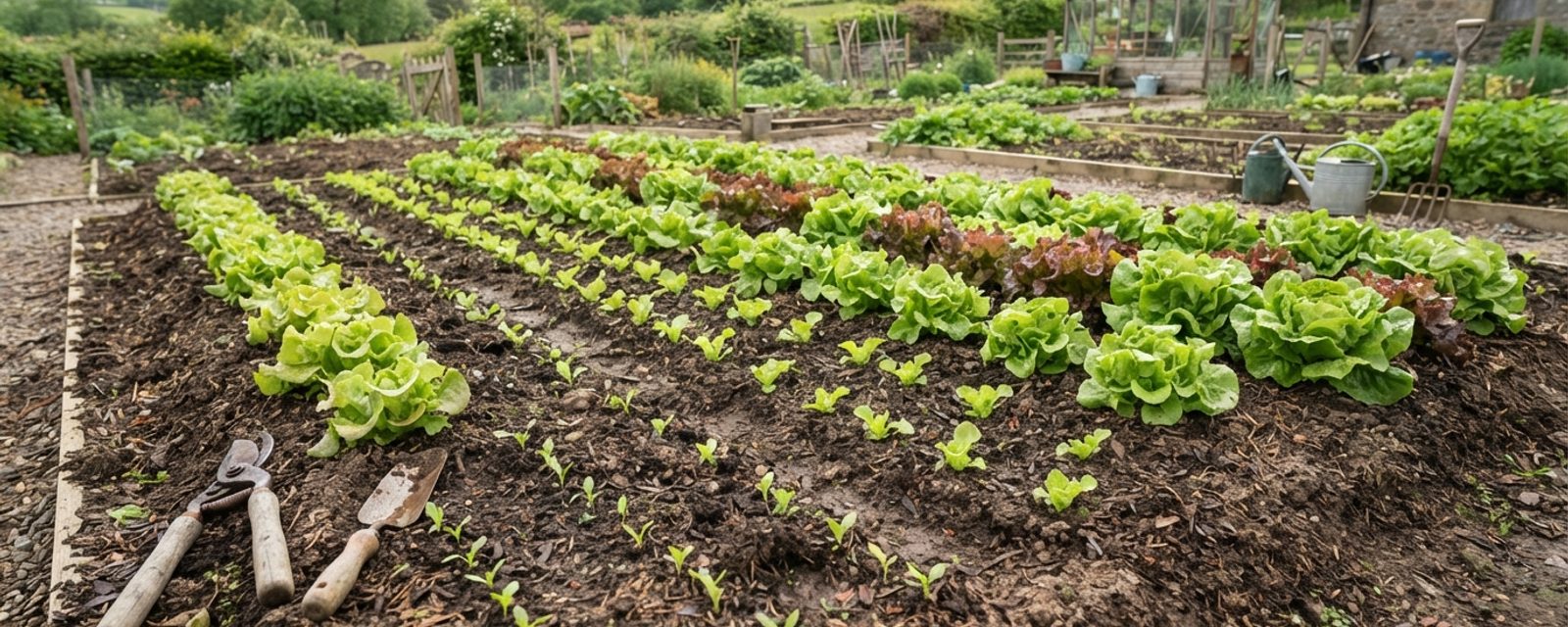
You sow a full row of lettuce on the first mild day in May. Six weeks later, every plant is ready within the same few days, more salad than one household can eat, followed by three weeks of nothing while you wait for the next lot to catch up. That glut-then-gap pattern isn't bad luck. It's the direct, predictable result of sowing everything on a single date.
A crop's total yield from a given bed is set mainly by the space and the growing conditions, not by which date you happened to sow it, provided the sowing has enough of the season left to reach full size. A sowing squeezed in right at the very edge of what the season allows is the exception: it may still mature, but often at a smaller size than one with a full run at the season. What succession sowing changes for everything within that safe window is the shape of the harvest over time. Sow once, and the harvest arrives as one tall spike: a lot of food ready in a narrow window, then nothing. Sow the same total amount in several smaller batches spaced a few weeks apart, and each batch matures a few weeks after the last, so the same total harvest gets spread into a series of smaller, usable amounts arriving steadily across the season. You end up eating fresh produce for months instead of composting a glut and then having a gap.
Spreading the harvest isn't the only reason to sow this way. A single sowing also puts the whole crop at the mercy of a single event, one slug invasion, one spell of blazing heat, one late frost catches every plant at the same vulnerable stage. Several smaller sowings a few weeks apart mean a bad week only ever costs you one batch, not the lot.
Staggering sowings: how often is "little and often"
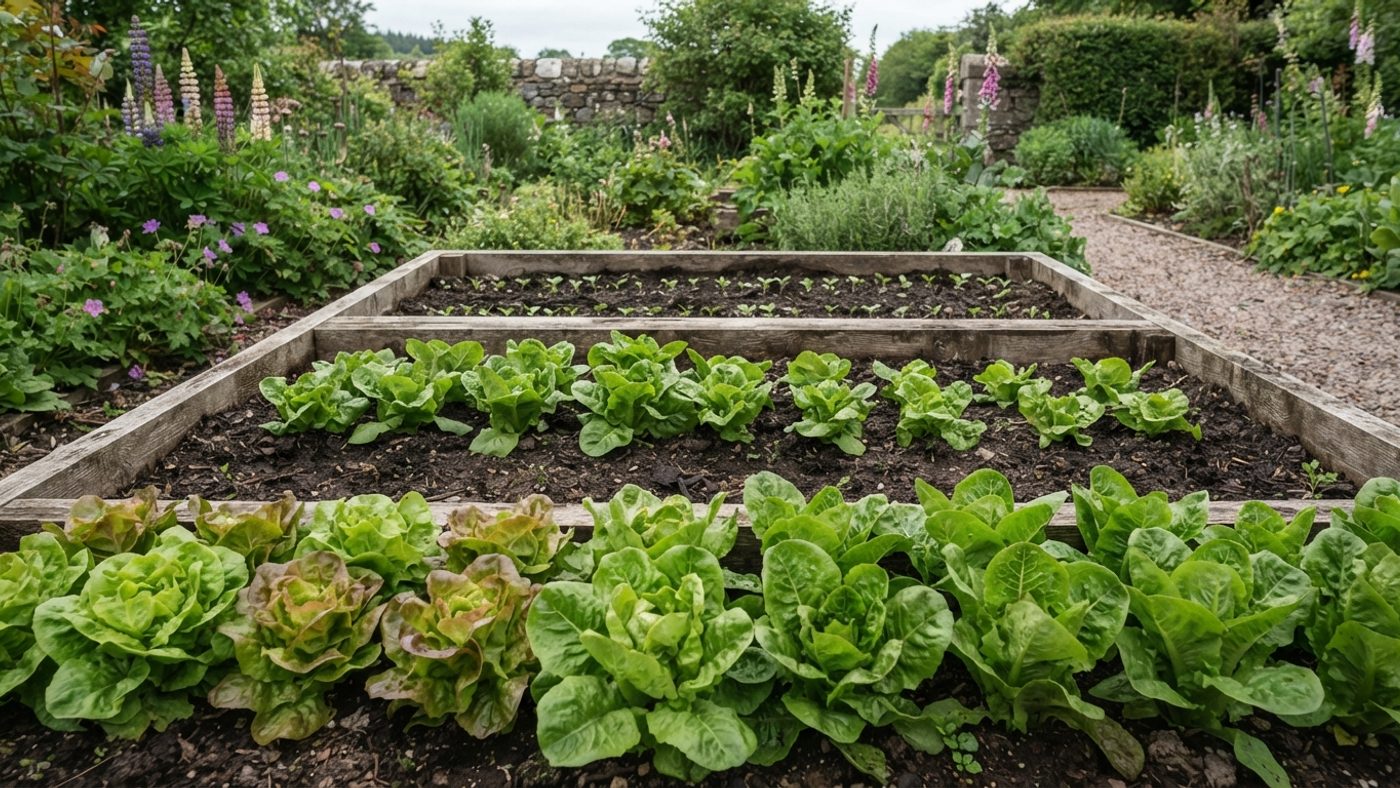
The standard advice is to make repeat, smaller sowings roughly every two to three weeks rather than one large sowing, and RHS confirms this as the general pattern for succession-suited vegetables, outdoor sowings can be repeated at intervals of one to four weeks from mid-spring through to late summer, depending on the crop and conditions. Seed only germinatesA seed sprouting: breaking dormancy and putting out its first root and shoot, given the right warmth and moisture. Full definition → once the soil has warmed past a workable minimum, and Scotland's soil generally reaches that point later in spring than the rest of the UK, see the Scottish frost dates page for how that varies by region, so "mid-spring" for a first sowing here often lands later than a UK-wide guide assumes, and every interval that follows shifts later with it, not just the first one. Rather than sowing strictly by the calendar, a useful trigger is to make the next sowing once the previous batch has reached its four "true leaves", the second set of leaves a seedling grows, once it's past the pair of rounded seed-leaves it germinates with, which keeps the gap between batches proportional to how fast things are actually growing in your particular weather that year, not a fixed number on paper.
Not every vegetable behaves the same way, and the right interval depends on how fast the crop bolts (runs to flower and seed, turning bitter or woody, usually triggered by heat or stress, including Scotland's long summer daylight hours, which push fast-boltingA plant switching early into flowering and seed production, usually triggered by stress, after which leaves, roots or bulbs turn bitter or unusable. Full page → crops like lettuce and coriander toward flowering even without much heat, further north and around midsummer especially), how long it stays at a usable eating stage, and how quickly it matures:
| Crop | Typical sowing interval | Notes |
|---|---|---|
| Lettuce (loose-leaf/cut-and-come-again) | Every 2-3 weeks, moving to weekly in warm summer weather | Prone to bolting once it matures — a classic succession crop |
| Radish | Every 2-3 weeks | Matures in as little as 4-8 weeks; oversized sowings go pithy and hot before you can eat them |
| Carrots | Every 3-4 weeks | Baby carrots ready in 4-6 weeks; maincropThe main, usually latest-sown and longest-growing type of a crop, grown for bulk and storage rather than an early harvest. Full definition → roots take roughly 12-16 weeks |
| Spinach, rocket, coriander | Every 2-3 weeks | All prone to bolting in heat, so small frequent batches beat one big sowing |
| Beans (French and runner) | Two or three sowings through late spring/early summer | Not weekly — a handful of staggered batches is enough to spread the crop |
Some vegetables don't benefit from this treatment at all, and it's worth not wasting the effort on them. Crops with a naturally long fruiting or storage period, tomatoes, peppers, aubergines, courgettes, cucumbers, onions, pumpkins, already deliver a stretched harvest or store well once picked, so one sowing (or at most two, for long-fruiting crops like courgettes) does the job. Slow-maturing winter vegetables such as leeks and Brussels sprouts are in the ground for so many months that staggering sowings by a few weeks makes little practical difference to when they're ready.
A clocheA small, portable clear cover placed over an individual plant or short row to trap warmth and keep off wind, rain and pests. Full definition →, fleeceA lightweight, breathable fabric laid or draped over plants to trap a little warmth and keep off frost, wind and some flying pests. Full definition → tunnel, cold frame, polytunnel or greenhouse over an early or late sowing buys extra weeks at both ends of this window, warming the soil enough for an earlier first sowing to germinate reliably, or protecting a late sowing from the first light frosts long enough to finish maturing, extra weeks worth having in a garden already working with a shorter frost-free window than most of the UK.
A second way to spread the same harvest doesn't need repeat sowing dates at all: sow a quick-maturing variety and a later, main-crop variety of the same vegetable on the same day. Lettuce 'Little Gem' and a slower main-crop lettuce, or an early and a maincrop carrot, staggered by maturity rather than sowing date, work well combined with the interval approach above, or on their own where repeat sowings aren't practical.
Two practical points worth knowing before you start: refresh the ground with a little compost or a general feed between sowings in the same spot, since each batch draws on the same soil rather than fresh ground the way a single once-a-year sowing would. And check your seed packet's sow-by date across a season of repeat sowings, most vegetable seed stays viable for a couple of years stored somewhere cool and dry, so a packet bought this spring will normally still be good for a batch sown in August, but it's worth a glance rather than an assumption.
Catch-cropping: using the gap, not just the calendar
Staggering solves when you sow. Catch-cropping solves where: rather than leaving a bed empty while it waits for its main occupant, you fill the gap with something that matures fast enough to be harvested and cleared before the main crop needs the space.
There are two versions of this gap:
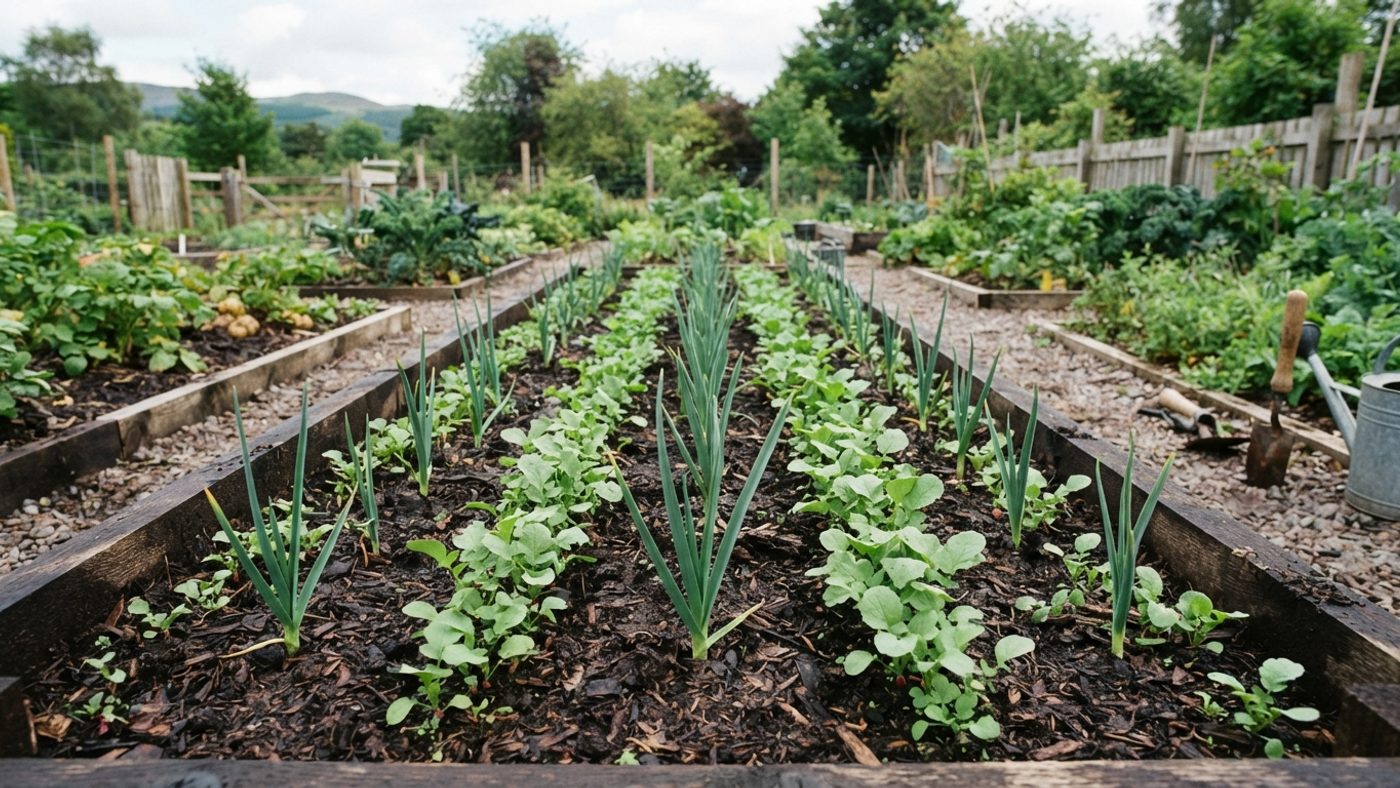
The gap before a slow crop goes in. If a bed is earmarked for something that won't be planted out until early summer, say, sweetcorn or squash after the frost risk has passed, that bed can carry a quick crop of radish or salad leaves in the weeks beforehand. As long as the catch cropA fast-maturing crop sown into a gap between two main crops, to use ground that would otherwise sit empty. Full definition → is lifted before the main crop needs full possession of the space, you've had a free harvest from ground that would otherwise have sat bare.
The gap while a slow crop is still small. Widely spaced, slow-establishing crops such as parsnips, leeks, garlic or overwinteringKeeping a plant alive and intact through the cold months, whether left outdoors, moved under cover, or stored dormant. Full definition → onions leave bare soil between the rows for weeks after sowing. A quick salad catch crop, lettuce, rocket, coriander or radish, sown into that gap is harvested and cleared well before the main crop's roots or leaves need the space, so nothing is lost and a second harvest is gained from the same bed in the same season.
The crops that work as catch crops are the same fast performers that suit staggered sowing generally: they establish quickly, don't compete seriously for light or nutrients in the few weeks they occupy, and are out of the ground again well inside a month or two. On bare ground you don't have a use for at all, a quick-growing green manureA fast-growing crop sown specifically to be dug back into the soil, adding organic matter and, with legumes, fixing nitrogen. Full definition → such as phacelia or mustard serves the same don't-leave-soil- empty purpose, though the point there is soil health rather than a crop to eat.
Working backward from frost: the last safe sowing date
The staggering and catch-cropping above both run up against the same limit eventually: how do you know when it's too late to start another sowing? The answer is to work backward from your first expected autumn frost.
The method has three steps:
- Start from your first expected autumn frost date, the date after which a tender crop is likely to be damaged or stopped in its tracks by cold.
- Subtract the crop's days-to-maturity figure, the number of days from sowing (or transplanting, for crops usually started that way) to harvest, as given on the seed packet or in growing guides.
- Subtract a buffer of at least a week or two on top of that. Shortening daylight hours and falling soil and air temperature both slow a plant's growth rate through autumn, so a crop sown in September takes noticeably longer to reach the same size than the same crop sown in May, the packet's days-to-maturity figure is usually measured under decent summer conditions, not a cooling autumn, so it understates how long a late sowing actually needs.
Worked example. Take a maincrop carrot with a days-to-maturity figure of around 12 weeks (84 days), and an illustrative first frost date of 20 October.
- Count back 84 days from 20 October → that lands on 28 July.
- Add a two-week buffer for slower autumn growth → the last safe sowing date is roughly mid-July.
Sow that carrot any later than mid-July, in this example, and it's racing a frost it's unlikely to beat before it's worth harvesting. A fast crop needs far less lead time, so it can be started much later against the same 20 October date:
| Crop | Days to maturity | Illustrative frost date | Last safe sowing date |
|---|---|---|---|
| Maincrop carrot | ~84 days (12 weeks) | 20 October | Mid-July |
| Radish | ~35-42 days (5-6 weeks) | 20 October | Early September |
Run your own crop's days-to-maturity figure and your own frost date through the same three steps to get your own last safe sowing date.
Why the frost date you use for this matters
The calculation above only works if the frost date going into it is the right one. Much general advice is written around England's later, longer growing season, so a UK-wide guide's safe sowing window runs further into the year than Scotland's does. Follow that timing here and the final sowing of the year can run out of season before it matures, not because the technique was wrong, but because the frost date it was built on wasn't yours.
Scotland's first frost isn't one date either, milder and coastal ground generally runs later into autumn before its first frost than inland, upland or Highland ground, see the Scottish frost dates page for the regional detail, so a single "last safe sowing date" printed for the whole country would be too cautious for one reader and too risky for another. Put your own postcode or area into the Frost Date Calculator tool to get a realistic first-frost estimate for where you actually garden, then apply the three-step method above using the days-to-maturity figure for whatever you're sowing.
The Planting Calendar tool builds that date into a fuller month-by-month sowing schedule, if you'd rather not do it crop by crop yourself.
Common questions
Which vegetables are actually worth succession sowing?
Fast-maturing or heat/daylight-sensitive crops give the clearest payoff: lettuce, radish, spinach, rocket, coriander, carrots, and beans sown in a couple of batches. Skip it for anything with a naturally long fruiting or storage window, like tomatoes, courgettes, onions or pumpkins, one well-timed sowing already covers those.
What's the difference between succession sowing and catch-cropping?
Succession sowing repeats the same crop over time, a few weeks apart, so it matures in waves instead of all at once. Catch-cropping repeats different crops in the same space: a fast crop fills a bed's temporarily empty ground, before or between a slower main crop, and is harvested and cleared before that main crop needs the room. The two are often combined on the same bed in the same season.
How much buffer should I add to my last-safe-sowing calculation?
At least one to two weeks on top of the crop's stated days-to-maturity figure, to account for slower growth as daylight hours and temperatures drop through autumn. If you're sowing right at the edge of your safe window, err toward the longer buffer, or cover the crop with fleece to buy it extra time.
Does wet Scottish weather change how I should succession sow?
It's worth factoring in. Scotland's west coast in particular gets meaningfully more rainfall than the rest of the UK, and slugs and snails are more active in damp conditions, so a wetter site plausibly keeps them active for more of the season than a drier one. A single large sowing at a vulnerable seedling stage can take a heavy hit in one wet spell either way, and staggering sowings a few weeks apart means a bad week only costs you one batch rather than the whole crop.
Can I still catch-crop or succession sow if I only have containers or raised beds?
Yes, the technique doesn't depend on garden size. Small beds and containers are, if anything, where making the most of gaps between plantings matters most, since there's less spare space to leave idle.
Sources
6 sources, recorded with what each was used for
- RHS: Successional sowing tips: Sowing interval guidance (fortnightly/one-to-four-week pattern), the "resow at four true leaves" trigger, lists of crops suited and not suited to succession sowing, and common problems
- RHS: How to grow carrots: Carrot days-to-maturity figures (4-6 weeks baby, roughly 12-16 weeks maincrop) and succession-sowing guidance, used for the worked backward-calculation example
- Met Office: How much does it rain in the UK?: Regional rainfall figures behind Scotland's west coast running wetter than most of the rest of the UK
- Garden Organic: The benefits of mixing up your planting: Intercropping and undersowing technique, used for the catch-cropping framing
- Garden Organic: Green manures: Using quick-growing green manures such as phacelia and mustard as a catch crop on bare ground between vegetable crops
- Garden Organic: Cultural weed controls: Sequential and intercropping definitions used for the catch-cropping explanation