
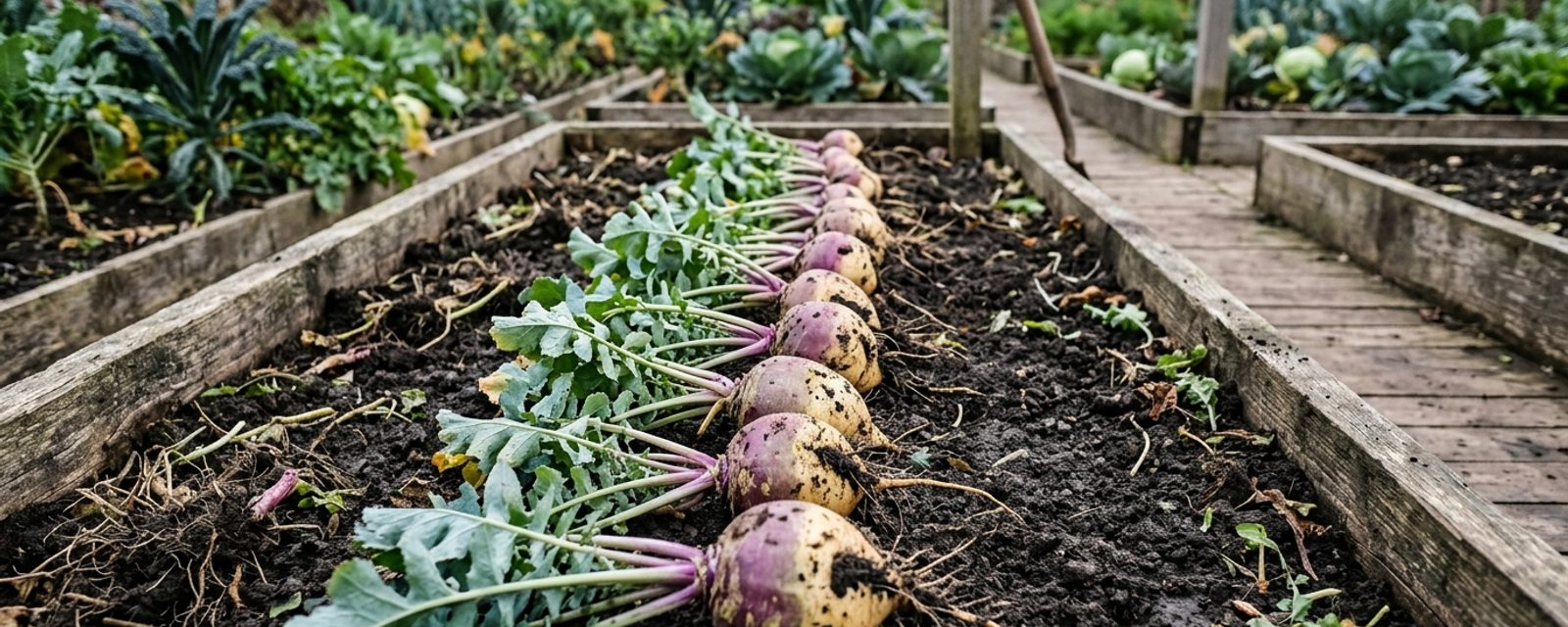
Swede is a biennialA plant that completes its life cycle over two years: growth in year one, then flowering, seeding and dying in year two. Full definition → by nature. Left to its own devices it would bulk up a root through one growing season, sit through winter, then bolt and flower the next spring, that's the plant's actual life cycle, and it's why a swede sown in May won't be worth lifting until September at the earliest. Growers force the crop to behave as an annual, harvesting the root before the plant ever gets the chance to flower, which means every swede in the ground is racing a single internal clock: put on enough bulk and enough disease resistance before winter closes in, in one uninterrupted run, with no second sowing to fall back on if the first one struggles. That single-shot biology is exactly why variety choice carries more weight for swede than for a crop you can resow every few weeks. Get the wrong variety in Scotland's damp, clubrootA soil-borne fungal disease of the brassica family that swells and distorts roots, and survives in soil for years. Full definition →-prone soil and there's no third attempt this year.
Quick answer
Gowrie is the best all-round pick for most Scottish gardens: hardy, good flavour, and the best mildew resistance among the three Award of Garden Merit (AGMThe RHS's Award of Garden Merit: a UK-wide trials award for reliable performance, not a Scotland-specific recommendation. Full definition →) varieties recommended. If clubroot has shown up in the plot before, choose Marian instead, it's the only one of these with a clubroot resistance claim. If storage flavour matters more than disease resistance, Brora's no-bitterness flesh holds up particularly well.
Why the standard "top 3" list undersells the decision
Most swede coverage stops at three headline varieties, Gowrie, Brora and Magres, because all three hold the Award of Garden Merit and all three are widely stocked. That's a reasonable shortlist for the country as a whole. It's an incomplete one on ground where clubroot is a known problem, because none of the three AGM varieties carry any claimed resistance to it, and the fungus that causes clubroot favours exactly the conditions common on much of Scotland's naturally acidic soil: damp, poorly-drained, acidic ground. Liming the soil to raise the pH is one way to manage that pressure. Variety choice is the other lever, and it's one most "best swede" round-ups don't pull at all, because the variety that offers it, Marian, isn't AGM-rated and so gets left off nearly every general list. For sowing depth, spacing and day-to-day care, see the full growing guide.
The five varieties worth comparing
Gowrie is the closest thing to a default recommendation: a purple-skinned swede with a long holding ability, harvestable through to January, and high resistance to powdery mildew. It's also susceptible to black rot, clubroot and leaf spot, the mildew resistance doesn't extend to the soil-borne disease that matters most here.
Brora trades disease resistance for eating quality. Its selling point is flesh with no bitterness at all, reddish-purple skin over a cream base, and reliable storage through autumn into the new year. It carries no resistance claims to mildew, black rot or clubroot, it's a flavour-and-storage variety, not a disease-resistance one.
Magres sits close to Gowrie: very winter hardy, good mildew resistance, good flavour, free from bitterness. Like Gowrie, it's susceptible to clubroot, so it doesn't solve the same problem.
Marian is the one worth knowing about even though it's absent from most lists. It isn't AGM-rated, which is presumably why it gets left out of general round-ups, but its RHS page states plainly that it "shows resistance to powdery mildew and club root", the only variety among these four with a clubroot resistance claim at all. That same page is worth reading carefully, though: its cultivation notes separately list the variety as potentially susceptible to club root too, an inconsistency on RHS's own page that isn't resolved one way or the other here. Nutty flavour, purple skin, yellow flesh. Anywhere clubroot has turned up before, or on a plot with acidic, poorly-drained ground where the disease is more likely to establish, Marian is still the variety that most directly addresses the risk, even with that caveat attached, rather than working around a different one entirely.
Tweed, also not AGM, is described by Gardener's World as British-bred, with an attractive purple top, creamy flesh, and doing well in poor soil. Its own plant page didn't yield the same level of detail as the other four, so treat these notes as less-verified.
| Variety | AGM | Hardiness | Mildew resistance | Clubroot resistance | Best for |
|---|---|---|---|---|---|
| Gowrie | Yes | H4The RHS's H1a–H7 scale for how much cold a plant can survive outdoors, H1a being tender indoor-only and H7 hardy anywhere in the UK. Full definition → | High | No | All-round pick; longest holding ability (to January) |
| Brora | Yes | H4 | None claimed | No | Flavour and long storage; no bitterness |
| Magres | Yes | H4 | Good | No | Flavour plus winter hardiness |
| Marian | No | H4 | Yes | Claimed, but same page also lists it as potentially susceptible | Clubroot-prone or acidic, damp ground |
| Tweed | No | Not confirmed | Not confirmed | Not confirmed | Poor soil (per Gardener's World; less verified) |
Best overall verdict
Gowrie earns the all-round pick on its trade-offs, not just its shortlist position: the trade-off of choosing Marian instead, no AGM badge, slightly less common in seed catalogues, an unresolved inconsistency on its own clubroot claim, is worth it specifically where clubroot has appeared before or the ground is acidic and slow to drain, since clubroot swells and distorts the roots until the plant wilts and the crop fails outright, a worse outcome than anything Gowrie's mildew resistance is protecting against. Brora is the right swap only where flavour and storage are the priority and clubroot and mildew aren't active threats on the plot.
Don't read either name as proof of Scottish breeding. Gowrie references the Carse of Gowrie in Perthshire and Brora a Sutherland village, but a place name alone isn't evidence a variety performs better in a Scottish garden. Gowrie has a real, if partial, link beyond the name: the seed trade credits Limagrain and James Hutton Institute trials (1990–2010) as its data source, and the James Hutton Institute, Scotland's own crop-research institute, based at Invergowrie in the Carse of Gowrie, breeds swede varieties for disease resistance today, though it doesn't currently name Gowrie among them. Brora has no such link at all, just the name.
Disease and pest pressure to weigh alongside variety choice
Variety resistance only covers part of the picture. Clubroot is the main soil-borne threat swede shares with the rest of the brassica family, and it's the one where variety choice makes the biggest practical difference, alongside liming acidic ground and rotating brassicasThe cabbage family: cabbage, kale, broccoli, cauliflower, Brussels sprouts, kohlrabi, swede, turnip and more, sharing the same pests, diseases and rotation rules. Full definition → away from any bed where it's appeared before.
| Pest or disease | Varies by variety here? |
|---|---|
| Clubroot | Yes, Marian claims resistance (with the caveat above), Gowrie/Brora/Magres don't |
| Powdery mildew | Yes, Gowrie and Magres resist it, Brora doesn't |
| Cabbage caterpillars | No, mesh from sowing, regardless of variety |
| Flea beetle | No, worse in warm, dry spells |
| Cabbage root fly | No, mesh pinned down at sowing is the defence |
| Slugs and snails | No, protect seedlings with mesh or barriers |
| Pigeons | No, protect over winter regardless of variety |
Common questions
Is Gowrie or Brora actually a Scottish-bred variety?
Not confirmed outright for either. Both reference Scottish place names, and Gowrie has a genuine trade-sourced link to James Hutton Institute trials plus Hutton's own current swede breeding work from its base in the Carse of Gowrie. Brora has no comparable evidence at all, just the name.
Which swede variety resists clubroot?
Of the varieties covered here, only Marian carries a clubroot resistance claim, and even that comes with a caveat: the same RHS page also lists the variety as potentially susceptible to club root elsewhere in its cultivation notes, an inconsistency on RHS's own page rather than a resolved fact. Gowrie, Brora and Magres are all listed as susceptible to clubroot despite two of them having good mildew resistance.
Is swede the same as turnip?
No, swede is Brassica napus (Napobrassica Group), turnip is Brassica rapa, a related but different crop. The two get called "neeps" interchangeably in Scotland, which is where the confusion usually starts.
Can a cold snap after sowing make swede bolt?
It's a real risk with the biennial brassicas as a group: a spell of cold weather while the plant is still young can trick it into behaving as if it's already been through a winter, triggering it to flower the same year instead of bulking up a root. Scotland's spring temperatures are more variable than further south, which makes sowing too early into a cold snap the riskier end of the late-spring-to-early-summer window, not sowing too late.
Does an AGM award mean a variety is better for Scotland?
Not necessarily. The Award of Garden Merit reflects general garden performance, not region-specific suitability, and none of the three AGM swedes carry clubroot resistance. Marian, which does, isn't AGM-rated at all, which is why it's largely absent from general "best swede" lists despite being the more relevant choice on clubroot-prone ground.
Sources
7 sources, recorded with what each was used for
- Swede: grow your own: Confirmed the three RHS-recommended AGM varieties (Gowrie, Brora, Magres) and their one-line descriptions
- Brassica napus (Napobrassica Group) 'Gowrie': Variety description, hardiness rating (H4), disease susceptibility list
- Brassica napus (Napobrassica Group) 'Brora': Variety description, hardiness rating (H4), disease susceptibility list
- Brassica napus (Napobrassica Group) 'Magres': Variety description, hardiness rating (H4), disease susceptibility list
- Brassica napus (Napobrassica Group) 'Marian': Variety description and clubroot/mildew resistance claim, and the same page's internally inconsistent susceptibility note, both independently verified verbatim
- How to grow swede: Supplementary variety notes on Brora, Tweed and Gowrie; storage advice
- James Hutton Institute — Brassica breeding: Confirmed Hutton's current swede breeding programme and its focus on disease resistance from its Invergowrie base, for the Gowrie provenance discussion