
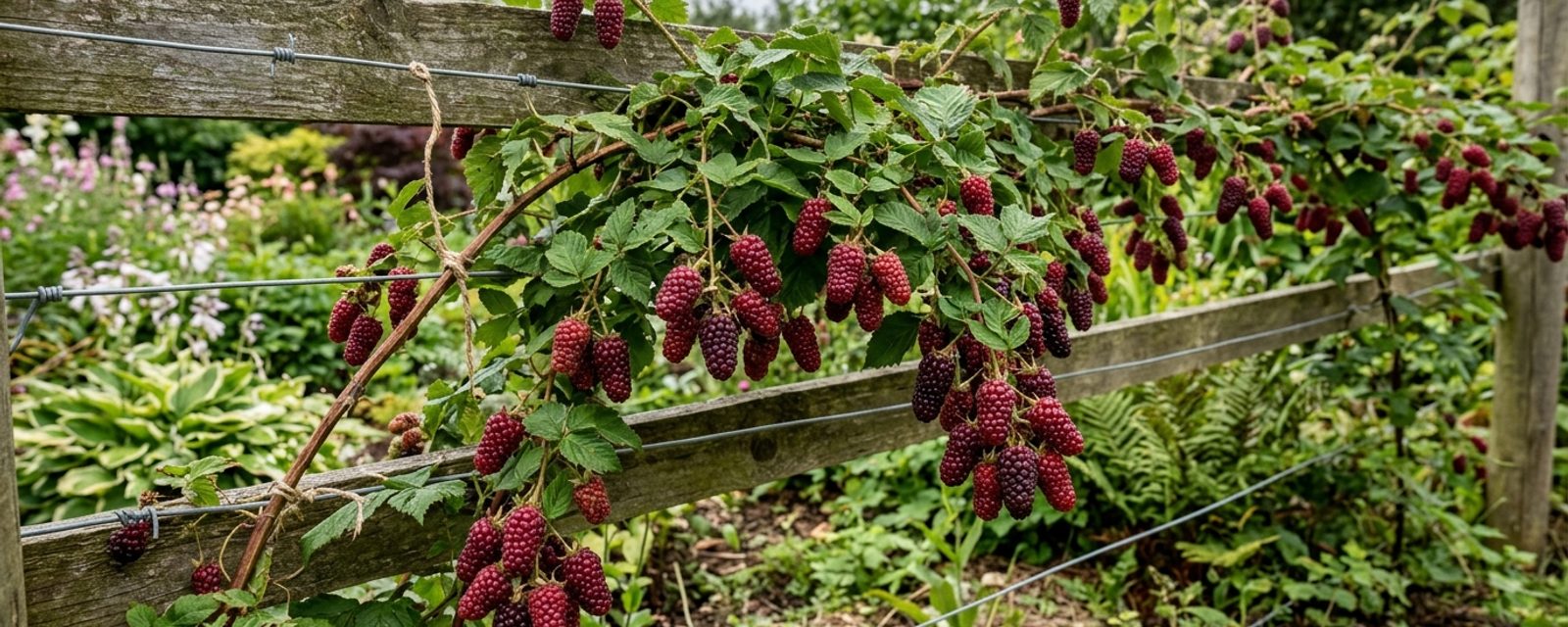
A tayberry isn't a species you can breed true from seed. It's a fixed genetic cross, a loganberry crossed with a black raspberry, and every plant sold under a cultivar name is a clone propagated from the same original selection. That matters more here than for most fruit: because each named tayberry cultivar is a single, genetically stable individual rather than a population with natural variation, the differences between the three cultivarsA plant variety that arose or was bred under cultivation and is kept true by deliberate propagation, rather than a naturally occurring wild species. Full definition → available in the UK, cane character and cold tolerance among them, are fixed traits you're choosing between, not a spectrum you can nudge with siting or pruning.
Quick answer
For most Scottish gardens, the standard tayberry is the strongest overall pick: it holds the RHS Award of Garden Merit, carries an H7 hardiness ratingThe RHS's H1a–H7 scale for how much cold a plant can survive outdoors, H1a being tender indoor-only and H7 hardy anywhere in the UK. Full definition →, and produces usually thornless canes, so the headline "spiny original" trade-off is less absolute than it first appears. Buckingham is the better choice for a small, sheltered garden where guaranteed thornless handling matters more than two hardiness bands' difference. Medana is worth choosing specifically for flavour and yield if you don't mind picking around actual thorns and your site is sheltered enough that H5 isn't a concern.
The tayberry itself was bred at the Scottish Crop Research Institute at Invergowrie, but breeding location and garden performance are separate questions. Only three tayberry cultivars carry their own individual plant listing: the standard tayberry, Buckingham, and Medana. The full growing guide covers how to plant, train and prune whichever one you choose; this is about which of the three actually suits your garden, and where the trade-offs genuinely bite.
One clarification worth stating up front: the tummelberry is a different, separately Scottish-bred hybrid berry cross (raspberry × tayberry-type breeding), not a tayberry cultivar, so it isn't part of the comparison below.
| Cultivar | Hardiness | Mature spread | Canes | AGMThe RHS's Award of Garden Merit: a UK-wide trials award for reliable performance, not a Scotland-specific recommendation. Full definition → |
|---|---|---|---|---|
| Standard tayberry | H7 (below -20°C) | 2.5–4m | Usually thornless | Yes |
| Buckingham | H5 | 1.5–2.5m | Thornless | No |
| Medana | H5 | 1.5–2.5m | Slightly thorned | No |
The genuine candidate set
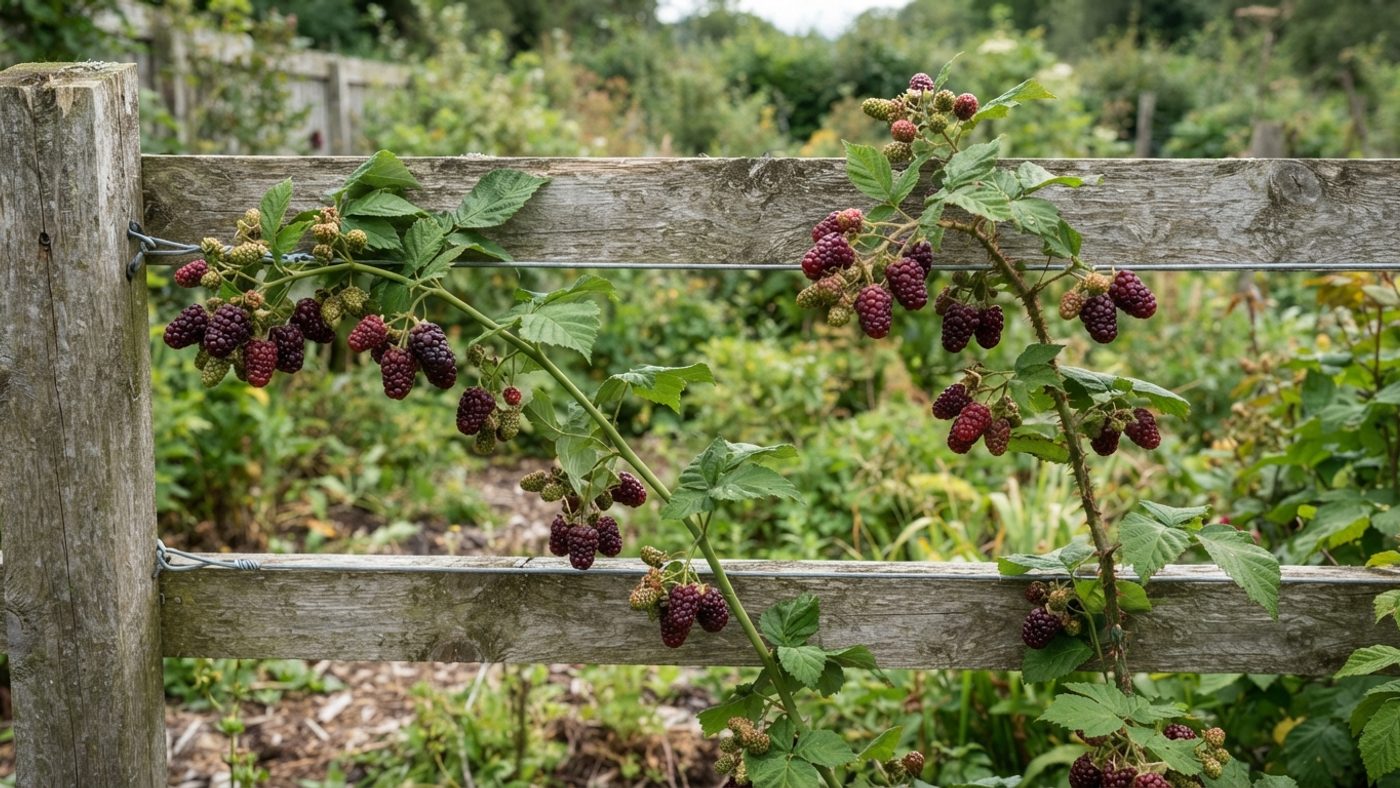
Three tayberry cultivars have their own individual plant listing: the standard tayberry, Buckingham, and Medana. The combined blackberries-and-hybrid-berries growing guide names the standard tayberry as one of four AGM varieties covering the wider group, alongside blackberries and other hybrid berries, not three further tayberry cultivars.
Which of the three, and for what situation
Small or urban garden, handling ease the priority. Buckingham is bred and sold specifically for thornless handling, it's also marketed as "Buckingham Thornless", and stays a more compact 1.5–2.5m spread against the standard variety's 2.5–4m, which matters if space is tight. The cost is real: H5 rather than H7, two full hardiness bands down. H5 means the plant survives severe UK winters down to -15 to -10°C, a genuine buffer for most gardens, but it's a trade worth making deliberately rather than assuming Buckingham is simply the improved version.
Exposed, cold, or upland site. The standard tayberry is the only one of the three rated H7, hardy below -20°C, a rating few UK winters, Scottish or otherwise, will ever properly test. Its canes are usually thornless, which softens the usual "spiny original" framing, though "usually" leaves room for occasional thorned growth, worth a cautious glove anyway when tying in canes. It's also the only one of the three to carry the AGM. Worth separating from cold tolerance: the H-rating measures winter minimum temperature, not wind or salt exposure, and all three cultivars are trained against a sheltered wall or fence rather than left freestanding, so a genuinely exposed coastal or hilltop site needs that shelter regardless of which cultivar is planted. Late spring frost at flowering is a separate risk again, affecting fruit set rather than the plant's survival; none of the three cultivars has a published frost-tolerance figure at blossom specifically, so treat it the same way as any spring-flowering fruit and be ready to fleeceA lightweight, breathable fabric laid or draped over plants to trap a little warmth and keep off frost, wind and some flying pests. Full definition → blossom on a forecast frost night (see the frost dates page).
Maximum yield and flavour, sheltered site. Medana is the outlier of the three for cane character: it's described as "a slightly thorned tayberry", the only one of the three with any real prickle to work around. In return it's rated for large, juicy, aromatic fruit, similarly praised as "large, well-flavoured" for Buckingham, but Medana is the one most consistently singled out for flavour intensity. It shares Buckingham's H5 rating, so it wants the same shelter, not the standard variety's exceptional cold tolerance.
Weighing the three against each other: the standard tayberry is the only one with an AGM and the H7 rating that removes hardiness as a limiting factor almost anywhere in the country, and it's also the cultivar actually bred at Invergowrie and named after the Tay, heritage rather than a growing reason, but a genuine one. Buckingham and Medana both give up two hardiness bands for a smaller footprint and easier or more flavourful picking respectively, a real trade rather than a straightforward upgrade.
Spacing and spread
Spacing follows cultivar vigour, per the table above: allow space at the top of the standard variety's 2.5–4m range if you're training it, and you can plant tighter with either of the other two.
Soil pH
No numeric soil pH figure is published for tayberries. All three cultivars are described as tolerant of acid, alkaline, and neutral soil, so pH is unlikely to be a limiting factor for any of the three.
Pollination and container growing
Whether the plant is self-fertileA plant that can set fruit using its own pollen, without needing a second, different variety nearby to cross-pollinate it. Full definition → or needs another plant nearby to fruit isn't stated for any of the three cultivars, and container growing isn't addressed for tayberries specifically either; the only hybrid-berry-family plants named as container-suitable are a handful of compact blackberry cultivars, not tayberries. Given all three cultivars are trained flat against wires on a wall or fence rather than grown as a freestanding shrub, a container is a poor match regardless.
Pests and disease, by variety
All three cultivars share the same core risk: susceptibility to grey mould, plus honey fungus as a rare but serious possibility. Grey mould thrives in damp, still air, so good airflow from correct wire training matters more on a wet west-coast site than a drier east-coast one, regardless of which cultivar is planted. Neither disease risk is described as varying meaningfully by cultivar. Birds strip ripening fruit on any of the three equally, and raspberry beetle and aphids are named as general risks across the group rather than tied to one cultivar over another. Where handling risk does differ by variety, it's the spinier canes of Medana specifically that make working close to ripening fruit more of a hazard than with the other two, worth netting on a framework rather than draping netting straight onto the canes, so you're not reaching in through thorns to free a trapped bird or untangle the net.
No yield-per-plant figure is published for any of the three cultivars, only qualitative fruit descriptions ("large", "well-flavoured", "juicy aromatic"). Full detail on each of these problems, including grey mould, honey fungus, aphids, raspberry beetle, birds, and raspberry viruses, is covered on the full growing guide and this site's individual pest pages.
Growing technique
All three cultivars fruit in the same July-to-August window, ready once the fruit reaches its deepest colour. Planting, wire training, pruning timing, and the full harvest and storage detail for whichever cultivar you choose are covered on the tayberry growing guide.
Common questions
Is Buckingham or Medana the better choice if I can only grow one thornless-leaning tayberry?
Buckingham is the fully thornless-bred option of the two; Medana is only "slightly thorned," a middle position rather than genuinely thornless. If avoiding thorns entirely is the priority, Buckingham is the more reliable choice on cane character alone.
Does the standard tayberry actually have thorns?
Its own RHS listing describes it as producing "usually thornless" canes, which is a softer claim than fully thornless — some thorned growth is possible. Treat it with the same care as a thornier variety when tying in canes, even though thorns aren’t its defining feature the way they can be assumed to be.
Is there a tayberry variety better suited to a small garden or container?
Buckingham and Medana both have a more compact 1.5-2.5m mature spread against the standard tayberry's 2.5-4m, so either suits a smaller space better on footprint alone; container growing specifically isn't addressed for any of the three.
Do all three tayberry varieties need the same amount of shelter?
No. The standard tayberry’s H7 rating gives it far more cold tolerance than Buckingham or Medana, both rated H5, so a genuinely exposed or upland Scottish site favours the standard variety specifically, while the other two are better suited to a sheltered spot regardless of the rest of the country’s hardiness zone.
Are there tayberry varieties beyond these three worth considering for Scotland?
RHS lists only these three cultivars with individual plant pages. A fourth name occasionally seen elsewhere, the tummelberry, is a separate hybrid berry cross bred in Scotland, not a tayberry cultivar, and isn’t a genuine alternative within this comparison.
Sources
4 sources, recorded with what each was used for
- Rubus (Tayberry Group) Tayberry (standard): Hardiness (H7), AGM status, cane/thorn description, spread, disease susceptibility, soil/sun tolerance, exposure rating
- Rubus (Tayberry Group) 'Buckingham': Hardiness (H5), thornless cane description, spread, fruit flavour/use, soil requirements, time to maturity
- Rubus (Tayberry Group) 'Medana Tayberry': Hardiness (H5), "slightly thorned" cane description, spread, fruit flavour/use, soil requirements
- James Hutton Institute: Blackberry/hybrid berry breeding: Breeding provenance context (Scottish Crop Research Institute, Invergowrie); not used as a suitability claim