
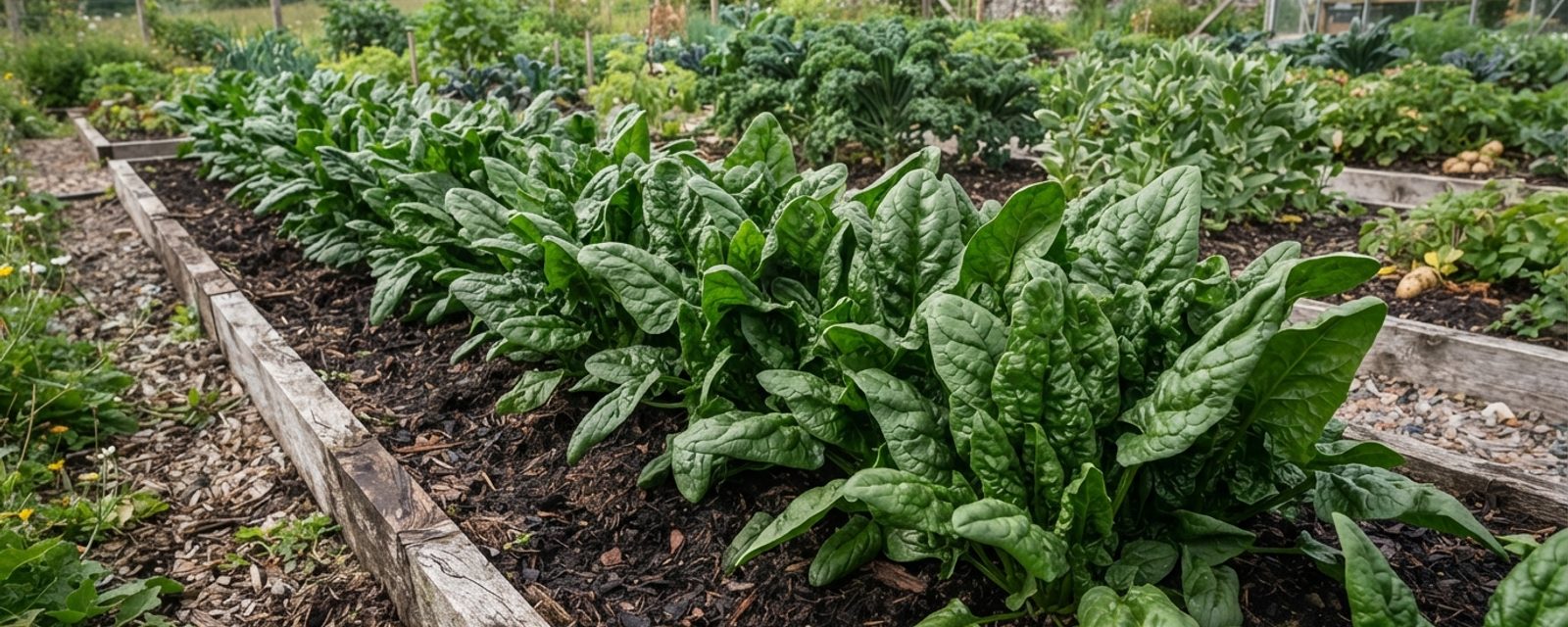
Spinach bolts, runs to flower, turns bitter, stops producing leaf, for two different physiological reasons, and they pull in opposite directions. Hot, dry summer weather is a known trigger for premature flowering, and cold is a trigger too: the plant grows best between 15-20°C, and conditions either side of that band, whether a cold snap or a hot, dry spell, can push it toward boltingA plant switching early into flowering and seed production, usually triggered by stress, after which leaves, roots or bulbs turn bitter or unusable. Full page →. Spinach is also a long-day plant, and day length is a cause alongside heat and drought. That matters specifically here: Scotland's high latitude gives longer summer daylight hours than most of the UK, which is worth factoring into a sowing decision even without a precise hour threshold to point to.
Quick answer
For most Scottish gardens, Mikado is the best overall pick: slow to bolt with good bolt and mildew resistance, and it handles the general run of conditions well. Choose Amazon instead if you want to sow in autumn and carry a crop through winter under cover, since it's the only one of the six with an explicit overwinteringKeeping a plant alive and intact through the cold months, whether left outdoors, moved under cover, or stored dormant. Full definition → note; choose Missouri instead for containers, where its compact habit and slow-to-bolt character suit a 30cm pot.
That day-length point cuts against the pattern that holds for most other crops in this series, where Scotland's cooler, shorter summer is a straightforward advantage. With spinach, a cool spring doesn't protect against bolting the way it does for lettuce, because cold is itself one of the two bolting triggers, and the day-length trigger doesn't care about temperature at all. The practical result, in line with what the full growing guide already recommends, is that a late-summer sowing for an autumn and spring harvest is usually the more dependable route than an early spring sowing timed to catch a short window before the days lengthen and the heat arrives.
The six AGM varieties, compared
All six varieties below hold the RHS Award of Garden Merit (AGMThe RHS's Award of Garden Merit: a UK-wide trials award for reliable performance, not a Scotland-specific recommendation. Full definition →). Hardiness is the standard H-rating scale: H5 means hardy in most places throughout the UK even in a severe winter, H2The RHS's H1a–H7 scale for how much cold a plant can survive outdoors, H1a being tender indoor-only and H7 hardy anywhere in the UK. Full definition → means it tolerates low temperatures but won't survive a hard frost. That gap matters more here than the number alone suggests, a Scottish row surviving into a hard frost is a live possibility most winters, not a rare edge case.
| Variety | Bolt resistance | Hardiness | Downy mildew | Sowing window |
|---|---|---|---|---|
| Mikado | Slow to bolt; good bolt resistance | H5 | May be susceptible | Feb-May only |
| Missouri | Slow to bolt | H2 | May be susceptible | Feb-May only |
| Lazio | No bolt claim | H2 | May be susceptible | Feb-May and Aug-Sept |
| Medania | Slow to bolt | H2 | May be susceptible | Feb-May and Aug-Sept |
| Amazon | Resistant to bolting (general page only) | H2 | Disputed, see note below | Feb-May and Aug-Sept |
| Apollo | Resistant to bolting | H2 | Some resistance | Feb-May and Aug-Sept |
Mikado and Missouri's own individual listings give only the February-to-May sowing window, with no autumn or winter-cultivarA plant variety that arose or was bred under cultivation and is kept true by deliberate propagation, rather than a naturally occurring wild species. Full definition → note on those specific pages, the general guide does describe a late summer/early autumn window for "hardy varieties" without naming which ones, so this isn't proof Mikado and Missouri can't be autumn-sown, only that their own pages don't say so. Amazon's strong "resistant to downy mildew and bolting" line comes from the curated variety blurb on the general grow-your-own page; its own individual plant page carries only the generic "may be susceptible to spinach downy mildew" disease field, without repeating that stronger claim. The two pages don't agree on Amazon's mildew resistance, so treat its bolt resistance as the reliable part of that claim and its mildew resistance as unconfirmed, if mildew is the bigger worry on your plot, Apollo is the safer pick of the two, since both of its own pages agree on it.
The best overall pick: Mikado
Mikado is the strongest general-purpose choice for a Scottish plot. It's slow to bolt with good bolt and mildew resistance, the combination that matters most given spinach bolts from cold as readily as from heat, so a cold snap after an early sowing is a real risk here, not just a hot spell. It also carries an H5 hardiness rating, the highest of the six, hardy in most places throughout the UK even in a severe winter, a real margin over the other five varieties' H2 rating, which only promises tolerance of low temperatures, not a hard frost. Its own listing doesn't specifically flag it for an autumn sowing the way Amazon's does (see below), so that hardiness margin is a general safety buffer rather than a stated overwintering recommendation. Its upright habitA plant's characteristic shape and manner of growth, such as upright, spreading, creeping or bushy. Full definition → with large, dark green leaves also suits the pick-outer-leaves harvest method the full growing guide covers in detail.
Where a different variety wins
- Overwintering under cover: Amazon. It's the only one of the six with an explicit statement that it can be overwintered under cover, on top of resistance to both bolting and downy mildew in its variety description. For an August sowing carried through a Scottish winter, Amazon is the clearest match, "under cover" here means the same fleeceA lightweight, breathable fabric laid or draped over plants to trap a little warmth and keep off frost, wind and some flying pests. Full definition → or clocheA small, portable clear cover placed over an individual plant or short row to trap warmth and keep off wind, rain and pests. Full definition → protection the full growing guide recommends from October onwards, not a heated structure.
- Containers: Missouri, named directly as "ideal for quick crops in containers," and it's slow to bolt, which matters more in a pot where roots have less buffer against stress. Apollo is a reasonable second choice for a pot too.
- Reliable yield over bolt-resistance: Lazio. No specific bolt claim is made for it, but it's described as reliable and high-yielding with smooth, rounded leaves, a reasonable choice where cropping volume matters more than squeezing out the last few weeks before bolting.
- Downy mildew-prone sites: Apollo. Its individual listing and the general variety blurb agree with each other on mildew resistance, which isn't true of every variety on this list, making it a safer bet on a damp, sheltered plot or anywhere on the west coast, where humid conditions favour the disease.
A note on soil
Spinach has no specific published pH preference, unlike many crops where a target range is given, so there's no number to aim for here beyond the general vegetable-bed advice covered in the full growing guide.
If bolting keeps beating you regardless of variety, perpetualA strawberry type that produces smaller flushes of fruit continuously through the season, rather than one large crop over a few weeks. Full definition → spinach, a leaf beet grown the same way, not a true spinach, is a far more bolt-tolerant fallback, covered in the full growing guide.
Common questions
Why won't my spinach seed germinateA seed sprouting: breaking dormancy and putting out its first root and shoot, given the right warmth and moisture. Full definition → in early spring?
Cold, most likely, spinach seed rots in soil that's still too cold rather than sitting dormant and waiting, which is why the spring sowing window starts at mid to late spring for an unprotected row, or earlier only under cloches or fleece. A whole row failing to come up is usually the ground temperature, not the seed.
Is spring or late-summer sowing better in Scotland?
Late summer, generally, and further north within Scotland that's worth taking seriously rather than as a rule of thumb: day length in high summer runs longer the further north you are, so a Shetland or Highland garden is working against a stronger version of the same day-length trigger than a Borders garden further south.
Which variety is most bolt-resistant?
The strongest wording goes to Mikado, Apollo and Medania, all confirmed "slow to bolt" on their own listings. Amazon's general description also claims bolt resistance, but that claim isn't repeated on its own individual plant page, so treat it as less certain than the other three.
Can I grow spinach in pots in Scotland?
Yes, Missouri is named specifically for containers, and the full growing guide recommends a 30cm pot minimum.
What pests and problems should I watch for?
Slugs, downy mildew, bolting, and birds (pigeons in particular) are the recurring problems for spinach in Scotland, the full growing guide covers management for each.
Sources
8 sources, recorded with what each was used for
- Spinach: Grow Your Own: General bolting causes and temperature band, spring and autumn sowing windows, and the curated variety blurbs for all six AGM varieties
- Spinacia oleracea 'Mikado': Bolt-resistance wording, hardiness rating, disease field, sowing window
- Spinacia oleracea 'Missouri': Bolt-resistance wording, hardiness rating, disease field, sowing window
- Spinacia oleracea 'Lazio': Hardiness rating, disease field, dual sowing window
- Spinacia oleracea 'Medania': Full cultivar description and bolt-resistance wording, hardiness rating, dual sowing window
- Spinacia oleracea 'Amazon': Hardiness rating, disease field, dual sowing window, overwintering comparison
- Spinacia oleracea 'Apollo': Bolt-resistance wording, disease field, hardiness rating, dual sowing window
- How to Grow Spinach: Apollo's container/bolt-resistance note, sowing frequency and harvest windows