
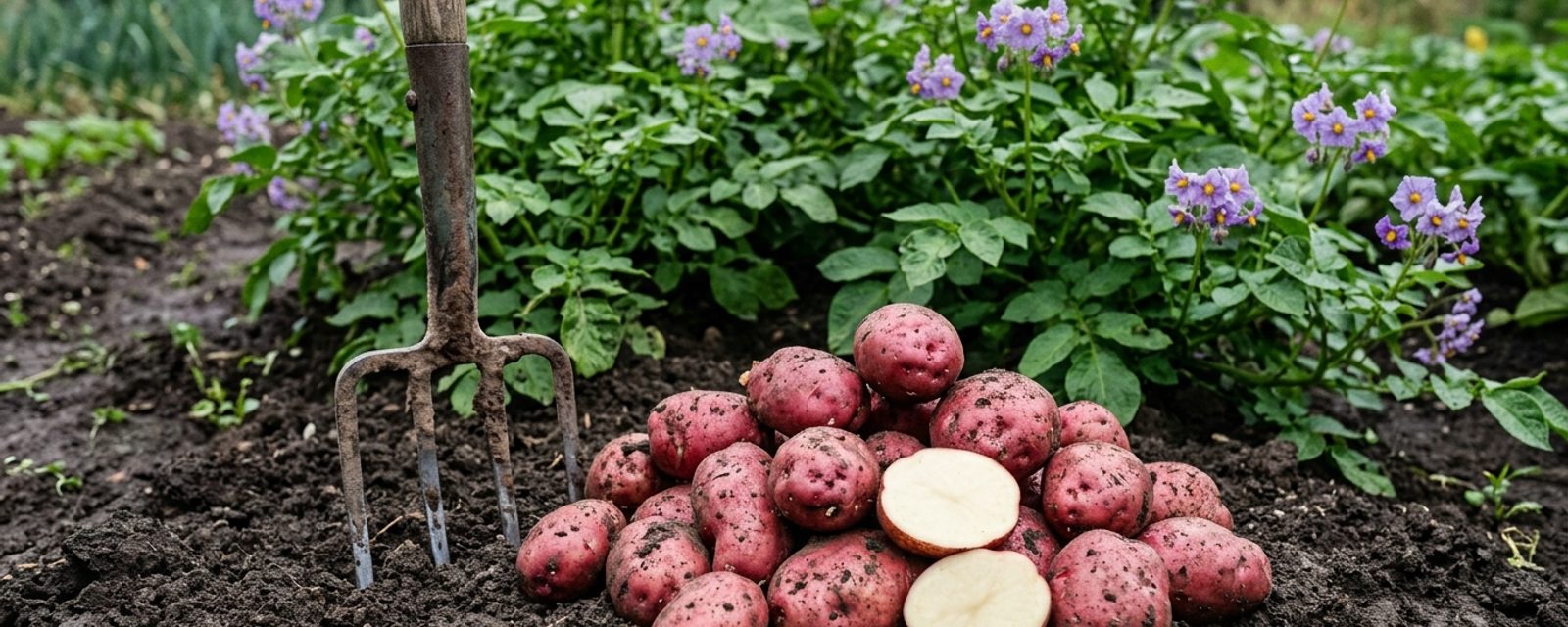
Potato blight is a race against the calendar. The disease needs warm, humid conditions to spread, and those conditions build as summer goes on, but the plant's own foliage is frost-tender, so it can't go in the ground any earlier to get ahead of that build-up. That gap sets up the central choice for a Scottish grower: a first early potato can be lifted in June or July, often before blight pressure has built up at all, while a maincropThe main, usually latest-sown and longest-growing type of a crop, grown for bulk and storage rather than an early harvest. Full definition → variety left in the ground into September has to survive the exact window when the disease is most active. Cropping type and blight resistance aren't two separate features to weigh, for a Scottish garden, cropping type largely determines how much blight resistance you actually need.
Quick answer
For most Scottish gardens, Sarpo Mira is the best all-round maincrop choice: bred specifically for blight resistance, so it can stay in the ground through the riskiest part of the season without the anxious foliage-watching that varieties like Maris Piper demand. If you want an earlier harvest that sidesteps blight risk by timing rather than genetics, choose a first early such as Maris Bard instead; if flavour and texture for salads matter more than blight risk, Charlotte or Pink Fir Apple are the better picks.
Prefer answering a couple of quick questions instead of reading the full comparison? Try the Variety Selector tool.
What the AGM list doesn't tell you
The RHS Award of Garden Merit (AGMThe RHS's Award of Garden Merit: a UK-wide trials award for reliable performance, not a Scotland-specific recommendation. Full definition →) is a UK-wide horticultural merit award, not a Scotland-specific or blight-specific one, twelve potato varieties currently hold it, and the award alone doesn't say which of those twelve will actually shrug off a wet Scottish August. Checking each variety individually shows they disagree far more than a single "12 AGM potatoes" list suggests: some name real, tested resistance to late blight, others state plainly that they carry none.
The comparison
| Variety | Type | Blight resistance | Typical harvest | Best for |
|---|---|---|---|---|
| Sarpo Mira | Late maincrop | Bred for resistance, named as its defining trait | Sept–Oct | Wet or blight-prone sites; storage |
| Desiree | Maincrop | Good resistance, plus some scab resistance | Aug–Sept | Maincrop growers who want resistance without going full Sarpo |
| Charlotte | Second early (salad) | Generally good, including to late blight | Jul–Aug | Salad use; a resistant second early |
| Maris Bard | First early | None claimed, escapes blight mainly by early harvest | Jun–Jul | Fastest reliable first early |
| Pink Fir Apple | Late maincrop (salad) | None claimed | Sept–Oct | Flavour and texture, on a drier or well-managed site |
| Maris Piper | Maincrop | None claimed | Aug–Sept | Flavour and chip quality, not a default for wet Scottish sites |
Nadine and Vivaldi are also RHS AGM second earlies worth knowing about.
Two other varieties are worth a mention. Orla and Carolus are both described by Gardener's World as blight-resistant, though neither currently holds the RHS AGM. Two older maincrops with Scottish origins are also still grown, Golden Wonder and Kerr's Pink, but neither carries an RHS AGM, so their blight performance isn't independently rated here.
Blight risk isn't uniform across a Scottish garden either: a sheltered, well-drained plot runs a lower risk than a low-lying or consistently damp one, wherever it sits. Treat "how wet does my own site actually run" as the more useful question than which region you're in.
Best overall: Sarpo Mira
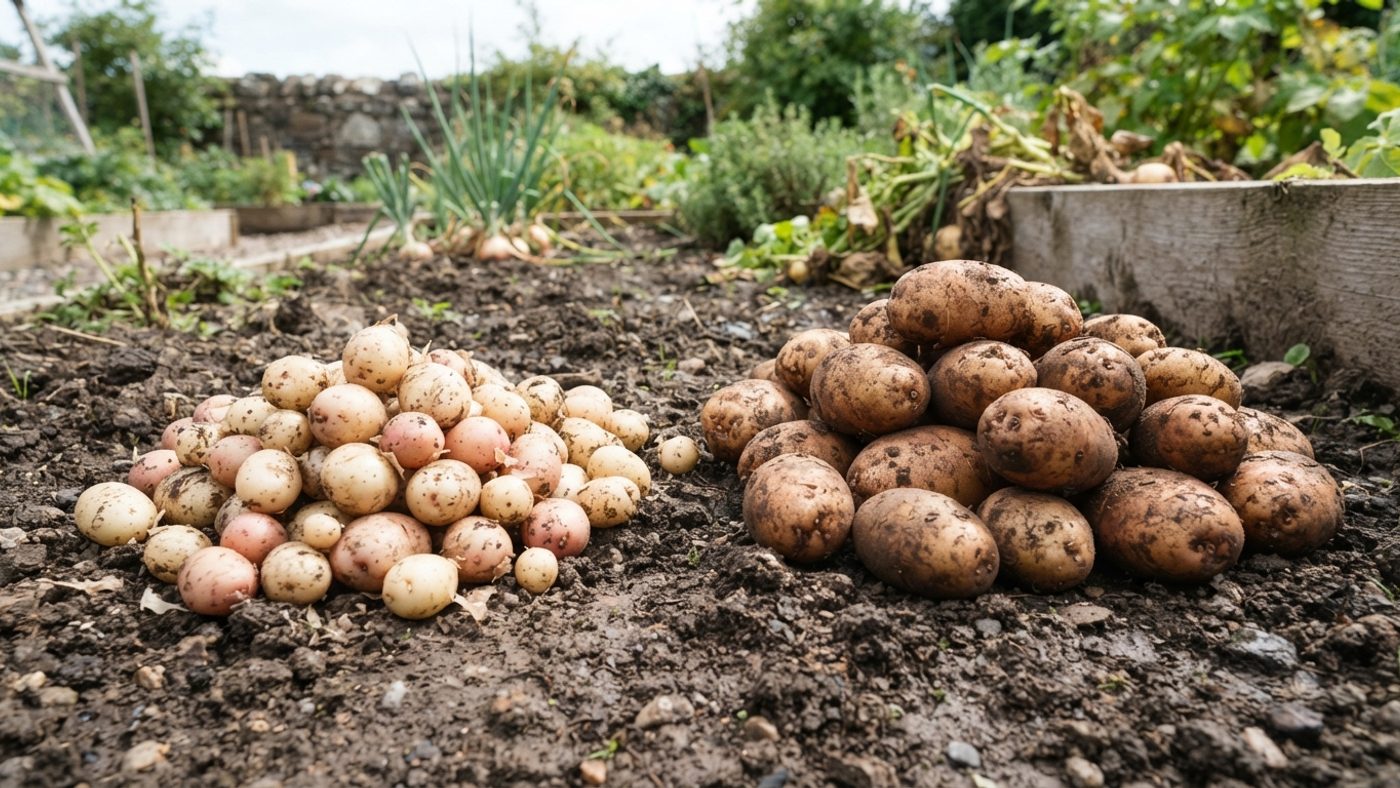
Sarpo Mira is named for resistance to blight as its defining characteristic, alongside good resistance to slugs, potato blackleg (a bacterial stem rot) and potato virus Y (which stunts growth and mottles the leaves). For a maincrop that has to sit in the ground through Scotland's riskiest blight weeks, that combination of traits is hard to match, it's also a heavy yielder that stores well over winter. Even a resistant variety still benefits from the general precautions covered in the full growing guide, including watching a blight forecast and clearing all tubersA swollen underground stem or root a plant uses to store energy, which can also grow into a new plant, the classic example being a potato. Full definition → and volunteers at the end of the season; resistance reduces the risk, it doesn't remove the need to manage it. For first and second earlies specifically, chitting is worth doing regardless of variety.
Situational picks
| Your situation | Pick | Why |
|---|---|---|
| Wet or blight-prone site | Sarpo Mira | Blight resistance named as its defining trait |
| Want resistance without going full Sarpo | Desiree | Good blight resistance, plus some scab resistance |
| Fastest escape from blight, by timing | Maris Bard | Lifted well before blight risk peaks |
| Best for storage | Sarpo Mira | High-yielding, stores well over winter |
| Salad or specialty use | Pink Fir Apple or Charlotte | Charlotte also carries real blight resistance |
| Flavour-first, drier or well-managed site | Maris Piper | No named blight resistance, needs vigilance |
Best for a blight-prone or consistently wet site: Sarpo Mira, for the reasons above. Desiree is the next-best maincrop option, also credited with good blight resistance, plus some resistance to potato scab, though it crops mid-to-late season rather than late.
Best first early, fastest escape from blight risk: Maris Bard. It's not bred for blight resistance and none is claimed for it, but as a heavy-cropping first early it's usually out of the ground well before blight becomes a serious threat, and it has good resistance to drought and bruising as a bonus.
Best salad or specialty variety: Pink Fir Apple, for its knobbly texture and nutty flavour, though it carries no blight resistance and is one of the older varieties still in general cultivation, best suited to a well-drained or carefully managed site rather than a consistently damp one. Charlotte is the better salad pick where blight risk is the deciding factor, credited with generally good disease resistance including to late blight, on top of its reputation for flavour.
A caution on the popular default: Maris Piper is Britain's most widely grown potato and delivers the classic flavour and texture many gardeners want, but no blight resistance is claimed for it at all. That's not a reason to avoid it outright, but it is a reason not to default to it for a Scottish maincrop bed without the same blight vigilance you'd apply to any non-resistant variety, see the potato blight page for what that vigilance actually involves.
Whichever variety you choose, the harvest windows above only hold if planting timing is right: work back from your own last frost date rather than a fixed calendar month. A useful practical check alongside that is soil temperature, wait until it's held around 7°C for three days before planting, since cold, wet spring soil rots a seed potato rather than growing it. The full growing guide covers planting depth and spacing by type.
Soil and scab
None of the varieties above carry documented resistance to potato scab except Desiree, which has some. Liming raises soil pH, and scab is worse on alkaline soil, so the standard advice for a potato bed is to avoid liming it regardless of which variety you grow, see the potato scab page for more on managing it. Slugs are also worth flagging at variety-selection time: Sarpo Mira has good resistance, which is a real secondary reason to favour it on ground with a slug problem, while none of the other varieties above claim any, see the slugs page for control methods.
Seed potatoes
Seed potatoes produced and sold in Scotland are classified under the Seed Potato Classification Scheme, run by the Scottish Government's Science and Advice for Scottish Agriculture (SASA), and inspection includes soil testing for potato cyst nematode (a soil-dwelling pest that can persist for years once established). Scotland is a major producer of certified seed potatoes, so certified Scottish seed is generally easy to source locally regardless of which variety on this list you choose.
Watching for blight
The forecasting model used across the UK to predict blight risk, the Hutton Criteria, was developed at the James Hutton Institute in Scotland, which also runs the Fight Against Blight tracking project and BlightSpy forecasts. You don't need to know the underlying temperature and humidity thresholds yourself; the practical takeaway is to check a blight forecast for your area during the growing season rather than relying on variety choice alone, however resistant. The full growing guide covers what to do once blight risk is confirmed in your area.
Common questions
I'm growing potatoes for the first time, which variety should I start with?
Maris Bard is a forgiving first choice: it crops reliably, is usually harvested before blight becomes a serious risk, and needs no special disease management. If you'd rather grow a maincrop from the start, Sarpo Mira is the more forgiving option of the two, since its resistance reduces how closely you need to monitor it.
If I grow a blight-resistant variety, can I skip the other blight precautions?
No. Resistance in Sarpo Mira, Desiree and Charlotte reduces the risk and severity of infection, but none of them are described as immune. The general precautions in the full growing guide, watching a forecast, removing infected foliage promptly, clearing all tubers at harvest, still apply.
For a maincrop, should I choose based on flavour or blight resistance?
On a site with any history of blight, or in a consistently wet part of Scotland, resistance should decide it, a lost crop has no flavour at all. On a drier, well-managed site with no blight history, flavour and texture (Maris Piper, Pink Fir Apple) are a reasonable basis for choice, as long as you're prepared to monitor the forecast and act quickly if blight appears.
Does the same variety work in a container as it does in open ground?
The varieties above don't differ in their suitability for containers specifically, that choice is driven more by cropping type than by blight resistance. First earlies (Maris Bard) are generally the easiest container potatoes because they crop quickly in a limited root run; a bulkier maincrop like Sarpo Mira or Desiree will need a larger container to yield well.
Sources
12 sources, recorded with what each was used for
- Potatoes: Grow Your Own: General cropping-type calendar (first early/second early/maincrop plant and harvest windows) and the list of 12 AGM potato varieties
- Solanum tuberosum 'Sarpo Mira': Blight resistance, slug resistance, blackleg and potato virus Y resistance, yield and storage traits
- Solanum tuberosum 'Desiree': Blight resistance, scab resistance, susceptibility to rot/blackleg/stem canker, cropping and storage traits
- Solanum tuberosum 'Charlotte': Disease resistance including late blight, susceptibility to dry rot and blackleg, salad use
- Solanum tuberosum 'Maris Bard': Cropping speed, drought and bruising resistance, blight susceptibility
- Solanum tuberosum 'Pink Fir Apple': Salad type, flavour and texture, blight/scab/rot susceptibility
- Solanum tuberosum 'Maris Piper': Cropping and flavour traits, blight susceptibility
- pH and Testing Soil: Scab risk on alkaline soil, basis for avoiding liming a potato bed
- The Best Potato Varieties to Grow: Corroboration of Sarpo Mira's blight resistance, and mention of Orla and Carolus as blight-resistant varieties outside this article's core comparison
- Potatoes: Vegetable Growing Guide: Soil-temperature planting check (wait for soil to hold around 7°C for three days), used as a maritime-climate reference point, not a Scottish figure
- Fight Against Blight / BlightSpy: Origin and existence of the Hutton Criteria blight forecasting model and the associated outbreak-tracking and forecast services
- Seed and Ware Potatoes: Classification Scheme: Seed Potato Classification Scheme, potato cyst nematode soil testing, and Scotland's role as a certified seed potato producer