
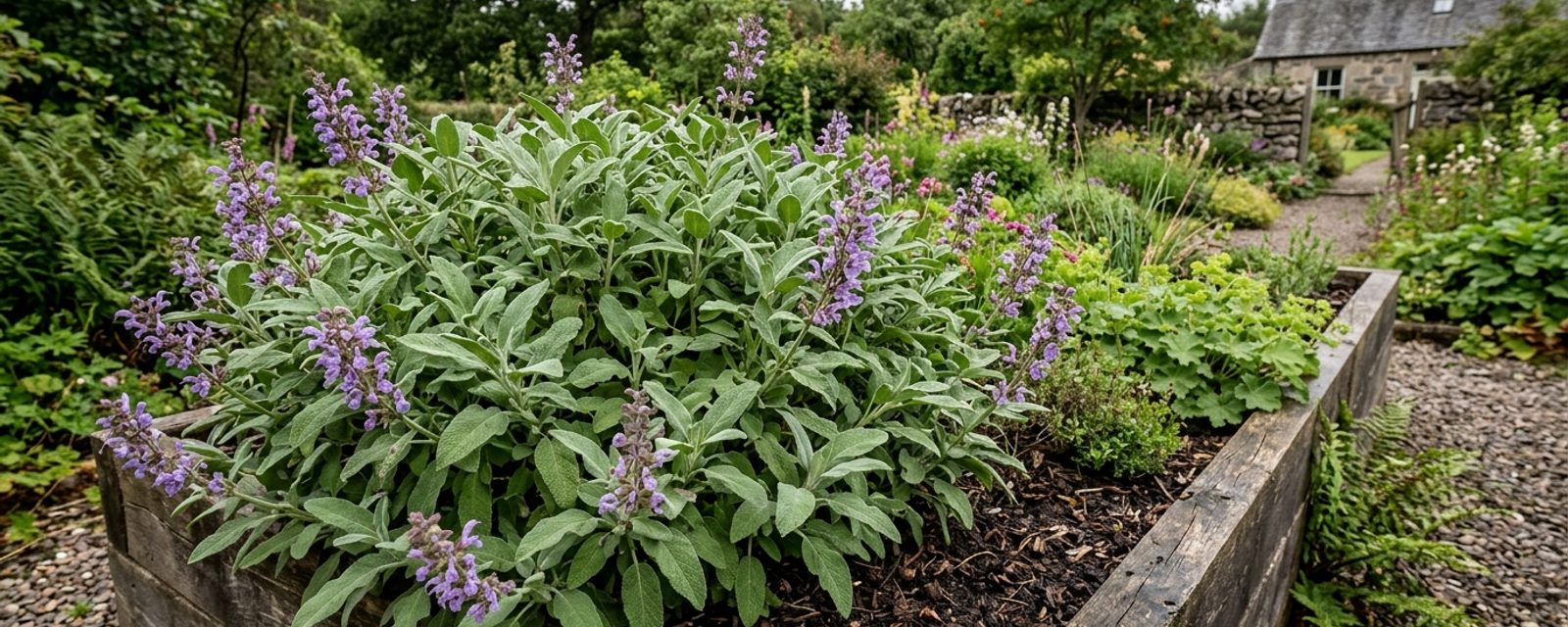
Salvia officinalis in the wild is not a fixed thing: its leaf colour, size and flowering vigour vary from plant to plant, because the pigments that mask its underlying green (the purples of anthocyanin, the yellows of reduced chlorophyll) and its tendency to throw up flower spikes are both genetically loose in the species. A "variety" of sage is usually a single plant that showed a distinctive, useful version of one of those traits, a purple leaf, a variegated one, a habit that stays leafy instead of running to flower, and was then fixed by taking cuttings rather than by breeding true from seed.
Quick answer
Berggarten is the best all-round sage for most Scottish gardens: it holds the RHS Award of Garden Merit, carries the largest usable leaf of the AGMThe RHS's Award of Garden Merit: a UK-wide trials award for reliable performance, not a Scotland-specific recommendation. Full definition → cultivarsA plant variety that arose or was bred under cultivation and is kept true by deliberate propagation, rather than a naturally occurring wild species. Full definition →, and flowers only lightly, staying leafier for longer rather than putting its energy into seed. Choose Purpurascens or Tricolor instead if you want the plant to earn its keep in an ornamental border as much as in the kitchen, Kew Gold if space is tight and you're growing in a container, and common sage (the straight species) if you want the strongest, most peppery flavour of the lot.
That's why sage cultivars are propagated vegetatively and sold as named clones: grow one from its own seed and you won't reliably get the same plant back. It's also why the choice between varieties is really a choice between different fixed trade-offs, leaf colour versus leaf size, ornamental impact versus flavour strength, compactness versus vigour, rather than a search for one objectively "best" plant. Site, planting, pruning and overwinteringKeeping a plant alive and intact through the cold months, whether left outdoors, moved under cover, or stored dormant. Full definition → are the same whichever clone ends up in the ground, and are covered in the full growing guide; here's how the named varieties actually differ.
The comparison
Three cultivars, Purpurascens, Icterina and Berggarten, hold the RHS Award of Garden Merit. All of the varieties below are rated H5The RHS's H1a–H7 scale for how much cold a plant can survive outdoors, H1a being tender indoor-only and H7 hardy anywhere in the UK. Full definition → (hardy in most UK locations, down to -15 to -10°C), and no hardiness distinction is published between any of these cultivars and the straight species, so there's no documented basis for treating any one of them as meaningfully hardier or more tender than another in a Scottish garden.
| Variety | AGM | Foliage / flowers | Mature size | Flavour |
|---|---|---|---|---|
| Common sage (species) | No | Grey-green, finely veined, to 6cm; pale blue flowers, early summer | To 75cm | "Strong, earthy, slightly peppery" |
| Berggarten | Yes | Broad grey-green leaves; pale violet-blue flowers, May–Aug | 0.5–1m | "Strong flavour" |
| Purpurascens | Yes | Purple young growth ageing to grey-green; purple-blue flowers | 0.5–1m | Not documented |
| Icterina | Yes | Yellow-and-green variegated, 3–6cm; lilac-blue flowers, early-mid summer | 0.5–1m | "Well-flavoured" |
| Tricolor | No | Grey-green, cream-variegated, purple-flushed young growth; light blue flowers | 0.5–1m | Not documented |
| Kew Gold | No | Golden-yellow leaves, compact habit; pale violet-blue flowers | To 30cm | Not documented |
| Maxima | No | Largest leaves of any sage on the market; grey-green; violet flowers | 0.5–1m+ | Not documented |
A seventh cultivar, Albiflora, exists mainly as a novelty: an evergreen, bushy sub-shrub with the same grey-green foliage as the species but rare white flowers instead of blue. No AGM or flavour distinction is attached to it, and beyond the white flower colour it offers nothing the varieties above don't already do better, worth knowing it exists, not worth building a bed around.
Flavour notes exist for only three of the seven: common sage is described as "strong, earthy, slightly peppery," Berggarten as having a "strong flavour," and Icterina as "well-flavoured", with nothing distinguishing said for Purpurascens, Tricolor, Kew Gold or Maxima. Treat that as an absence of data rather than an absence of flavour; none of these plants are described as bland, but only three have a documented flavour note at all.
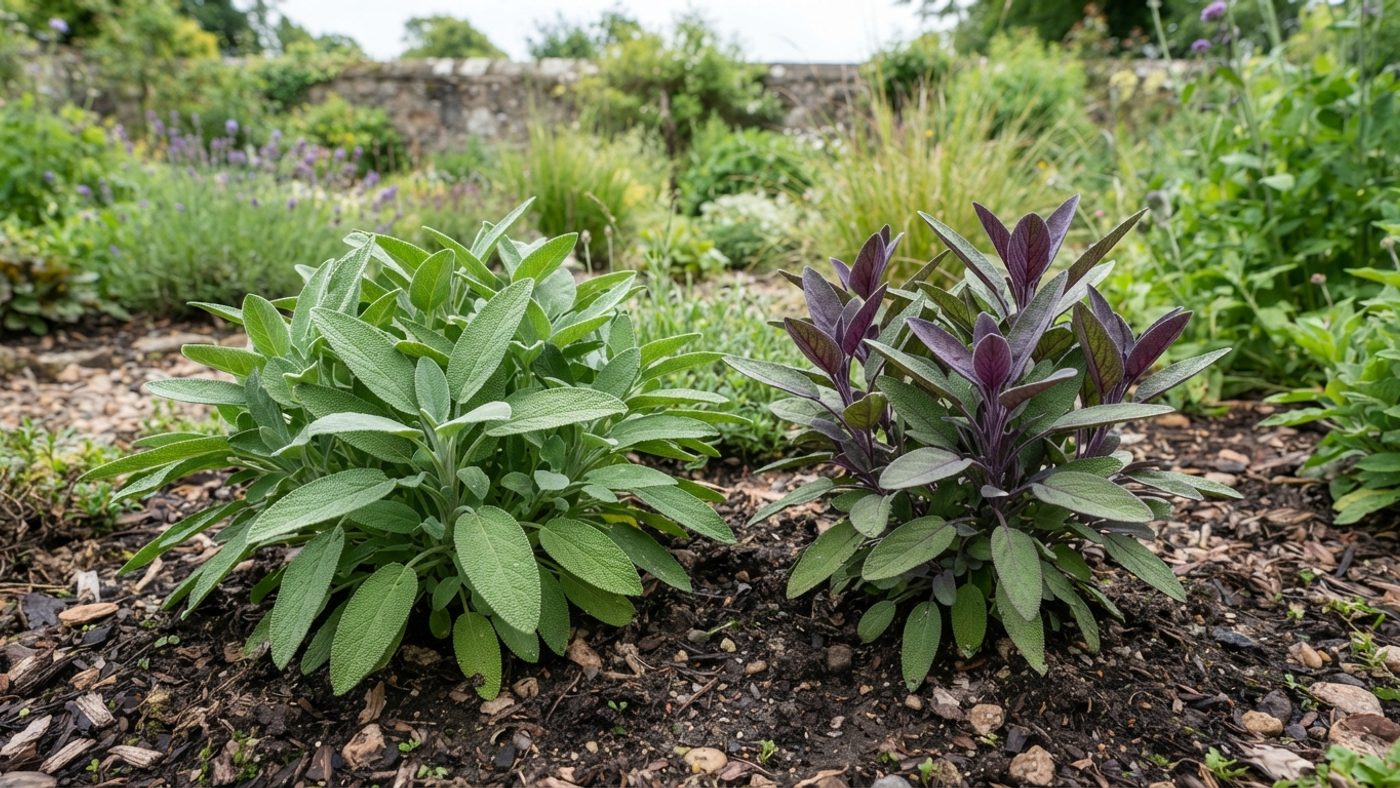
The purple, gold and variegated leaves on Purpurascens, Tricolor, Icterina and Kew Gold are all produced by the same trade-off: pigment (anthocyanin) or variegation (patches with less working chlorophyll) sits over or instead of some of the green. Nothing here quantifies what that costs a plant in growth, but the general principle, less working chlorophyll gives a plant less to photosynthesise with, is a reason to expect these cultivars to grow a little slower than plain green common sage or Berggarten, and to give them the sunniest spot available rather than tucking them into shade. A container on a warm patio or against a south-facing wall is worth considering for these four specifically, for the same reason.
Which sage for your situation
- General kitchen use, one plant to cover everything: Berggarten, its broad leaves are easier to fry whole or slice for a sauce than the smaller-leaved Icterina or Kew Gold, which suit chopping into a dish more than standing as the centrepiece.
- Strongest, most traditional sage flavour: common sage (the species), the only variety with an explicitly peppery description, and the parent of every named cultivar here.
- Decorative border or potager, where looks matter as much as the pan: Purpurascens (purple foliage) or Tricolor (cream, green and purple variegation), both strong on visual interest even though Tricolor itself doesn't hold the award. Give either the most sheltered, sunniest spot available; a windy, coastal or exposed site tests any Mediterranean shrub, and there's less margin to work with once leaf colour is already trading off some vigour.
- Containers or small gardens: Kew Gold, the most compact of this group at around 30cm, versus 50cm-plus for the others.
- Maximum leaf volume for drying or preserving in bulk: Maxima, bred specifically for the largest leaves on the market.
- A talking-point or collector's plant, not a workhorse: Albiflora, for the rare white flowers, go in with the expectation that it's ornamental first, culinary second.
None of these are documented as more pest- or disease-resistant than another, rosemary beetle, sage and Ligurian leafhoppers, capsid bugs and powdery mildew are listed against every cultivar above equally, and root rot from winter waterlogging remains the dominant risk for all of them regardless of leaf colour. Choosing a variety for its foliage doesn't buy you out of any of that; drainage and shelter matter the same amount whichever one you plant.
Buying: young plant or seed?
Grown from seed, common sage takes about a year to reach a size worth harvesting from, with germinationA seed sprouting: breaking dormancy and putting out its first root and shoot, given the right warmth and moisture. Full definition → itself taking around two weeks. For that reason a bought plant or cutting is the recommended route for most gardeners rather than seed, sage is widely available as young plants in spring and early summer, and larger plants in 2- or 3-litre pots are sold through most of the year. This matters more for the cultivars above than for the species: because Berggarten, Purpurascens, Icterina, Tricolor, Kew Gold and Maxima are all clonal selections, seed collected from any of them won't reliably grow into the same plant, buying a young plant (or taking a cutting from an established one) is the only way to be sure you're getting the named variety rather than a genetic reversion toward plain green sage.
Soil pH
No target pH range is published for sage, so there's no specific number to test for or against here, unlike a crop such as blueberries or cauliflower, where Scotland's often naturally acidic soils are a genuine named risk. What actually matters for sage is drainage, not acidity: full sun, shelter, and free-drainingSoil that lets water pass through quickly rather than pooling, so roots aren't sitting in wet ground after rain. Full definition → ground, with grit worked into anything heavy.
Common questions
Which sage variety tastes the strongest?
Common sage, the straight species, is the only one with a documented "strong, earthy, slightly peppery" flavour. Berggarten is separately described as strongly flavoured; Icterina as "well-flavoured." No flavour note is published for Purpurascens, Tricolor, Kew Gold or Maxima.
Do purple or variegated sages taste different from plain green sage?
No flavour comparison is published for Purpurascens, Tricolor or Kew Gold against the species, so there's no documented basis for saying they're milder or stronger. Treat them as ornamental-first choices unless you've tasted your own plant and formed a view.
Is any sage variety hardier than the others in Scotland?
All the cultivars covered here, and the species itself, carry the same H5 hardiness rating (hardy down to -15 to -10°C), so there's no basis for choosing one over another on cold-hardiness grounds. What varies by site is drainage, not cold-hardiness: waterlogged ground over a wet winter is the real risk to any of these varieties.
Should I grow sage from seed or buy a plant?
Buy a young plant or take a cutting, especially for a named cultivar. Seed-grown common sage takes about a year to reach harvestable size, and named varieties like Berggarten or Purpurascens don't come true from their own seed, so seed-grown plants may not match the parent.
Which sage is best for a small garden or a pot?
Kew Gold, at around 30cm, is the most compact of the varieties covered here and the best fit for container growing or a small bed.
Sources
11 sources, recorded with what each was used for
- How to grow Sage: General cultivar list, AGM count, buying-vs-seed guidance, flavour notes for common sage/Berggarten/Icterina
- Salvia officinalis 'Berggarten': AGM status, size, flavour, pest/disease list
- Salvia officinalis 'Purpurascens': AGM status, foliage description, hardiness, size
- Salvia officinalis 'Icterina' (v): AGM status, foliage/flower description, hardiness, size
- Salvia officinalis 'Tricolor' (v): Foliage description, hardiness, size, AGM status (not held)
- Salvia officinalis 'Kew Gold': Foliage description, compact size, hardiness
- Salvia officinalis 'Maxima': Leaf-size distinction, general care
- Salvia officinalis 'Albiflora': White-flower distinction, size, hardiness
- Salvia officinalis | common sage: Species description, flavour note, hardiness
- Salvia officinalis 'Purpurascens': Foliage/flower description, AGM confirmation
- How to grow sage: General growing conditions, cross-checked against RHS