
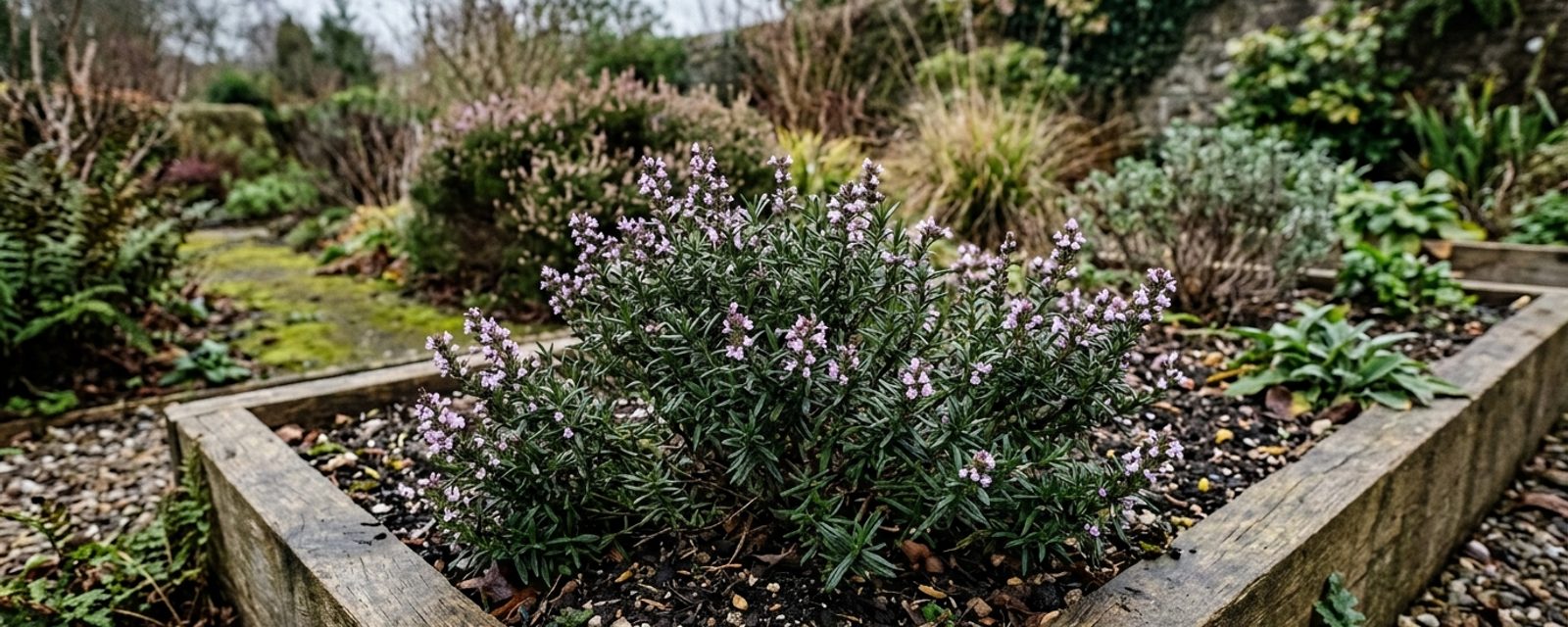
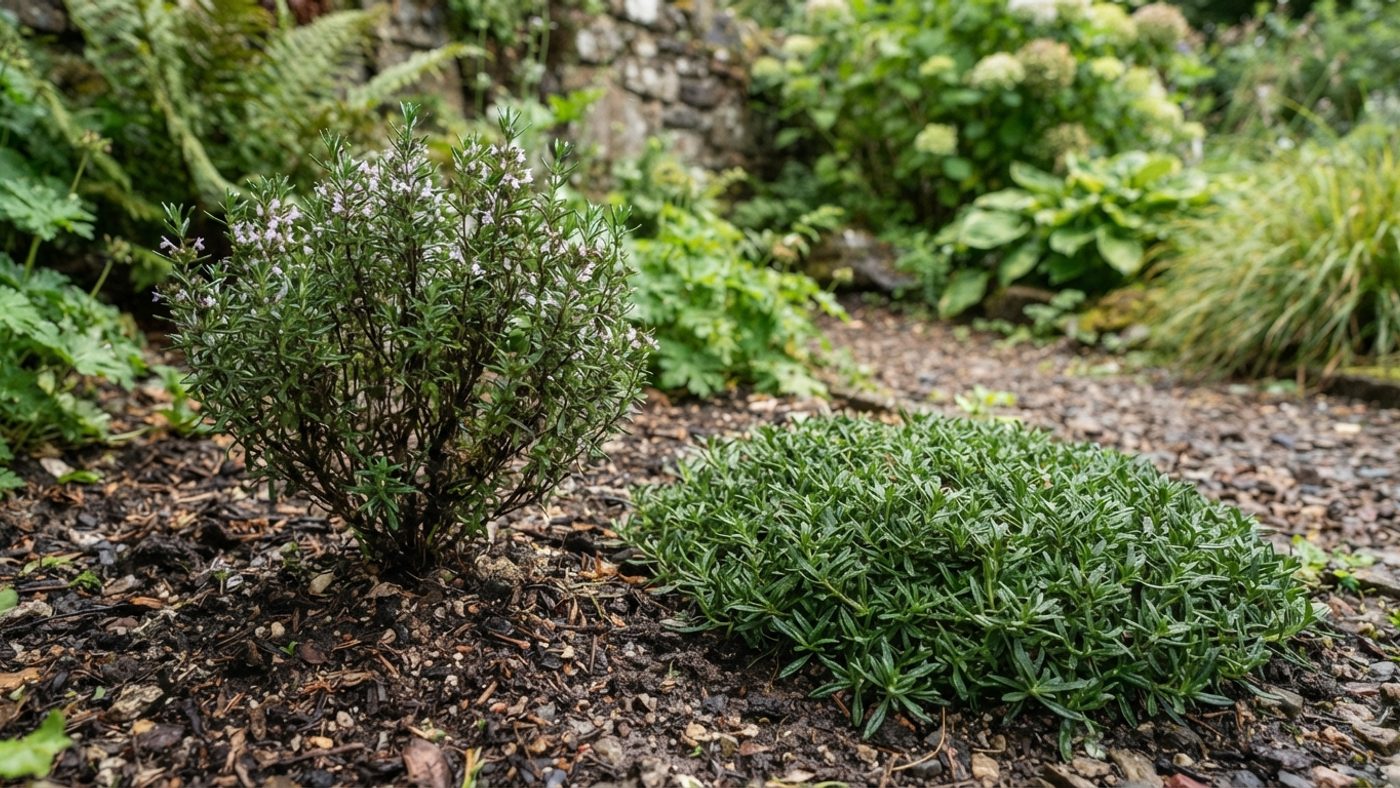
"Savory" is not one plant with different personalities, it's treated as three genuinely separate species that happen to share a common name and a family resemblance in flavour. Summer savory (Satureja hortensis) is an annual that lives fast and dies at first frost. Winter savory (Satureja montana) is a dwarf, sub-shrubby perennial that stays evergreen through a Scottish winter. Creeping savory (Satureja spicigera) is a low, mat-forming perennial built for edging and ground cover rather than height. They're related, but choosing between them is closer to choosing between three different herbs than to picking a colour of the same plant.
Quick answer
For most Scottish gardens, winter savory is the best all-round pick: it's a hardy (H5The RHS's H1a–H7 scale for how much cold a plant can survive outdoors, H1a being tender indoor-only and H7 hardy anywhere in the UK. Full definition →), evergreen perennial that goes in once and keeps producing for years with minimal fuss. Choose creeping savory instead if you want low ground cover or edging rather than an upright bush (it shares winter savory's H5 hardiness but needs better winter drainage). Choose summer savory instead if you want the mildest flavour for cooking, don't mind resowing every year, or are growing in a pot where a compact annual is easier to manage than a perennial that needs a permanent spot.
None of the three carries an RHS Award of Garden Merit, and none has any named cultivarsA plant variety that arose or was bred under cultivation and is kept true by deliberate propagation, rather than a naturally occurring wild species. Full definition →, buying savory means choosing a species, not a cultivar, unlike thyme or rosemary, where dozens of named selections compete for the buying decision. For full growing detail once you've picked a species, see the winter savory guide (covers winter and creeping savory in depth) or the summer savory guide.
Summer, winter and creeping savory compared
| Type | Hardiness | Height/Spread | Flavour | Best use | Winter care |
|---|---|---|---|---|---|
| Summer savory (S. hortensis) | H4 (-10 to -5°C), lowest of the three, though moot since it's grown as an annual and dies back each year regardless | 0.1–0.5m, bushy annual | Milder, often preferred for cooking sparingly | Containers, windowsills, annual culinary bed | None needed, plant dies off; resow next spring |
| Winter savory (S. montana) | H5 (-15 to -10°C) | 0.1–0.5m, dwarf sub-shrub | Stronger, more peppery | Permanent culinary bed, Mediterranean-style borders, containers | Evergreen to semi-evergreen; no special protection needed given good drainage |
| Creeping savory (S. spicigera) | H5 (-15 to -10°C) | Height to just 0.1m, spread 0.1–0.5m | Similar peppery character to winter savory, in a low mat | Ground cover, edging, path margins, rockeries | Evergreen; protect from excessive winter wet specifically |
A "sub-shrub" is a low, woody-based plant partway between a herbaceous perennial and a full shrub, winter savory keeps a permanent woody framework near the ground but stays compact rather than growing into a proper bush.
H5 (-15 to -10°C) covers most Scottish gardens, but it's a UK-wide band, not a Scotland-specific one, colder inland and upland sites that regularly drop past that figure can still lose a plant in a hard winter. All three types want full sun and alkaline or neutral soil; creeping savory in particular does best against a south- or west-facing aspect, a genuine reason to give it the sunniest, most sheltered spot going rather than treat aspect as an afterthought once the ground-cover job is decided.
Which type for which situation
A permanent culinary herb bed. Its evergreen habit means winter savory gives you something to pick even in a mild Scottish winter, unlike summer savory, which is gone by the first frost.
A pot or windowsill. Summer savory works well here precisely because it's an annual: it stays compact for one season, doesn't need the years-long commitment of a perennial in a container, and its milder flavour suits a "grow a bit, use a bit" kitchen routine. Winter savory also tolerates containers if you'd rather not resow annually.
Ground cover or edging. This is creeping savory's job specifically, nothing else in this comparison forms a low mat. It's the type to reach for along a path edge or at the front of a border where height would be a problem. Just be mindful of drainage in a wet Scottish winter; sitting in standing water is its one specific vulnerability.
Mild flavour for regular cooking. Summer savory's flavour is the gentler of the family. Adding savory leaves sparingly is sound advice if you haven't cooked with them before, especially relevant if you're used to summer savory's softer character and then try the stronger perennial types.
Soil pH: what's actually known
All three types prefer alkaline or neutral soil and full sun. No numeric pH range is published for savory, unlike many crops where a specific band (say, pH 6.0–7.0) is given, the guidance here stops at "alkaline or neutral". That's worth checking rather than assuming: much of Scotland's naturally wetter, peatier ground trends acidic, the opposite direction to what savory wants, so a simple soil test before planting is worth the five minutes it takes if you're not already growing other lime-loving herbs there. Don't aim for a specific number: avoid strongly acidic ground and lean toward neutral-to-alkaline soil if you're choosing a spot or amending one.
Buying: seed vs young plant
The remaining buying question, once you've picked a species, is seed versus a ready-grown plant from a garden centre or herb nursery.
Growing advice favours starting savory from seed indoors at around 20°C, with germinationA seed sprouting: breaking dormancy and putting out its first root and shoot, given the right warmth and moisture. Full definition → in 2–3 weeks, a genuine ask for a Scottish spring, since that's propagator or warm-windowsill territory rather than something you can do reliably outdoors before late spring. Plant out in spring once the soil is starting to warm, spacing plants at least 20cm apart. If you don't have a propagator or warm windowsill, buying a young winter or creeping savory plant sidesteps the germination step entirely and gets a perennial established a season earlier. For winter and creeping savory, propagation from softwood cuttings or layeringPropagating a new plant by pinning a low, flexible stem into the soil while still attached to the parent, so it roots before being cut free. Full definition → is also viable if you already have an established plant to take material from. Summer savory, being an annual, is really a seed decision each year regardless, buying a young plant only defers the resowing question by one season. Once plants are around 10cm tall, all three are ready for their first pick.
The pest and disease picture
No specific pests or diseases are named for savory grown in the sun and well-drained conditions it wants, it's described simply as generally healthy and trouble-free. That's genuinely unusual: most popular culinary herbs carry at least one named susceptibility. Rosemary contends with rosemary beetle, and mint is a regular target for mint rust, but savory carries no equivalent entry at all, one fewer thing to watch for on a low-maintenance herb bed.
Two things worth knowing before you commit
Winter savory is a plant-once, years-long perennial, but a sub-shrub left unpruned for several seasons tends to turn straggly and woody at the base, so it isn't entirely maintenance-free once established; a light spring prune keeps it compact. Softwood cuttings or layering both give a way to renew or multiply a plant that's past its best without buying a replacement.
Growing winter or creeping savory in a container rather than open ground changes the winter-wet picture worth flagging: a pot left standing outdoors collects and holds more water around the roots than free-drainingSoil that lets water pass through quickly rather than pooling, so roots aren't sitting in wet ground after rain. Full definition → open ground does, which cuts against the very drainage these plants need. Raising the pot onMoving a plant into a larger pot as its roots fill the current one, giving it more room and fresh compost before it becomes pot-bound. Full definition → feet, or moving it under cover for winter, addresses the same risk named for creeping savory specifically, applying the same drainage logic to a container rather than a bed.
Seedlings of any of the three types are more vulnerable early on than that trouble-free reputation suggests, it really describes established plants in good drainage. Slugs and snails can still take young seedlings and freshly planted-out perennials in a wet Scottish spring, the same general risk as most seedlings, so the usual precautions are worth taking until plants are established.
Common questions
Is winter savory the same plant as summer savory, just a hardier version?
No, they're different species (Satureja montana versus Satureja hortensis), not two forms of one plant. Winter savory is a perennial sub-shrub that's evergreen through winter; summer savory is an annual that completes its life cycle and dies each year regardless of how mild or harsh the winter is.
Can I grow creeping savory instead of winter savory in the same spot?
Not really as a direct swap, creeping savory tops out at around 10cm and spreads as a mat, so it won't give you the small upright bush winter savory does. It's better suited to edging or ground cover than to a herb bed where you want height to harvest from.
Does savory need acidic soil like some Mediterranean herbs?
No, the opposite, all three types prefer alkaline or neutral soil, not acidic. No exact pH number is published for savory, so treat "avoid acidic ground, lean neutral-to-alkaline" as the practical guidance rather than a precise target.
Are there different varieties of winter savory to choose between, like there are for rosemary or thyme?
No. No named cultivars and no Award of Garden Merit exist for any of the three savory types. The meaningful choice is between the species (summer, winter, creeping), not between varieties within one.
Why doesn't my savory plant have any pest problems?
This appears to be genuinely typical rather than a sign you're doing something wrong, savory grown in sun with good drainage is generally trouble-free, unlike herbs such as rosemary or mint which have named recurring problems. Young seedlings are the exception; slugs and snails are still worth guarding against until plants are established.
Sources
6 sources, recorded with what each was used for
- Savory: Grow Your Own: Confirms the three savory types, spacing, sowing temperature/germination time, propagation methods, and general pest/disease-free growing conditions
- Satureja hortensis (summer savory) plant details: Hardiness rating, height/spread, soil/sun preference, plant description
- Satureja montana (winter savory) plant details: Hardiness rating, height/spread, soil/sun preference, plant description
- Satureja spicigera (creeping savory) plant details: Hardiness rating, height/spread, aspect preference, winter wet protection note
- 10 Unusual Ornamental Herbs to Grow: Description of winter savory as a perennial, semi-evergreen herb with a peppery flavour
- How to Grow Herbs: Summer savory sowing detail (light-dependent germination, harvest timing) and flavour-strength caution