
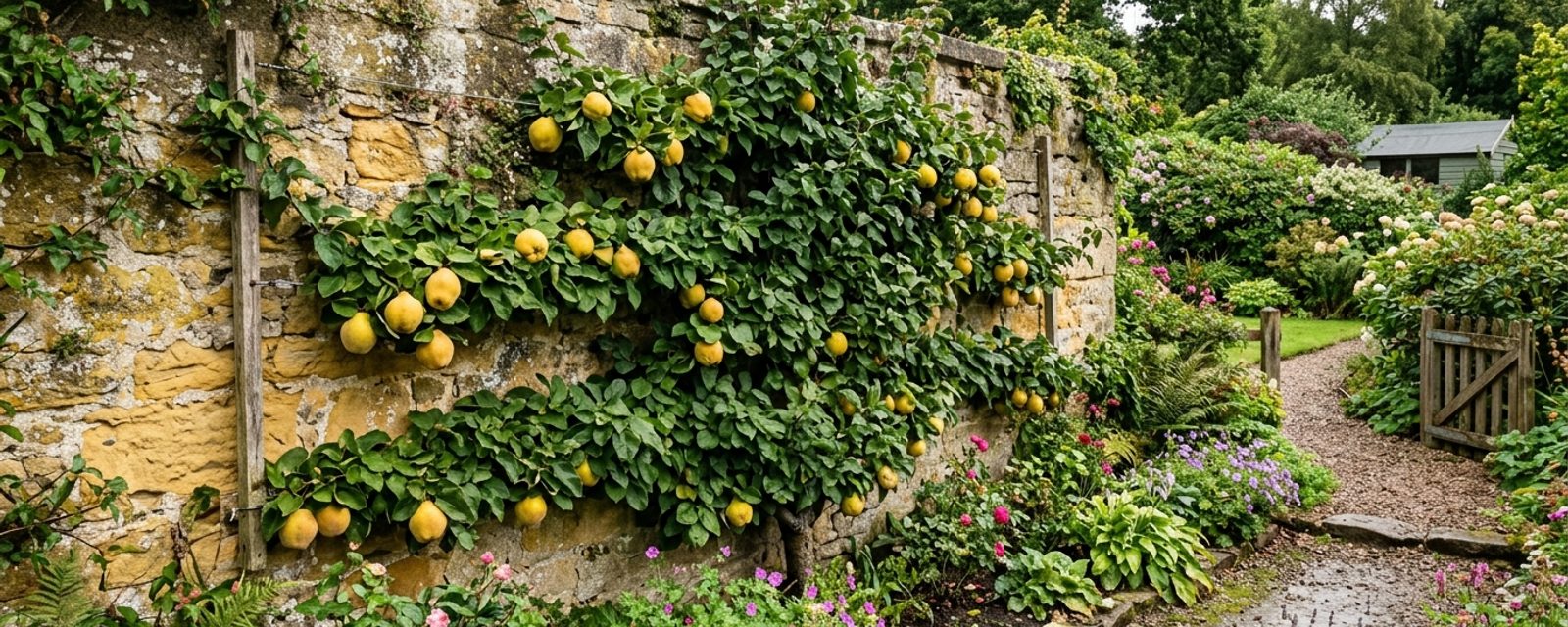
Quince asks something almost no other tree fruit does: it needs direct sun to ripen its fruit at all, it fruits on the tips of last year's shoots rather than the short spurs apples and pears rely on, and even a perfectly ripened fruit is still inedible the day it's picked, it needs weeks of "mellowing" in storage first. This is one plant, unhelpfully, with three separate physiological quirks stacked on top of each other, and none of them are optional to understand before choosing a variety. It is worth being precise about what "quince" means here, too: this article covers Cydonia oblonga, the true quince tree that produces a large aromatic pear-shaped fruit for cooking and preserving. It is not the low, thorny flowering shrub sold as ornamental or Japanese quince (Chaenomeles, also called japonica), a different genus entirely, grown for its spring flowers rather than its fruit.
Quick answer
Serbian Gold is the best all-round choice for Scotland: compact, holds the Award of Garden Merit, and is one of only two varieties with a real wet-summer trial result behind its leaf-blight tolerance. Choose Champion instead if garden space or a shorter wait to first fruit matters more than anything else, or Aromatnaya if you want quince fruit that can be eaten fresh without the usual weeks of storage.
Why quince growing in Scotland comes down to variety choice
Self-fertilityA plant that can set fruit using its own pollen, without needing a second, different variety nearby to cross-pollinate it. Full definition →, tip-bearing and the mellowing period are fixed across every quince cultivarA plant variety that arose or was bred under cultivation and is kept true by deliberate propagation, rather than a naturally occurring wild species. Full definition →, so none of them factor into which one to choose. What actually varies between varieties is a different kind of hardiness: how a tree copes with a wet, cool summer, how compact it stays, how long it takes to bear its first crop, and whether the fruit needs that storage period at all. RootstocksThe root system and lower stem a fruit tree is grafted onto, chosen to control the tree's eventual size rather than for its own fruit. Full definition →, planting timing and pruning technique are covered in the full quince growing guide; this comparison focuses on the six named varieties.
Quince wants deep, fertile, moisture-retentive soil that isn't waterlogged, a real distinction on Scotland's often heavy, wet ground, where drainage matters as much as the soil type itself. No numeric pH figure is published; it tolerates a wide range. Spring blossom is frost-susceptible across the crop generally, and no source differentiates flowering time between named varieties, so treat frost protection at blossom as a concern for any quince, not a reason to favour one cultivar over another. Fruit is best picked before the first hard frost, in the October-to-November window.
Sun matters more for quince than for most fruit on this site. A milder, more sheltered garden can grow it closer to free-standing; a colder or more exposed site is where the standard advice for cold regions, training the tree against a south- or south-west-facing wall rather than growing it free-standing, stops being optional, whichever variety is chosen. That's a real requirement to plan around, not a reason to rule quince out.
The single biggest disease risk affecting variety choice is quince leaf blight, and it's the main thread running through the comparison below.
The six varieties compared
Six quince varieties carry individual growing information: four are described directly on the main quince growing page (Meech's Prolific, Vranja, Serbian Gold, and Aromatnaya), and two more, Champion and Lusitanica, sold as "Portuguese quince", have their own individual plant pages with fuller detail than the growing page shows for them. Serbian Gold is also listed under the synonym "Leskovac" on a separate plant-database entry; that is the same cultivar, not a seventh variety.
Two labels recur through the table below. AGMThe RHS's Award of Garden Merit: a UK-wide trials award for reliable performance, not a Scotland-specific recommendation. Full definition → is the Award of Garden Merit, a UK-wide mark of reliable garden performance, not a Scotland-specific recommendation. H5 is a hardiness ratingThe RHS's H1a–H7 scale for how much cold a plant can survive outdoors, H1a being tender indoor-only and H7 hardy anywhere in the UK. Full definition → meaning hardy in most places throughout the UK, even in a severe winter down to -15°C to -10°C, all six varieties here share it, so hardiness itself doesn't separate them; what does is how each copes with a wet growing season, not a cold one.
| Variety | AGM | Hardiness | Fruit | Distinguishing trait |
|---|---|---|---|---|
| Serbian Gold | Yes | H5 | Rounded, golden-yellow, aromatic | Wisley-trialled leaf-blight tolerance; compact tree (4m x 4m) |
| Vranja | Yes | H5 | Large, pear-shaped, fragrant | Earliest cropper of the six; long-established, widely stocked |
| Meech's Prolific | No | H5 | Pear-shaped, sweetly scented | Reliable heavy cropper; no trait beyond volume |
| Aromatnaya | No | H5 | Round-to-ovate, 7–10cm | Can be eaten fresh, unlike the others; also blight-tolerant |
| Champion | No | H5 | Large, pear-shaped, fragrant | Smallest mature spread (1.5–2.5m); fastest to first crop (5–10 years) |
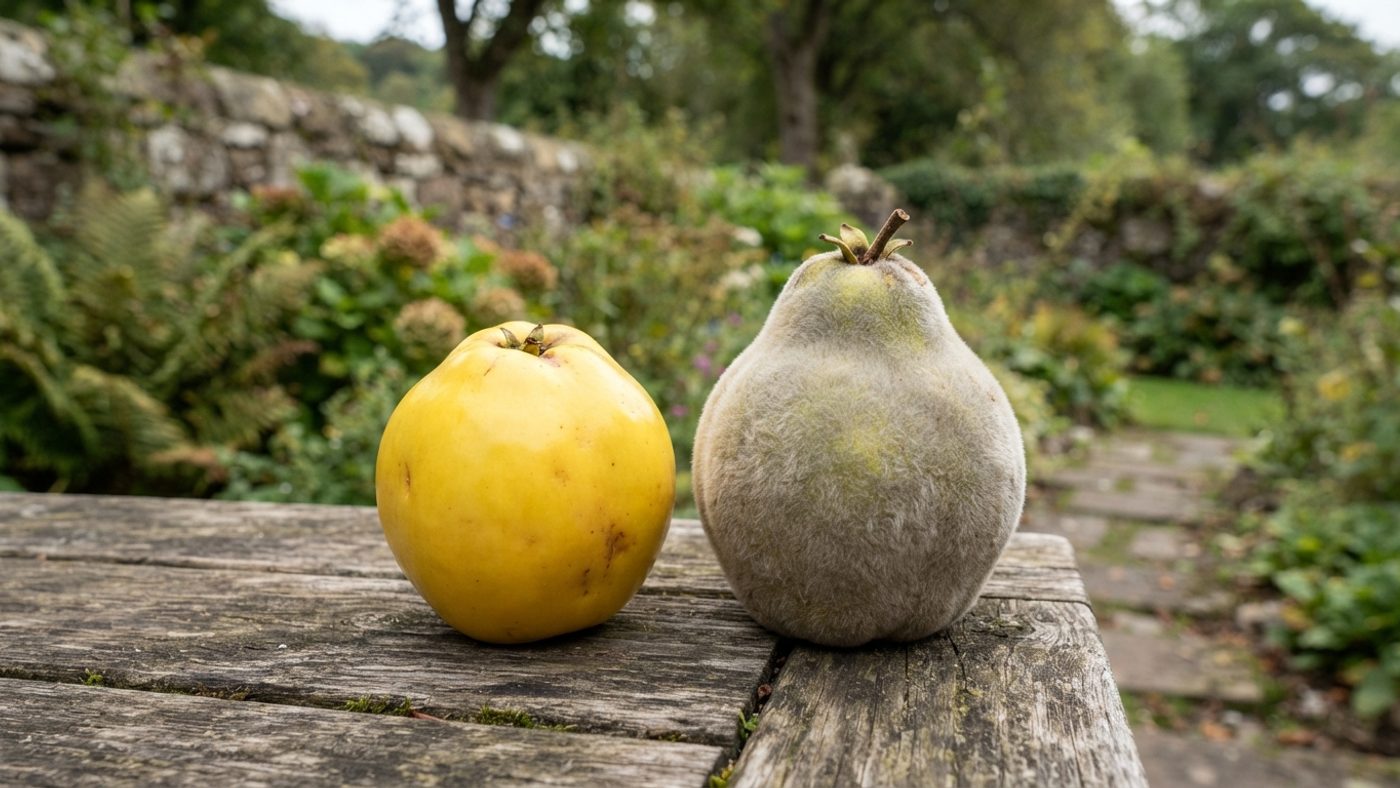
| Lusitanica ("Portuguese quince") | No | H5 | Large, pear-shaped, deep-yellow | Silvery-grey down on foliage and fruit; no stated disease resistance |
Best overall pick: Serbian Gold
Serbian Gold holds the Award of Garden Merit, stays compact at a mature 4m x 4m, and is one of two varieties actually trialled against quince leaf blight, a wet-2023-summer trial at RHS Garden Wisley found it showed good tolerance, with smaller lesions and little to no early leaf fall compared with susceptible cultivars in the same trial. Wisley is in Surrey, not Scotland: the trial matches wet-summer rainfall, not Scotland's cooler temperatures or shorter growing season. Serbian Gold is also said to be resistant to fireblight, a hedge worth keeping rather than treating as settled, and produces good jelly-making fruit ready in early-mid autumn.
Which variety for your situation
Small garden, or don't want a 10–20 year wait: Champion. Its mature spread and time to first crop are both the smallest of the six, see the table above.
Want to eat quince fresh, without weeks of storage: Aromatnaya. Uniquely among the six, its fruit can be eaten straight off the tree rather than needing the usual mellowing period. It shares Serbian Gold's Wisley-trialled leaf-blight tolerance, though it carries no AGM and remains generally susceptible to the standard quince problem list, aphids, brown rot, fireblight, powdery mildew, and codling moth, outside that specific trial result.
Want the widely available, traditional benchmark: Vranja. It's the AGM variety most UK nurseries stock, and the earliest cropper of the six, though it carries no particular disease-resistance data of its own.
Want the most ornamental tree, or the largest fruit: Lusitanica ("Portuguese quince"). Its young foliage and fruit both carry a distinctive silvery-grey down not seen on the others, and its fruit runs large. Its own page lists no disease resistance in its favour, so weigh the ornamental appeal against needing to watch for leaf blight and the standard problem list without any documented advantage there.
Considering Meech's Prolific: it's a reliable, heavy-cropping variety, but no data sets it apart from Vranja, no AGM, no disease-resistance note, just consistent yield. It's a fair choice if a tree is already available locally, not a reason to pick it over the others.
Common questions
Is quince the same as flowering quince or japonica?
No. This article covers Cydonia oblonga, the tree that produces large, aromatic fruit for cooking. Flowering or ornamental quince (Chaenomeles, also sold as japonica) is a separate, unrelated shrub grown for its spring flowers, not fruit.
Do I need two quince trees to get fruit?
No, every variety covered here is self-fertile, so a single tree is enough to crop.
Why can't I eat quince straight off the tree?
Picked fruit generally needs 6–8 weeks of storage to "mellow" before it's usable, the one exception among these six being Aromatnaya, which can be eaten fresh.
How long before a quince tree fruits in Scotland?
Most varieties take 5–6 years for a first crop and 10–20 years to reach full maturity; Champion is the exception, reaching first crop in as little as 5–10 years thanks to its more compact growth.
Sources
8 sources, recorded with what each was used for
- Quince: Grow Your Own: Cultivation facts (self-fertility, rootstocks, sun requirement, tip-bearing habit, mellowing/storage), and the four varieties named directly on the page
- Quince Leaf Blight: The Wisley 2023 trial finding on Serbian Gold and Aromatnaya's leaf-blight tolerance
- Cydonia oblonga 'Vranja Nenadovic': Vranja variety detail
- Cydonia oblonga 'Serbian Gold': Serbian Gold variety detail, including the fireblight hedge
- Cydonia oblonga 'Meech's Prolific': Meech's Prolific variety detail
- Cydonia oblonga 'Aromatnaya': Aromatnaya variety detail, including the eat-fresh trait
- Cydonia oblonga 'Champion': Champion variety detail
- Cydonia oblonga 'Lusitanica': Lusitanica/Portuguese quince variety detail