
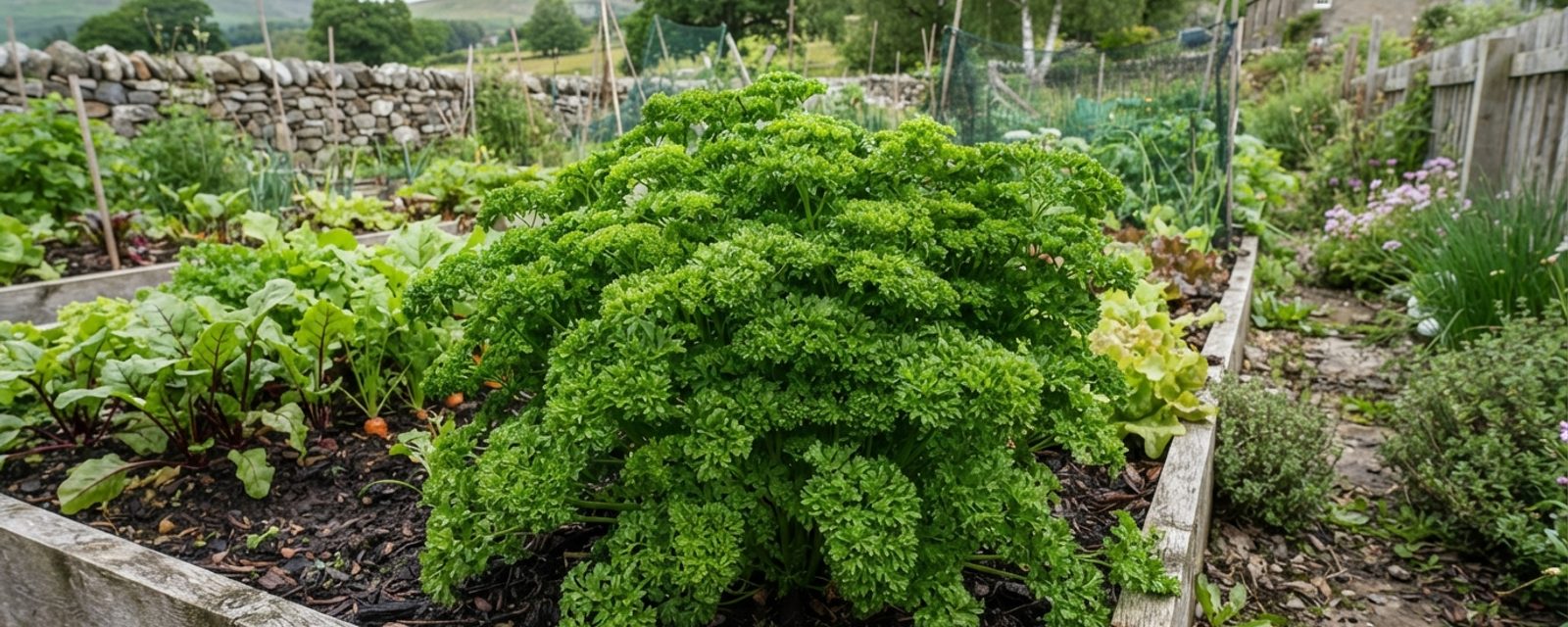
Three weeks after sowing, the parsley drillA shallow, straight groove made in prepared soil for sowing seed into, at a set depth so germination and rows are even. Full definition → can still look empty while the neighbouring rows of lettuce and radish are already up. That's normal, not a failure: parsley's seed coat is hard, and even a warm, well-prepared bed can take a month or more to show seedlings. In a cool, damp Scottish spring, cold soil stretches that wait further and adds a second problem, seedlings that do struggle through are more prone to boltingA plant switching early into flowering and seed production, usually triggered by stress, after which leaves, roots or bulbs turn bitter or unusable. Full page → early if the weather then turns warm and dry. Variety choice doesn't fix slow germinationA seed sprouting: breaking dormancy and putting out its first root and shoot, given the right warmth and moisture. Full definition →; nothing sold as parsley seed germinates fast. But it does settle two other real questions: which type suits the kitchen, and which of the four Award of Garden Merit (AGMThe RHS's Award of Garden Merit: a UK-wide trials award for reliable performance, not a Scotland-specific recommendation. Full definition →) cultivarsA plant variety that arose or was bred under cultivation and is kept true by deliberate propagation, rather than a naturally occurring wild species. Full definition → actually holds up when checked against its own individual plant page.
Quick answer
For flavour and everyday cooking, a flat-leaf variety (French or Italian) beats any curly type, both are hardy to H6 (down to about -15°C) even though neither carries the AGM. For a curly variety with the strongest paper trail, Moss Curled is the safer pick: it's the only one of the four AGM-listed cultivars whose own plant page actually shows the AGM badge. Bravour is a close second (same H6 hardiness, no AGM shown on its own page). Titan and Envy are both rated H4The RHS's H1a–H7 scale for how much cold a plant can survive outdoors, H1a being tender indoor-only and H7 hardy anywhere in the UK. Full definition →, a real step down in hardiness from the rest of this list, so keep them for a single-season crop or a sheltered spot rather than an overwinteredKeeping a plant alive and intact through the cold months, whether left outdoors, moved under cover, or stored dormant. Full definition → one.
The AGM list doesn't hold up the way it first appears to
The general parsley growing page names four cultivars with the AGM: Titan, Moss Curled, Bravour, and Envy. Their own individual plant pages tell a different story: only Moss Curled's page displays the AGM badge. Titan, Bravour, and Envy's own pages carry no AGM mention at all. Either the general page is carrying an award since withdrawn or never formally recorded on the individual entries, or the individual pages are out of date, nothing published resolves which. A gardener choosing on AGM credentials alone should know that three of the four named cultivars don't currently show that credential on their own page, even though the general variety list still carries them.
The AGM measures general UK garden merit, not Scottish performance specifically, and none of these four cultivars has published Scottish trial data behind it. SASA (Science and Advice for Scottish Agriculture) holds a small parsley germplasm collection, but that's a seed conservation archive, not a comparative variety trial, and no Scotland-specific performance data for named parsley cultivars was found published anywhere. Each cultivar's own hardiness rating, which the general page doesn't break out, turns out to be the more useful Scotland-relevant differentiator than the AGM question is.
The six varieties compared
| Variety | AGM (general page) | AGM (own page) | Type | Hardiness | Notes |
|---|---|---|---|---|---|
| Moss Curled | Yes | Confirmed | Curly | H6 (to -15°C) | Tightly curled, deeply cut leaves; the classic garnish curl |
| Bravour | Yes | Not shown | Curly | H6 | Compact habit, ~30cm; "great flavour" for a curly type |
| Titan | Yes | Not shown | Flat-leaf | H4 (-10 to -5°C) | Compact, upright French-type flat-leaf; the only flat-leaf cultivar on the general AGM list |
| Envy | Yes | Not shown | Curly | H4 | Densely curled, ornamental; does well in containers |
| French | No | No | Flat-leaf | H6 | Stronger flavour than curled types; the standard cooking recommendation |
| Italian | No | No | Flat-leaf | H6 | Robust, flat, dividedPropagating a clump-forming perennial by digging it up and splitting it into several smaller pieces, each with roots and shoots attached. Full definition → leaves; grown as the culinary default across much of Europe |
The hardiness split is the real story in this table. Moss Curled, Bravour, French, and Italian are all H6, hardy through a Scottish winter without special protection. Titan and Envy are both H4, roughly a 5°C-wide step down, tolerating cold but not as reliably through a hard or prolonged frost. Since this site's own parsley guide recommends a late-summer sowing specifically to overwinter under a clocheA small, portable clear cover placed over an individual plant or short row to trap warmth and keep off wind, rain and pests. Full definition → for spring leaves, that gap matters more here than it would for a variety only ever grown as a single-season annual: Moss Curled or Bravour are the steadier choice for that overwintering strategy, and Titan or Envy are better suited to a spring-to-autumn crop, a container that can be moved under cover, or a sheltered raised bed.
Moss Curled and Bravour: the curly pair carrying most of the AGM weight
Moss Curled is the one variety here where the AGM credential is fully confirmed, general page and individual plant page both show it. It's also the older, more widely stocked of the two, with the tightly curled, deeply cut foliage most people picture when they hear "curly parsley." Bravour matches it on hardiness (H6) and habit, a compact plant, around 30cm, with masses of tightly curled dark green leaves described in its own listing as having "great flavour," an unusual claim for a curly variety given how consistently flat-leaf types are rated the stronger-flavoured group elsewhere. Both suit containers, edging, and garnish use equally well, and either is a safe pick for an overwintered sowing.
Titan and Envy: the AGM-listed pair with the hardiness gap
Titan is the outlier of the four AGM-listed cultivars in more than one way: it's the only flat-leaf type among them (a Petroselinum crispum var. neapolitanum selection, the same botanical group as French and Italian parsley), described in its own listing as "a relatively compact, upright, flat-leaved cultivar." It shares that flat-leaf structure with the two non-AGM varieties below, but at H4 it's noticeably less cold-hardy than either of them. Envy is a curly type, "lovely dark green, densely curled leaves," also rated H4, and does well in containers, which is exactly the growing method that sidesteps its lower hardiness rating, since a pot can be moved somewhere sheltered for winter. Neither Titan nor Envy's own page mentions vigour, disease resistance, or germination speed beyond the standard susceptibility list shared by every parsley cultivar (carrot fly, aphids, celery leaf miner, leaf spot, plant viruses), there's no sourced basis for treating either as faster-germinating or more bolt-resistant than the rest of this list.
French and Italian: no AGM, but the flavour standard
Neither French nor Italian parsley carries the AGM, and that shouldn't be read as a quality gap: French parsley's flavour is "stronger than some of the curled varieties," its own listing states, which is why cooks reach for flat-leaf over garnish curl in the first place. Both are H6 hardy, robust, and the closest thing this list has to an unranked default, sold everywhere, used interchangeably, and functionally the same plant under two names in most seed catalogues. If the goal is a kitchen herb rather than an award-winning specimen, French or Italian is the more useful buy than any of the four AGM cultivars above.
Other named cultivars worth knowing exist
The four AGM-listed cultivars and the two flat-leaf standards don't cover every parsley sold in the UK. Gardener's World names two further curly and large-leaf options: Aphrodite (dark green, tightly curled, grown as a garnish curly type) and Gigante Napoletano (a large-leaved, strongly aromatic flat-leaf type). Neither carries a confirmed AGM, worth knowing they exist if a seed catalogue lists them, but not strong enough contenders to displace anything in the table above.
No specific soil pH figure is published for parsley as a crop from the sources this site draws on. The University of Massachusetts Amherst Extension's vegetable management guide gives a working target of around pH 6.5, neutral to slightly alkaline, a reasonable starting point for any of the six varieties here, since none of the individual plant pages breaks pH tolerance out by cultivar.
Curly or flat-leaf: the real kitchen decision
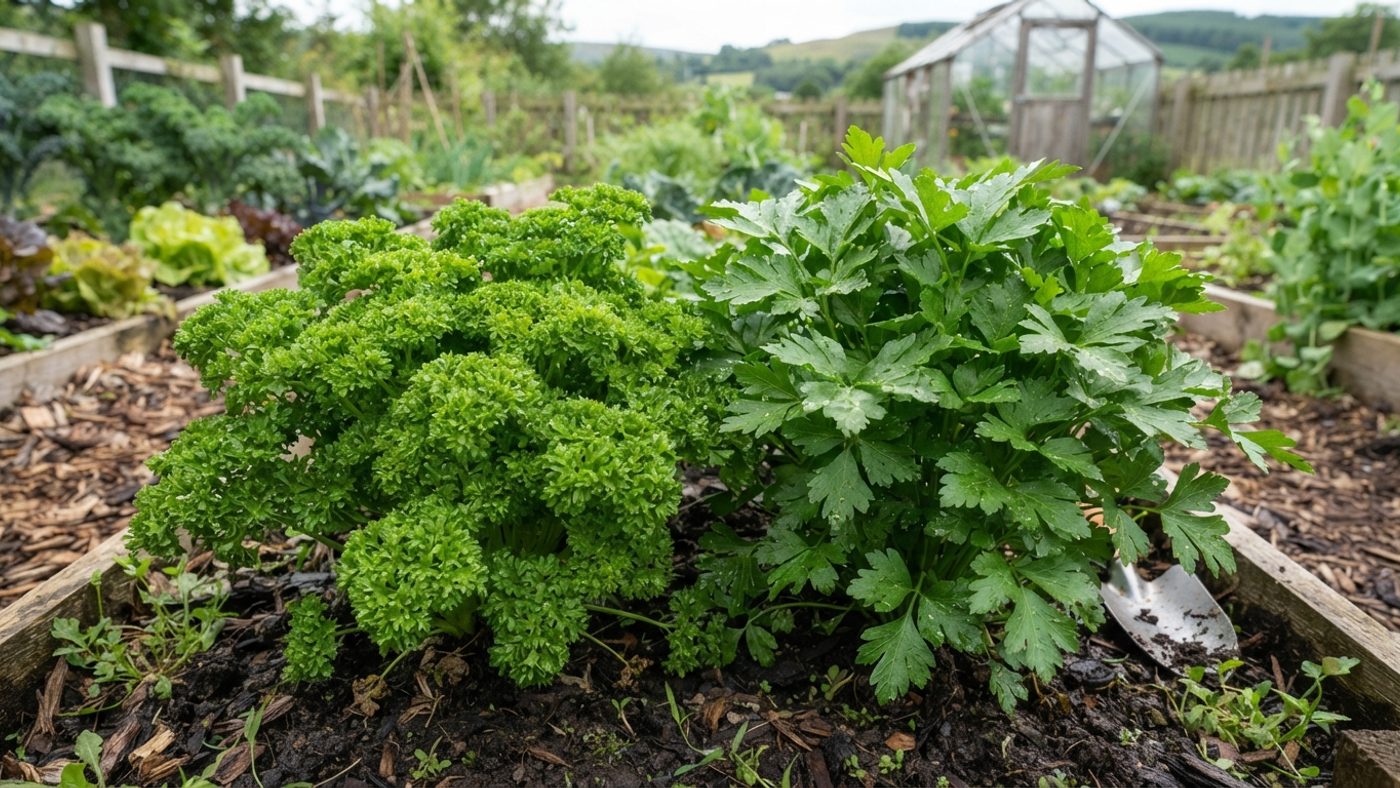
Type matters more than variety for how the leaves cook. Flat-leaf parsley, French, Italian, or Titan, has the stronger flavour and freezes better than curly types once chopped, which is worth knowing if the plan is to freeze a batch rather than use it fresh. Curly parsley, Moss Curled, Bravour, or Envy, holds its shape well as a garnish and looks the part on a plate, but its flavour reads as noticeably milder alongside a flat-leaf sprig from the same bed. Growing both, in separate short rows, is the practical answer if there's room: neither type asks for different treatment once sown, so the only real cost is a bit more bed space.
Germination and bolting: no variety shortcut, but real technique that helps
What both sources agree on is technique: warm water poured along the sowing drill, or seed soaked overnight, speeds germination that otherwise runs to six weeks or more; starting seed indoors on a warm windowsill removes the cold, wet Scottish soil from the equation entirely, since that's what stretches germination further than the seed's own six-week baseline. Once a plant is established, deadheadingRemoving spent flowers before they set seed, which redirects a plant's energy into further flowering rather than seed production. Full definition → any flower stalk that appears delays the bitter-leaf, biennialA plant that completes its life cycle over two years: growth in year one, then flowering, seeding and dying in year two. Full definition → bolt by another few weeks, useful if a plant sends up premature flowers during an unusually warm or stressed spell rather than in its expected second year. See the full growing guide for the complete sowing and harvest routine.
Pests, and where these varieties actually differ
All six varieties compared here share the same susceptibility list, per their own pages: carrot fly, aphids, celery leaf mining fly, leaf spot, and plant viruses, none of the individual plant pages claims any cultivar resists these better than another. Slugs are the threat Gardener's World flags most directly, particularly against young seedlings during the slow weeks before germination completes; a barrier or beer trap around a newly sown drill matters more here than variety choice does. Gardener's World also suggests interplanting with garlic or onion as a general carrot-fly deterrent, a reasonable low-cost addition, though it isn't something independently confirmed elsewhere. Bolting isn't a pest but behaves like one in practice, once a plant runs to flower, whichever variety it is, the leaves turn bitter and the plant is better pulled and replaced than nursed along.
Which one for your situation
Best overall for cooking: French or Italian flat-leaf. Stronger flavour, H6 hardy, no AGM needed to justify the choice.
- Want the strongest AGM paper trail on a curly type: Moss Curled, the only one of the four AGM-listed cultivars confirmed on its own page as well as the general list.
- Overwintering under a cloche for spring leaves: Moss Curled, Bravour, French, or Italian, all H6, a full band hardier than Titan or Envy.
- Growing in a container that can be moved under cover: Titan or Envy suit this well; their H4 rating matters far less in a pot than in open ground.
- Freezing a batch rather than using it fresh: a flat-leaf variety holds up better than curly once thawed.
- Garnish or classic parsley sauce: any of the three curly options, Moss Curled, Bravour, or Envy.
Common questions
Why do Titan, Bravour, and Envy show AGM on the general RHS parsley page but not on their own plant pages?
RHS's own listing carries a discrepancy: the general grow-your-own page names all four as AGM cultivars, but only Moss Curled's individual plant page currently displays the AGM badge. RHS doesn't publish a reason for the mismatch anywhere.
Is French parsley the same as Italian parsley?
Functionally, yes. Both are flat-leaf, H6 hardy, and neither carries the AGM. RHS lists them as separate named entries, but the practical difference for a home cook is negligible, either is a reasonable flat-leaf default.
Does any parsley variety germinate faster than the others?
Not according to the sources checked. Every variety shares the same month-or-more germination window; warm water on the drill, seed soaking, and sowing indoors are the only sourced ways to speed it up.
Should I bother with an AGM variety at all?
Only if the paper trail matters to you. The AGM measures general UK garden merit, not Scottish performance, and two non-AGM varieties (French, Italian) beat every AGM cultivar here on flavour and match the best of them on hardiness.
Sources
9 sources, recorded with what each was used for
- Parsley: Grow Your Own: The four AGM-listed cultivars (Titan, Moss Curled, Bravour, Envy), French and Italian named without AGM, germination timing, sowing depth/spacing, curly-vs-flat flavour framing, pest list
- Petroselinum crispum var. neapolitanum 'Titan': No AGM shown on own page, flat-leaf type, H4 hardiness, compact upright habitA plant's characteristic shape and manner of growth, such as upright, spreading, creeping or bushy. Full definition →, pest/disease susceptibility list
- Petroselinum crispum 'Envy': No AGM shown on own page, curly/densely curled leaf description, H4 hardiness, container suitability
- Petroselinum crispum 'Moss Curled': AGM badge confirmed on own page, H6 hardiness, tightly curled leaf description
- Petroselinum crispum 'Bravour': No AGM shown on own page, H6 hardiness, compact habit, "great flavour" description
- Petroselinum crispum 'French': No AGM, flat-leaf description, H6 hardiness, stronger-flavour-than-curled statement
- Petroselinum crispum 'Italian': No AGM, flat-leaf description, H6 hardiness
- How to Grow Parsley: 'Aphrodite' and 'Gigante Napoletano' as further named cultivars, deadheading to delay bolting, slugs and snails as a seedling-stage threat, freezing chopped parsley over drying for storage, garlic/onion interplanting as a carrot-fly deterrent
- New England Vegetable Management Guide: Parsley and Cilantro: Soil pH target of around 6.5 (neutral to slightly alkaline)