
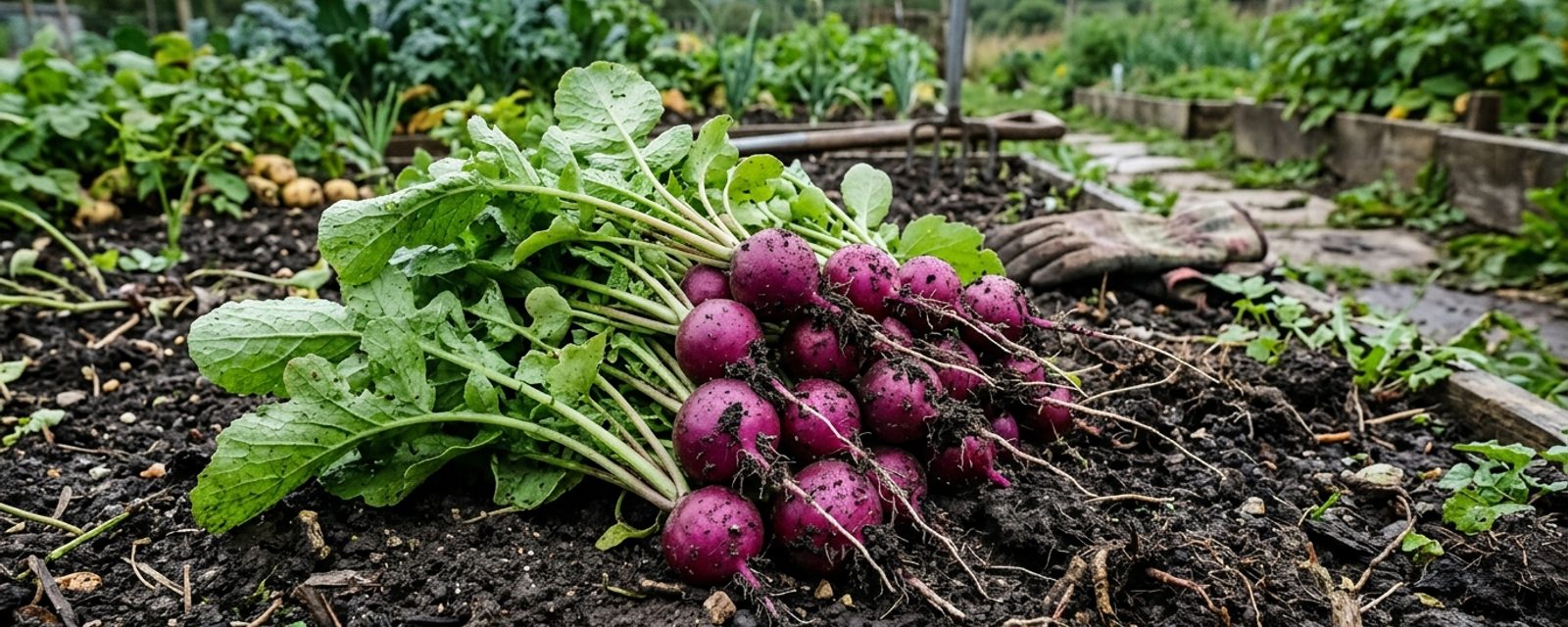
Radish's growing year splits into two jobs that don't overlap: a fast salad type sown from February through summer, and a completely different winter type with a three-week sowing window in high summer. A salad variety chosen for Feb–Sept cropping and a winter variety chosen for a July/August sowing are solving different problems, not competing for the same slot.
Quick answer
For salad radish, Scarlet Globe is the safest all-rounder, the only variety here with AGMThe RHS's Award of Garden Merit: a UK-wide trials award for reliable performance, not a Scotland-specific recommendation. Full definition → confirmed on its own plant page rather than just the general list. Amethyst is worth growing alongside it for a purple root that stays usable a little longer if you can't pull it the moment it's ready. For winter radish, Black Spanish Round is the better-documented variety, but despite what this site's own guide previously said, it does not carry an AGM.
The seven varieties compared
| Variety | Type & season | Root | AGM status | Maturity |
|---|---|---|---|---|
| Scarlet Globe | Salad, Feb–Sept | Red globe, white flesh, mild | Confirmed on its own page | About 4 weeks |
| Amethyst | Salad, Feb–Sept | Purple/mauve skin, white flesh | General page only | About 4 weeks |
| French Breakfast 4 Francis | Salad, Feb–Sept | Red cylindrical, white tip | General page only | 21 days |
| Ilka | Salad, Feb–Sept | Round, Russian heirloom | Not RHS-listed | Grows to 7.5cm without turning pithy |
| Tarzan | Salad, good for early sowing | Round, crimson red | Not RHS-listed | Stays non-pithy "for weeks" |
| Black Spanish Round | Winter, sow July–Aug only | Round, black skin, white flesh | Not AGM | 8–10 weeks; lifted from November |
| China Rose | Winter, sow July–Aug | Oblong, medium-large | Not AGM | 8–10 weeks |
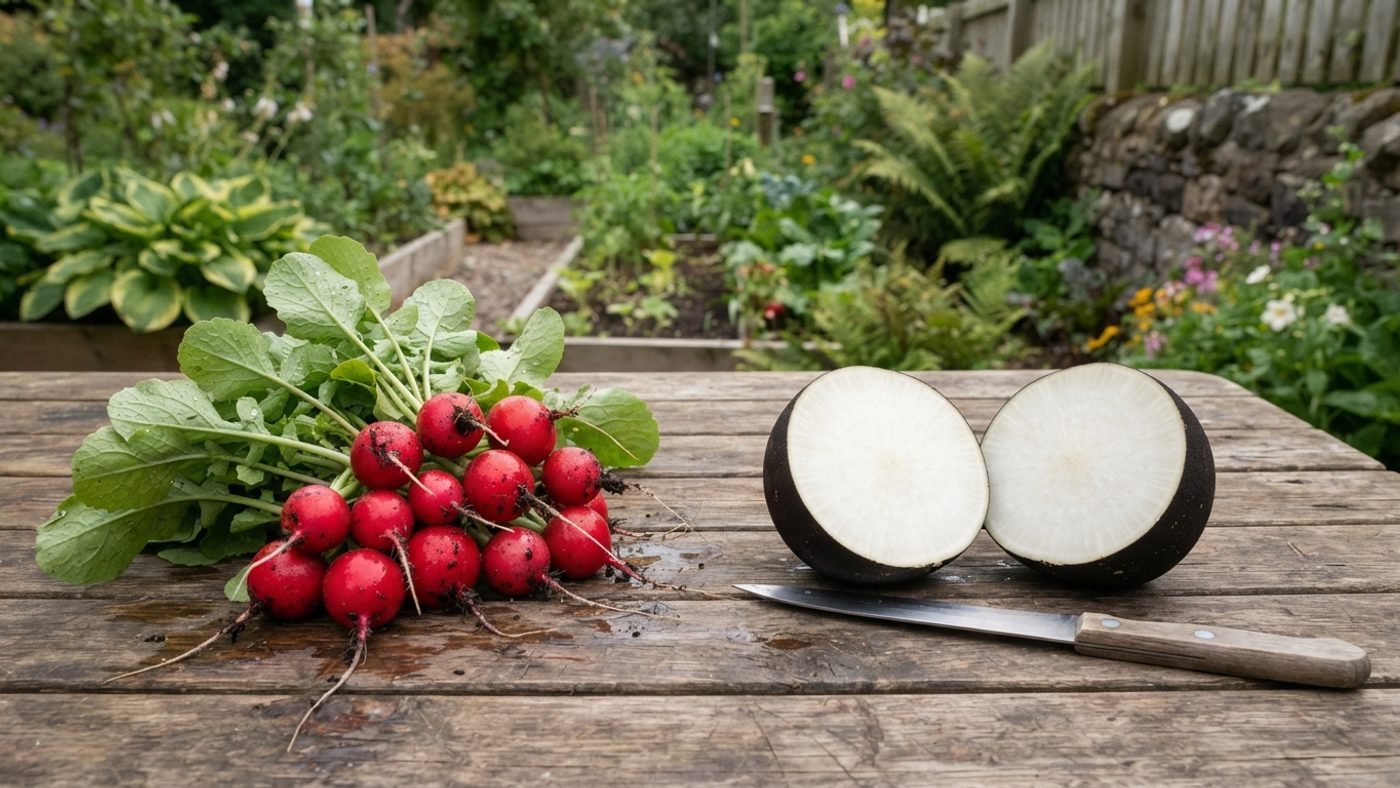
Black Spanish Round is not AGM
Scarlet Globe, Amethyst and French Breakfast 4 Francis all carry an "AGM" tag on the general radish variety list. Black Spanish Round is on the same list without one, and its own individual plant page confirms the same. It's still the winter radish with the most detail published on it, and still worth growing, it just isn't an AGM one, and this site's own growing guide previously said otherwise. That's now been corrected.
A second, smaller discrepancy: Amethyst and French Breakfast 4 Francis are both tagged AGM on the general list, but neither carries the badge on its own individual plant page the way Scarlet Globe does. Scarlet Globe is the one variety here where the AGM claim is confirmed twice over; the other two rest on the general list alone. That doesn't make Amethyst or French Breakfast 4 Francis any less worth growing, both are genuinely useful, distinct varieties, described below, Scarlet Globe is simply the one you can call AGM without an asterisk.
Salad radish: five ways to solve the same speed problem
Salad radish's real failure mode isn't disease, it's timing, and it cuts both ways. BoltingA plant switching early into flowering and seed production, usually triggered by stress, after which leaves, roots or bulbs turn bitter or unusable. Full page → can be triggered by long daylight as well as by heat, so a sowing forcedCovering plants to exclude light and speed early, tender growth in the dark, most associated with rhubarb and sea kale in late winter. Full definition → on through May and June's long Scottish days can run to flower before it's swelled a proper root, not just in a hot spell. Every one of these varieties is edible within about a month of sowing, and every one gets worse, not better, the longer it sits in the ground after that, the flesh turns pithy, spongy and hollow rather than staying crisp. The differences between them mostly come down to how much forgiveness they give at the far end, if you can't pull them the moment they're ready. A February sowing generally needs a clocheA small, portable clear cover placed over an individual plant or short row to trap warmth and keep off wind, rain and pests. Full definition → or pre-warmed soil to get going at all; where the ground itself is heavy and slow to warm in early spring, a container or trough is a genuine workaround rather than a compromise.
Scarlet Globe is the plain, dependable choice, round red roots, white flesh, mild flavour, ready in about four weeks. It carries the widest published pest and disease list of any radish here: susceptible to flea beetles, slugs and snails, and cabbage root fly among pests, and to brassicaThe cabbage family: cabbage, kale, broccoli, cauliflower, Brussels sprouts, kohlrabi, swede, turnip and more, sharing the same pests, diseases and rotation rules. Full definition → downy mildew, brassica white blister, club rootA soil-borne fungal disease of the brassica family that swells and distorts roots, and survives in soil for years. Full definition →, damping offA fungal disease that kills seedlings at soil level, usually caused by overwatering, poor airflow, or reused unsterilised compost or trays. Full definition →, fungal leaf spot and virus diseases. That's not a reason to avoid it, every radish carries some version of this list, it's simply the best-documented plant here, which makes it a safe default where you want a well-characterised variety rather than a specialist one.
Amethyst is the purple-skinned option, and the one credited with being "slow to turn woody" on the general variety list, useful if your sowing-to-harvest gap sometimes slips by a few days. That claim isn't repeated on its own individual plant page, which also carries no AGM badge (see above).
French Breakfast 4 Francis is the fastest variety in this comparison by a clear margin, it matures in only 21 days, about a week quicker than Scarlet Globe or Amethyst, and has high tolerance to summer heat. The speed matters more than the heat tolerance here: a 21-day variety fits an extra sowing or two into the same February–September window a 28-day variety can't match, which is worth more on a crop with a naturally short effective season than the heat-tolerance trait itself.
Two further varieties worth knowing about don't have their own RHS plant pages at all, but are named with real, specific traits by Gardener's World, which covers several radish cultivarsA plant variety that arose or was bred under cultivation and is kept true by deliberate propagation, rather than a naturally occurring wild species. Full definition → RHS doesn't: Ilka, a Russian heirloom described as growing "to a diameter of 7.5cm without becoming pithy", noticeably more forgiving than the roughly 2.5cm ("5p coin") size ordinary salad radish is normally pulled at, and Tarzan, a round crimson variety described as "good to raise early" and staying non-pithy "for weeks". Neither carries an AGM or appears on RHS's own radish page, but both genuinely extend the forgiveness option beyond Amethyst if missing the harvest window by more than a couple of days is a real risk for you. As less common heirloom-type seed, they're worth checking seed-catalogue availability for before planning a whole bed around them.
Winter radish: a different plant on a different calendar
Sow either winter type earlier than the July–August window and it bolts rather than forming a usable root, that's the real reason for the narrow timing, not just a general recommendation. If you're leaving roots in the ground rather than lifting them in November, "under cover" means a proper layer, fleeceA lightweight, breathable fabric laid or draped over plants to trap a little warmth and keep off frost, wind and some flying pests. Full definition → or a straw mulchA layer of material spread over the soil around plants to suppress weeds, retain moisture, and improve soil structure as it breaks down. Full definition → over the row, not a single light layer, since a hard, prolonged frost will get through anything thinner.
Black Spanish Round, round, with black skin and white flesh, is a late-maturing heritage annual radish available to harvest in autumn, and the winter variety with the most published detail behind it. It's not AGM (see the correction above), but it remains the better-sourced of the two winter options.
China Rose, a synonym of 'Rose d'Hiver de Chine', gets a much thinner entry: "medium to large oblong, tasty roots" is essentially the full extent of what's published about it directly, on either its own plant page or the general list. If you want a winter radish with real depth behind it, Black Spanish Round is the better-supported choice; China Rose is worth growing as a second, larger-rooted option if you want variety, but there's less published detail to stand behind for it specifically.
Soil pH
No soil pH figure is published for radish specifically by the sources this site draws on. The UMass Amherst New England Vegetable Management Guide states radish soil should be maintained at pH 6.0–6.8, neutral to very slightly alkaline. Testing your own soil is worth doing before assuming no adjustment is needed; none of the seven varieties here have a documented reason to differ from that range.
Which one for your situation
If you're sowing little and often and can generally get out to pull radish within a day or two of it being ready, Scarlet Globe is the one variety here with AGM confirmed on its own page, and there's no real reason to look further for an everyday salad radish. If your schedule is less predictable, work, weather, a week away, Amethyst or, for even more slack, Ilka's 7.5cm-without-pithy claim buys real room either side of the ideal pull date. French Breakfast 4 Francis earns its place specifically in a tight succession plan, where its 21-day maturity lets you fit an extra sowing into the same window. For winter cropping, Black Spanish Round is the better-documented choice of the two winter varieties; grow China Rose alongside it for variety rather than instead of it.
Whichever varieties you choose, both types share the same pest and disease list, since radish is a brassica: watch for slugs and snails on young seedlings, flea beetles (cosmetic damage on this crop, not worth treating), cabbage root fly, more of a risk to the slower-growing winter varieties than fast salad radish, club root, which affects radish the same as any other brassica in the rotationMoving each crop family to different ground each year, on a multi-year cycle, so pests and diseases that build up in soil don't get a repeat host. Full definition →, and root rot in waterlogged soil. Bolting is the single biggest risk to any of these varieties, salad or winter, the full growing guide covers the sowing timing and watering that keeps it in check.
Common questions
Is Black Spanish Round actually AGM, or not?
No. RHS's general radish page lists it without an AGM tag, and its own individual plant page confirms the same. This site's own growing guide previously stated otherwise, and has now been corrected.
Which radish variety is most forgiving if I forget to pull it on time?
Amethyst is credited with being slow to turn woody, though that claim only appears on RHS's general page, not its own plant page. Gardener's World's Ilka, a Russian heirloom not listed by RHS at all, goes further: it's described as growing to 7.5cm across without becoming pithy, well past the roughly 2.5cm size ordinary salad radish is normally pulled at.
What's the fastest radish variety to grow?
French Breakfast 4 Francis, at 21 days, around a week quicker than Scarlet Globe or Amethyst's roughly four weeks. That speed is useful for fitting extra sowings into a succession plan rather than for flavour or texture.
Does any radish variety resist club root or flea beetle?
No. None of the varieties compared here carry any published resistance to club root or flea beetle. Rotation and general growing-guide control advice matter more than which cultivar is sown.
Sources
8 sources, recorded with what each was used for
- Radishes: Grow Your Own: General variety list, AGM tags as shown on the general page, salad vs winter radish types, card-level descriptions
- Raphanus sativus 'Scarlet Globe': AGM confirmation on its own page, root/flavour description, pest and disease list
- Raphanus sativus 'Amethyst': No AGM badge on its own page, root description and maturity timing
- Raphanus sativus 'French Breakfast 4' - Francis: No AGM badge on its own page, 21-day maturity claim, heat-tolerance claim, disease notes
- Raphanus sativus 'Black Spanish Round': No AGM badge on its own page, root and maturity description
- Raphanus sativus 'Rose d'Hiver de Chine' (China Rose): No AGM badge on its own page
- The Best Radish Varieties to Grow: Ilka, Tarzan and Plum Purple, three varieties with real traits not covered by RHS
- New England Vegetable Management Guide: Radish: Soil pH figure (6.0-6.8), since RHS does not publish one for this crop