
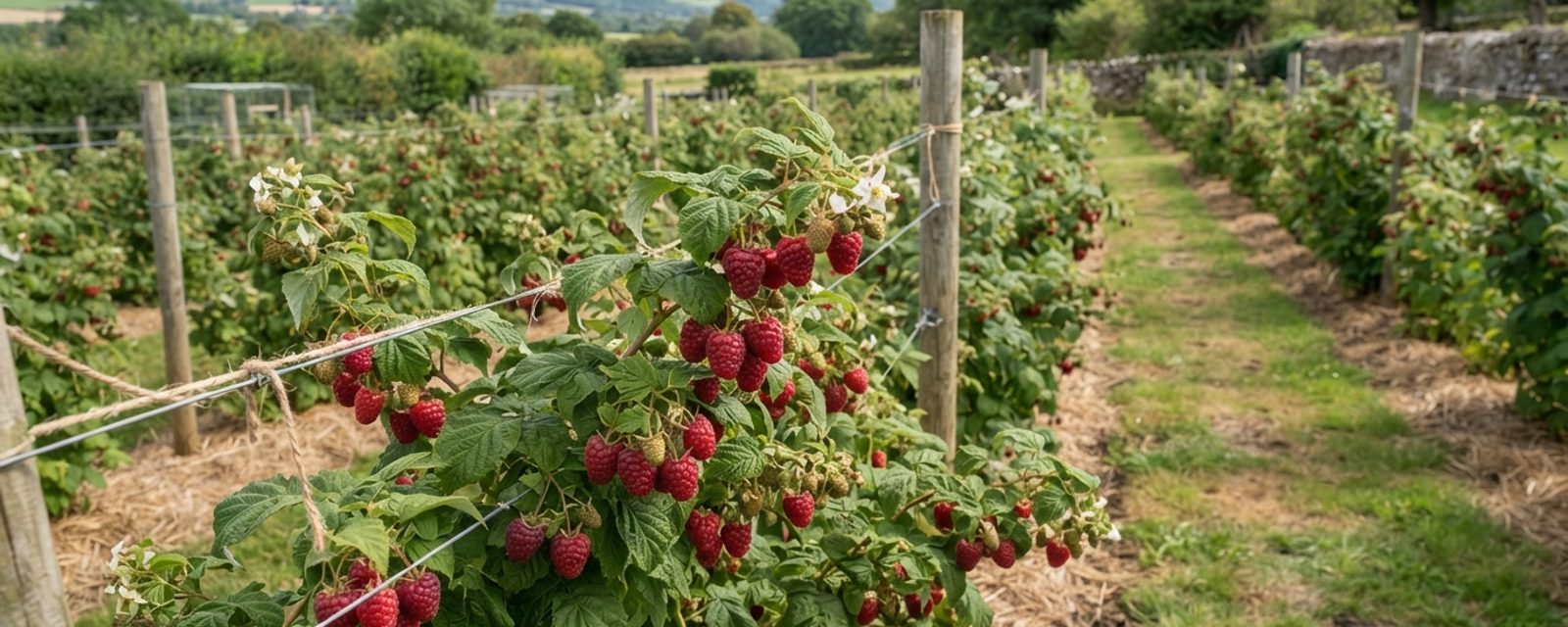
A raspberry cane only fruits once, then dies back, and which season it dies back in is decided the moment the variety is chosen. Summer-fruiting types carry their crop on canes grown the previous year, so the plant needs a full year in the ground before it fruits at all, and those canes then need tying to wires and pruning out after harvest. Autumn-fruiting types fruit on the current year's new growth instead, which means a newly planted cane crops in its first autumn and the entire year's pruning is one pass with secateurs in February. That single mechanical difference, not flavour or fruit size, is the real fork in the road before any variety name comes into it.
Quick answer
Glen Ample is the strongest all-round summer-fruiting pick: spine-free canes, heavy yields, and Scottish breeding provenance from the James Hutton Institute. For the lower-commitment route, an autumn-fruiting variety such as Polka or Joan J crops in its first year and needs only one pruning pass a year; Joan J's canes are also spine-free. If you want a second summer-fruiting name to extend the season either earlier (Malling Jewel or Malling Admiral) or later (Tulameen or Octavia), all four are viable, and none of the nine AGMThe RHS's Award of Garden Merit: a UK-wide trials award for reliable performance, not a Scotland-specific recommendation. Full definition → raspberries differ in cold hardiness: every one of them is rated H6The RHS's H1a–H7 scale for how much cold a plant can survive outdoors, H1a being tender indoor-only and H7 hardy anywhere in the UK. Full definition →.
Nine names, one award, and what it does and doesn't tell you
Nine raspberry varieties carry the Award of Garden Merit (AGM): All Gold, Glen Ample, Glen Magna, Joan J, Malling Admiral, Malling Jewel, Octavia, Polka, and Tulameen. The AGM is a UK-wide garden-merit award, not a Scotland-specific recommendation. All nine are compared here, each checked against its own individual plant page rather than the general summary alone; the full raspberry growing guide has planting, spacing and pruning detail for whichever one you choose.
Every one of the nine varieties carries the AGM symbol on its own individual page as well as on the general summary, and every one of them shares the same hardiness rating, H6, meaning fully hardy anywhere in the UK, including a Scottish winter, with no extra protection needed. That's a genuinely useful negative result: cold hardiness plays no part in choosing between them, because none of the nine is any hardier than the rest. The real differences are cropping season, cane character, and vigour, not hardiness or the award itself. Planting timing, spacing, and support needs are the same whichever of the nine you plant.
Head-to-head: all nine AGM varieties
| Variety | Type | Cropping window | Cane character | Notable trait |
|---|---|---|---|---|
| Glen Ample | Summer, mid-season | Roughly July–August | Spine-free | Hutton-bred; named by Hutton as the UK's number one variety; heavy yields, good for freezing |
| Glen Magna | Summer, late-season | Late summer, long season | Vigorous | Also Hutton-bred; large fruit, good keeping season length |
| Octavia | Summer, late-season | Extends into early autumn | Vigorous; can spread if not managed | Large, uniform, good-quality fruit; bridges the summer/autumn gap |
| Malling Admiral | Summer, early | Late July to mid-August | Fairly vigorous, erect | Firm, long fruit with a small core |
| Malling Jewel | Summer, early-mid | Early to midsummer | Compact, less vigorous | Suits smaller plots; reliable early cropper |
| Tulameen | Summer, late | Long harvest period into late summer | Spine-free | Well-flavoured, high yield; can be grown in a large pot |
| All Gold | Autumn (primocane) | From late July, main flush in autumn | Slightly thorny | Only yellow-fruited AGM variety; sweet flavour; can double-crop |
| Joan J | Autumn | Late summer into autumn | Spine-free, upright | Good size and flavour; thornless canes ease picking |
| Polka | Autumn (primocane) | From late July, main flush in autumn | Slightly thorny | Red fruit, good keeping quality; can double-crop |
Hardiness is omitted from the table because it doesn't vary: all nine are H6. All nine also carry a near-identical general pest and disease list on their own pages: aphids, leafhoppers, raspberry beetle, grey mould, and rarely honey fungus, with a few also naming glasshouse red spider mite or gall mites. None of the nine individual pages names cane blight, cane spot, or root rot resistance as a distinguishing trait for any one variety over another.
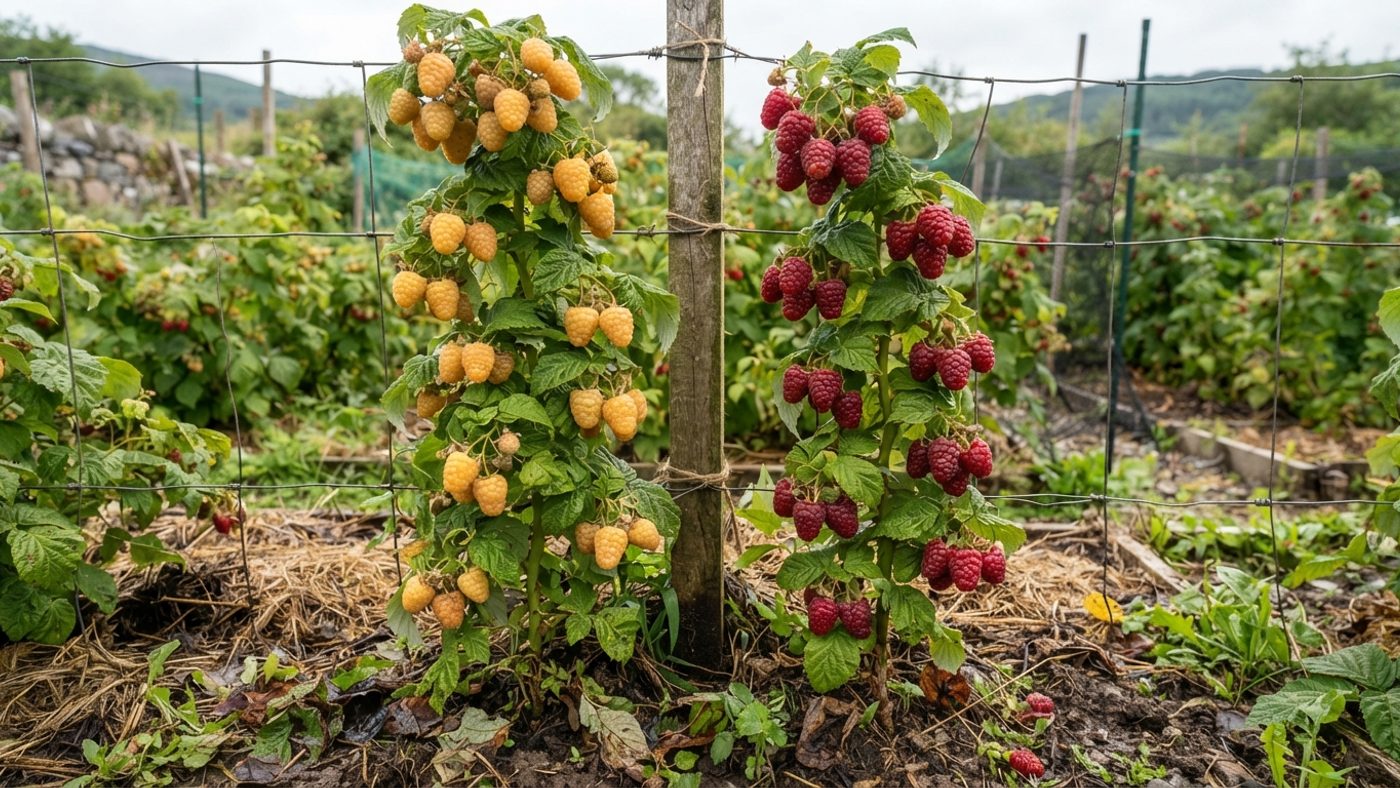
Two varieties, All Gold and Polka, are described almost identically on their own pages: stout canes with slight thorns, and a primocane habit, meaning they fruit on canes grown that same year, giving them the potential for two crops in a single season: a smaller one starting to ripen in late July, then the main flush in autumn. The difference between them is fruit colour and keeping quality after picking, not cropping behaviour.
The one trait Gardener's World names that RHS's own pages don't
Where the two sources genuinely diverge is disease resistance. Gardener's World, in its own raspberry growing guide, names Glen Ample, Glen Magna, and a third variety not on the AGM list (Glen Moy) as having "good disease resistance." None of the individual plant pages for those varieties make that claim; each one carries the same generic pest-and-disease list quoted above, with no variety singled out as more resistant than another. This isn't necessarily a contradiction: the plant-finder pages are built to a standard template that doesn't usually carry comparative resistance claims, so a variety's absence from that wording doesn't mean the trait is false, only unstated on that page. Gardener's World's claim sits alongside the RHS data, not confirmed by it.
Two Hutton-bred names, and why they aren't the same case
Glen Ample and Glen Magna are the only two AGM raspberries also confirmed bred at the James Hutton Institute in Dundee, Scotland's own commercial soft-fruit breeding programme. That provenance is a genuinely Scottish fact for both, and it's tempting to treat them as interchangeable on that basis. They aren't. Hutton's own varieties page names Glen Ample specifically as "the number one variety in the UK" and gives it a dedicated line; Glen Magna appears only as one of six names in a list, with no distinguishing description at all. Hutton states no breeding aim tied to climate or hardiness for either variety. Glen Ample carries a stronger, more specific case from its own breeder than Glen Magna does, even though both share the same Scottish origin and the same award.
The thornless canes worth knowing about
Joan J and Tulameen both carry spine-free canes, confirmed on their own individual pages, a trait the general summary doesn't flag by variety and the same trait Glen Ample already has. Raspberry rows are picked at close quarters, canes tied in and handled repeatedly through the season, and a thornless cane is a genuine practical convenience rather than a marginal one. All Gold and Polka, by contrast, are both described as "slightly thorny" on their own pages. If avoiding thorns matters to you specifically, Glen Ample (summer, mid-season), Tulameen (summer, late), and Joan J (autumn) between them cover both cropping types without a single spine.
A named Scotland-specific claim, from outside the AGM list
Neither the general page nor any of the nine varieties' own pages makes a direct claim about which raspberry suits a Scottish climate specifically. Gardener's World comes closer: it names a further variety, Zeva, as suited to cooler northern climates, the one direct climate-suitability claim either source makes about any raspberry by name. Zeva doesn't carry the AGM and isn't independently checked beyond Gardener's World's own page. Autumn Bliss, the most widely sold autumn-fruiting raspberry in UK garden centres, is worth knowing about for the same reason: real and commonly grown, but not an AGM holder either, so neither variety appears in the main comparison above.
Which one for your situation
| Your situation | Pick |
|---|---|
| Want the strongest all-round summer variety | Glen Ample |
| Want the lowest-commitment route: crops in year one, one pruning pass a year | Polka or Joan J (autumn-fruiting) |
| Thorns are a real nuisance | Glen Ample, Tulameen, or Joan J (all spine-free) |
| Small plot, want a compact summer plant | Malling Jewel |
| Want to extend the summer crop as late as possible | Tulameen or Octavia |
| Want yellow fruit | All Gold (the only AGM yellow variety, and can double-crop) |
Buying named varieties
Glen Ample and Polka are common enough to turn up at general garden centres. The other seven, especially the Malling names and Joan J, are more reliably found through specialist fruit nurseries than a general shelf, particularly as bare-rootA plant, usually a fruit tree or hedging, sold with its roots exposed rather than in a pot, and only available while dormant. Full definition → canes in their November-to-March planting window. If a named cultivarA plant variety that arose or was bred under cultivation and is kept true by deliberate propagation, rather than a naturally occurring wild species. Full definition → isn't in stock locally, ordering ahead from a fruit nursery is more reliable than waiting for it to appear in person.
Soil pH
Raspberries want slightly acidic soil, ideally pH 6 to 6.7. No separate pH range is published per variety, so this figure applies across all nine. Soil pH varies by site regardless of region, so test yours rather than assume it.
Common problems
Raspberry beetle larvae burrow into the ripening fruit, found by pale grubs inside berries at picking time. Grey mould rots fruit in wet weather and spreads fastest where canes are crowded and airflow is poor. Cane blight kills canes back from ground level, usually entering through a wound, and infected canes need cutting out and destroying promptly. Viruses spread by aphids cause stunted growth and small, crumbly fruit with no cure once a plant is infected; buying certified virus-free stock is the only real defence. Birds will strip a row before you get to pick it; netting supported clear of the canes is the standard defence. None of the nine varieties compared here is documented as more or less resistant to any of these pests or diseases. Waterlogging is a separate risk worth naming on its own: raspberries will not tolerate sitting wet over winter, and on heavy or poorly drained ground, that matters more than which variety is planted in it. Raised beds or improved drainage fix the problem at the site; no variety choice does.
Common questions
Do any of the nine AGM varieties differ in cold hardiness?
No. All nine, All Gold, Glen Ample, Glen Magna, Joan J, Malling Admiral, Malling Jewel, Octavia, Polka, and Tulameen, carry the same hardiness rating, H6, hardy throughout the UK and northern Europe. Cold hardiness genuinely doesn't separate them; cropping season, cane character, and vigour do.
Does "bred at the James Hutton Institute" mean a variety is proven to suit Scottish gardens?
No, and neither RHS nor Hutton claims that. Hutton breeds raspberries for the commercial growing industry, not home gardens, and states no climate or hardiness breeding aim for the crop. Glen Ample and Glen Magna's Scottish origin is a genuine, sourced fact, but it's provenance, not evidence that either performs better in a Scottish garden than a variety bred elsewhere.
Should I grow a summer-fruiting or autumn-fruiting variety in Scotland?
Either works, and growing one of each extends the harvest from late June through October. Between the AGM varieties specifically, the summer-fruiting side has more spine-free options: Glen Ample and Tulameen both carry thornless canes, against just one on the autumn side, Joan J.
Why do two varieties, All Gold and Polka, get described almost identically?
Because they're built the same way: both are primocane types with stout, slightly thorny canes, capable of two crops in a year, starting to ripen from late July with the main flush in autumn. The real difference between them is fruit colour, yellow for All Gold, red for Polka, plus a noted difference in keeping quality after picking.
Sources
12 sources, recorded with what each was used for
- Raspberries: Grow Your Own: General cropping calendar, summer vs autumn type behaviour, pruning, hardiness/climate preference, pest and disease list, the nine-variety AGM list
- Rubus idaeus 'Glen Ample': Hardiness, AGM confirmation, spine-free canes, mid-season cropping, yield and freezing note, disease/pest list
- Rubus idaeus 'Glen Magna': Hardiness, AGM confirmation, vigour, late-summer cropping, disease/pest list
- Rubus idaeus 'Octavia': Hardiness, AGM confirmation, extended cropping into autumn, vigour/spread caution, disease/pest list
- Rubus idaeus 'Malling Admiral': Hardiness, AGM confirmation, cropping window, cane character, disease/pest list
- Rubus idaeus 'Malling Jewel': Hardiness, AGM confirmation, compact growth, early-midsummer cropping, disease/pest list
- Rubus idaeus 'Tulameen': Hardiness, AGM confirmation, spine-free canes, late-season cropping, disease/pest list
- Rubus idaeus 'All Gold': Hardiness, AGM confirmation, primocane double-cropping behaviour, cane character, disease/pest list
- Rubus idaeus 'Joan J': Hardiness, AGM confirmation, spine-free upright canes, autumn cropping, disease/pest list
- Rubus idaeus 'Polka': Hardiness, AGM confirmation, primocane double-cropping behaviour, cane character, keeping quality, disease/pest list
- Fruit Breeding: Raspberry Varieties: Glen Ample and Glen Magna's Hutton-bred provenance; Hutton's own description of Glen Ample as "the number one variety in the UK" against no equivalent description for Glen Magna; no stated climate/hardiness breeding aim
- How to Grow Raspberries: Disease-resistance claims for Glen Ample, Glen Magna, and Glen Moy not stated on RHS's own individual plant pages; Zeva named as suited to cooler northern climates; Tulameen's suitability for large pots; Malling Jewel as a compact, reliable early cropper