
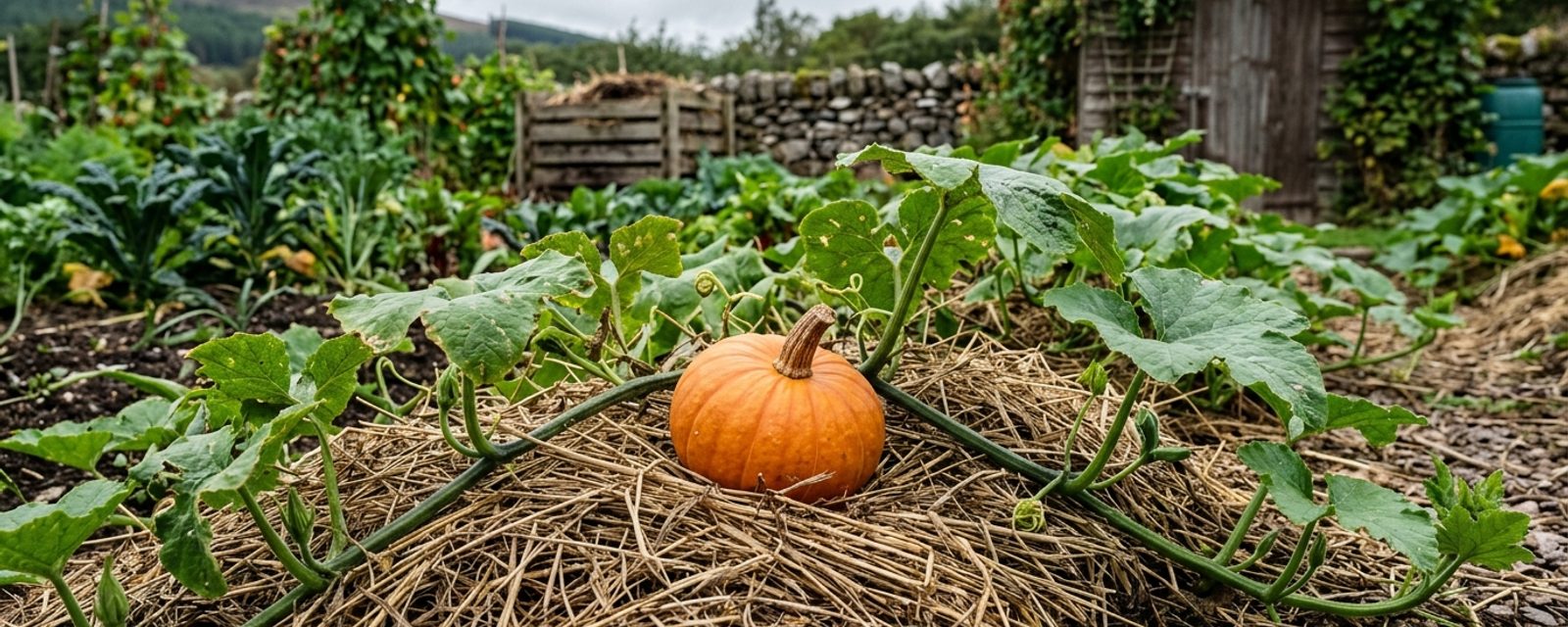
A pumpkin's fruit doesn't grow to size and then ripen, it does both at once, drawing on weeks of stored sunlight to fill out its walls before the skin hardens and the flesh sets sugar. The bigger the fruit a variety is bred to produce, the more of that accumulated warmth it needs before frost cuts the growing season short, which is exactly why picking a pumpkin variety is really a question about how much summer a Scottish plot can actually offer it. Pumpkins need a long, hot growing season, and the fruit must ripen fully in order to store well, close to the opposite of a typical Scottish summer, and Scotland's frost timing varies significantly by region, so an early-frost area has even less margin than the figures below assume. That single constraint does more to separate these five varieties from each other than any other trait on their plant pages.
Quick answer
Charmant is the best overall pick for most Scottish gardens: it's the smallest-fruited of the four full-size varieties, carries some powdery mildew resistance, and stores well into winter. Choose Jack be Little instead if you want the surest ripening with the least risk, or if you're short on space; choose Atlantic Giant only if you're growing for show rather than for the table, and only with a genuinely long, sheltered, sunny plot.
Why ripening time is the real decision here
None of RHS's own pumpkin plant pages state a days-to-maturity figure specific to each variety, all five carry the same generic "Time to Maturity: 1 year" label used for annual crops, which doesn't distinguish which ripens first. Fruit size is the honest proxy instead: a bigger pumpkin has more flesh to fill, so it needs more weeks of warmth to do it, all else equal, the same logic behind treating Cargo, Hundredweight and Atlantic Giant as needing more heat and a longer run than Charmant or Jack be Little (see the pumpkins growing guide for cultivation detail).
Garden Organic supplies a number the RHS variety pages don't: 14–20 weeks from sowing to harvest. Sown indoors in mid-to-late April, as the full growing guide recommends, and planted out after the last frost, 14–20 weeks lands harvest somewhere between late August and October depending on variety and season. That's comfortable at the short end but genuinely tight at the long end against an early autumn frost, tighter still in colder inland and upland parts of Scotland, and the varieties with the most fruit mass to fill (Hundredweight, Atlantic Giant) are the ones most likely to sit at that long end. That estimate combines Garden Organic's timeframe with the fruit-size data; neither source states it outright as a single figure.
The five varieties head to head
Five pumpkin varieties are named on the general grow-your-own page, with individual plant pages for each. None carries the Award of Garden Merit, pumpkins as a crop sit outside the usual award scheme entirely, so no pick here can be framed as AGMThe RHS's Award of Garden Merit: a UK-wide trials award for reliable performance, not a Scotland-specific recommendation. Full definition →-backed.
| Variety | Species | Fruit size | Max spread | Hardiness | Stated storage |
|---|---|---|---|---|---|
| Charmant | Cucurbita pepo | 6–8kg | 1.5–2.5m | H1CThe RHS's H1a–H7 scale for how much cold a plant can survive outdoors, H1a being tender indoor-only and H7 hardy anywhere in the UK. Full definition → (5–10°C) | Well into winter |
| Jack be Little | Cucurbita pepo | Palm-sized (~10 fruits/plant) | 1–1.5m | H2 (1–5°C) | Up to 12 months |
| Cargo | Cucurbita pepo | 6–10kg | 2.5–4m | H1C (5–10°C) | Well into winter |
| Hundredweight | Cucurbita pepo | Very large, best at one fruit/plant | 1.5–2.5m | H2 (1–5°C) | Not stated |
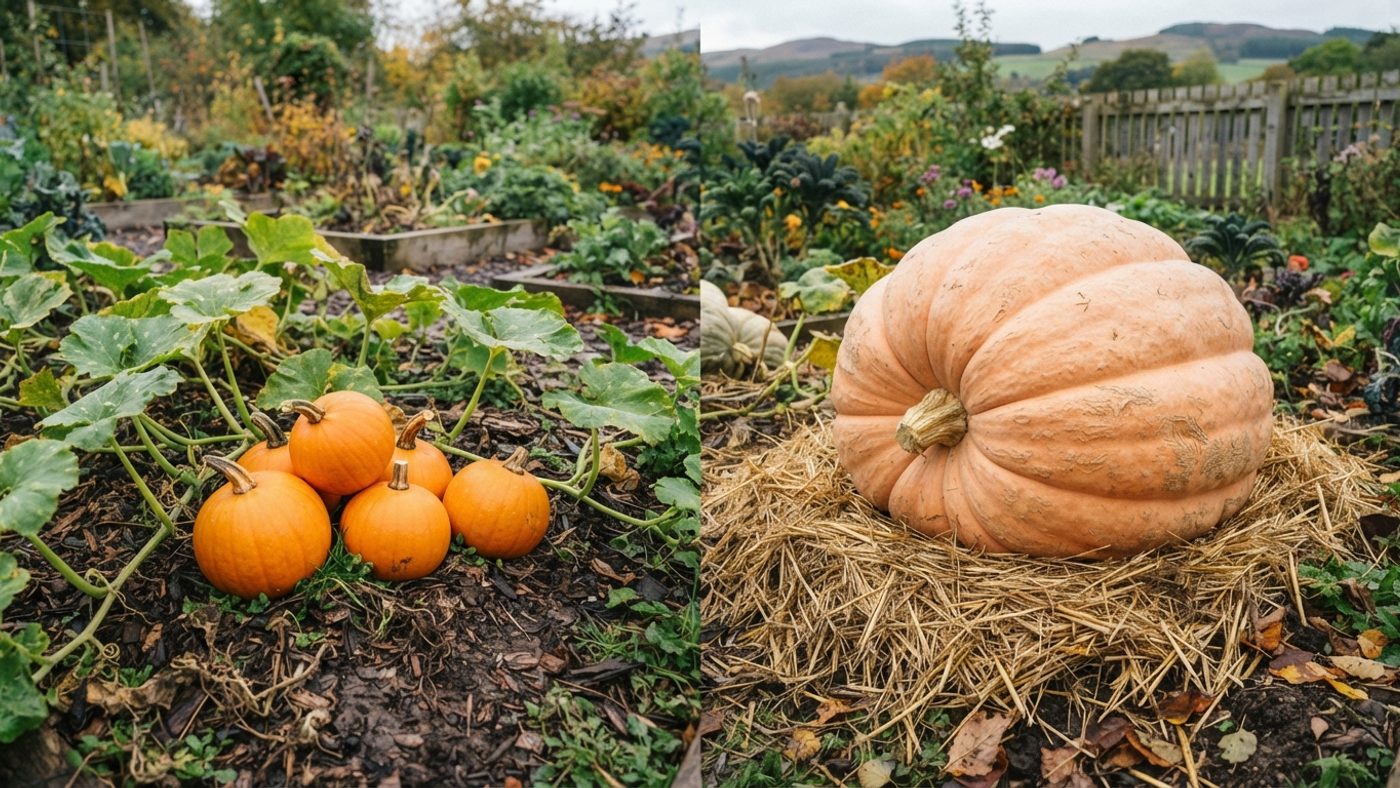
| Atlantic Giant | Cucurbita maxima | Can exceed 1.8m diameter; record 782kg | Up to 5m | H2 (1–5°C) | Not stated |
Four of the five, Charmant, Jack be Little, Cargo and Hundredweight, are Cucurbita pepo. Atlantic Giant is the outlier, a different species (Cucurbita maxima) bred purely for scale, and its own page describes the flesh as "watery," making it a competition and display pumpkin rather than an eating one, though it's usable in stocks and soups. Where storage life isn't listed above as a range, the individual pages for Hundredweight and Atlantic Giant simply don't state a figure at all.
The best overall pick: Charmant
At 6–8kg, Charmant is the smallest-fruited of the four full-size varieties. Its own plant page notes it shows "some resistance" to powdery mildew, the only one of the five with any resistance trait named at all, and it stores well into winter. Two things complicate that pick, though: a discrepancy in how big the plant actually is, and a hardiness rating that runs against the "safe, easy" reputation.
A discrepancy worth flagging: is Charmant actually compact?
The general grow-your-own page describes Charmant as having "compact plants with powdery mildew resistance." But Charmant's own individual plant page tells a different story: it calls the plant a "spreading, trailing" scrambler with a maximum spread of 1.5–2.5 metres, reaching roughly 2m along the ground. That's the identical spread range given for Hundredweight, a variety whose own page says needs "ample space" specifically because of its giant fruit. Two RHS pages about the same variety, in other words, don't agree on how much room it takes. Plan bed space around the 1.5–2.5m figure from Charmant's own individual plant page rather than the word "compact" from the general page, a plant description written specifically for one cultivarA plant variety that arose or was bred under cultivation and is kept true by deliberate propagation, rather than a naturally occurring wild species. Full definition → is the safer figure to build a planting plan around than a general summary line.
There's a second surprise sitting next to it. Charmant is rated H1C (5–10°C minimum), meaning it can only go outside in summer and is more tender than Hundredweight, Atlantic Giant and Jack be Little, which are all rated the hardier H2 (1–5°C). Cargo shares Charmant's H1C rating. So the variety most often treated as the "safe, easy" Scottish choice is actually the least cold-tolerant of the five. That doesn't overturn the case for Charmant: the H1C/H2 hardiness rating governs when a young plant can safely go outside, and every variety here is started under cover and only planted out once hardened offGradually getting young plants raised indoors used to outdoor conditions over 7–14 days before planting out, so cold, wind and direct sun don't shock or damage them. Full definition → and past frost, so the rating stops mattering once the plant is established. Fruit size and ripening time, which keep mattering right through to autumn, are the bigger factor for a short growing season, but the hardiness gap is a genuine tension worth knowing rather than papering over.
The safest choice: Jack be Little
If ripening risk or space is the deciding factor, Jack be Little is the stronger pick. Its fruit is palm-sized, one of the smallest pumpkin fruits there is, at roughly ten per plant, which means far less mass to fill before frost, the smallest footprint of any of the five at 1–1.5m spread, and a hardier H2 rating than Charmant. It also has the longest stated storage life of the group by a wide margin: up to 12 months once fully ripened, against Charmant and Cargo's "well into winter" (the growing guide gives 3–6 months as pumpkins' general baseline) and no figure at all for Hundredweight or Atlantic Giant. The trade-off is size and versatility, these are ornamental, single-serve pumpkins, not carving or big-batch cooking pumpkins. It's susceptible to grey mould and powdery mildew, same as the rest of the group, but is otherwise described as generally pest-free.
The giants: Cargo, Hundredweight, Atlantic Giant
These three carry the most ripening risk and the least Scottish garden practicality, in ascending order.
Cargo (6–10kg, H1C, 2.5–4m spread) sits between Charmant and the true giants, bigger fruit than Charmant with the same tender hardiness rating, and it's the only one of the five whose own page names slugs and snails as a susceptibility alongside grey mould and powdery mildew, so slug control matters more here than for the others, see the slugs pest page.
Hundredweight can produce "very large" pumpkins in good conditions, especially if restricted to a single fruit per plant, the technique the growing guide covers under giant-pumpkin thinning. It needs "ample space" per its own page despite sharing Charmant's 1.5–2.5m spread figure, and no storage life is stated for it.
Atlantic Giant is the specialist choice: a different species altogether, bred for scale rather than eating, with vines up to 5 metres and record fruit weighing 782kg. It demands the most season, the most space, and the most consistent Scottish sunshine of the five, this is a variety for growers chasing a show-stopping fruit, not a reliable autumn harvest.
How much space do you actually need
The spread column in the table above (1–1.5m up to 5m) is the real planning figure: on a modest allotment plot, that range is the difference between a variety that fits comfortably in one corner and one that needs most of the plot to itself. Garden Organic's average pumpkin footprint of 120cm wide and 45cm tall, given for the crop generally rather than any one variety, sits inside the smaller half of that range, useful confirmation that Jack be Little and Charmant really are the modest-space picks, not just the modest-fruit ones.
Soil matters too. None of these five varieties states a soil pH preference on its own page; Teagasc's pumpkin technical note gives a general preference around pH 6.5 for the crop as a whole. Garden soil varies widely and can run acidic without obvious signs, so it's worth testing pH before planting rather than assuming the ground is already close to 6.5, liming towards neutral if a test shows it's needed. Seed for all five varieties is generally available from garden centres and online retailers, none is a specialist or hard-to-source pick.
Poor fruit set in a cool, wet spell is also worth watching for: cucurbits as a family rely on insect pollination, and a small female flower that yellows and drops instead of swelling is usually a sign it wasn't pollinated, more likely in a run of cold or wet weather when bees are scarce. Hand-pollinating by transferring pollen from a male flower to a female one with a soft brush or by hand is a straightforward fix while the weather settles, and it's usable on any of the five varieties above.
Pests and disease across all five
Powdery mildew is named as a risk on every one of the five individual plant pages, but only Charmant's carries any resistance trait, Cargo, Hundredweight, Atlantic Giant and Jack be Little are all stated as susceptible with nothing to offset it. Grey mould (botrytis) is named as a risk for all five with no resistance in any of them. Slugs and snails are named specifically on Cargo's page and are a general threat to young pumpkin plants across the board. Frost protection matters directly for the more marginal varieties above: straw, fleeceA lightweight, breathable fabric laid or draped over plants to trap a little warmth and keep off frost, wind and some flying pests. Full definition → or cardboard over any pumpkin still on the plant buys extra ripening days when an early frost threatens, though a frosted pumpkin can't then be stored, and a warm, sunny, sheltered site with soil pre-warmed under clocheA small, portable clear cover placed over an individual plant or short row to trap warmth and keep off wind, rain and pests. Full definition → or fleece for two weeks before outdoor sowing gives every variety here a better run at its stated maturity window. For the full detail on sowing timing, spacing, giant-pumpkin thinning technique and curing fruit for storage, see the pumpkins growing guide.
Common questions
Which pumpkin variety ripens fastest in Scotland?
None of the RHS plant pages state a days-to-maturity figure per variety, so there's no precise ranking to give. Jack be Little, as the smallest-fruited of the five, is the safest bet against an early frost.
Can I grow Atlantic Giant in Scotland?
You can, but treat it as a show project rather than a reliable food crop. It's H2 hardy like most of the others, but its sheer fruit scale (up to 1.8m diameter) means it needs the longest run of warmth and the most space of any variety here, and its flesh is described as watery rather than good eating.
Is Charmant really compact, or does it need more room than that?
The general grow-your-own page calls it compact; Charmant's own individual plant page describes it as spreading and trailing with a 1.5–2.5m maximum spread, the same range as Hundredweight. Plan bed space around the 1.5–2.5m figure to be safe.
Do any of these varieties resist powdery mildew?
Only Charmant, and even there it shows "some resistance," not immunity. The other four are all stated as susceptible.
Sources
8 sources, recorded with what each was used for
- Pumpkins: Grow Your Own: General crop requirements, the five named varieties, and stated pest/disease risks
- Cucurbita pepo 'Charmant': Fruit size, mildew resistance, storage, spread, and hardiness rating
- Cucurbita pepo 'Jack be Little': Fruit size, storage life, spread, and hardiness rating
- Cucurbita pepo 'Cargo': Fruit size, storage, spread, hardiness, and susceptibility detail
- Cucurbita pepo 'Hundredweight': Fruit size, spread, hardiness, and space requirements
- Cucurbita maxima 'Atlantic Giant': Species, fruit scale, flesh quality, spread, and hardiness
- Pumpkins and Squashes: 14–20 week sowing-to-harvest timeframe and general plant footprint baseline
- Pumpkins Technical Note (2020): Soil pH preference