
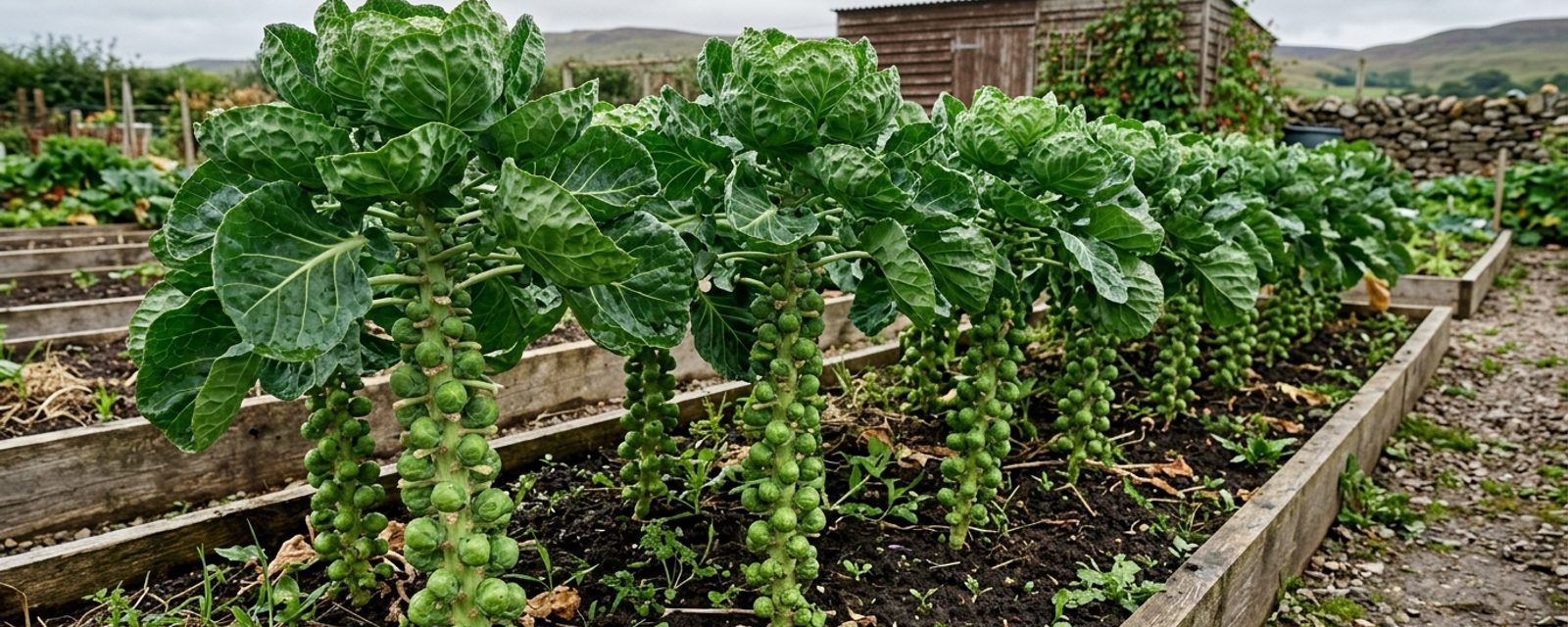
A Brussels sprout isn't a fruit and it isn't a root crop — it's a lateral bud. Each sprout forms in a leaf axil, the joint where a leaf stalk meets the main stem, and a single plant produces dozens of them stacked up a stem that can reach 80cm or more. That stem stays in the ground doing very little visible work for most of the year: sown between February and May, the plant spends spring and summer building height and leaf area, and only from late summer onward does it start swelling buds into the tight green buttons everyone recognises. Harvest can run from September through to February or later, six to nine months after sowing, on the same patch of ground.
Quick answer
For most Scottish gardens, Crispus or Maximus is the safer default: both have their club rootA soil-borne fungal disease of the brassica family that swells and distorts roots, and survives in soil for years. Full definition → resistance confirmed on their own individual RHS variety pages, and club root is the brassicaThe cabbage family: cabbage, kale, broccoli, cauliflower, Brussels sprouts, kohlrabi, swede, turnip and more, sharing the same pests, diseases and rotation rules. Full definition → disease that Scotland's commonly acidic soils actively encourage. Cascade is described as club-root resistant on RHS's general growing guide, but its own dedicated variety page doesn't repeat that claim, so treat it as the less certain of the three on unproven ground. Igor is worth choosing only where club root genuinely isn't a risk, since it's the one AGMThe RHS's Award of Garden Merit: a UK-wide trials award for reliable performance, not a Scotland-specific recommendation. Full definition → variety with no resistance claim anywhere.
That long occupation of the ground is also why frost is a feature rather than a threat for this crop. Once the plant is exposed to a hard cold snap, it converts some of the starch stored in its cells into sugars, a standard plant response to freezing temperatures, since sugars lower the freezing point of cell fluid and protect the tissue from ice damage. The side effect is that sprouts picked after a frost taste noticeably sweeter and less bitter than sprouts picked before one, which is why growers deliberately hold late varieties in the ground into winter rather than harvesting everything as soon as it's ready. A cold Scottish winter gives a standing crop repeated chances at that flavour payoff. Sowing, spacing and harvest technique are in the full growing guide; this article is about which variety earns that long a place in the ground.
Two things decide the choice: whether the variety can shrug off club root, and how well it "stands", holds its sprouts firm and closed rather than blowing open or turning soft, through the weeks or months it sits in the ground after reaching maturity. All four in this comparison want the same 60cm spacing between plants and rows, firm rather than freshly dug soil, and staking or mounding on an exposed site — variety only settles the disease- resistance and cropping-window half of the decision, not the cultivation half.
Why club root drives the choice in Scotland
Club root is a soil-borne disease that swells and distorts brassica roots, and it thrives in acidic, poorly drained soil, conditions that describe a large share of Scottish gardens. A simple soil test kit tells you where you actually stand before you lime blind. The standard defence is liming the bed the winter before sowing to raise soil pH to at least 6.5, which makes the soil less hospitable to the pathogen; crop rotationMoving each crop family to different ground each year, on a multi-year cycle, so pests and diseases that build up in soil don't get a repeat host. Full definition →, keeping brassicas off the same ground for several years running, is the other standing defence, since the pathogen persists in soil long after infected plants are gone. Choosing a variety bred with genetic resistance is a third layer on top of both, not a replacement for either: resistant varieties can still be affected under heavy infection pressure, they're just considerably less likely to fail outright. Symptoms, spread and management are covered in full on the club root pest page.
The four AGM varieties, head to head
All four hold the RHS Award of Garden Merit, a UK-wide horticultural quality mark rather than a Scotland-specific recommendation, so it confirms garden merit generally, not that a variety was bred or trialled for Scottish conditions specifically. That's why the club root and standing-ability detail below matters more for a Scottish decision than the award itself. All four are also F1The first-generation offspring of two specific, deliberately chosen parent plants, bred for a predictable, uniform result but not worth saving seed from. Full definition → hybrids: buy fresh seed each year rather than saving your own, since F1 seed doesn't breed true to type.
| Variety | Season | Club root resistance | Standing ability | Height |
|---|---|---|---|---|
| Igor | Mid to late | Not claimed; "may be susceptible" | Not specifically claimed | Up to 80cm, sturdy stem |
| Cascade | Harvest November–February | Claimed on the general guide only; not repeated on its own variety page | Long standing period | Tall stems; hardy on exposed sites |
| Crispus | Early to mid, from September | Resistant, confirmed on its own page | Holds condition for several weeks on tall stalks | Tall, sturdy stalks |
| Maximus | Harvest September–February | Resistant, confirmed on its own page | Long standing period, longest of the four | Tall, columnar habit |
Igor is the clearest outlier. Neither its own RHS variety page nor the general growing guide claims club root resistance for it, the variety page lists club root among diseases it "may be susceptible" to, the wording RHS uses for cultivarsA plant variety that arose or was bred under cultivation and is kept true by deliberate propagation, rather than a naturally occurring wild species. Full definition → with no resistance breeding behind them. Igor earns its AGM on cropping reliability and sprout uniformity, not on disease resistance. On unlimed, acidic Scottish ground, that makes it the variety to be most cautious with.
Cascade's resistance claim doesn't hold up consistently across RHS's own pages. The general growing guide states Cascade is "resistant to club root and powdery mildew," but Cascade's dedicated variety page lists club root among the diseases it may be susceptible to, without repeating the resistance claim. Crispus's own page, by contrast, states its resistance directly and its susceptibility list pointedly excludes club root, a consistent claim across both RHS pages, which Cascade doesn't get. If club root is a real risk on your plot, treat Cascade as the less certain of the three "resistant" AGM varieties, not the equal of Crispus and Maximus.
Maximus resists club root too, and is arguably the best-standing of the three. Its own RHS page states it directly, the same way Crispus's does, and describes the variety as holding condition well over its full September-to-February harvest window, the longest of the four.
Between the two consistently confirmed varieties, cropping window decides it. Crispus is earliest, giving pickings from September; Maximus is latest and longest-standing, running through to February. A garden with room for only one sowing does best picking based on when the sprouts are wanted.
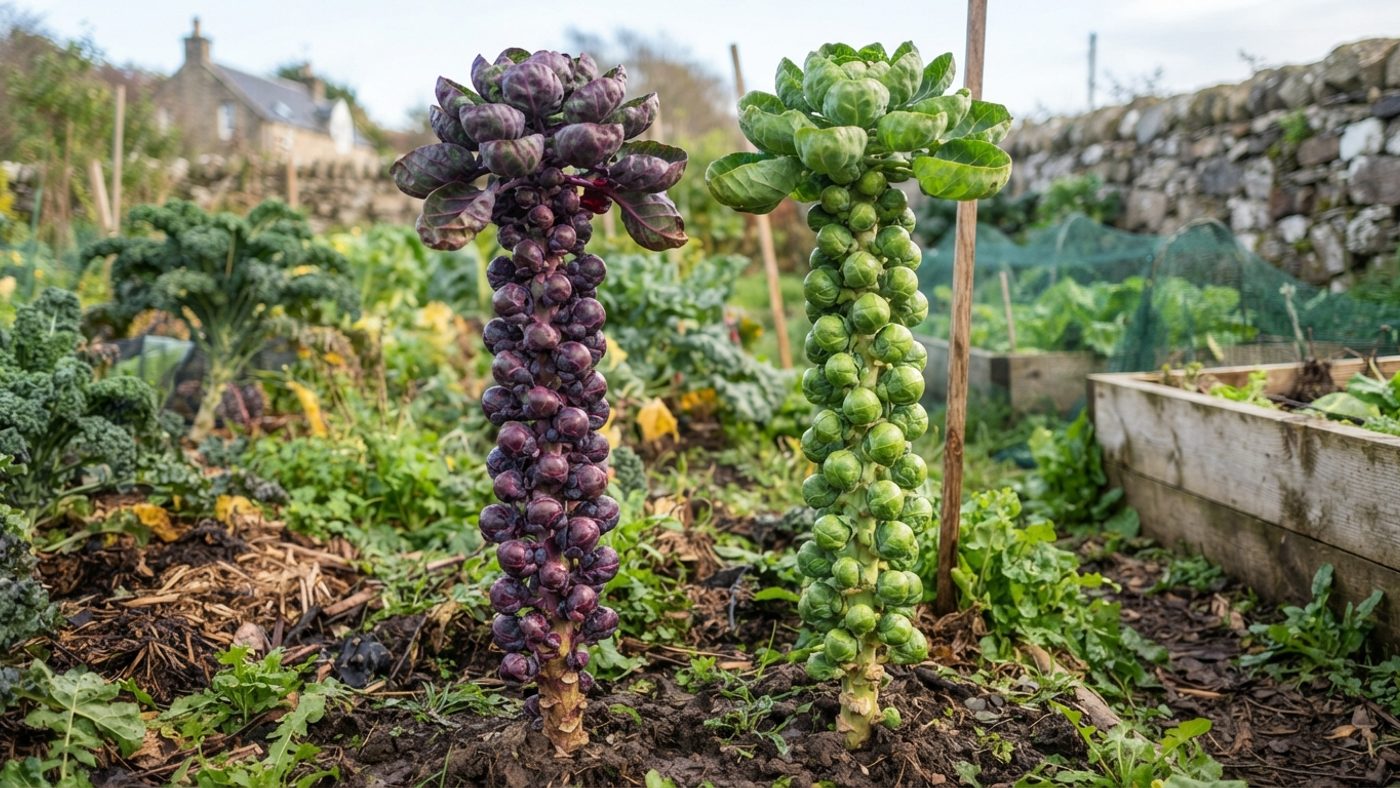
Red Bull is a colour exception, not a serious rival. It's a purple-sprouted variety growing to around a metre with good cropping over a long season, but its own RHS page lists only susceptibility to downy mildew and white blister with no club root resistance claim, and it doesn't carry the AGM. Grow it for the novelty on the plate, alongside a resistant workhorse variety, not instead of one.
What Gardener's World adds
Gardener's World names different cultivars from the four compared here, so it adds nothing new on variety choice itself. What it does add is a concrete timeline figure the RHS pages don't state directly: Brussels sprouts can take up to 31 weeks from sowing to first harvest, most of the growing year, with early varieties cropping from late summer and later ones running into late winter.
Which one for your situation
Standard Scottish garden, acidic or untested soil: Crispus or Maximus. Both have club root resistance stated directly on their own RHS variety pages, not just the general guide; pick Crispus for an earlier first picking from September, Maximus if you'd rather hold the crop right through to February.
Want the longest standing crop through deep winter: Maximus. Latest of the confirmed-resistant varieties and specifically described as holding condition well over its full harvest window.
Soil already limed to pH 6.5+ or known clear of club root: Igor or Cascade are both reasonable here, since neither variety's main selling point, Igor's uniform sprouts, Cascade's flavour and hardiness on exposed sites, is undermined by an uncertain resistance claim once the disease pressure itself is removed.
Exposed, windy site: Cascade is the one RHS specifically describes as hardy enough for exposed sites across the UK, which matters on a coastal or hillside plot in addition to staking.
Want a novelty for the table: Red Bull, purely for the purple colour, alongside, not instead of, a resistant main crop.
Soil, pests, and the growing guide
Whichever variety you choose, raising soil pH to at least 6.5 by liming the bed over winter is the first line of defence against club root, and it applies regardless of which of these four you plant, even Crispus and Maximus, since resistance reduces risk rather than removing it entirely. Over-rich soil or too much nitrogen is the other common cause of loose, "blown" sprouts alongside soft ground, whatever variety you've chosen, so don't over-compensate on feed while chasing tight buttons. Watch too for the other pests that show up on brassica beds through the long growing season: cabbage white caterpillars, aphids, flea beetle on young transplants, cabbage root fly at the base of the stem, and pigeons, which turn to a standing sprout crop for food once a long Scottish winter has stripped most other pickings bare. None of that is decided by variety choice, but a plant that's already fighting club root has less resilience left for the rest of it. For full sowing dates, spacing, staking, and harvest technique, see the Brussels sprouts growing guide.
Common questions
Is Cascade or Crispus better for a first-time Brussels sprout grower in Scotland?
For a first bed with untested soil, Crispus is the more cautious pick: its own RHS plant page states club root resistance directly, where Cascade's own page doesn't repeat the general guide's resistance claim. Where the two genuinely differ beyond that is habit: Cascade is the one RHS specifically rates hardy on exposed sites across the UK, worth weighing if your plot catches the wind. If wind exposure isn't a factor, timing settles it: Crispus from September, Cascade from November.
Does Igor really have no club root resistance, or is that just not mentioned?
Its own RHS variety page states plainly that it "may be susceptible" to club root, the standard RHS wording for varieties without a confirmed resistance claim — and unlike Crispus and Maximus, nothing on Igor's page or the general growing guide claims otherwise. On acidic or unlimed Scottish ground, that makes Igor the variety to treat with the most caution, or to reserve for beds already limed to pH 6.5 or higher.
What does "standing ability" actually mean for Brussels sprouts, and why does it matter more here than for other vegetables?
Standing ability describes how long a plant holds its sprouts firm and tightly closed after reaching maturity, rather than the buttons loosening or turning soft on the stem. Because Brussels sprouts occupy the same bed for six to nine months and are typically picked over many weeks, a variety with poor standing ability can lose quality before you've worked through the crop. Maximus and Cascade are both specifically noted by RHS for holding condition over an extended harvest window. Standing ability is bred into the variety, but firm, well-consolidated soil and a staked or mounded stem do the rest of the work.
Do I still need to lime my soil if I plant a club-root-resistant variety like Crispus or Maximus?
Yes. Genetic resistance reduces the likelihood of a resistant variety failing under club root pressure, but it isn't a substitute for correcting the soil conditions that let the disease thrive in the first place. Liming the bed the winter before sowing to raise pH to at least 6.5 is still the primary defence; resistant varieties are the second layer on top of it, and under heavy infection pressure even resistant plants can struggle.
Is Red Bull worth growing instead of one of the four AGM green varieties?
Not as a replacement. Red Bull's own RHS page doesn't carry an Award of Garden Merit and doesn't claim club root resistance — it lists only susceptibility to downy mildew and white blister. It's a genuinely different purple sprout worth growing for variety on the plate, but if club root is a risk on your ground, it shouldn't be your only or main variety. Grow it alongside a resistant green variety like Crispus or Maximus rather than in place of one.
Sources
7 sources, recorded with what each was used for
- Brassica oleracea (Gemmifera Group) 'Igor': Season, height, sprout description, AGM status, and disease susceptibility wording (no resistance claim)
- Brassica oleracea (Gemmifera Group) 'Cascade': Harvest window, standing period, hardiness on exposed sites, AGM status, and the susceptibility wording that doesn't repeat the general guide's resistance claim
- Brassica oleracea (Gemmifera Group) 'Crispus': Club root resistance confirmation, sprout description, standing ability, and AGM status
- Brassica oleracea (Gemmifera Group) 'Maximus': Club root and downy mildew resistance claim, harvest window, standing ability, and AGM status
- Brassica oleracea (Gemmifera Group) 'Red Bull': Colour, height, and disease susceptibility (no resistance claim, no AGM)
- Brussels sprouts: grow your own: General variety summaries (including Cascade's stated resistance claim, flagged as inconsistent with its own dedicated page) and general club root/liming background
- How to grow Brussels sprouts: The 31-week sowing-to-harvest timeline