
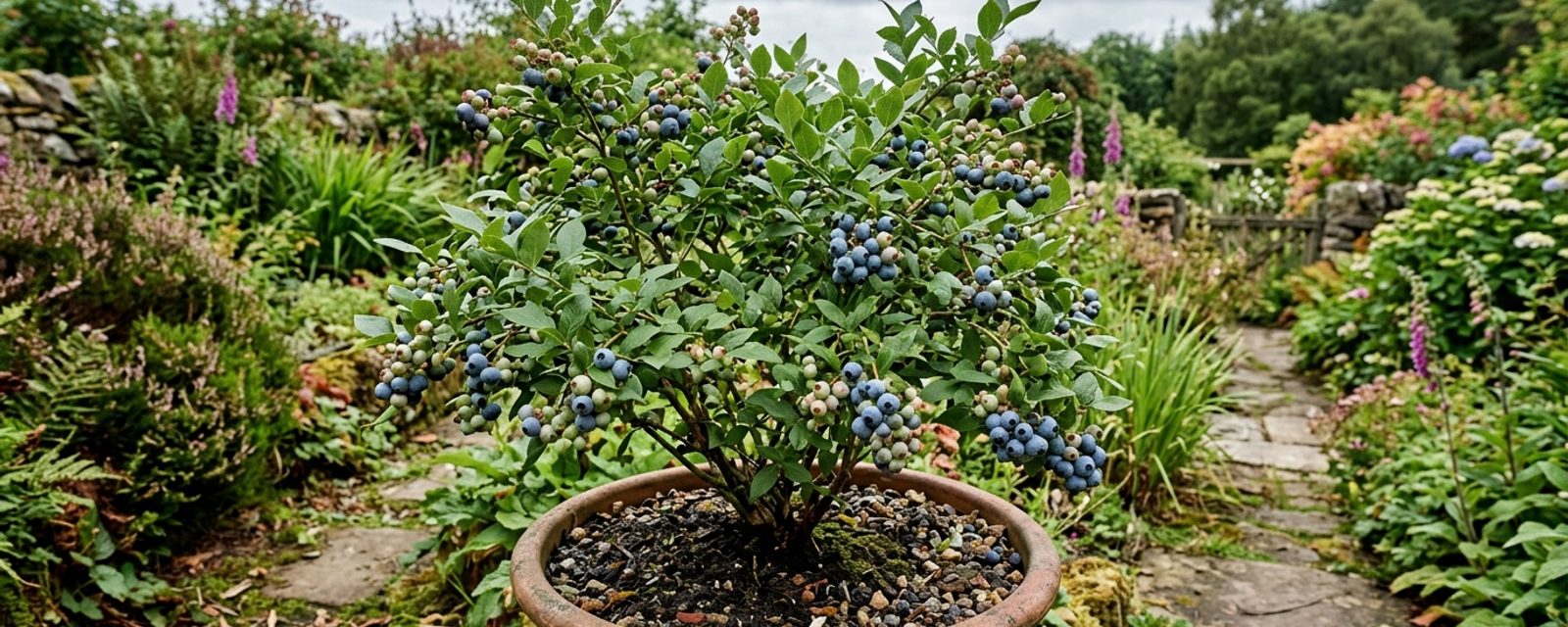
Blueberries need genuinely acid soil, pH 4.5–5.5, a stricter requirement than almost any other garden fruit, and that single requirement matters more to success than variety choice does. Once the soil (or a pot of ericaceous, meaning acid-loving-plant, compost) is right, the varieties themselves split cleanly on three things: how short a summer they can still crop well in, how big the bush grows, and whether the berries are even blue. Duke and Spartan carry the Award of Garden Merit (AGMThe RHS's Award of Garden Merit: a UK-wide trials award for reliable performance, not a Scotland-specific recommendation. Full definition →), the UK's own mark of a plant that performed well in trial; Bluetta, Sunshine Blue, Pink Lemonade and Ozarkblue don't carry it, but each earns its place on the shortlist for a different, concrete reason.
Quick answer
Go for Duke if only one variety is being picked: RHS and Gardener's World independently describe it, in their own separate words, as suited to a shorter growing season, on top of carrying the AGM. Pair it with Spartan where there's room for two bushes. A patio or small garden with only pot space calls for Bluetta or Sunshine Blue instead, both staying under a metre. Skip Ozarkblue: its own plant page states it suits hotter summers, the wrong direction for Scotland.
What the crop guide already covers
The full blueberries growing guide already covers acid soil and the container alternative, when and how to plant, watering with rainwater rather than tap water, feeding, mulchingA layer of material spread over the soil around plants to suppress weeds, retain moisture, and improve soil structure as it breaks down. Full definition → and pruning in depth, none of that is repeated here. One figure worth flagging up front, since it applies to every variety below equally: no fixed year for a first crop is given, but a bush reaches full productivity, 2.25–5kg a year, at around seven years old. That figure isn't broken down by region, so treat it as a UK-wide average rather than a Scotland-specific timeline; no source states whether a shorter Scottish growing season pushes it later. This piece is scoped to one question: which named variety is actually worth planting, and why.
Six varieties, unevenly described
Six blueberry varieties are named in total, but fully described only three of them at first glance. Ozarkblue, Spartan and Duke each get a full entry in the "Recommended Varieties" section, with season, size and flavour spelled out. Bluetta, Sunshine Blue and Pink Lemonade are named earlier on the same page, in passing ("less vigorous, compact varieties, such as Bluetta and Sunshine Blue" and "there are even varieties that produce pink berries, such as Pink Lemonade") with no season, size or flavour detail attached there. Each of those three has its own individual plant page with the detail the general page leaves out.
None of the three carries an AGM, and none states a hardiness ratingThe RHS's H1a–H7 scale for how much cold a plant can survive outdoors, H1a being tender indoor-only and H7 hardy anywhere in the UK. Full definition → on its own page (Duke and Spartan's own pages do: H6, meaning hardy throughout the whole of the UK, down to around -15 to -20°C). Here's what each one's own page actually says:
| Variety | AGM | Season | Size (H×S) | What it's for |
|---|---|---|---|---|
| Duke | Yes | Early-mid, flowers late, crops early | 1.5m × 1.5m | Best all-round pick; two sources independently flag it for a shorter season |
| Spartan | Yes | Early-mid | ~1.5m × 1.5m | Large, sweet berries; reliable second early variety alongside Duke |
| Ozarkblue | No | Late | 1.5–2.5m × 1.5–2.5m | Named "suitable for areas with hotter summers" on its own page, a reason to avoid it here, not choose it |
| Bluetta | No | Early summer | 0.5–1m × 0.5–1m | Compact, container-suited |
| Sunshine Blue | No | Mid-summer | 0.5–1m × 0.5–1m | Compact, semi-evergreen, container-suited |
| Pink Lemonade | No | Mid-to-late summer | 1–1.5m × 1–1.5m | Pink berries, upright habitA plant's characteristic shape and manner of growth, such as upright, spreading, creeping or bushy. Full definition →, orange-red autumn leaves |
Duke's own regional finding is the strongest single data point in this whole comparison: the general growing page states directly that it "flowers late but crops early, so suitable for colder/northern areas," and Gardener's World, writing independently, calls it good for "areas with a shorter summer season." Two authorities landing on the same variety, in their own separate words, though neither explains exactly why late flowering helps. Blueberry flowers can be damaged by a late spring frost; flowering later likely means less of that flowering window overlaps frost risk, a reasonable link rather than a stated fact. The regional frost dates page shows how much that risk itself varies across Scotland, later and more frequent inland and at altitude than on the coast.
Ozarkblue's own page adds something the general grow-your-own page's short blurb leaves out entirely: it's "suitable for areas with hotter summers." That's the opposite of what most of Scotland offers, a genuine reason to steer past it here rather than just a late-season variety with nothing else to say about it.
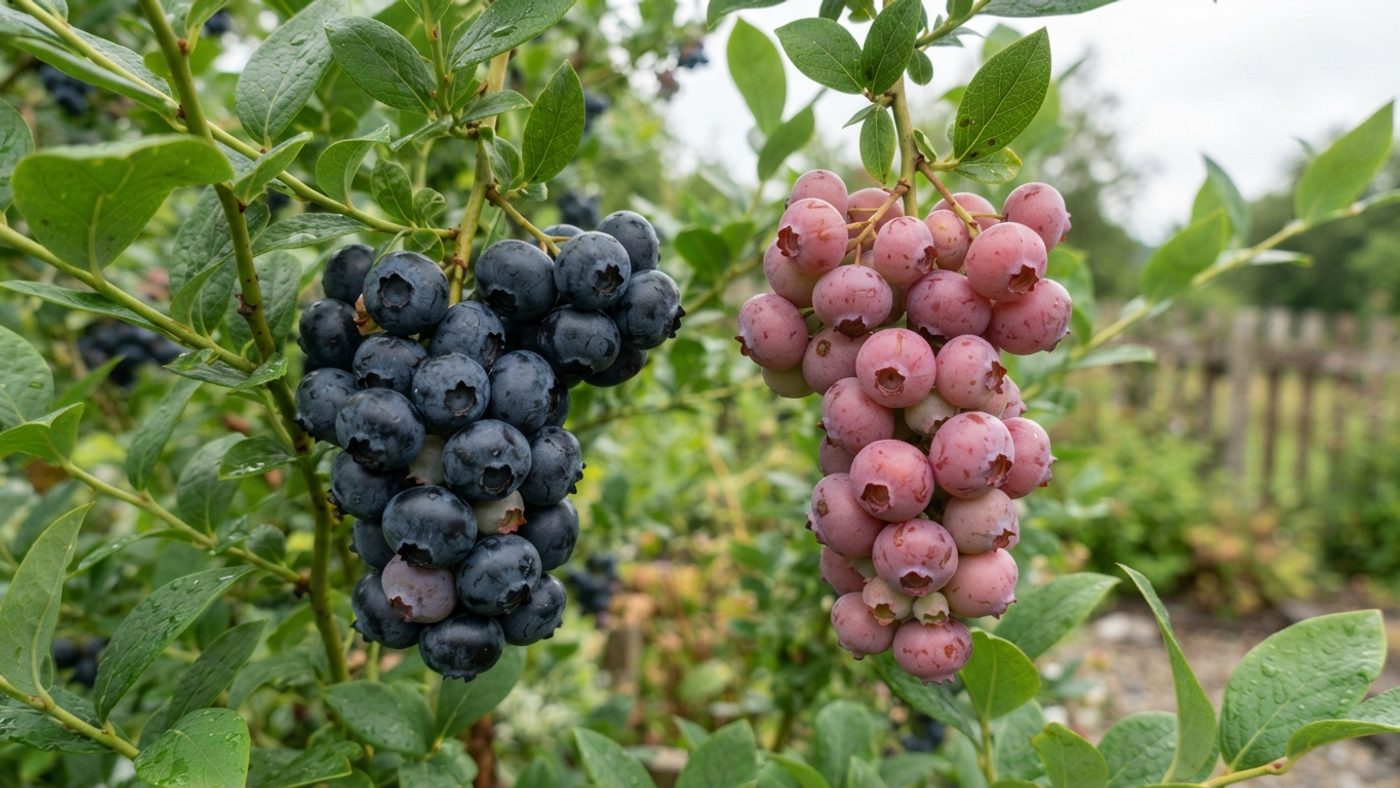
Bluetta and Sunshine Blue solve a different problem: fitting a blueberry into a small garden or a patio pot at all, and both are named specifically as the container recommendation on the general page (sizes in the table above). Sunshine Blue adds semi-evergreen foliage that turns purple-red rather than dropping bare, worth knowing if winter garden appearance matters. Pink Lemonade is the outlier of the six: pink rather than blue fruit, described as "medium-size flushed pink green berries, turning deep pink from mid-summer," with orange-red autumn colour on top. It's a genuine novelty pick rather than a heavy cropper, and its own page gives no yield figure the way Duke's and Spartan's do.
A second source adds three more names
Gardener's World's own growing guide names three further varieties that don't appear anywhere on the general RHS page: Earliblue, Brigitta and Bluecrop.
- Earliblue, an early ripener, large light-blue sweet berries, with good autumn colour, at roughly 1.8m x 1.8m.
- Brigitta, large fruit, ripening late (end of August), and Gardener's World is specific that it needs cross-pollinationPollen moving from one plant to a different, compatible variety, needed for fruit to set on any variety that isn't self-fertile. Full definition → with another variety to crop adequately.
- Bluecrop, described as self-fertileA plant that can set fruit using its own pollen, without needing a second, different variety nearby to cross-pollinate it. Full definition → but cropping better with a pollination partnerA second, different variety of the same fruit planted nearby so the two can cross-pollinate each other, needed by any variety that isn't self-fertile. Full definition → nearby, producing a heavy August harvest at a more compact 1.2m x 90cm. Its own individual RHS page confirms the same size range and adds "large, blue, firm fruits with a rich flavour," though Bluecrop doesn't appear on the general grow-your-own varieties list.
Gardener's World's page also names a "Pink Sapphire," which the Pink Lemonade page lists as a synonym for the same cultivarA plant variety that arose or was bred under cultivation and is kept true by deliberate propagation, rather than a naturally occurring wild species. Full definition →, not a separate variety, so the two sources between them cover nine distinct blueberries, not ten.
None of Earliblue, Brigitta or Bluecrop carries an AGM either. They're worth naming as further options precisely because a reader shouldn't assume RHS's own page is the complete list of what's out there, but they don't have the same weight of Scotland-specific evidence behind them that Duke does.
Which one for your situation
Duke is the best overall pick for most Scottish gardens: AGM-rated, and the only variety with two independent sources naming it specifically for a shorter growing season. Plant it alongside Spartan where there's room for two bushes, since cross-pollination increases the harvest even though blueberries are partially self-fertile on their own, and both Duke and Spartan's own pages go further, recommending three different cultivars together for the best possible yield.
For a patio or a small garden where only a large pot is realistic, Bluetta or Sunshine Blue are the better choice over Duke or Spartan on size alone (see the table above), and both are named as the container recommendation. Vine weevil is a particular risk for any container-grown blueberry, whichever variety is chosen, since the grubs damage roots inside the confined space of a pot.
If cropping heavily matters more than anything else and a second bush is already planned in, Bluecrop is worth considering alongside Duke: Gardener's World describes it producing "masses of fruits" in August at a compact size close to Bluetta and Sunshine Blue's.
Pink Lemonade is the one to plant for looks and novelty rather than yield: no source gives it a stated crop weight, and its value is the pink fruit and the autumn foliage colour, not heavy cropping.
Ozarkblue is the one variety on this list worth actively steering away from in a Scottish garden. It isn't a bad plant, yields and flavour are described as good, but its own page states it suits hotter summers specifically, working against, not for, the shorter and cooler season most Scottish gardens actually have.
Soil and site still decide more than the variety
A sheltered site matters alongside the soil: wind exposure isn't unique to any one variety here, and the full growing guide covers testing and correcting soil pH in detail. If a late frost is forecast while any of the varieties above are in flower, the advice is the same regardless of which one is planted: cover with fleeceA lightweight, breathable fabric laid or draped over plants to trap a little warmth and keep off frost, wind and some flying pests. Full definition → or an old bedsheet overnight, removed again during the day so insects can still reach the flowers.
Watch, too, for powdery mildew and phytophthora root rot, both named as blueberry risks regardless of variety, root rot in particular follows waterlogged or poorly drained soil rather than any single cultivar's weakness. Birds will take the fruit from any variety here equally as it ripens; netting matters more than variety choice for protecting the crop.
Common questions
Is AGM the same as "recommended for Scotland"?
No. The Award of Garden Merit is a UK-wide award for garden performance in RHS trials, not a Scottish-specific recommendation. Duke earns its place here because of a separate, additional finding, two sources independently naming it for a shorter growing season, on top of carrying the AGM, not because of the AGM alone.
Do I need to plant more than one blueberry bush?
No, most varieties are partially self-fertile and will crop alone. A second, different variety nearby increases the harvest, and Duke and Spartan's own RHS pages go further still, recommending three different cultivars together for the best possible yield. Brigitta is a partial exception: Gardener's World is specific that it needs cross-pollination with another variety to crop adequately.
Are Bluetta and Sunshine Blue actually different varieties, or just two names for the same plant?
Different varieties. Both are compact and container-suited, but Sunshine Blue is semi-evergreen with foliage that fades to purple-red rather than dropping, while Bluetta is fully deciduous with plainer red autumn colour. They're grouped together here because RHS itself names them together as its container recommendation, not because they're the same plant.
Why isn't Ozarkblue recommended here despite RHS calling its yield and flavour good?
Because its own individual page states it's "suitable for areas with hotter summers," a trait that works against, not for, Scotland's shorter and cooler growing season. The assessment of the fruit itself is genuinely positive; the climate fit is the specific reason it's placed last here.
Sources
9 sources, recorded with what each was used for
- Blueberries: Grow Your Own: Acid soil requirement and pH range, the container alternative, the passing mentions of Bluetta, Sunshine Blue and Pink Lemonade, the formal entries for Ozarkblue, Spartan and Duke, partial self-fertility, watering, first-crop/full-productivity timing and yield, late-frost fleece protection for flowers, named pest/disease risks
- Vaccinium corymbosum 'Duke' (F): AGM confirmation, H6 hardiness, size, the "plant three different cultivars" pollination note
- Vaccinium corymbosum 'Spartan' (F): AGM confirmation, size, season, and the same three-cultivar pollination note
- Vaccinium 'Ozarkblue' (F): Season, size, and the "suitable for areas with hotter summers" finding
- Vaccinium corymbosum 'Bluetta' (F): Size, season, habit; confirms no AGM and no hardiness rating stated
- Vaccinium 'Sunshine Blue' (F): Size, season, semi-evergreen habit and autumn foliage colour
- Vaccinium 'Pink Lemonade' (F): Size, season, berry colour description, autumn foliage colour, the "Pink Sapphire" synonym
- Vaccinium 'Bluecrop' (F): Size and fruit description, corroborating Gardener's World's own entry
- How to Grow Blueberries: Independent corroboration of Duke's shorter-season suitability and Spartan's early cropping, and three further named varieties not on RHS's page (Earliblue, Brigitta, Bluecrop)