
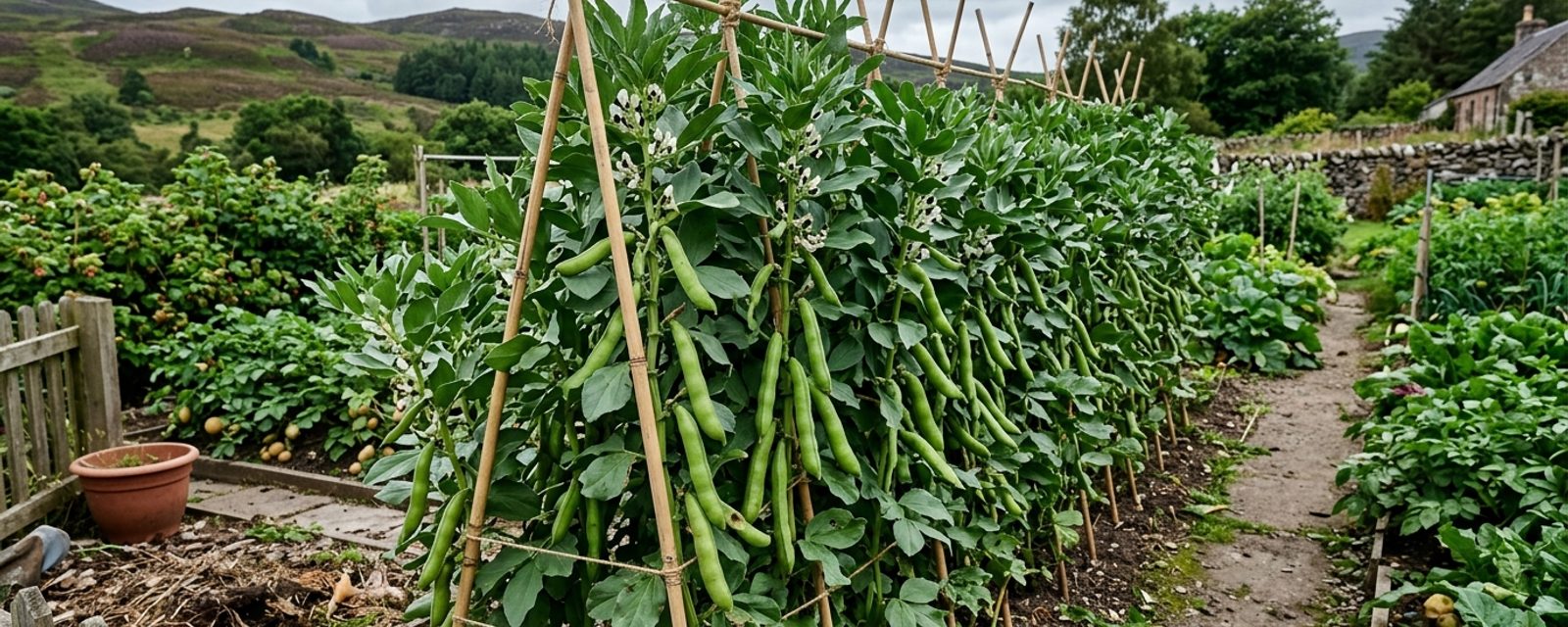
Aquadulce Claudia is the familiar autumn-sower and The Sutton the dwarf windy-site pick, but RHS lists two more varieties worth weighing up before you order seed: Dreadnought, a heritage type with unusually large pods, and Witkiem Manita, a fast spring-sown cropper. Comparing all four against their own individual RHS plant records, rather than the general growing summary alone, turns up real differences in hardiness ratingThe RHS's H1a–H7 scale for how much cold a plant can survive outdoors, H1a being tender indoor-only and H7 hardy anywhere in the UK. Full definition →, height and pod size, plus one outright discrepancy in how a variety's award status is recorded.
Quick answer
Aquadulce Claudia is the best overall pick for most Scottish gardens: it carries the highest hardiness rating (H5) of the four and is best suited to autumn sowing and overwinteringKeeping a plant alive and intact through the cold months, whether left outdoors, moved under cover, or stored dormant. Full definition →. Choose The Sutton instead for an exposed or windy plot or for container growing, and Witkiem Manita if you can only sow in spring and want an early crop. Dreadnought is worth growing for its heritage interest and unusually large pods, but carries no confirmed Award of Garden Merit (AGMThe RHS's Award of Garden Merit: a UK-wide trials award for reliable performance, not a Scotland-specific recommendation. Full definition →), the mark for a plant rated reliable for UK gardens.
How the four compare
| Variety | AGM (own page) | Hardiness | Height | Pod length | Beans/pod |
|---|---|---|---|---|---|
| Aquadulce Claudia | Yes | H5 | 100–150cm | up to 25cm | ~6 |
| The Sutton | Yes | H3 | 10–50cm (bushy) | up to 15cm | ~6 |
| Dreadnought | No, see below | H3 | 100–150cm | up to 20cm | 7–8 |
| Witkiem Manita | Yes | H4 | 50–100cm | not stated | not stated |
Hardiness is the real differentiator here, and it doesn't split the way the pod-size figures might suggest: the biggest-podded varieties aren't the hardiest ones. A shorter, cooler growing season leaves less margin for error if a winter turns severe, so a variety only rated to withstand mild winters is a bigger gamble as an autumn sowing than one rated for severe cold. Aquadulce Claudia is the variety named specifically for autumn sowing and overwintering outdoors, consistent with its H5 rating. The Sutton, Dreadnought and Witkiem Manita are also viable as clocheA small, portable clear cover placed over an individual plant or short row to trap warmth and keep off wind, rain and pests. Full definition →-protected autumn sowings, but with a lower hardiness cushion if the winter turns severe. Cloche or fleeceA lightweight, breathable fabric laid or draped over plants to trap a little warmth and keep off frost, wind and some flying pests. Full definition → protection through winter is worth treating as standard rather than optional for anything below H5. See the frost dates reference for how late frost typically runs in your area, since that's the window an overwintering sowing has to survive.
Spacing and sowing depth don't vary by variety: all four go in 5cm deep, 15–23cm apart within the row, in single rows 45cm apart or double rows with 60cm between each pair. None of the four has a published per-plant yield figure, so there's no reliable way to say exactly how many plants a household needs. A row a metre or two long, at that spacing, is a reasonable starting point to judge against your own appetite for beans in the first year, then adjust next time.
Scotland's growing conditions vary sharply by region: a sheltered Ayrshire or Lothian garden, an exposed coastal or island plot, and an upland Highland site don't share a single climate, and RHS hardiness ratings are UK-wide bands rather than a Scotland-specific measurement. The reasoning above still holds generally, but a gardener on a genuinely harsh or exposed site should treat H3-rated varieties as riskier for autumn sowing than the same rating would suggest in a milder part of the country.
Aquadulce Claudia: the hardiest, and the biggest pods
Aquadulce Claudia carries the AGM, H5 hardiness, and pods up to 25cm holding an average of six white-skinned beans, the longest pods of the four varieties here. It reaches 1–1.5m and needs staking as it grows. The same pest and disease susceptibilities apply as to the other three: pea and bean weevil, black bean aphid, and (in stored seed) broad bean seed beetle, plus broad bean rust and chocolate spot. None of the four carries a stated disease-resistance claim: susceptibility to blackfly and chocolate spot is a shared risk across the whole group, not something a variety choice avoids.
The Sutton: the dwarf option for wind and containers
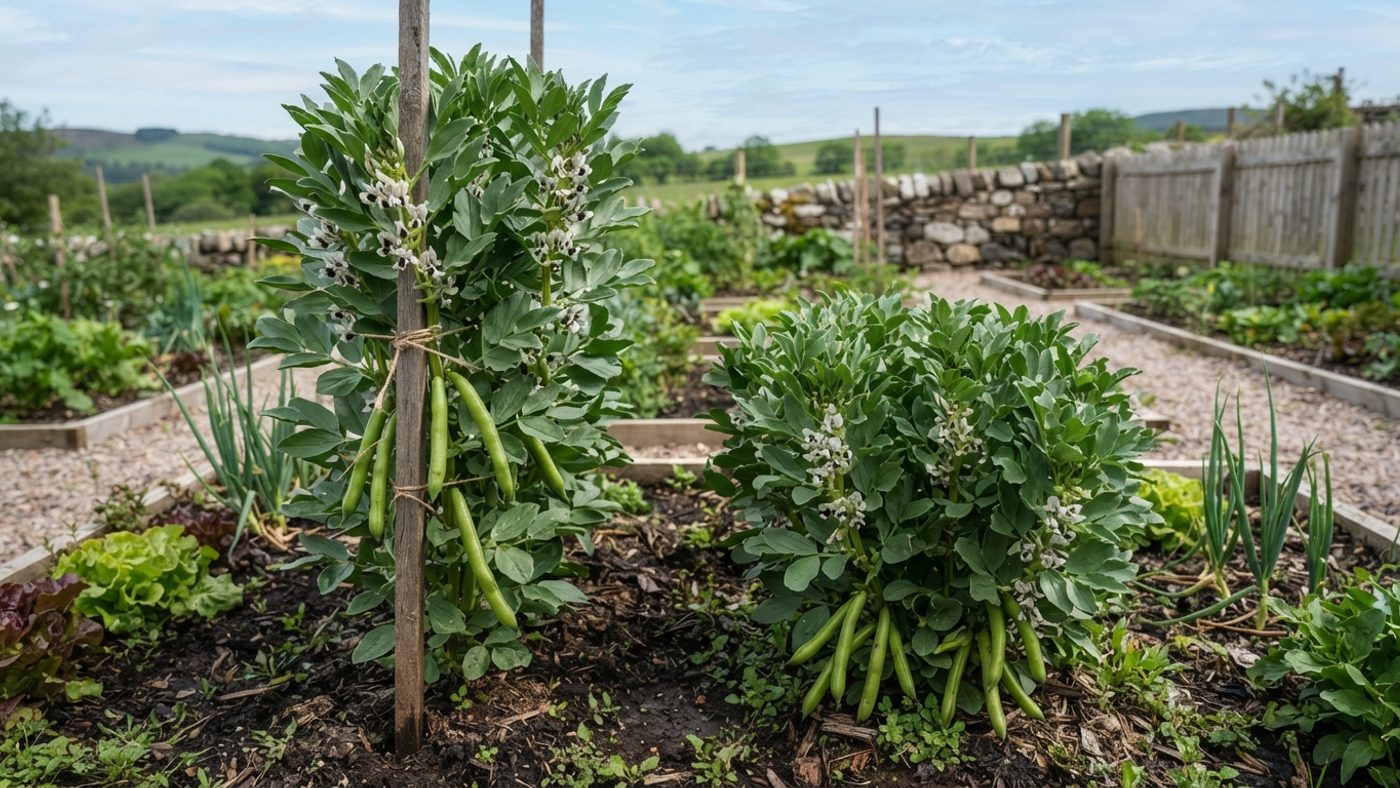
The Sutton carries the AGM but only an H3 hardiness rating, and a compact, bushy habit at roughly 35–45cm tall against Aquadulce Claudia's 1m-plus. Pods run shorter too, up to 15cm with a similar average of six beans. The low, bushy habit is the reason to reach for this one on an exposed or windy site or in a container or raised bed, where Aquadulce Claudia's height would need substantial staking to stay upright. The trade-off is the lower hardiness rating, which matters more for an autumn sowing than a spring one.
Dreadnought: the heritage variety with the biggest bean count — and an AGM discrepancy
Dreadnought's own RHS plant page describes it as having blue-green (glaucous) foliage, with pods to 20cm carrying seven or eight green-skinned white beans, more beans per pod than either Aquadulce Claudia or The Sutton, at a height around 120cm. It's rated H3, the same lower hardiness band as The Sutton. Its own page carries no AGM badge or mention anywhere in its content, while the RHS "grow your own" summary page for broad beans lists Dreadnought in a table of AGM-rated varieties, a direct disagreement between two RHS-published pages, not a case where one page simply adds detail the other omits, and nothing else on Dreadnought's own record settles which is correct. Sowing timing and hardiness are otherwise consistent between the two pages.
Witkiem Manita: the fast spring cropper
Witkiem Manita carries the AGM and an H4 hardiness rating, hardy through most of the UK, between The Sutton/Dreadnought's H3 and Aquadulce Claudia's H5, at a height of 50cm to 1m. Pod length and beans per pod aren't published for this variety. It's the variety most associated with a straightforward spring sowing, since it's a fast-maturing type intended to be sown from February under glass or March/April outdoors for an early summer harvest without needing to gamble on overwintering at all.
Disease and pest exposure is shared across all four
All four varieties carry an identical pest and disease list on their RHS pages: pea and bean weevil, black bean aphid, and broad bean seed beetle in stored seed, plus broad bean rust and chocolate spot as diseases. Chocolate spot has no chemical control available — good airflow, removing infected material, and not composting diseased plants are the only mitigations, and cool, damp conditions generally favour it, so airflow and spacing matter more in a wetter summer than a dry one. Heavy blackfly colonies are best reduced by pinching outRemoving the soft growing tip of a stem to stop upward growth and make the plant branch out sideways instead. Full definition → shoot tips once the first flowers have set. None of the four is described as more resistant to any of these than the others, so variety choice here doesn't reduce pest or disease risk, good site hygiene and pinching out do that regardless of which variety is sown. For an autumn sowing specifically, mice and voles will dig up and eat the seed before it germinatesA seed sprouting: breaking dormancy and putting out its first root and shoot, given the right warmth and moisture. Full definition → over the winter months, when the pest and disease pressures above aren't yet active; netting or a cloche over the row protects it. See the black bean aphid and chocolate spot pages for detail on managing each.
Soil pH
No soil pH preference is published for broad beans — records list acid, alkaline, or neutral soil as all acceptable across all four varieties, without a stated optimum range. Treat pH as an open question rather than a target to hit.
Storage and eating
Young pods can be eaten whole, similar to mangetout, while beans are small. For freezing, blanch shelled beans in boiling water for around three minutes and cool immediately in iced water before bagging. Seed saved from a mature, dry pod stays viable for around two years in cool, dry storage, the same across all four varieties.
Best pick, and when a different one wins
Where an exposed site, a container, a heritage variety, or a spring-only sowing window changes the calculation, The Sutton, Dreadnought, or Witkiem Manita answer that specifically rather than being a compromise on Aquadulce Claudia. Growing an autumn-sown Aquadulce Claudia alongside a spring-sown Witkiem Manita, rather than picking just one, is also a reasonable way to spread the harvest: an autumn sowing crops from around May, well ahead of a spring sowing, which then keeps cropping on through summer, two windows instead of one, and less riding on a single sowing surviving winter intact.
Which variety to grow is only half the decision; how to grow it is covered in full on the broad beans growing guide, sowing timing, spacing, staking, and support.
Common questions
Can broad beans be autumn-sown reliably in Scotland?
Yes, with a hardy variety, though the margin depends on which one and where the garden sits. Under cloche protection, all four varieties covered here can go in during October or November, but only Aquadulce Claudia is rated H5, the RHS's top hardiness band, which gives it the widest safety margin against a genuinely severe winter — check the frost dates reference for how late frost typically runs where you garden.
Does variety choice affect chocolate spot or blackfly risk?
No — all four varieties covered here carry an identical pest and disease list on their RHS pages, with no stated resistance differences between them. Chocolate spot risk is reduced by airflow and removing infected material rather than by variety choice.
Is Dreadnought AGM-rated or not?
Its own RHS plant page carries no AGM badge or mention, but the RHS general broad bean growing page lists it in a table of AGM varieties. The two RHS-published pages disagree, and nothing else on Dreadnought's own record resolves which is correct.
Which variety suits a container or small raised bed best?
The Sutton, at roughly 35–45cm tall with a compact bushy habit, is the variety most consistently associated with container and confined-space growing, needing no staking.
Sources
7 sources, recorded with what each was used for
- Vicia faba 'Aquadulce Claudia': AGM status, H5 hardiness, height/spread, pod length, beans per pod, pest/disease list, sowing window
- Vicia faba 'The Sutton': AGM status, H3 hardiness, dwarf height/spread, pod length, beans per pod, pest/disease list, sowing window
- Vicia faba 'Dreadnought': No AGM shown on this page, H3 hardiness, height/spread, pod length, beans per pod, pest/disease list, sowing window
- Vicia faba 'Witkiem Manita': AGM status, H4 hardiness, height/spread, pest/disease list, sowing window
- How to Grow Broad Beans: General sowing timing, its own AGM-variety summary table (which lists Dreadnought as AGM, unlike Dreadnought's own plant page), soil/compost guidance, common pest and disease list
- How to Grow Broad Bean: Seed storage life for saved seed, corroborating RHS's sowing windows independently
- How to Sow and Grow Broad Beans: Eating young pods whole like mangetout, blanchingExcluding light from part of a growing plant, usually by earthing up, wrapping or covering, so it grows pale, tender and less bitter. Full definition → time and method for freezing, note that chocolate spot has no chemical control available