
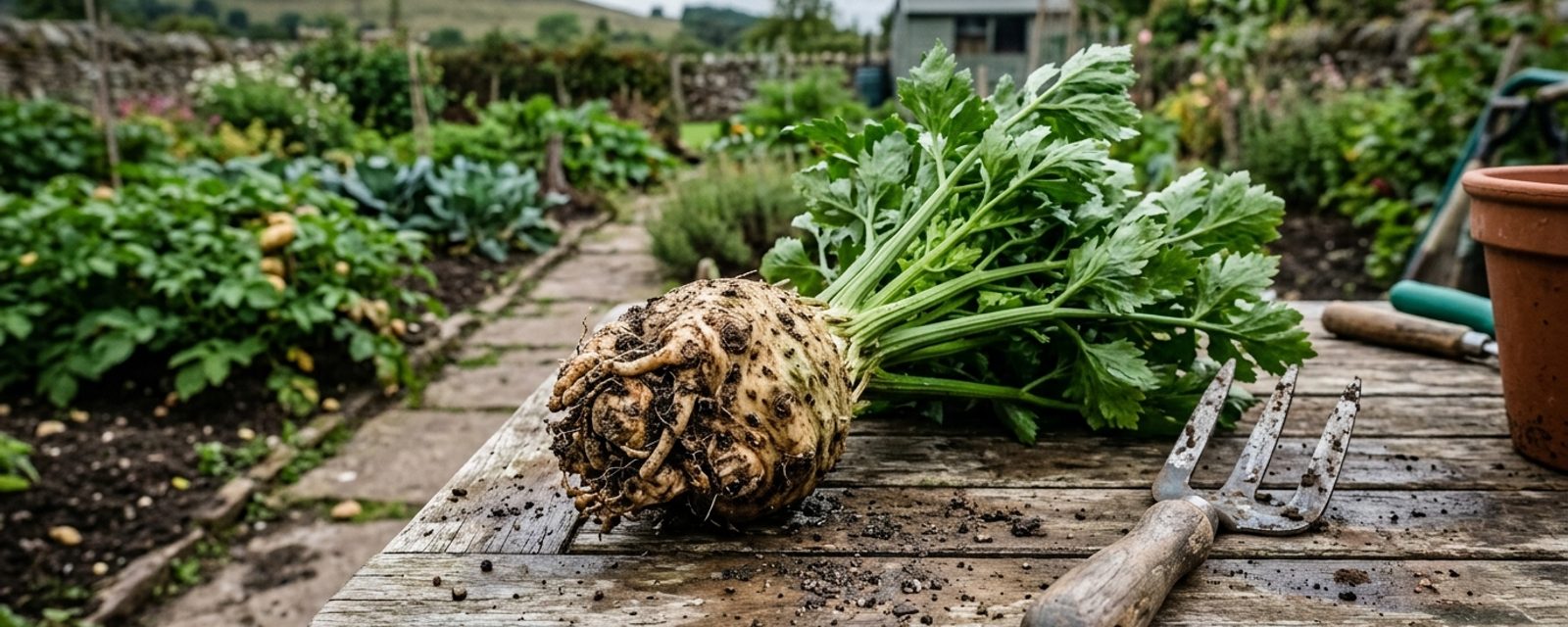
Celeriac's whole problem in a Scottish garden is time. The root needs six to eight months from sowing to something worth lifting, and a growing season that starts late or gets interrupted by a cold snap can leave you with a fist-sized knob instead of the dense, dinner-plate root you were after. Variety choice is one of the few levers you actually control against that, and six named celeriac cultivarsA plant variety that arose or was bred under cultivation and is kept true by deliberate propagation, rather than a naturally occurring wild species. Full definition → are worth knowing, not just the two most commonly stocked by UK seed racks.
Quick answer
Asterix is the strongest starting point for a short Scottish season: it's the one variety named directly as earliest of the six to reach cropping size, which buys back time against the season-length problem. If boltingA plant switching early into flowering and seed production, usually triggered by stress, after which leaves, roots or bulbs turn bitter or unusable. Full page → after a cold snap is your bigger worry, Ibis carries the most concretely sourced claim, "bolt hardy" is stated on its own RHS plant page, not just the general growing guide. Prinz and Monarch are worth choosing over Asterix only where the season genuinely runs long enough for their larger roots and better storage life to matter.
Why this crop's variety choice is really about the calendar
Sow indoors under heat from February to March, celeriac is never sown direct outdoors, so every week gained at the start is a week the root has to bulk up before it's lifted. The late-May/early-June planting-out window applies whichever variety you choose, it's a UK-wide figure, so check frost dates for your area rather than treat it as fixed, since it can vary a few weeks between a sheltered central-belt garden and an exposed upland or northern one. Full sowing and planting-out method is in the growing guide.
Six celeriac cultivars carry individual descriptions: Asterix, Prinz, Ibis and Monarch carry the Award of Garden Merit; Brilliant and Giant Prague don't. The AGMThe RHS's Award of Garden Merit: a UK-wide trials award for reliable performance, not a Scotland-specific recommendation. Full definition → is a UK-wide garden-merit award, not a Scottish recommendation, it means a cultivar performs reliably across UK trial conditions generally, not that it's been specifically tested against a short Scottish season. Spacing and feeding are the same whichever of the six you choose; see the growing guide for those.
The six varieties compared
| Variety | AGM | Harvest start | Bolt/disease claim | Root and flavour |
|---|---|---|---|---|
| Asterix | Yes | Not given per-month (general guide only) | "Good resistance to disease and bolting", general growing guide | Earliest to reach cropping size of the six |
| Prinz | Yes | September | General guide: "resistant to leaf disease and bolting." Own page states no resistance claim, only pest susceptibility | Round, smooth stem, crisp white flesh, "strong celery-like flavour" |
| Ibis | Yes | October | "Bolt hardy", stated on its own RHS plant page | Fast-growing, smooth round white globes, nutty celery-like flavour, "good standing and storing ability" |
| Monarch | Yes | September | No bolt or disease-resistance claim on either page | Flatter-round, smooth, creamy stems, "subtle nutty flavour", good storage |
| Brilliant | No | Not given per-month | No bolt or disease-resistance claim | Smooth-skinned, white flesh "that does not discolour", stores well |
| Giant Prague | No | Not given per-month | No bolt or disease-resistance claim | Heirloom (introduced 1871), fairly vigorous, slightly flattened base, stores well |
Asterix has no individual RHS plant page of its own — every claim about it, including its AGM status and its earliness and bolt-resistance, comes from the general "How to grow celeriac" summary page rather than a dedicated cultivar page the way the other five have. That doesn't make the claim untrue, the general guide is still a real source, but it does mean Asterix's bolt resistance is a general-page claim, not independently confirmed on a page of its own the way Ibis's "bolt hardy" is. Ibis is, on the evidence actually available, the more concretely sourced bolt-resistance pick of the two, even though Asterix is the one singled out as the earlier cropper.
There's a second discrepancy on the same point: the general growing guide describes Prinz as "resistant to leaf disease and bolting," but Prinz's own individual plant page makes no such claim at all, it lists only pest susceptibilities (carrot fly, celery leaf-mining fly) and a possible susceptibility to celery leaf spot. Both pages are RHS; they just don't agree with each other on this specific point.
Harvest timing: a small difference that matters on this crop
The general guide gives one harvest window for celeriac as a whole, October through March. But the individual plant pages for Prinz and Monarch both state harvest "from September onwards," while Ibis's own page states harvest "from October onwards." On a crop where the whole constraint is whether the root gets enough season to bulk up, a variety that's stated to be ready a few weeks earlier is a genuinely useful piece of information the general guide doesn't surface on its own, it only shows up by checking each variety's individual page.
Which one for your situation
Strongest starting point for a short season: Asterix. If your sowing slips into March rather than February, or you simply want the biggest cushion against a season that runs short, Asterix's earliness gives it the best chance of still producing a worthwhile root of the six.
Best-sourced bolt resistance: Ibis. If a late cold snap after planting out is your specific worry, celeriac plants that get chilled while still young are the ones most likely to bolt, Ibis is the one variety among the six where "bolt hardy" is stated directly on its own plant page, not inferred from a general guide. The trade-off is timing: Ibis is also the latest of the AGM varieties to be ready, from October rather than September, so it's a better fit where bolting is the bigger risk than running out of season altogether.
Where the season does run long enough: Prinz or Monarch. Both are AGM cultivars with real, sourced quality claims (Prinz: large roots, crisp white flesh, strong flavour; Monarch: subtle nutty flavour, good storage) and both are ready a little earlier, from September, than Ibis. The trade-off against Asterix is that neither carries a documented bolt-resistance claim on its own plant page, so they suit a more sheltered, reliably-timed sowing better than a marginal one.
Brilliant and Giant Prague are worth knowing, not necessarily growing, for most Scottish plots. Neither carries an AGM, and neither has a documented bolt-resistance claim, a real gap given how much this crop's Scottish outcome depends on that trait. Brilliant's real selling point is flesh that doesn't discolour once cut, useful if you're prepping celeriac for mash or gratin ahead of time, and Giant Prague is a genuine 1871 heirloom for anyone who wants to grow a variety with real history rather than the newest AGM cultivar. Both still need the same early, heated sowing as the other four; neither trait offsets Scotland's season-length problem the way Asterix's earliness or Ibis's bolt hardiness does.
One more variety, from a different source. Gardener's World's own growing guide names a seventh cultivar not listed individually by RHS at all, Alabastor, described there as having "good flavour and less prone to bolting," alongside Prinz with the same description. Alabastor has no RHS Award of Garden Merit and no individual RHS plant page to check that bolt-resistance claim against, so it's mentioned here as a secondary-source data point worth knowing about if you can't get hold of seed for the six RHS-listed cultivars, not a variety with the same weight of evidence behind it as Asterix or Ibis.
Soil pH
No published soil pH figure exists for celeriac from either RHS or Gardener's World, both describe soil requirements (fertile, moisture-retentive, well-drained, rich in organic matter) without giving a pH range.
Managing the risks these varieties don't solve on their own
Variety choice narrows the risk on this crop, it doesn't remove it. Young celeriac plants are a particular target for slugs and snails, raising plants in pots rather than direct-sowing (celeriac isn't direct-sown anyway) and keeping a close eye on them until they're well established is the main defence, and no variety here claims slug resistance. Bolting itself is triggered by a cold snap while plants are still young, most often from being planted out or exposed to cold before they're properly hardened offGradually getting young plants raised indoors used to outdoor conditions over 7–14 days before planting out, so cold, wind and direct sun don't shock or damage them. Full definition →, the strongest documented defence against it here is Ibis, but not planting out ahead of the recommended late May/early June window matters for every variety on this list, AGM or not. Celery leaf mining fly tunnels into leaves and causes pale blisters on all six varieties equally; none of them carry any documented resistance to it. Watering consistency, hardening off and how to store the roots over winter don't change by variety either, see the growing guide for all three.
Common questions
Is Asterix really the best choice if RHS doesn't have a dedicated plant page for it?
Its AGM status and its earliness and bolt-resistance claims are genuine RHS claims, they just come from RHS's general "How to grow celeriac" page rather than a cultivar page of its own, unlike the other five varieties covered here. The claim is real, sourced to RHS; it just isn't independently corroborated on a second RHS page the way Ibis's bolt-hardiness claim is.
Which celeriac variety is most bolt-resistant?
Ibis carries the most concretely sourced claim: its own RHS plant page states it is "bolt hardy." Asterix and Prinz are both described as bolt-resistant on the general growing guide, but Prinz's own individual plant page doesn't repeat that claim. Monarch, Brilliant and Giant Prague carry no bolt-resistance claim from either page.
Do any celeriac varieties mature faster than others?
Asterix is named directly as reaching cropping size earlier than the other varieties. Among the rest, Prinz and Monarch are both stated to be ready for harvest from September, a few weeks ahead of Ibis, which is stated to be ready from October, a genuine difference on a crop where the growing season is frequently the limiting factor.
Is it worth growing a non-AGM variety like Brilliant or Giant Prague?
Only for a specific reason, not as a general Scottish choice. Brilliant's flesh doesn't discolour once cut, useful if you're prepping it ahead for mash or gratin. Giant Prague is a genuine 1871 heirloom for anyone growing for variety or history rather than the newest cultivar. Neither carries a documented bolt-resistance claim, which is a real gap given how much this crop's outcome in Scotland depends on that trait.
Sources
7 sources, recorded with what each was used for
- How to grow Celeriac: General variety list (all six named cultivars with descriptions and AGM status), sowing/transplant/harvest timing, pest and disease list
- Apium graveolens var. rapaceum 'Prinz': AGM status, hardiness (H4The RHS's H1a–H7 scale for how much cold a plant can survive outdoors, H1a being tender indoor-only and H7 hardy anywhere in the UK. Full definition →), harvest timing (from September), flavour/root description, pest susceptibility list; confirms no disease/bolting resistance claim on this specific page
- Apium graveolens var. rapaceum 'Ibis': AGM status, hardiness (H4), "bolt hardy" and storage claim, harvest timing (from October), flavour/root description
- Apium graveolens var. rapaceum 'Monarch': AGM status, hardiness (H4), harvest timing (from September), flavour/root description, storage claim
- Apium graveolens var. rapaceum 'Brilliant': Confirms no AGM badge, hardiness (H4), non-discolouring flesh claim, storage claim
- Apium graveolens var. rapaceum 'Giant Prague': Confirms no AGM badge, hardiness (H4), heirloom (1871) origin, root description, storage claim
- How to grow celeriac: Names Alabastor as a seventh variety not covered individually by RHS ("good flavour and less prone to bolting"), same description given for Prinz; general sowing/harvest timing; no pH figure given