
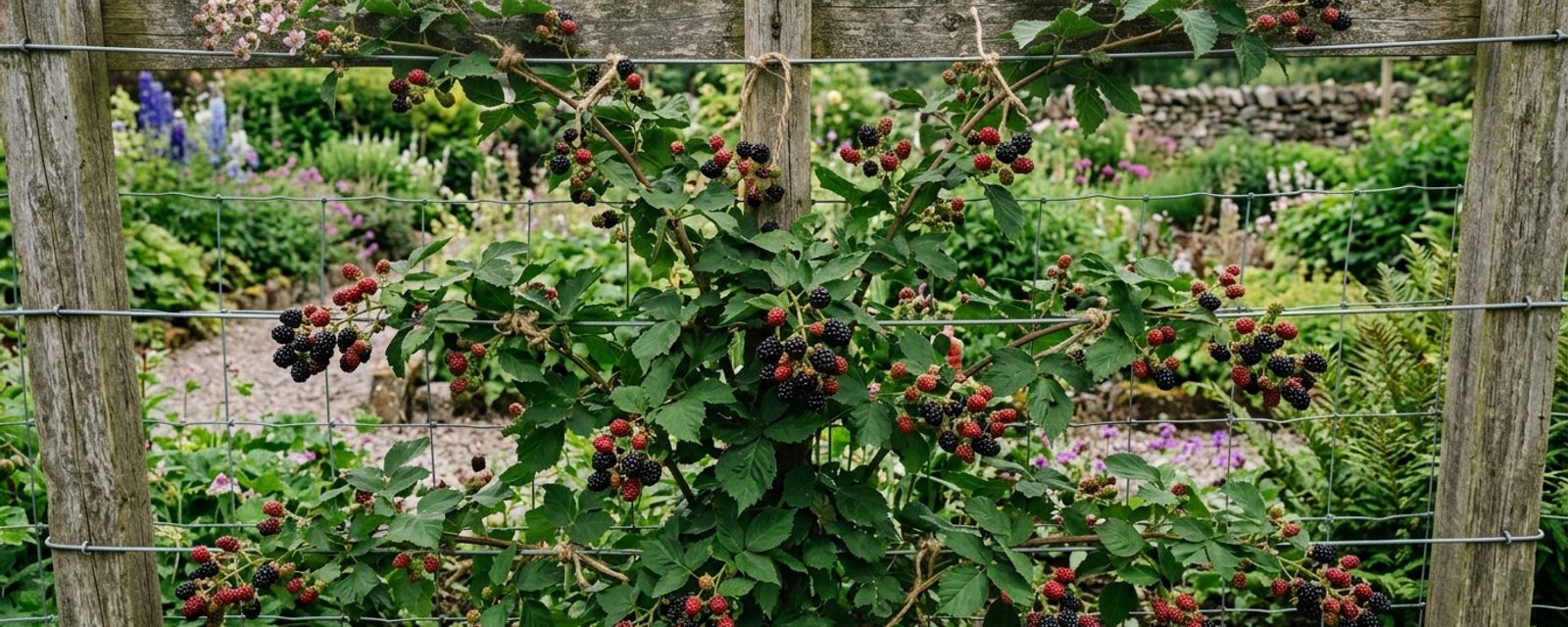
If you've ever bitten into a blackberry that looked ready, deep black, plump, easy to pull off the cane, and got a mouthful of sourness instead of sweetness, the fruit wasn't underripe by accident. Blackberries colour up fully a few days before they actually finish sweetening, so picking on colour alone means picking too early almost every time. The fix isn't patience with the fruit you've got, it's picking on feel rather than colour (a ripe berry pulls off the cane with almost no resistance; if it fights you, leave it) and choosing a variety with a harvest window and flavour profile that actually suits your site, from an earliest-ripening pick that gets a full season in before autumn closes in, to one bred specifically for a higher sugar content.
Quick answer
For most Scottish gardens, Loch Ness is the strongest all-round pick, it's thornless, carries the Award of Garden Merit, and has the longest harvest window of any variety here, cropping from mid-August until the first frosts. If your plot is exposed or you garden somewhere cold and windy, Merton Thornless or Loch Maree are a full hardiness band tougher. If space is tight, Adrienne is the most compact option and ripens earliest, by mid-July.
Why there are only a handful of names worth knowing
"Blackberries and hybrid berries" is a wide group on paper, but only a few names come up as genuinely distinct true blackberry cultivarsA plant variety that arose or was bred under cultivation and is kept true by deliberate propagation, rather than a naturally occurring wild species. Full definition → (Rubus fruticosus agg.) once you set aside the hybrids. Tayberries and loganberries, both raspberry-blackberry crosses, get lumped in with blackberries in general growing advice, but they're different enough in habit and flavour to warrant their own coverage: see the best tayberry varieties for Scotland and best loganberry varieties for Scotland articles, plus their own crop guides. This article sticks to true blackberries: Loch Ness, Loch Tay, Loch Maree, Loch Katrine, Karaka Black, Merton Thornless, and Adrienne. Whichever one you pick, planting depth, wire training and pruning work the same way, all covered in the blackberries growing guide; a container at least 45cm wide and deep also works for any of them if space is short, which matters most for whichever compact pick you land on below.
Head-to-head comparison
| Variety | Hardiness | Height & spread | Thorns | Harvest window | AGMThe RHS's Award of Garden Merit: a UK-wide trials award for reliable performance, not a Scotland-specific recommendation. Full definition → | Notable trait |
|---|---|---|---|---|---|---|
| Loch Ness | H6The RHS's H1a–H7 scale for how much cold a plant can survive outdoors, H1a being tender indoor-only and H7 hardy anywhere in the UK. Full definition → (-20 to -15°C) | 1.5–2.5m x 1.5–2.5m | Thornless | Mid-August to first frosts | Yes | Longest harvest window; most widely grown |
| Loch Tay | H6 (-20 to -15°C) | 1–1.5m x 1–1.5m | Thornless | Earlier and sweeter than Loch Ness | Yes | Compact, semi-upright |
| Loch Maree | H7 (below -20°C) | 1.5–2.5m x 2.5–4m | Thornless | July–August | No | Double pink flowers; hardiest Loch variety |
| Loch Katrine | Not stated (too new for AGM trial) | Not stated | Thornless | 8-week season | No | Brix-to-acid ratio of 17; released 2024 |
| Karaka Black | H6 (-20 to -15°C) | 1.5–2.5m x 4–8m | Thorny | Early summer into autumn | No | Largest fruit, 10g+ average berry weight |
| Merton Thornless | H7 (below -20°C) | 1.5–2.5m x 2.5–4m | Thornless | August | No | Widest soil pH tolerance; joint-hardiest |
| Adrienne | H6 (-20 to -15°C) | 1–1.5m x 1–1.5m | Thornless | Mid-July | No | Earliest-ripening; smallest footprint |
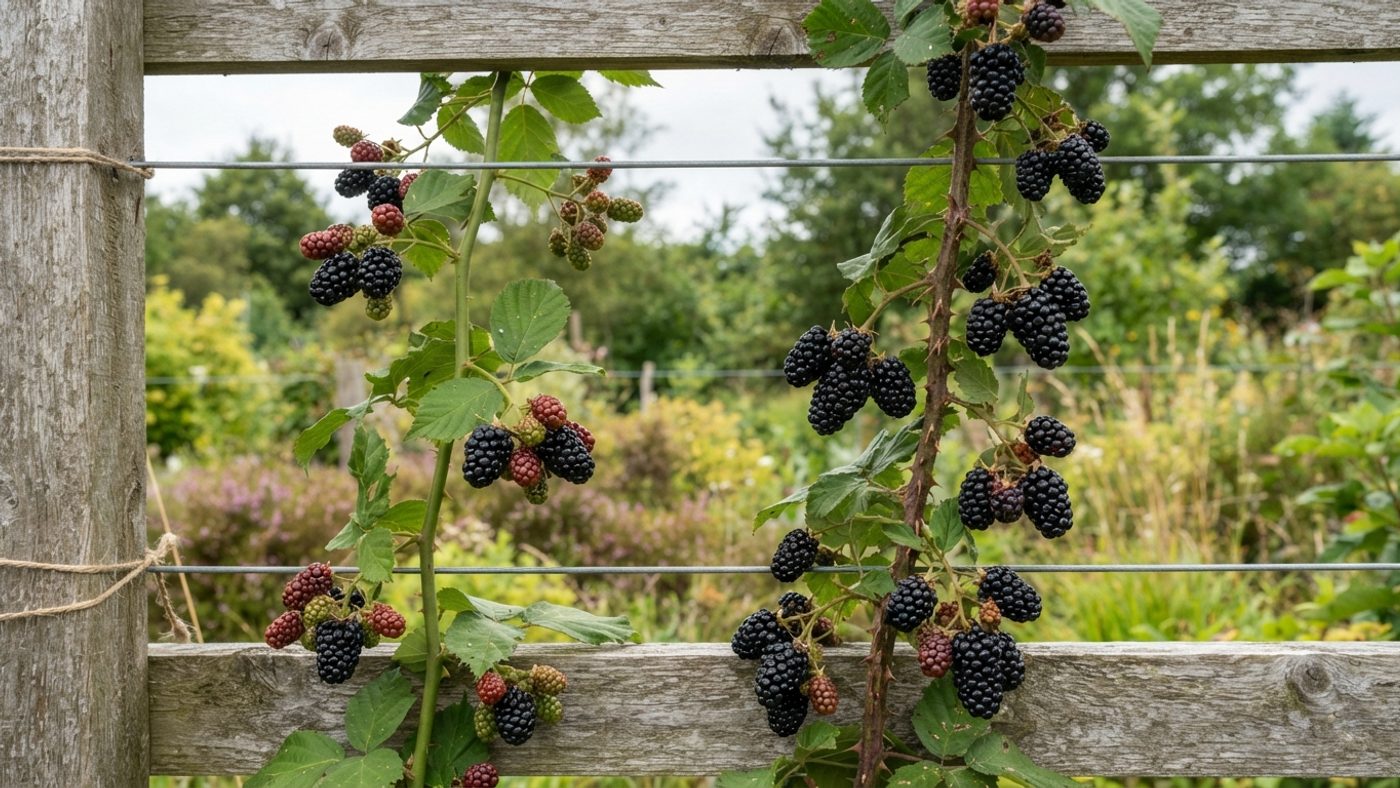
AGM isn't a hardiness ranking
Loch Ness and Loch Tay are the only two true blackberries here with the Award of Garden Merit, but they aren't the hardiest options on this list. Merton Thornless and Loch Maree both rate H7, one band tougher than either AGM variety, meaning they're rated to survive conditions colder than -20°C, the severest continental European winters. An AGM reflects reliable garden performance UK-wide; it doesn't mean the variety is the toughest against cold specifically. For an exposed or particularly cold Scottish site, Merton Thornless or Loch Maree are worth weighing against the AGM names on that basis alone.
Which one for your situation
Best overall: Loch Ness. It combines thornless canes, an AGM, and by far the longest harvest window of any variety here, mid-August through to the first frosts, which spreads picking over weeks rather than concentrating it. Its fruit is described as having the tangy flavour of wild blackberries, firm and glossy-black. It's also the most widely grown blackberry, bred at the Scottish Crop Research Institute (now the James Hutton Institute) in Dundee, so it's a genuinely Scottish-bred plant as well as a well-documented one.
Exposed or very cold site: Merton Thornless or Loch Maree. Both rate a hardiness band above Loch Ness (see the table above). Merton Thornless also tolerates a wider range of soil pH than any Loch variety. Loch Maree adds double pink flowers and a July-August harvest that starts earlier than Loch Ness.
Small garden: Adrienne. At 1–1.5m in both height and spread, it has the smallest footprint here, matched only by Loch Tay. Some retailer and grower figures put Adrienne's spread closer to 2.5m rather than 1–1.5m, worth bearing in mind if space is genuinely tight. It's also the earliest-ripening cultivar in this comparison, with large, firm, conical fruit ready by mid-July, a full month ahead of Loch Maree or Karaka Black.
Biggest fruit, don't mind thorns: Karaka Black. New Zealand-bred rather than Hutton-bred, with fruit up to 7.5cm long and an average berry weight over 10g, bigger than any Loch variety. It's also the most sprawling, with a spread up to 8m, so it needs room.
One to watch: Loch Katrine. Released in 2024, the first new Hutton blackberry since 2006, bred by Nikki Jennings. Brix measures sugar content, and Loch Katrine's brix-to-acid ratio of 17 is high enough to give notably sweet, aromatic fruit without background bitterness. Fruit runs up to 9g over an 8-week picking season, with trial yields matching Loch Ness. It's too new for an AGM trial and doesn't yet have its own RHS plant page, so documentation is thinner than the established names, but the breeding data on it is strong.
Soil pH
There's no figure specific to blackberries' preferred pH from the sources this site draws on. University of Maryland Extension, a US rather than UK source, states the ideal soil pH range for blackberries is 6–6.5, just below neutral. The individual pages for these cultivars list neutral soil as suitable, so a garden already sitting anywhere from slightly acid to neutral needs no correction either way.
Hybrid berries: a brief note
Tayberries and loganberries have their own dedicated coverage on this site, linked above. Two other hybrids sometimes grouped with blackberries, Tummelberry and Boysenberry, don't have dedicated pages here yet. Neither is a straightforward alternative to the varieties above if hardiness is the deciding factor. General blackberry-and-hybrid-berry growing advice describes Tummelberry as "suitable for colder areas," yet Tummelberry's own individual plant page rates it H5, lower than every true blackberry cultivar in the table above. Boysenberry is described in general prose as "very hardy," yet its own page rates it H6, the same rating as Loch Ness, Loch Tay, Karaka Black and Adrienne rather than something higher.
Pests and diseases to watch for
The true blackberry cultivars covered above share a similar pest and disease profile: aphids, raspberry beetle, and gall mites are the pests named on their individual variety pages, and grey mould is the main disease risk, with honey fungus noted as a rarer possibility on Loch Ness, Loch Tay, and Loch Maree specifically. Birds are also worth netting against once fruit starts to colour.
Common questions
Which blackberry variety is best for Scotland overall?
Loch Ness, for most gardens: thornless, holds the Award of Garden Merit, and its harvest window runs longer than any other variety here, mid-August to the first frosts.
Is there a blackberry variety that's hardier than Loch Ness?
Yes, Merton Thornless and Loch Maree both rate H7 (hardy through the severest European winters, below -20°C), a band above Loch Ness and Loch Tay's H6 (-20 to -15°C), making them better suited to exposed or particularly cold sites.
What's the best blackberry for a small garden?
Adrienne, at 1–1.5m in height and spread (some sources put its spread nearer 2.5m), is the most compact option and also ripens earliest, by mid-July.
Are tayberries or loganberries covered in this article?
No. Both are raspberry-blackberry hybrids rather than true blackberries, and both have enough of their own named-cultivar detail to warrant their own separate variety articles.
Sources
12 sources, recorded with what each was used for
- Rubus fruticosus agg. 'Loch Ness': Hardiness, size, aspect, harvest window, AGM status, pests/diseases
- Rubus fruticosus agg. 'Loch Tay': Hardiness, size, AGM status, cropping timing
- Rubus fruticosus agg. 'Loch Maree': Hardiness, size, thornlessness, flower colour, harvest window
- Rubus fruticosus agg. 'Karaka Black': Hardiness, size, thorns, fruit size, harvest window
- Rubus fruticosus agg. 'Merton Thornless': Hardiness, size, soil pH tolerance, harvest window
- Rubus fruticosus agg. 'Adrienne': Hardiness, size, aspect, harvest timing
- Rubus 'Tummelberry': Hardiness rating, thorns, breeding origin
- Rubus 'Boysenberry Thornless': Hardiness rating, thornlessness, fruit colour/timing
- Blackberries and Hybrid Berries: Grow Your Own: General group framing, Tummelberry/Boysenberry prose claims
- James Hutton Institute — Blackberry Breeding: Loch Ness/Loch Tay breeding provenance; Loch Katrine full profile
- How to Grow Blackberries (Gardener's World): Adrienne spread cross-check, Loch Katrine corroboration, general UK hardiness statement
- Start Growing Thornless Blackberries (FS-2023-0660): Soil pH range