
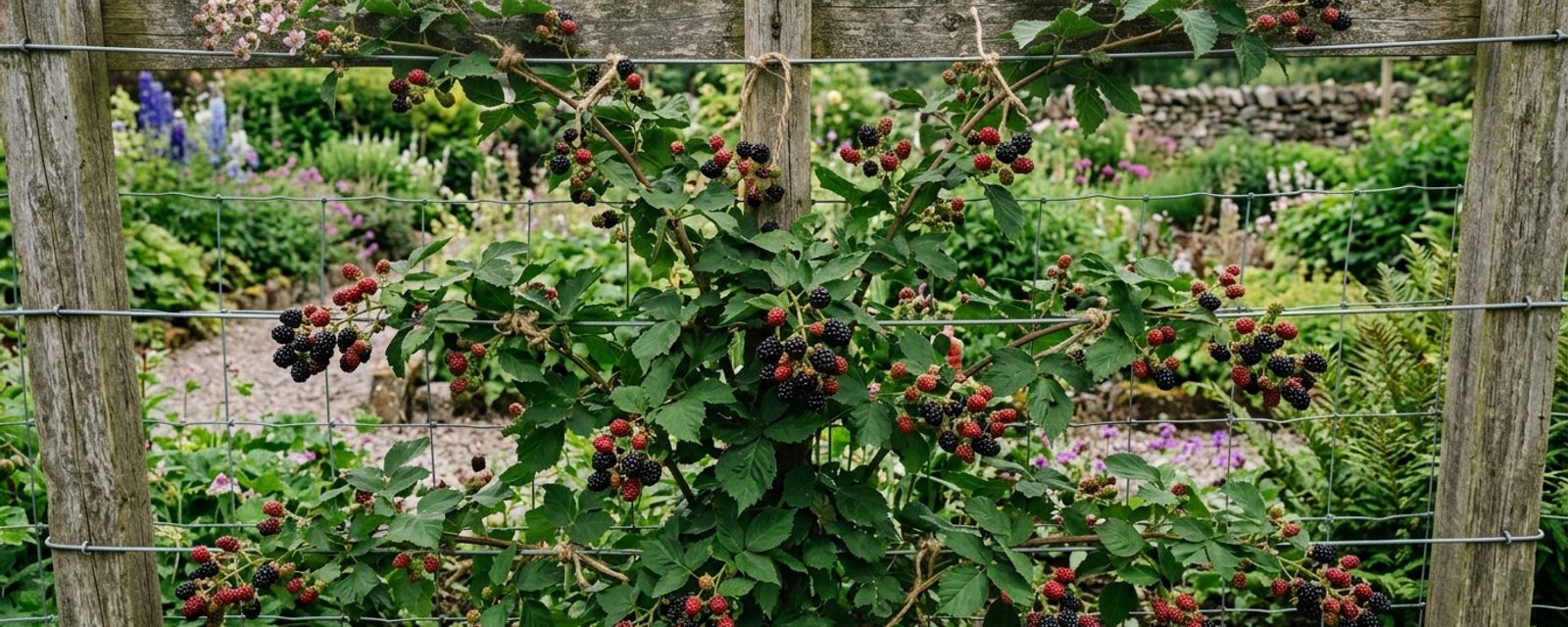
Rubus fruticosus
One of the best blackberry varieties available was bred just up the road in Dundee. Pick them too early, though, and there's no fixing it afterwards: they don't ripen once picked.
A cultivated blackberry variety is a genuinely different plant from the hedgerow bramble it's related to: larger, sweeter fruit, and often no thorns at all. Grown on wires rather than left to scramble, it's a productive, low-maintenance fruit once the framework is in place.
Bramble control without losing the wildlife value → covers the wild hedgerow plant instead: where it earns its keep for pollinators and birds, and where to cut it back at a boundary before it spreads into beds.
Site and planting
Choose a sunny, sheltered site if possible, though plants will still fruit in light shade. Soil should be fertile and well-drained, avoiding anywhere that waterlogs. Plant mid-autumn to early spring, ideally while dormant. Space moderately vigorous varieties 2.5-3.5m apart, and the most vigorous up to 4m; compact varieties like Loch Ness need much less, around 2m. For a wall-trained plant, position the hole at least 30cm from the base. In a container, use a pot at least 45cm wide and deep.
Training and support
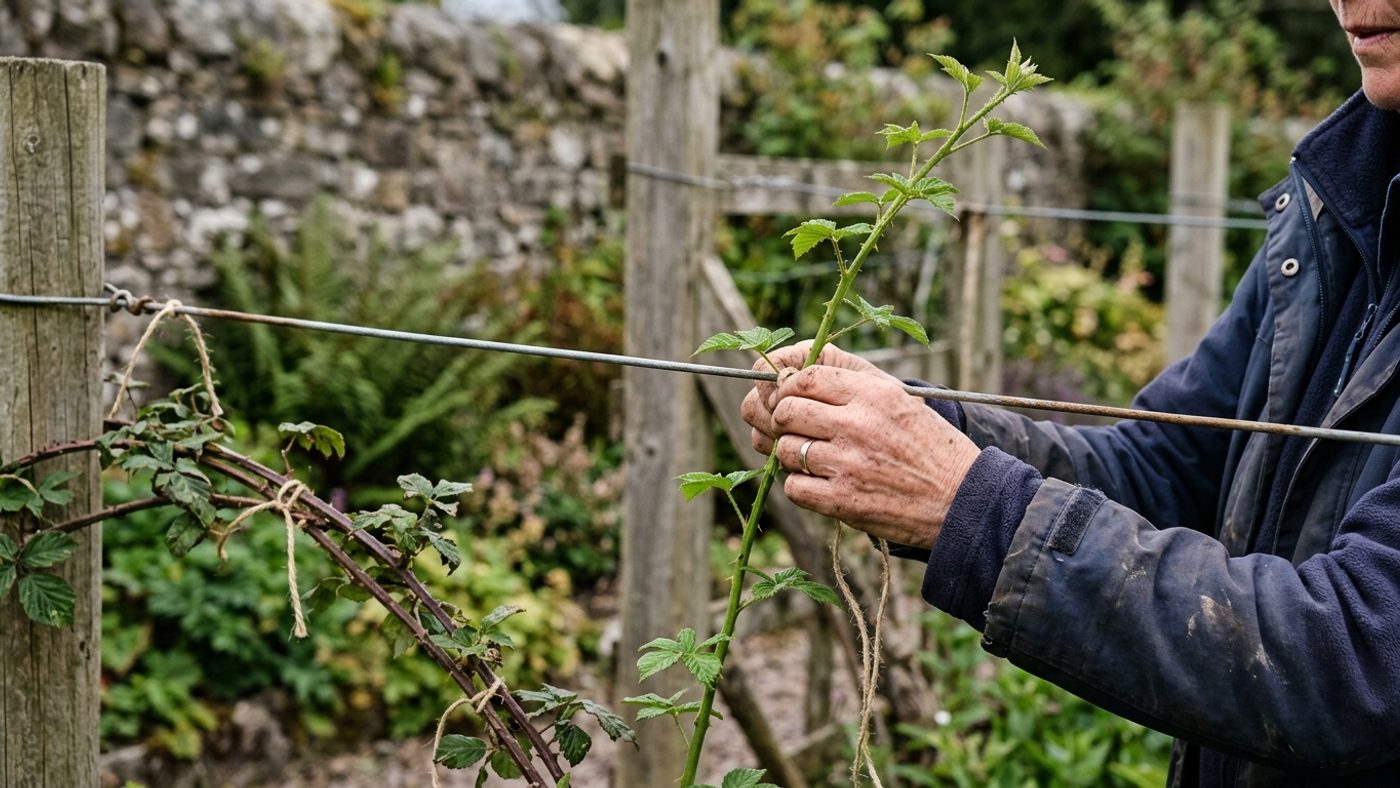
Set up horizontal wires fixed to a wall, fence or posts, spaced about 45cm apart, with the lowest wire about 45cm above the ground. Tie in new canes as they grow rather than letting them scramble. After planting, cut all stems down to healthy buds 20-25cm from the ground; during the first winter, cut back any side-shoots that formed to about 7.5cm long.
Care
Water well immediately after planting and through any prolonged dry spell in the first growing season; established plants shouldn't need extra watering. MulchA layer of material spread over the soil around plants to suppress weeds, retain moisture, and improve soil structure as it breaks down. Full definition → each spring with a 5-7.5cm layer of organic matter: a well-mulched plant generally needs no additional feeding.
A vigorous variety can spread further than expected if left unchecked; even a compact one like Loch Ness has the potential to become a nuisance without regular tying-in and pruning. Tie new canes to the wires as they grow, since it's far easier to keep on top of than to untangle later.
Pruning
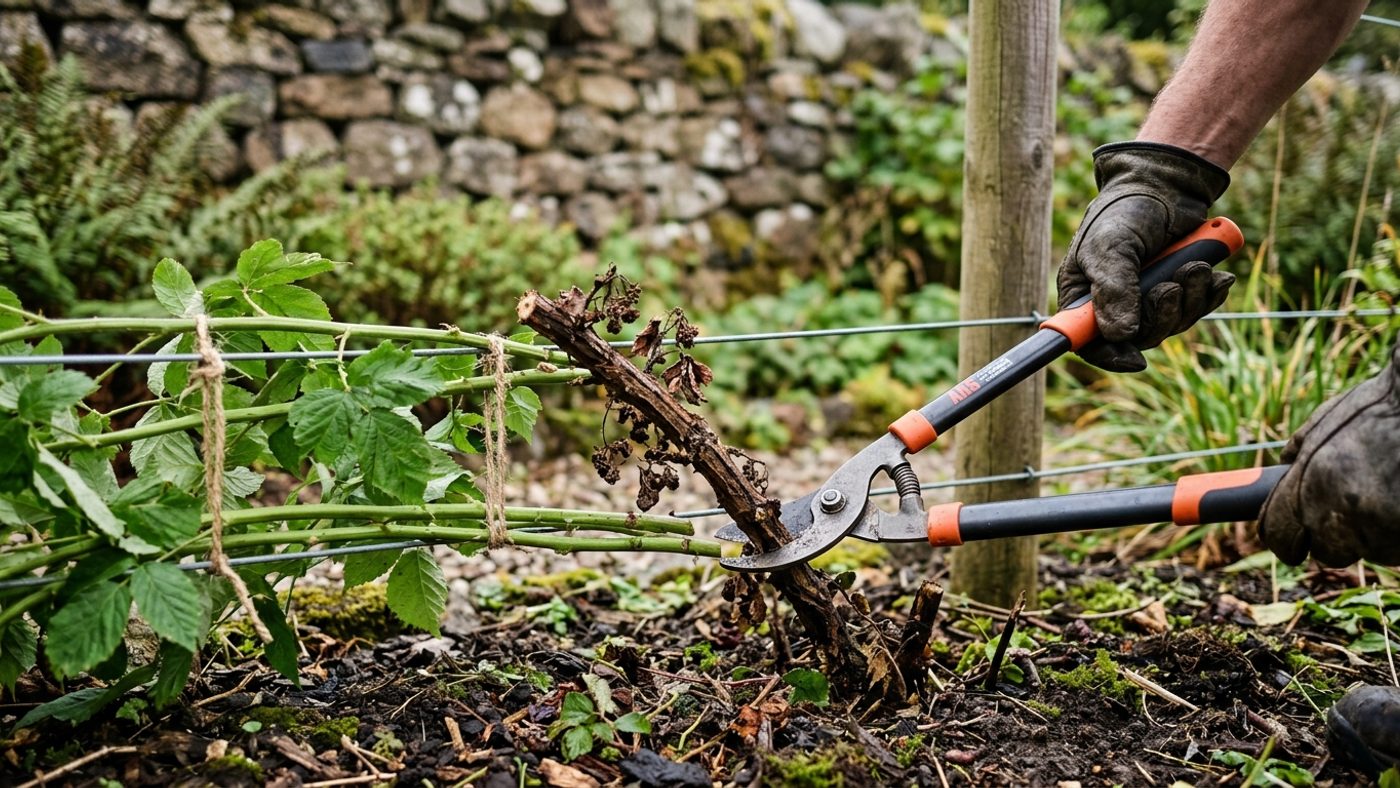
Once established, prune out the old, fruited canes at the base any time from when harvesting finishes until late winter, not held back as a single winter job. This year's new canes, which haven't fruited yet, are kept and tied in separately; they carry next year's crop. Keeping fruiting and non-fruiting canes visually separate, fan-trainedA fruit tree or bush trained flat with branches radiating out from a low point, the standard shape for wall-grown stone fruit. Full definition → or to one side, makes this straightforward.
Varieties
Four blackberry and hybrid varieties carry the Award of Garden Merit. Thornlessness and Scottish breeding history are the two traits worth choosing between.
Tayberry and loganberry, both raspberry-blackberry hybrids with their own AGMThe RHS's Award of Garden Merit: a UK-wide trials award for reliable performance, not a Scotland-specific recommendation. Full definition → varieties and enough going on to cover separately, have their own guides. Tummelberry is often described as suited to colder areas, though its own individual plant page rates it H5The RHS's H1a–H7 scale for how much cold a plant can survive outdoors, H1a being tender indoor-only and H7 hardy anywhere in the UK. Full definition →, lower than every true blackberry here — worth checking before relying on it for an exposed site. Boysenberry, called very hardy in general terms, rates H6 on its own page, unexceptional rather than standout.
★ Our pick for Scotland
Loch NessAGM
Thornless · compact · H6 · mid-August to first frosts
Bred at the Scottish Crop Research Institute, now the James Hutton Institute, in Dundee: genuine Scottish breeding provenance, part of the same 'Loch' naming convention as its successor Loch Tay.
Why this one: Thornless canes, sweet flavour and high productivity are Hutton's stated breeding priorities for blackberries, and Loch Ness delivers on all three. It's also the most widely grown blackberry variety, rated H6, and carries an unusually long harvest window, mid-August until the first frosts.
Also worth considering
Loch TayAGM
Thornless · compact, semi-upright · earlier and sweeter than Loch Ness
Also Hutton-bred, released as Loch Ness's successor, with an earlier season and sweeter flavour: a real choice between the two, not one simply replacing the other.
Best Blackberry Varieties for Scotland → compares all named blackberry varieties head-to-head, with the practical detail that doesn't fit in a summary card.
Harvesting
Loch Ness crops from mid-August until the first frosts, an unusually long picking window for a soft fruit. Store shallow, only two or three layers deep in a bowl or punnet, since fruit crushes easily under its own weight.
Common problems
- Birds strip ripening fruit fast; net plants raised on a framework rather than draped directly over the canes.
- Aphids distort new growth and shoots.
- Raspberry beetle larvae feed inside ripening fruit, the same pest that also attacks raspberries.
See more problems
- Grey mould rots fruit and canes in damp conditions; good airflow from correct pruning and training helps prevent it.
- Raspberry viruses can affect blackberries too, causing weak growth and poor cropping with no cure; buy certified virus-free stock and remove badly affected plants.
- Mites and red berry mite can cause poor fruit set and uneven ripening.
Common questions
Are all blackberry canes thorny?
No: several AGM varieties are specifically bred thornless, Loch Ness and Loch Tay among them; thornless canes were a stated priority of the James Hutton Institute breeding programme that produced both. Full sourced breakdown: <a href="/tools/garden-myths/blackberries/">Blackberry Myths →</a>
When should I prune blackberry canes?
Not as one single winter job: cut fruited canes out at the base any time from when harvesting finishes until late winter, and keep this year's new, unfruited canes tied in separately, since they carry next year's crop. Full sourced breakdown: <a href="/tools/garden-myths/blackberries/">Blackberry Myths →</a>
Do blackberries keep ripening after picking?
No: blackberries will not ripen any further once picked, so wait until fruit is fully ripe and dark on the cane before picking. Full sourced breakdown: <a href="/tools/garden-myths/blackberries/">Blackberry Myths →</a>
Is Loch Ness actually connected to Scotland, or just a name?
Genuinely connected: it was bred at the Scottish Crop Research Institute, now the James Hutton Institute, in Dundee, and its successor Loch Tay continues the same naming convention after another Scottish loch. Full sourced breakdown: <a href="/tools/garden-myths/blackberries/">Blackberry Myths →</a>
Sources
4 sources, and what each was used for
- RHS: getting started, thornless vs thorny, 4 AGM varieties plus named non-AGM hybrids (Tummelberry, Boysenberry, Karaka Black), sizing by vigour, site and soil prep, planting depth and timing, spacing, container growing, watering, feeding, wire spacing for training, initial and established pruning method, harvesting (no further ripening once picked), storage, and named problems
- RHS: H6 hardiness, thornless upright canes to 2m, AGM, extended mid-August-to-first-frosts harvest window, disease susceptibility (grey mould, rarely honey fungus)
- James Hutton Institute: confirms Loch Ness and Loch Tay as James Hutton Institute (formerly Scottish Crop Research Institute)-bred, the 'Loch' naming convention, breeding priorities (thornless, sweet, high-yielding, disease-tolerant), and Loch Tay's earlier/sweeter comparison to Loch Ness. Used strictly for breeding provenance, not as a suitability claim.
- gardenersworld.com: independently corroborates autumn planting, Loch Ness spacing and dimensions, the two-year-old-cane pruning rule, ripening by colour and gentle pulling, and bird protection