
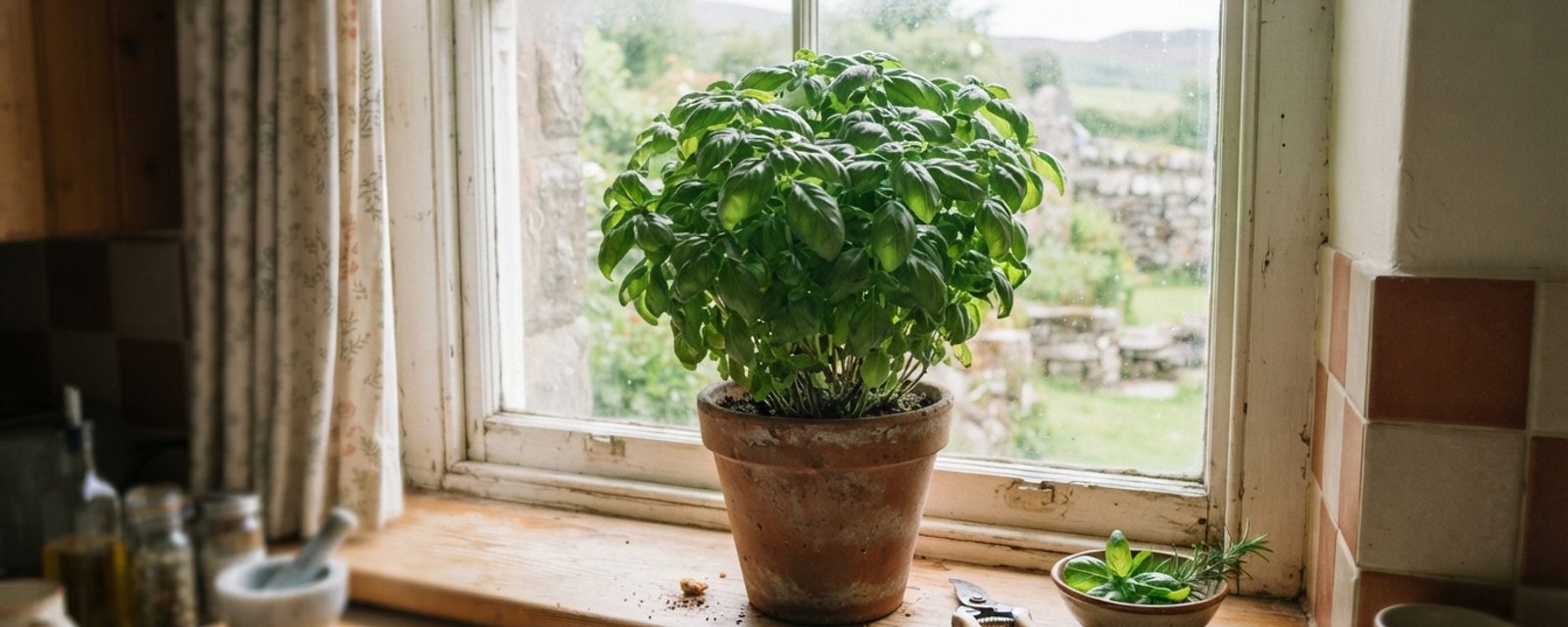
Basil doesn't grow outdoors reliably anywhere in Scotland, so "best variety" here means something different than it does for a hardy vegetable: every named basil variety in this comparison is grown the same way, under cover, and the real question is which one earns its space on a windowsill or in a greenhouse once you've accepted that. RHS lists five varieties with the Award of Garden Merit (AGMThe RHS's Award of Garden Merit: a UK-wide trials award for reliable performance, not a Scotland-specific recommendation. Full definition →), its main quality mark for garden plants: Salvo, Mrs Burns' Lemon, Pluto and Aroma 2, plus a red-leaved AGM form. That's the shortlist, five departures from the standard sweet Genovese basil most people already know, the large-leaved variety with the strongest aroma and no AGM of its own, covered in full in the growing guide. Two of the five don't actually carry the AGM badge on their own individual plant page at all, despite the general summary listing all five.
Quick answer
Pluto is the strongest all-round pick for a Scottish windowsill: a genuinely compact, dome-shaped plant with the AGM confirmed on its own RHS page, suited to a small pot. Mrs Burns' Lemon (also AGM-confirmed on its own page) is the pick for a different flavour. Salvo and Aroma 2 are both worth growing for weather resistance and slow boltingA plant switching early into flowering and seed production, usually triggered by stress, after which leaves, roots or bulbs turn bitter or unusable. Full page → respectively, but neither variety's own individual RHS page actually shows the AGM badge that the general basil page credits it with, so treat that award as unconfirmed rather than settled. The red-leaved form, 'Basilico Rosso', is the ornamental option if looks on a patio matter as much as the crop.
The full basil growing guide covers sowing, pinching outRemoving the soft growing tip of a stem to stop upward growth and make the plant branch out sideways instead. Full definition →, and the windowsill-versus-greenhouse decision in detail; this page is about choosing between varieties once you've accepted where basil actually has to live in Scotland.
Why "which variety" is a different question for basil
RHS states plainly that basil isn't hardy in the UK, needs around 20°C to germinateA seed sprouting: breaking dormancy and putting out its first root and shoot, given the right warmth and moisture. Full definition →, and needs night temperatures consistently above 10°C to survive outdoors, a bar a Scottish summer doesn't reliably clear. RHS's own advice for cooler locations is to grow it in a greenhouse, and Gardener's World independently gives the same steer: "to get a quality crop that lasts from early spring to mid-autumn, it's best to grow basil in a greenhouse or polytunnel, or on a warm, light windowsill." Two separate authorities landing on the same recommendation, for the same reason: basil's flavour oils develop with heat, so a plant that merely survives outdoors in a cool grey Scottish summer produces small, flavourless leaves, while the same plant under glass or on a warm windowsill fills out properly.
That changes what a variety actually needs to deliver here. It isn't outdoor hardiness, nothing on this list has any. It's how well a variety performs in the specific conditions most Scottish basil actually gets: a pot, indoors or under glass, often on a windowsill with limited space and inconsistent light through a Scottish summer.
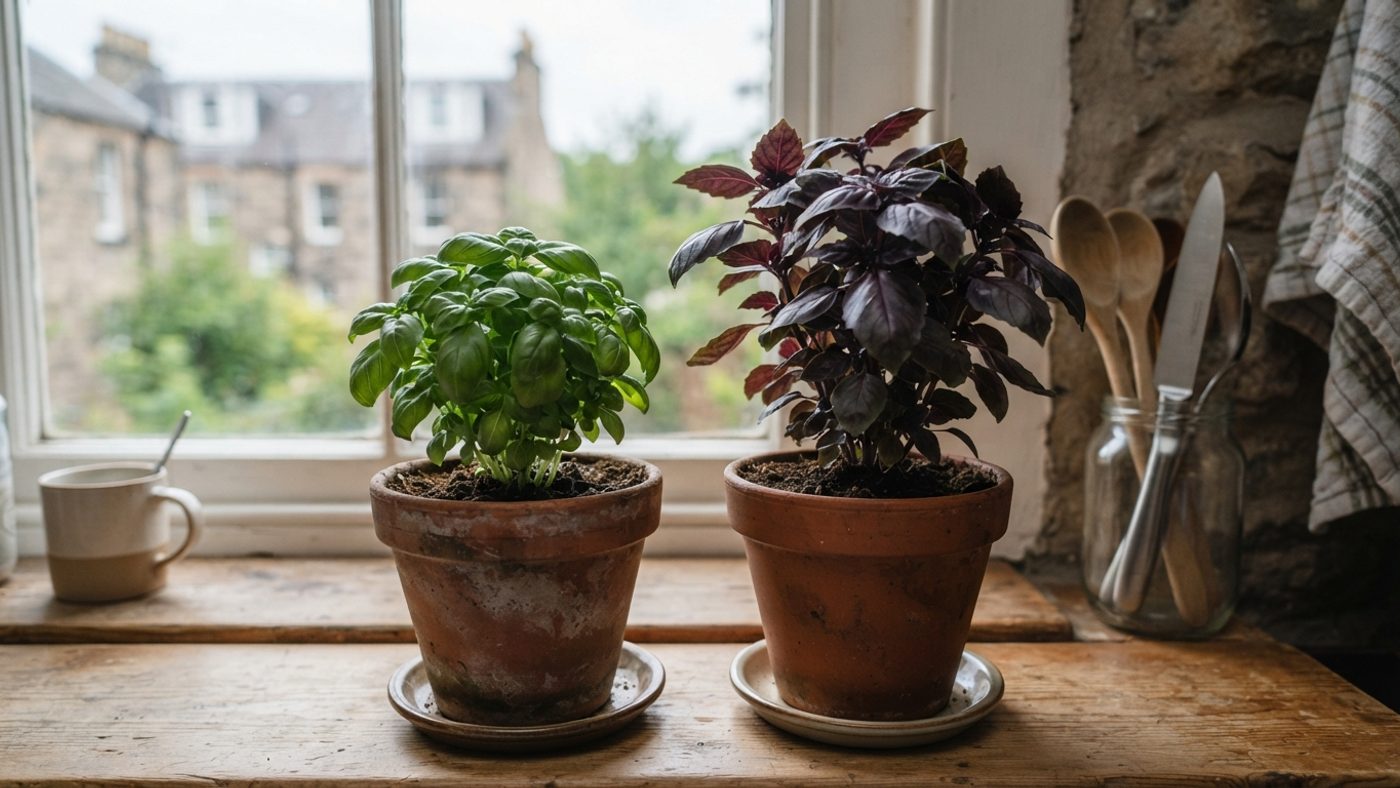
The five AGM varieties, checked one by one
Here's how the five compare, own page against general summary:
| Variety | AGM on own page | Habit / size | Best for a small pot? | Distinctive trait |
|---|---|---|---|---|
| Salvo | Not shown | Neat, upright, 0.1-0.5m | Yes, "best grown in a container" | Own page notes "disease and weather resistance" |
| Mrs Burns' Lemon | Shown | Tall, upright, 0.1-0.5m | No size figure beyond the generic range | Intensely lemon-scented leaves; flowers attract bees |
| Pluto | Shown | Compact dome, to about 20cm | Yes, the most container-shaped of the five | Small, even, bush-forming |
| Aroma 2 | Not shown | 50-60cm | Less so, wants a proper pot, not a narrow ledge | Slow to bolt; resists Fusarium disease per RHS's own trial write-up |
| Red-leaved ('Basilico Rosso') | Shown | 0.1-0.5m | Yes, listed for "patio and container plants" | Deep purple stems and leaves, purple-and-white flowers; ornamental as much as culinary |
All five carry the same H1C hardiness ratingThe RHS's H1a–H7 scale for how much cold a plant can survive outdoors, H1a being tender indoor-only and H7 hardy anywhere in the UK. Full definition →, tender, needs a minimum of 5-10°C, must come under cover before any frost or cold snap, so hardiness itself doesn't separate them the way it would for an outdoor crop. What separates the five varieties instead is habit, flavour, and, as it turns out, whether the AGM claim actually holds up on inspection.
Salvo and Aroma 2: listed as AGM, but not confirmed on their own pages
RHS's general growing guide names both Salvo and Aroma 2 in its "Recommended varieties" section with "AGM" attached directly to the variety name, and links through to what look like their own plant pages. Visiting those individual pages directly shows neither one displays an AGM badge or any Award of Garden Merit mention anywhere on the page itself. Salvo's own page describes it as "noted for its disease and weather resistance" with no AGM claim; Aroma 2's own page describes "some resistance to bolting and disease" and its H1C rating, again with no AGM shown.
A variety appearing on a crop's general AGM list without the badge showing on its own individual page isn't proof the award was withdrawn or never held, RHS's trial-and-awards section separately confirms Aroma 2 "was awarded the RHS Award of Garden Merit after the 2012 trial at RHS Garden Wisley," which is a genuine, dated confirmation from a different RHS page. But the variety's own current plant page, the page a shopper would actually land on, doesn't carry the badge, so it's worth knowing the two pages disagree before treating "AGM" as settled fact for either variety.
Mrs Burns' Lemon, Pluto and the red-leaved form: confirmed on both pages
The other three don't have that problem. Mrs Burns' Lemon, Pluto, and the red-leaved AGM form ('Basilico Rosso') all display the AGM badge directly on their own individual RHS pages, matching what the general page claims. For these three, the award isn't in question.
Which variety actually suits a windowsill or small pot
The "best for a small pot" column in the table above summarises it: Pluto is the clearest fit, a genuinely compact dome shape rather than a tall plant that goes leggyDescribes a plant that's grown tall, thin and sparse rather than bushy, usually from too little light or not being pinched out. Full definition → before you can harvest much. Salvo and the red-leaved form are also explicitly container-suited on their own pages. Aroma 2 wants a proper pot rather than a narrow windowsill ledge, and Mrs Burns' Lemon's own page gives no size figure more specific than RHS's generic species-wide range.
All five carry the identical H1C rating and "grow as an annual, indoors" instruction on their own pages, none is more cold-tolerant than another. Variety choice here is about shape and productivity in a pot, not about which one copes better with a cool Scottish summer, because none of them are being asked to.
Slow to bolt matters more here than it sounds
Aroma 2's "slow to bolt" trait, stated on RHS's own trial page as making the variety "productive for the longest possible season," is worth taking seriously in a Scottish context specifically because a Scottish basil season is already short and unpredictable. Once basil flowers, leaf production drops and flavour declines, the growing guide already covers pinching out flower buds as the main defence against that on any variety. A variety that's genuinely slower to bolt in the first place is one less thing to manage on a plant that's already working against a compressed, low-light growing window compared with basil grown somewhere genuinely warm.
Pests and diseases: what actually threatens basil under cover
Growing basil indoors or under glass in Scotland changes which pests matter. Outdoor pests specific to open ground barely come into it; the risks that do turn up are ones that thrive in the sheltered, humid conditions basil is grown in here.
All five varieties may be susceptible to aphids, slugs, snails, and leafhoppers per their own individual pages, plus powdery mildew as a disease risk. Gardener's World's own basil guide names an overlapping but not identical set: "protect plants from snails and slugs. Basil is also prone to attack by whitefly and red spider mite," adding that it "can also be susceptible to grey mould and powdery mildew, so ensure that plants grown in a greenhouse have good ventilation." Between the two sources, the practical list for a windowsill or greenhouse basil plant is aphids, whitefly, red spider mite, slugs and snails, and, as fungal risks specific to the sheltered, still air a windowsill or greenhouse creates, grey mould and powdery mildew, both worth managing with the same fix Gardener's World names directly: ventilation.
Soil pH: no figure published
No numeric soil pH figure for basil appears anywhere in the sources checked, general page, growing guide, or any of the five variety pages, a standard peat-freeCompost made without peat, which is harvested from a slow-forming, carbon-storing wetland habitat that peat extraction damages. Full definition → multi-purpose compost is the practical answer for a container-grown herb regardless.
A word on light, not just warmth
Every variety here is being compared on habit and flavour, but the constraint behind all of it, repeatedly, across RHS's greenhouse advice, Gardener's World's windowsill steer, and the compact-habit reasoning above, is limited light and warmth through a Scottish growing season, not just cold. None of the varieties compared claims better shade tolerance than another; RHS's own advice is a "sheltered position in full sun" across all five. Where a windowsill genuinely can't offer that (a north-facing kitchen, a dim Scottish autumn extension of the season), a small supplementary grow light is the practical fix growers commonly use rather than anything variety choice can solve, worth knowing as a general option, distinct from and outside anything RHS or Gardener's World states specifically about basil.
Beyond the AGM five: two more from Gardener's World
Gardener's World names several basil varieties beyond RHS's AGM list. Two are worth adding to a Scottish shortlist for reasons distinct from the five above:
'Crimson King' — described as "a British-bred, purple-leaved variety with uniform, 'cupped' leaves and greater vigour than other purple varieties." Bred in Britain specifically, and named as more vigorous than other purple types, which is a genuine edge for a variety that's already working against limited light and warmth here. It doesn't carry an AGM badge or appear on RHS's AGM list.
'Greek' — described as having smaller leaves with a "slightly sweeter, anise-clove flavour" and named as compact and suited to containers. A genuine third option alongside Pluto for anyone specifically choosing on pot size rather than flavour profile, though again, not an AGM holder.
Neither claim above appears on an RHS page, both are Gardener's World's own descriptions. Named varieties like these are typically raised from seed rather than bought as ready-grown plants, general garden centres mostly stock standard sweet Genovese basil as plugs, so seed is the more reliable route to any of the varieties covered here. One thing to know before saving your own seed: RHS's own page for Aroma 2 describes it as an F1 hybridThe first-generation offspring of two specific, deliberately chosen parent plants, bred for a predictable, uniform result but not worth saving seed from. Full definition →, so seed saved from it won't grow true to type the following year. None of the other four varieties' own pages state their F1 status either way, so treat home-saved seed from them as unconfirmed rather than assume it behaves the same as open-pollinated seed.
Which one for your situation
Windowsill pot, want the safest confirmed pick: Pluto. It's the only one of the five with both a genuinely compact, container-shaped habit stated on its own page and the AGM badge confirmed there too, with nothing to second-guess. The AGM itself is a general garden-performance award, not a container-suitability rating, so it's Pluto's own stated dome habit doing the real work here, the badge is a bonus, not the reason to choose it.
- Want a different flavour rather than the standard sweet taste: Mrs Burns' Lemon. AGM-confirmed on its own page, and a genuinely distinct lemon-scented leaf rather than a variation on the usual basil flavour, good in salads, fish dishes, and drinks as well as cooking.
- Growing under glass for as long a season as possible: Aroma 2. The slow-to-bolt trait and the RHS-confirmed Fusarium resistance are both real, sourced advantages for a plant that's already fighting a short Scottish window, worth choosing even though its AGM status isn't confirmed on its own current page.
- Want something more weather-resistant, still worth trying: Salvo. Its own page's "disease and weather resistance" note is a genuine, if vaguer, claim worth factoring in, with the same AGM caveat as Aroma 2.
- Patio pot where looks matter alongside the crop: the red-leaved form, 'Basilico Rosso'. AGM-confirmed on its own page, and the only one of the five grown as much for its deep purple colour as for cooking.
- Purple leaves with more vigour specifically: 'Crimson King', per Gardener's World, if the red-leaved AGM form's flavour or growth rate doesn't suit, not RHS-confirmed, but a genuine second purple-leaved option.
Whichever variety you pick, the growing guide covers the technique that actually determines how much you harvest regardless of variety: regular pinching out of the growing tips, prompt removal of flower buds, and watering to keep the compost evenly moist without waterlogging it.
Common questions
Does variety actually matter for basil in Scotland, or is it all about the windowsill?
The growing environment matters more than variety choice: basil needs a warm windowsill or greenhouse in cooler locations regardless of which variety you grow. But within that constraint, variety still decides pot shape and productivity: Pluto's compact dome habit genuinely suits a small windowsill pot better than a taller variety would, and Aroma 2's slower bolting genuinely extends a short season.
Are Salvo and Aroma 2 actually AGM varieties or not?
Real, but currently unconfirmed on the page you'd actually land on: RHS's general page and, for Aroma 2, a separate 2012 Wisley trial write-up both confirm the award, yet neither variety's own individual plant page shows the badge. Worth knowing before you buy on the strength of "AGM" alone.
Can I grow any of these varieties outdoors in Scotland?
In a genuinely warm, sheltered, south-facing spot in a good summer, you can try, but none of the five AGM varieties suits outdoor Scottish conditions better than another, all five carry the identical H1C hardiness rating and the same 'grow as an annual, indoors' instruction.
Do I need to worry about soil pH for basil?
No numeric pH figure for basil is published anywhere in the sources checked. A standard peat-free multi-purpose or seed compost is the practical answer for a container-grown crop like this.
Sources
9 sources, recorded with what each was used for
- How to grow Basil: Non-hardiness, 20C germination, 10C night threshold, greenhouse-for-cooler-locations advice, and the "Recommended varieties" list naming Salvo, Mrs Burns' Lemon, Pluto, Aroma 2 and the red-leaved form with AGM
- Ocimum basilicum 'Salvo': Hardiness (H1C), size, "disease and weather resistance" description; confirms no AGM badge shown — independently confirmed by the hub via direct WebFetch
- Ocimum basilicum 'Mrs Burns' Lemon': Lemon-scented leaf description, bee-attracting flowers, hardiness; confirms AGM badge shown
- Ocimum basilicum 'Pluto': Compact dome-shaped habit and size, pest susceptibility list, hardiness; confirms AGM badge shown
- Ocimum basilicum 'Aroma 2': Leaf description, "some resistance to bolting and disease," hardiness, size, F1 hybrid status; confirms no AGM badge shown — independently confirmed by the hub via direct WebFetch
- Ocimum basilicum, red-leaved: 'Basilico Rosso' synonym, deep purple stem/leaf/flower colour, hardiness, container suitability; confirms AGM badge shown
- Using award-winning plants in your garden — 10 award-winning herbs: Aroma 2's 2012 RHS Garden Wisley trial award, Fusarium disease resistance, slow-to-bolt trait
- Ocimum basilicum var. purpurascens 'Red Rubin': Confirms Red Rubin is a separate purple basil cultivarA plant variety that arose or was bred under cultivation and is kept true by deliberate propagation, rather than a naturally occurring wild species. Full definition → without an AGM badge, used for the FAQ distinction from the red-leaved AGM form
- How to grow Basil: Greenhouse/polytunnel/windowsill recommendation, pest list (slugs, snails, whitefly, red spider mite), disease list (grey mould, powdery mildew) with the ventilation fix, and the 'Crimson King' and 'Greek' variety descriptions