
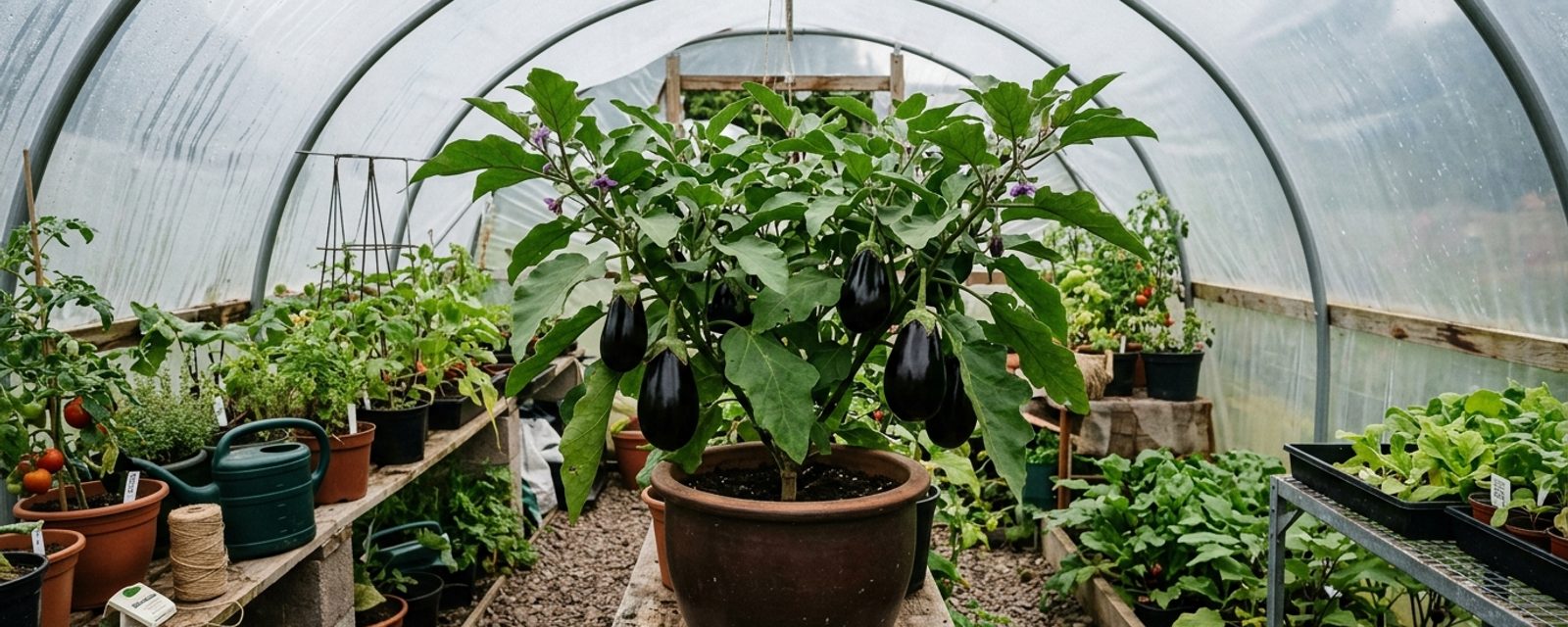
By late August, a lot of Scottish aubergine plants are still carrying fruit that's stalled somewhere between egg-sized and full, not diseased, not starved, just out of season left to run. Aubergines need a minimum of five months from sowing to harvest even in their best conditions, and a plant started in February with that clock only just closing by late July has almost no margin left if the summer's been cool or the variety wasn't suited to a cold start. Which variety goes in the ground does more work against that problem than almost anything else about how the crop is grown.
Quick answer
Bonica (AGMThe RHS's Award of Garden Merit: a UK-wide trials award for reliable performance, not a Scotland-specific recommendation. Full definition →) is the strongest all-round pick for an unheated Scottish greenhouse or polytunnel: early cropping, large glossy black fruit, and named as suited to exactly that setup. Where greenhouse or patio space is tight, Kaberi or Galine (both AGM, both compact, both bred for containers) or Fairy Tale (no AGM, but the narrowest footprint of any named variety) are the better fit. Skip Melanzana Violetta di Firenze unless the season's already running generously, its own plant page puts its harvest window starting later than every other variety here, working directly against the five-month problem this crop already has in Scotland.
Why variety choice matters more here than on most crops
A compact variety matters for a separate reason beyond earliness: most Scottish aubergines are grown under cover, where greenhouse or polytunnel space, not garden ground, is the real limit on how many plants fit. The aubergine growing guide covers the full sowing and care routine.
Fruit set matters just as much once flowers appear. A greenhouse kept closed against a cool Scottish summer means fewer pollinating insects get in, which is exactly when the fallback matters: opening vents on warm days to let insects reach the flowers, or hand-pollinating by tapping or shaking the flowers directly. Full technique is in the growing guide.
The four AGM varieties
Four aubergine varieties currently hold the Award of Garden Merit, Bonica, Kaberi, Galine and Clara. The AGM is a UK-wide award for garden performance, not a Scotland-specific recommendation, but each variety's own plant page gives real, checkable figures on habit and fruit that are worth comparing directly rather than treating all four as interchangeable.
| Variety | Height / spread | Fruit | Named trait |
|---|---|---|---|
| Bonica | 0.7m / 0.5m | Large, glossy black | Early cropping; named specifically for an unheated glasshouse |
| Kaberi | 0.5–1m / 0.5–1m | Egg-sized, dark purple | Compact, thornless, bred for containers; fast-maturing |
| Galine | 0.5–1m / 0.5–1m | Large-egg-sized, glossy purple | Compact, bred for containers |
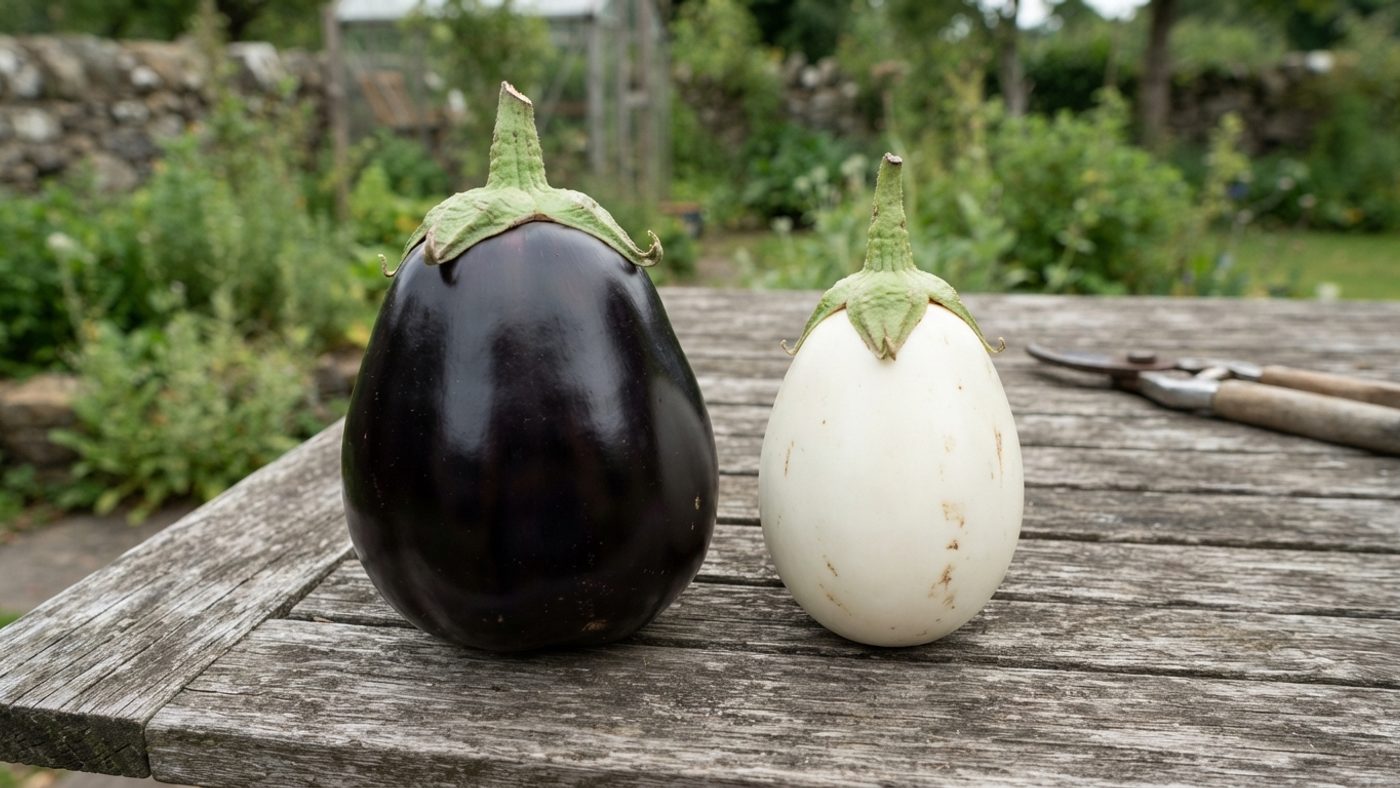
| Clara | 0.5–1m / 0.5–1m | Medium, oval, white skin and white flesh | The general summary page describes it as "matures early" |
Bonica and Kaberi cover the two ends of the season problem from different directions, Bonica by cropping early, Kaberi by combining a fast-maturing fruit with a footprint small enough for a container. Galine is essentially a second compact/container option alongside Kaberi, useful mainly for variety in fruit shape rather than any distinct trait of its own.
Clara specifically: the general summary page describes it as "matures early," in the same breath as Bonica and Kaberi. Clara's individual plant page gives no days-to-harvest figure beyond the generic "1 year" annual-vegetable boilerplate, and that exact same generic figure appears on Bonica's, Kaberi's and Galine's own individual pages too, so it provides no evidence Clara is actually faster than either already-established pick. What Clara's own page does confirm is a genuinely different fruit: medium, oval, and white-skinned with white flesh, against Bonica's large black fruit and Kaberi's dark purple egg shape. That's a real difference, but a culinary and visual one rather than a Scotland-relevant one, nothing on Clara's own page ties the white skin or oval shape to hardiness, earlier ripening, or any trait that helps against the season problem. Worth growing if the shape and colour genuinely matter to you; not a stronger choice than Bonica or Kaberi against Scotland's season specifically.
The five Gardener's World varieties
Gardener's World names five further aubergine varieties with no AGM and no overlap with the RHS list: Moneymaker, Fairy Tale, Little Fingers, Melanzana Violetta di Firenze and Asian Bride. None carry an AGM, but each has its own dedicated plant page with real height, spread and season-timing figures, compared directly below.
| Variety | Height / spread | Fruit | Harvest window |
|---|---|---|---|
| Moneymaker | 60cm / 30cm | Long, slender, matt purple | June–October |
| Fairy Tale | 75cm / 30cm | Slim, lavender with white stripes | June–October, early to mature |
| Little Fingers | 90cm / 30cm | Finger-sized | June–October |
| Asian Bride | 75cm / 30cm | Finger-sized, cream ripening to pink-purple | June–September |
| Melanzana Violetta di Firenze | 75cm / 30cm | Large, ribbed, oval | Late July–October |
The figure that stands out across the whole table is spread: every one of the five varieties has a 30cm spread on its own plant page, tighter than any of the four AGM picks (all 0.5m or wider). None of these five carry an award, but a genuinely narrower footprint is a real Scotland-relevant trait where greenhouse or polytunnel space is the limiting factor.
A few things worth knowing about specific varieties in this group:
- Fairy Tale is the standout on footprint even within this narrower group, described on its own page as compact and container-suited. Of everything in this whole comparison, it's the tightest realistic option for a small greenhouse staging area or a large patio pot.
- Little Fingers is worth a direct flag: its own plant page describes it as growing on "sturdy, compact plants" in the same paragraph that gives its height as the tallest in this entire comparison, taller than Bonica. "Compact" oversells the plant's own height figure; expect it to need the same vertical space as a full-sized variety, just in a narrower footprint.
- Moneymaker pairs early cropping with the same narrow spread as the others, which makes it a reasonable space-saving alternative to Bonica where the priority is fitting more plants into a limited greenhouse rather than the single largest possible fruit.
- Asian Bride finishes earliest of the whole set, a month shorter at the back end than Moneymaker, Fairy Tale or Little Fingers. For a crop already fighting to fit a five-month season into a Scottish summer, an earlier-finishing variety is arguably more useful than a "compact" label alone.
- Melanzana Violetta di Firenze is the one variety in this whole comparison worth actively avoiding unless the season's running long: its own plant page gives its harvest window starting later than every other named variety here. That's a real risk on top of a crop that already needs its full five months just to reach a normal-length harvest window, a late-starting variety narrows the margin further rather than working with it.
Grafted plants — an option beyond named varieties
Grafted aubergine plants are also documented: an aubergine top grown on a separate, more vigorous rootstockThe root system and lower stem a fruit tree is grafted onto, chosen to control the tree's eventual size rather than for its own fruit. Full definition →. Grafted vegetable plants generally have greater vigour and more resistance to soil-borne pests and diseases such as nematodes, and aubergines are among the crops graftingJoining a chosen fruiting variety onto a separate rootstock, so the tree grows the fruit of one plant on the roots of another. Full definition → suits. No specific cold-climate or Scotland claim is made for grafted aubergines by name, so this is worth treating as a genuine alternative route to a stronger plant rather than a substitute for choosing the right named variety above.
Which one for your situation
- Growing in an unheated greenhouse or polytunnel, want the safest all-round choice: Bonica.
- Greenhouse or patio space is genuinely tight: Kaberi or Galine (both AGM-backed and bred for containers), or Fairy Tale if you want the narrowest footprint available and don't need the AGM.
- Want to push the earliest possible finish to the season: Kaberi (fast-maturing, AGM) or Asian Bride (earliest-finishing harvest window of the whole comparison, no AGM).
- Fruit shape and colour matter to you as much as season fit: Clara, for its oval white fruit, just don't expect it to crop any faster than Bonica or Kaberi.
- Avoid unless your season is already running generously: Melanzana Violetta di Firenze, for the later-starting harvest window above.
Container growing and blossom end rot
Every compact variety above (Kaberi, Galine, and all five Gardener's World picks) is realistically a container candidate, which raises one connected risk worth naming: container-grown plants dry out faster and need daily watering in hot weather, and inconsistent watering is the named cause of blossom end rot on this crop. A compact variety's space-saving is real, but it comes with a genuinely higher watering-consistency demand than a variety grown straight in enriched ground soil. Red spider mite risk rises in the same dry conditions a container can create, alongside the usual under-cover risks of aphids and whitefly, the full detail on managing all four is in the growing guide.
Soil pH
No aubergine-specific soil pH figure is published by the sources this site draws on. Rather than invent one, this is stated plainly as a gap: grow in a moist, well-drained, fertile soil or container compost and don't assume a specific pH target matters more than that.
Common questions
Which aubergine variety should I grow in an unheated Scottish greenhouse?
Bonica. It's named specifically as suited to an unheated glasshouse and pairs that with early cropping, the trait that matters most against this crop's five-month season.
Is Clara worth choosing over Bonica or Kaberi?
Not for speed, its own plant page gives no evidence it's actually faster than either. Choose it for its oval, white-skinned fruit if that's what you want.
Are the Gardener's World varieties worse choices than the RHS AGM ones, since none carry an award?
Not automatically. None have been through RHS trials for the AGM, so there's no independent garden-merit confirmation for any of them, but their own plant pages give real, comparable figures, and several (Fairy Tale especially) have a genuinely narrower footprint than any AGM variety. The exception is Melanzana Violetta di Firenze, whose own later harvest window is a real reason to be cautious with it here, independent of the AGM question.
Can any aubergine variety actually mature outdoors in a Scottish garden, without a greenhouse?
It's a genuine stretch regardless of variety, the five-month sowing-to-harvest minimum and the need for the hottest, sunniest spot apply across all of the varieties in this comparison. An early-cropping or fast-maturing variety improves the odds; a greenhouse or polytunnel is still what makes the timeline realistic.
Sources
13 sources, recorded with what each was used for
- Aubergines: Grow Your Own: The four named AGM varieties and their summary descriptions, the five-month season requirement, the under-cover recommendation
- Solanum melongena 'Bonica': Height/spread, fruit description, hardiness
- Solanum melongena 'Kaberi': Height/spread, container-suited description, fruit description
- Solanum melongena 'Galine': Height/spread, AGM confirmation, fruit description
- Solanum melongena 'Clara': Height/spread, fruit description (oval, white skin and flesh), and the generic '1 year' maturity figure
- How to Grow Aubergines: The five named non-AGM varieties as a set, spacing figure
- Solanum melongena 'Fairy Tale': Height/spread, compact/container description, early maturity
- Solanum melongena 'Little Fingers': Height/spread, fruit description, "sturdy, compact plants" description
- Solanum melongena 'Moneymaker': Height/spread, fruit description, harvest window
- Solanum melongena 'Asian Bride': Height/spread, fruit description, harvest window
- Solanum melongena 'Melanzana Violetta di Firenze': Height/spread, fruit description, harvest window
- Grafting Vegetables: General grafted-vegetable vigour and disease-resistance claims, confirmation aubergines are among the crops grafting suits
- Aubergines – Greenhouse Salad Crops: GerminationA seed sprouting: breaking dormancy and putting out its first root and shoot, given the right warmth and moisture. Full definition → temperature, pinch-height and storage detail, no pH or variety-specific figures given