
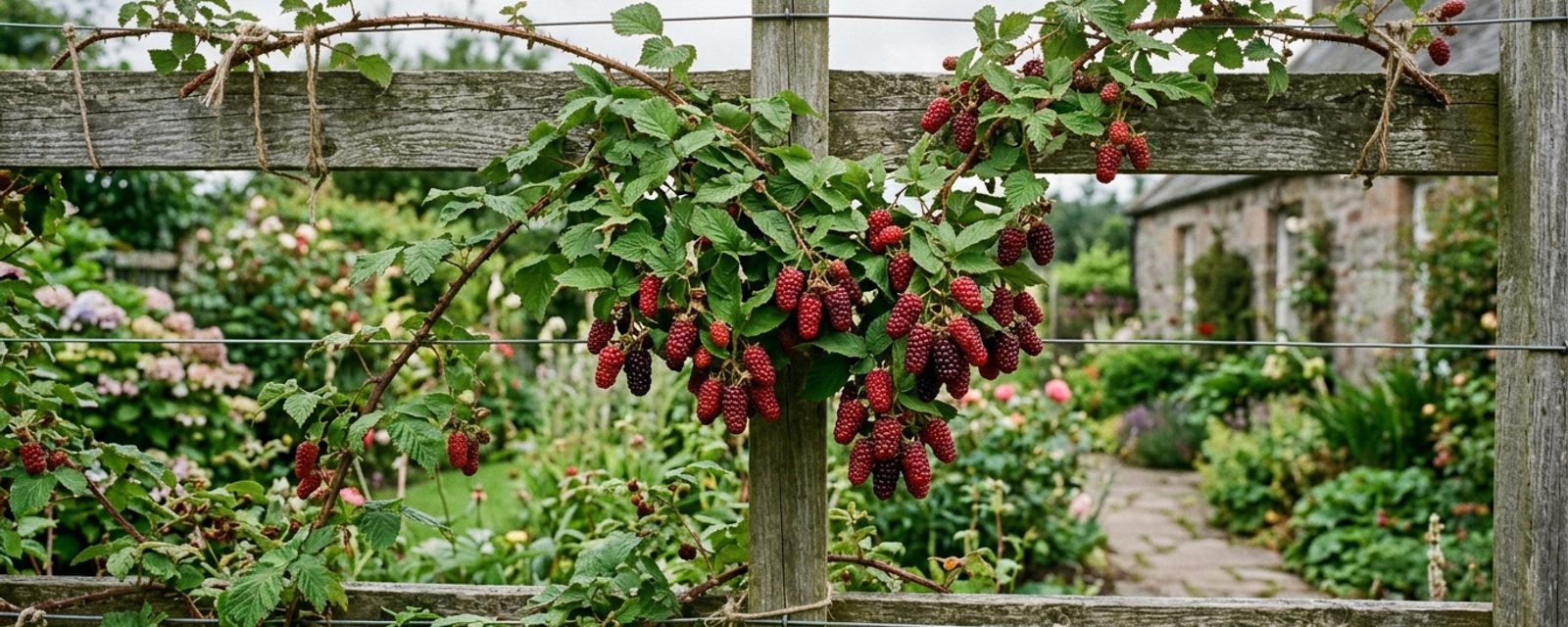
A loganberry is what happens when a raspberry and a blackberry cross into a single plant: the elongated, conical shape and the crumbly, seedy structure come from the blackberry side, while the deep red-to-purple colour and the tart-sweet flavour come from the raspberry side. It wasn't engineered in a lab; it was found growing in an American garden in the 1880s, by an amateur breeder named James Harvey Logan, who gave it his own name. That single accidental cross is the ancestor of every loganberry sold today, which is why the naming is so simple: the original hybrid itself, sold as the standard or species loganberry, plus just two selected forms bred from it since, 'Ly 59' and 'Ly 654'.
Quick answer
For most Scottish gardens, the standard loganberry is the best overall pick: its H7The RHS's H1a–H7 scale for how much cold a plant can survive outdoors, H1a being tender indoor-only and H7 hardy anywhere in the UK. Full definition → hardiness gives it a margin the other two don't have on an exposed or inland site, at no cost to fruit quality. Choose 'Ly 654' instead if the garden is small and sheltered and thorns are a genuine nuisance; it's thornless, at the cost of two hardiness bands. There's no situation where 'Ly 59' beats the standard variety, since it carries the same lower hardiness as 'Ly 654' without the thornless trade-off.
Why there are only three names to choose between
Loganberry has never been bred into the range of named cultivarsA plant variety that arose or was bred under cultivation and is kept true by deliberate propagation, rather than a naturally occurring wild species. Full definition → that raspberries or strawberries have. The standard hybrid and its two registered selections, 'Ly 59' and 'Ly 654', are the entire set with any real horticultural documentation: this comparison covers all three, not a shortlist pulled from a longer one.
Head-to-head: the three cultivars
Hardiness ratings run from H1 (needs heat indoors) to H7 (survives the severest continental winters, below -20°C); H5 covers most UK winters, down to about -15 to -10°C. The RHS Award of Garden Merit (AGMThe RHS's Award of Garden Merit: a UK-wide trials award for reliable performance, not a Scotland-specific recommendation. Full definition →) is a UK-wide mark, not a Scotland-specific recommendation.
| Cultivar | Hardiness | Size at maturity | Thorns | AGM | Vigour |
|---|---|---|---|---|---|
| Loganberry (standard) | H7 | 1.5–2.5m height and spread | Thorny | No | Standard |
| 'Ly 59' | H5 | Similar to the standard variety | Thorny | No | Moderately vigorous |
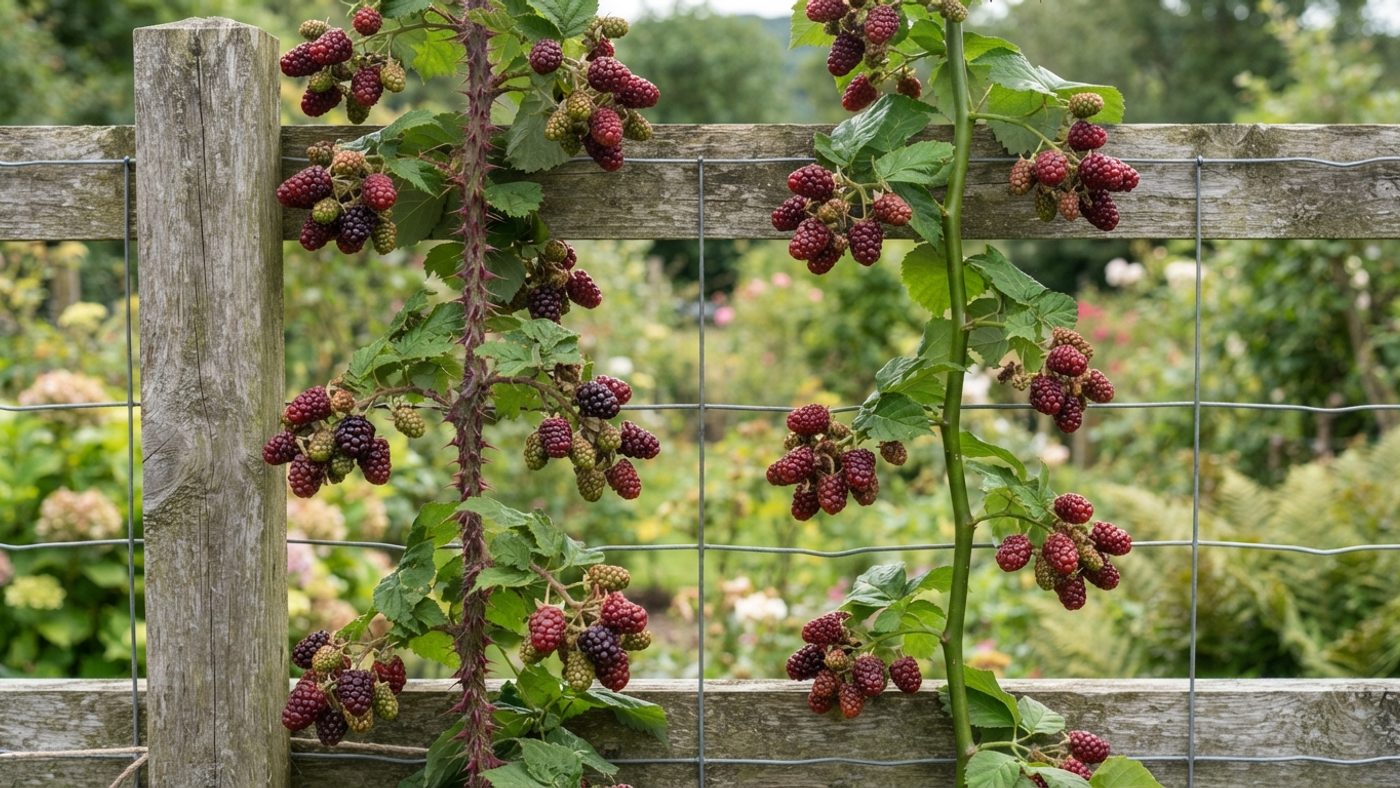
| 'Ly 654' | H5 | Similar, but less vigorous overall | Thornless | Yes | Less vigorous than 'Ly 59' |
All three want a sheltered, wind-protected aspect; the training and support they need once planted is identical regardless of which one goes in the ground, and the full growing guide covers that setup in detail. The hardiness band is a starting point, not the whole picture: an upland or inland garden runs colder than the coast, and even neighbouring towns can differ by a frost date or two (see the frost dates page for the regional detail).
Waterlogging matters more than the hardiness figures suggest for a bramble like this. Planting advice for the group is to avoid ground that's likely to sit wet over winter, often a bigger threat to the roots than the cold itself, raise the bed or improve drainage first if the site is heavy clay, whatever hardiness band the chosen cultivar carries.
Which one for your actual site
| Your situation | Pick |
|---|---|
| Exposed, inland, or a frost-pocket site | Standard variety (H7) |
| Small, sheltered garden, thorns a real nuisance | 'Ly 654' (thornless, H5) |
| Choosing only between 'Ly 654' and 'Ly 59' | 'Ly 654', same H5 rating as 'Ly 59', without the thorns |
Soil pH
All three cultivars tolerate acid, alkaline, or neutral soil, with no numeric pH range published for the crop. Match general fruit-growing practice: a well-drained, fertile soil in the neutral range, rather than a specific target figure.
How many plants does a household actually need
A single loganberry plant, once established, produces a genuinely heavy crop over its July-to-September window, one plant is usually enough for a household eating the fruit fresh, in crumbles, or in small batches of jam. Two plants make sense mainly if you want a longer succession of picking, want to freeze a meaningful quantity for the rest of the year, or are training the canes as a screen or hedge rather than growing purely for fruit, since the plants are commonly used that way. Space is the practical limit either way: canes need 2.5–3.5m between plants (a bit less for 'Ly 654', given its lower vigour), on top of the 1.5–2.5m the plant itself spreads to at maturity, so most domestic gardens don't have room to justify more than two.
Buying stock: expect to plan ahead, not browse a shelf
Loganberries are a specialist fruit. The fruit itself is rarely sold fresh in shops, since it's hard to harvest by machine and doesn't keep long once picked, so it isn't commercially viable at scale; the plants themselves also tend to sit with specialist fruit nurseries rather than general garden centres. Bare-rootA plant, usually a fruit tree or hedging, sold with its roots exposed rather than in a pot, and only available while dormant. Full definition → canes are sold dormant, November to March, which is also the best planting window; ordering ahead for that window is more reliable than expecting to find potted canes on a shelf in spring. If a nursery only lists "loganberry" with no cultivar name attached, it's very likely the standard variety, since 'Ly 654' in particular tends to be named explicitly when a supplier carries it, given its AGM.
Storage and freshness after picking
None of the three cultivars ripen further once picked, so timing the harvest with the tug-test (a ripe berry pulls cleanly away from its white central core) matters more than it would for a fruit that continues to ripen in the bowl. Picked fruit keeps for several days refrigerated, unwashed, spread in a single layer to avoid crushing. For anything beyond that, loganberries freeze well: open-freeze the berries spread out on a tray or dish so they don't clump, then transfer to a bag or box, where they'll keep for up to two months. This is the practical case for growing your own rather than relying on ever finding loganberries in a shop.
Common problems to watch for
Aphids, raspberry beetle, grey mould, birds, and, rarely, honey fungus are the problems that turn up across the combined guide for the group and the individual cultivar pages. Grey mould thrives in the same wet conditions that make winter drainage worth getting right in the first place, so good airflow from correct training pays off against both. Raspberry viruses and two named mites, raspberry leaf and bud mite and red berry mite, are also listed against the wider blackberry-and-hybrid-berry group; buy certified virus-free stock as the main defence against the first, since there's no cure once a plant is infected.
Common questions
How many loganberry plants do I actually need for a household?
One plant is usually enough for fresh eating and occasional baking, since a mature plant carries a heavy crop over its full July-to-September window; go to two only if you want a longer picking season or enough fruit to freeze in bulk.
Why can't I just buy loganberries at the supermarket instead of growing them?
They're hard to harvest by machine and have a short shelf life once picked, which makes them commercially impractical at scale, so growing your own is close to the only reliable way to eat them fresh.
Do I need to order loganberry canes in advance, or can I just buy one at a garden centre?
Plan ahead. With only three named cultivars in circulation, stock tends to sit with specialist fruit nurseries rather than general garden centres, and bare-root canes are sold in their dormant window, November to March, the same window you'll want to plant in.
Can I freeze a loganberry glut, and how long does it keep?
Yes. Open-freeze the berries spread out on a tray so they don't clump, then bag or box them; they'll keep for up to two months. Fresh, unwashed fruit in the fridge keeps for several days in a single layer.
What soil pH should I aim for?
RHS lists all three cultivars as tolerant of acid, alkaline, and neutral soil without giving a numeric range, so aim for a well-drained, reasonably fertile soil around neutral.
Sources
5 sources, recorded with what each was used for
- Rubus × loganobaccus (standard loganberry): Hardiness, AGM status, size, soil/aspect tolerance, disease susceptibility for the standard variety
- Rubus × loganobaccus 'Ly 59': Hardiness, thorn habit, vigour, soil/aspect for 'Ly 59'
- Rubus × loganobaccus 'Ly 654': Hardiness, AGM, thornless habit, vigour comparison for 'Ly 654'
- RHS: Blackberries and hybrid berries, grow your own: Spacing, planting, pruning, pests, container growing, and the AGM variety list for the wider group
- Gardener's World: How to grow loganberries: Origin/history, ripeness test, harvest window, storage and freezing, commercial scarcity, birds as a pest