
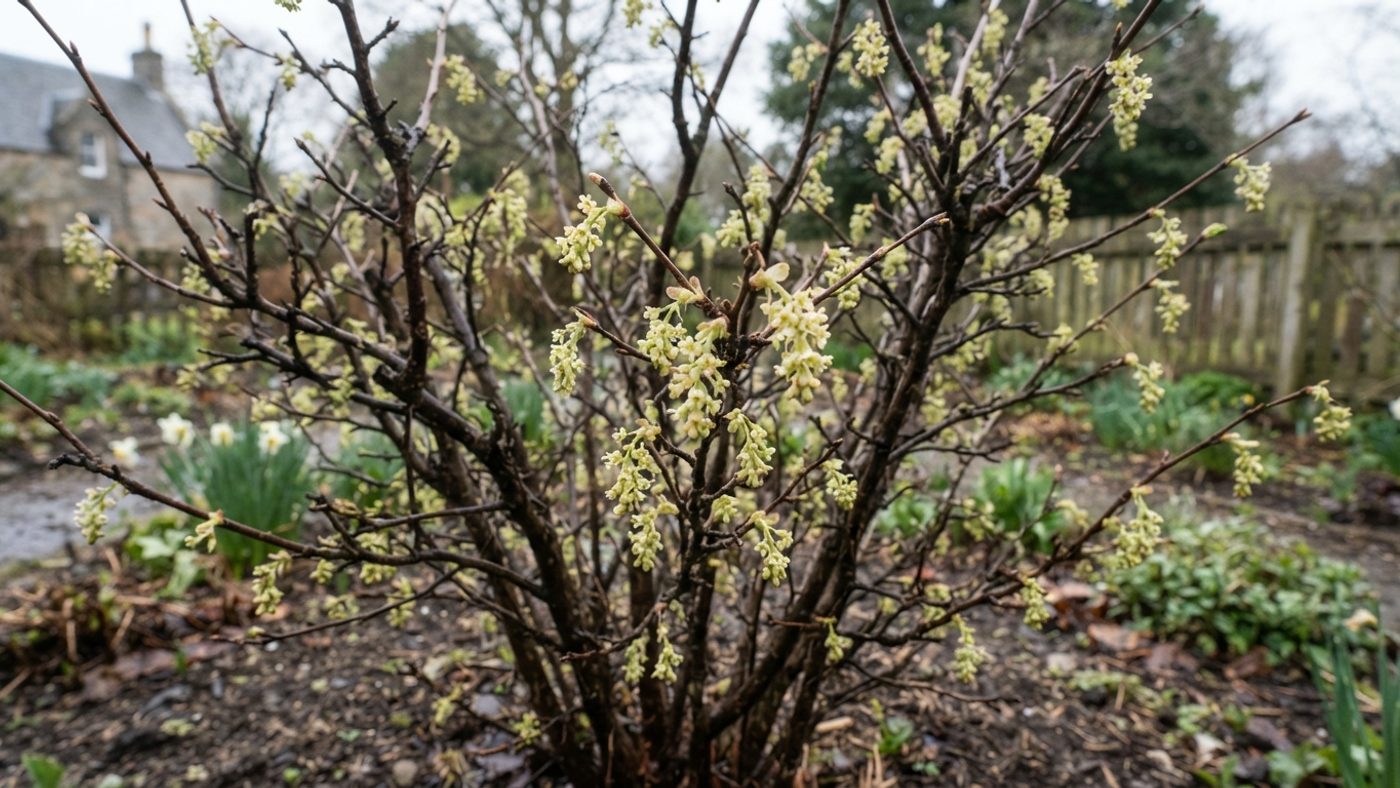
A blackcurrant flower opens on a bare stem in April, weeks before the leaves have fully unfurled, with nothing but its own petals between it and a late frost. If that frost bites, the flower dies and the fruit that would have hung from it in July never forms, one cold night can take a season's harvest before it's even started. That single vulnerable moment is the reason blackcurrant breeders spend decades chasing one trait above almost any other: a flower that opens later, once the risk has mostly passed.
Quick answer
For most Scottish gardens, Ben Connan is the strongest all-rounder: compact, holds the Award of Garden Merit, mildew-resistant, and bred to flower later than older varieties. If your site is genuinely frost-prone, a hollow, an east-facing slope, an upland garden, Ben Tirran carries the strongest late-flowering pedigree of any blackcurrant bred in Scotland, though it has no AGMThe RHS's Award of Garden Merit: a UK-wide trials award for reliable performance, not a Scotland-specific recommendation. Full definition → and needs seeking out from a specialist fruit nursery. If gall mite or reversion virus has been a problem locally, Ben Hope and Ben Gairn are the disease-resistance specialists, even though neither has confirmed AGM status.
Why this variety list needed a second look
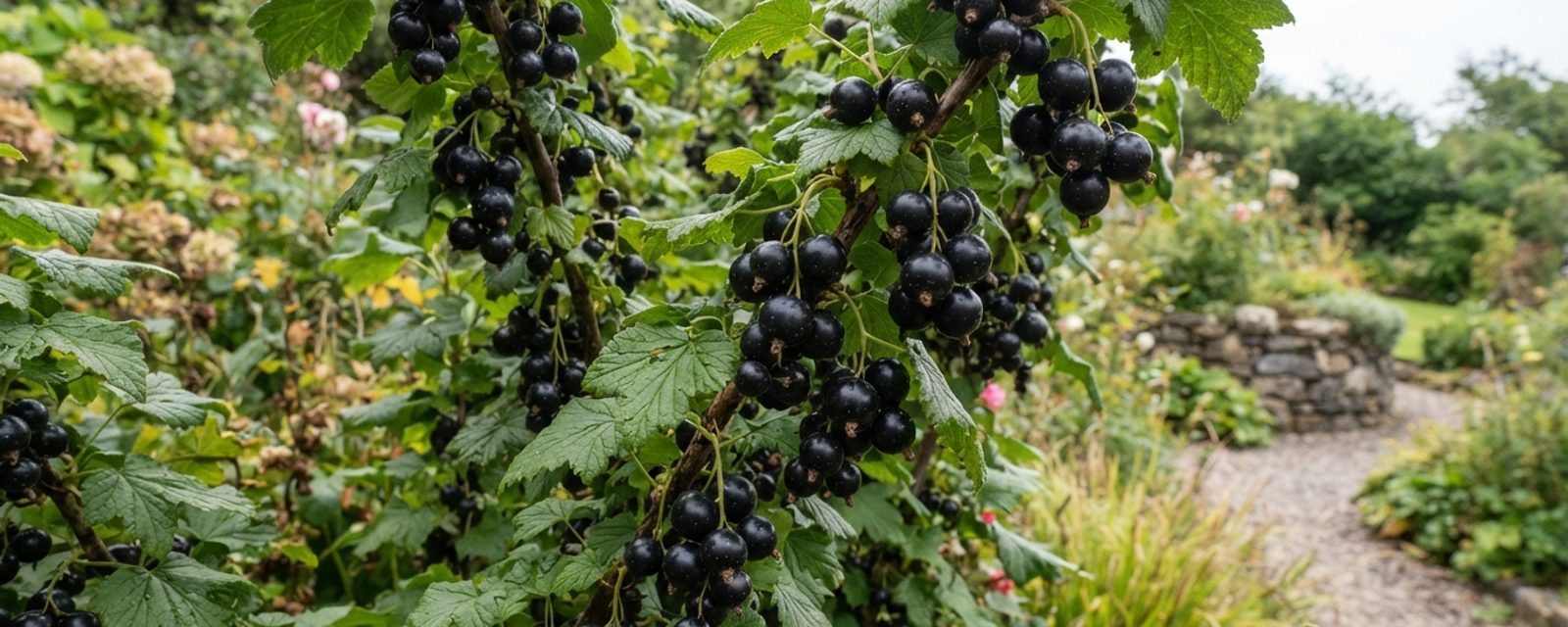
Blackcurrants already get unusually thorough coverage on this site: the growing guide profiles five varieties, Ben Connan, Ben Hope, Ben Gairn, Big Ben and Ben Sarek, and four of those carry direct Hutton breeding citations tracing back to the James Hutton Institute in Dundee, which has run the UK's blackcurrant breeding programme since the 1950s. But two things were left open. First, Ben Hope and Ben Gairn's Award of Garden Merit status was unresolved, absent from the data, but never actually confirmed either way. Second, and more interesting: modern blackcurrant varieties are bred to flower later, specifically because that suits cold locations, but nothing named which variety, in absolute terms, actually delivers on that. The second question turns up a sixth variety, new to this site, that answers the frost question better than any of the five already covered.
AGM status, resolved
Neither Ben Hope nor Ben Gairn holds the Award of Garden Merit. Each variety's own plant page carries no AGM badge, the general blackcurrant growing page doesn't break the award down by cultivarA plant variety that arose or was bred under cultivation and is kept true by deliberate propagation, rather than a naturally occurring wild species. Full definition →, so this only shows up per-variety. Some blackcurrants do carry AGM, Ben Connan and Big Ben both do, so the absence on Ben Hope and Ben Gairn is a real result, not an unchecked gap. Both remain genuinely good varieties for the disease-resistance traits they were bred for: an AGM measures wider UK garden merit across several trial seasons, and a variety without one can still be the right choice for a narrower, specific reason, which is the case for both of these.
One flag worth stating plainly rather than quietly fixing: this site's own blackcurrant growing guide previously listed Ben Sarek as an AGM variety, but Ben Sarek's own plant page carries no AGM badge or mention, checked directly, including a full search of the page text for "AGM" and "Award of Garden Merit," neither present. That guide has now been corrected.
Named varieties compared
| Variety | AGM | Season | Standout trait | Where it struggles |
|---|---|---|---|---|
| Ben Connan | Yes | Early | Compact, heavy-cropping, resistant to mildew and leaf spot | No specific frost data beyond the general "modern variety" claim |
| Big Ben | Yes | Early | Very large fruit on a compact plant, one of the named later-flowering examples | Not bred for a specific disease resistance the way Ben Hope or Ben Gairn are |
| Ben Sarek | No | Mid | Compact, good for containers, resistant to powdery mildew | No AGM despite wide availability; no stated frost/flowering advantage |
| Ben Hope | No | Late | Strong resistance to gall mite (the Ce gene), the insect that spreads reversion virus | No AGM; no specific flowering month stated |
| Ben Gairn | No | Early | Bred specifically for reversion-virus resistance | Early-flowering, so it does not carry the frost-avoidance trait a "modern variety" label might suggest |
| Ben Tirran | No | Late | Hutton's breeding programme names this cultivar the "highest expression" of its late-flowering, frost-avoidance breeding line | Released 1990; less widely stocked than the newer Ben series |
Ben Gairn's own plant page describes it as "early-flowering and ripening," which sits at odds with any assumption that being a Hutton-bred modern variety automatically means later flowering. Reversion-virus resistance is Ben Gairn's real, sourced strength, frost avoidance isn't part of its case.
The late-flowering story actually has a named answer — just not among the five already covered
What none of the five varieties above carries is a claim in absolute terms rather than only relative to another cultivar.
The James Hutton Institute's blackcurrant breeding programme states the answer directly. Its early objective was "to produce improved germplasm with cold tolerance, especially in the spring... and fungal disease resistance," pursued specifically "by the introduction of a late-flowering character into many of... [Hutton's] varieties, reaching its highest expression in 'Ben Tirran' released in 1990." Ben Tirran flowers late and is "less susceptible to frost damage" as a direct result, a real, purchasable garden plant, not a commercial-only variety: working nursery suppliers stock it, and it turns up at ordinary specialist fruit nurseries.
That's a genuine, absolute frost-avoidance claim, backed on both the breeding rationale and the garden-facing trait, but it belongs to Ben Tirran, a variety this site hadn't previously covered, not to any of Ben Connan, Ben Hope, Ben Gairn, Big Ben or Ben Sarek. Those five are still real, and four are still Hutton-provenanced. Ben Connan and Big Ben are both named on the general growing page as examples of the "flower later" generation, but neither variety's individual plant page states an actual flowering month or a frost-escape claim the way Ben Tirran's does. Worth being precise about what's proven and what isn't: pushing flowering later than Ben Tirran's point starts costing yield, per Hutton's own breeding page, which is also why the programme's recent focus has shifted toward low-chill tolerance for milder winters rather than pushing later flowering further. Provenance and a named trait are two different things, and this is one case where the trait itself, not just the Scottish breeding story, is directly sourced for a specific variety.
For contrast: Baldwin, an older commercial blackcurrant variety still grown in some gardens, is noted as susceptible to both mildew and frost, the exact combination the newer Hutton varieties were bred to move away from, and a useful reminder that "blackcurrant bush" doesn't automatically mean frost-resistant.
Disease resistance as the other real decision point
Where a garden's real risk isn't frost but disease, the choice runs differently. Big bud mite is the vector for reversion virus, the most damaging blackcurrant disease and one with no cure, infected bushes have to be removed. Ben Hope's Ce gene gives it real resistance to the mite itself, which matters because it interrupts the route the virus spreads by, not just the symptom. Ben Gairn takes the opposite angle: it was bred for direct resistance to reversion virus rather than resistance to the mite that carries it. Where powdery mildew or currant and gooseberry leaf spot are the recurring problem instead, Ben Connan's resistance to both is the more relevant trait, and pruning for an open bush with good airflow helps every variety regardless of its bred-in resistance.
Currant aphids distort and blister leaves but, unlike aphids more broadly, don't spread plant viruses themselves, tolerable on most varieties. Birds will take a crop from any variety equally; netting is the only real answer, not a trait any cultivar carries.
Soil pH
No specific pH figure is published for blackcurrants. The only stated guidance is that they "will cope in most other soil conditions" beyond their preference for moist, well-drained ground, broad enough that this site categorises blackcurrant pH tolerance as simply "tolerant" rather than citing a numeric range, since no source gives one to cite.
Which one for your situation
- Most gardens, no specific problem to solve: Ben Connan. Compact, AGM, resistant to the two most common fungal problems, and an early cropper.
- Frost-prone site, a hollow, an east-facing slope, an upland garden, or anywhere the region's last frost date in this site's frost dates guide runs late: Ben Tirran, for the strongest sourced late-flowering claim of any blackcurrant with real Scottish breeding provenance, accepting that it has no AGM and needs ordering from a specialist fruit nursery rather than a general garden centre.
- Gall mite or reversion virus has been a problem locally: Ben Hope (mite resistance) or Ben Gairn (direct virus resistance), both without AGM, but both bred specifically to solve this.
- Very small garden or a container: Ben Sarek or Ben Gairn, the two most compact varieties in this list.
Full planting, pruning, and pest management detail is in the blackcurrant growing guide, this piece is only about choosing which one to plant.
Common questions
Do any blackcurrant varieties actually hold the Award of Garden Merit?
Yes, Ben Connan and Big Ben both do, confirmed on each variety's own plant page. Ben Hope and Ben Gairn do not, despite both being genuine Hutton-bred varieties with real disease-resistance traits. Ben Sarek doesn't either, despite being described as an AGM variety elsewhere on this site, see the AGM section above.
Which blackcurrant variety is most frost-resistant for a cold Scottish garden?
Ben Tirran carries the clearest sourced claim: the James Hutton Institute's own breeding page names it as the strongest expression of its late-flowering, frost-avoidance breeding line, and its plant page confirms it flowers late enough to usually escape spring frost. It isn't currently sold as widely as the newer Ben Connan or Big Ben, so it may need ordering from a specialist fruit nursery.
Is Ben Gairn a late-flowering variety, like Ben Hope?
No. Ben Gairn's own plant page describes it as early-flowering. Its real strength is resistance to reversion virus, not frost avoidance, don't choose it expecting a late-flowering trait it doesn't carry.
Can I grow more than one variety to spread the harvest and cut frost risk?
Yes, and it's a reasonable way to hedge both timing and weather risk in one move. Ben Gairn and Ben Sarek ripen early; Ben Hope and Ben Tirran run later. Pairing an early and a late variety spreads picking across more of the midsummer-to-August harvest window instead of one heavy crop all at once, and because early- and late-flowering varieties aren't hit by the same frost night, a single cold snap is less likely to wipe out both at once.
Sources
9 sources, recorded with what each was used for
- How to Grow Blackcurrants: General cultivation, the "modern varieties bred to flower later" claim and which named varieties it attaches to, AGM listing for Ben Connan/Big Ben, uniform-ripening trait
- Ribes 'Ben Hope' (B): Confirms no AGM shown on its own page; late-season ripening; no specific flowering month stated; disease susceptibility list
- Ribes nigrum 'Ben Gairn' (B): Confirms no AGM shown on its own page; states "early-flowering and ripening"; reversion-virus resistance and foliar disease resistance; H6The RHS's H1a–H7 scale for how much cold a plant can survive outdoors, H1a being tender indoor-only and H7 hardy anywhere in the UK. Full definition → hardiness
- Ribes nigrum 'Ben Sarek' (B): Confirms no AGM shown on its own page; powdery mildew resistance; H6 hardiness
- Ribes nigrum 'Big Ben' PBR (B): Confirms AGM badge present; H6 hardiness
- Ribes nigrum 'Ben Connan' (B): Confirms AGM
- Ribes nigrum 'Ben Tirran' (B): No AGM shown; late-flowering, "less susceptible to frost damage" as a direct result; H6 hardiness; self-fertileA plant that can set fruit using its own pollen, without needing a second, different variety nearby to cross-pollinate it. Full definition →; ripens late July/early August
- James Hutton Institute — Blackcurrant Breeding Programme: States the programme's original objective, that this was achieved through introducing a late-flowering character reaching its highest expression in Ben Tirran, and that further delays beyond that point cost yield
- How to Grow Blackcurrants (Gardener's World): Named Baldwin as an older commercial variety susceptible to mildew and frosts, used here as a direct contrast to the newer Hutton-bred varieties