
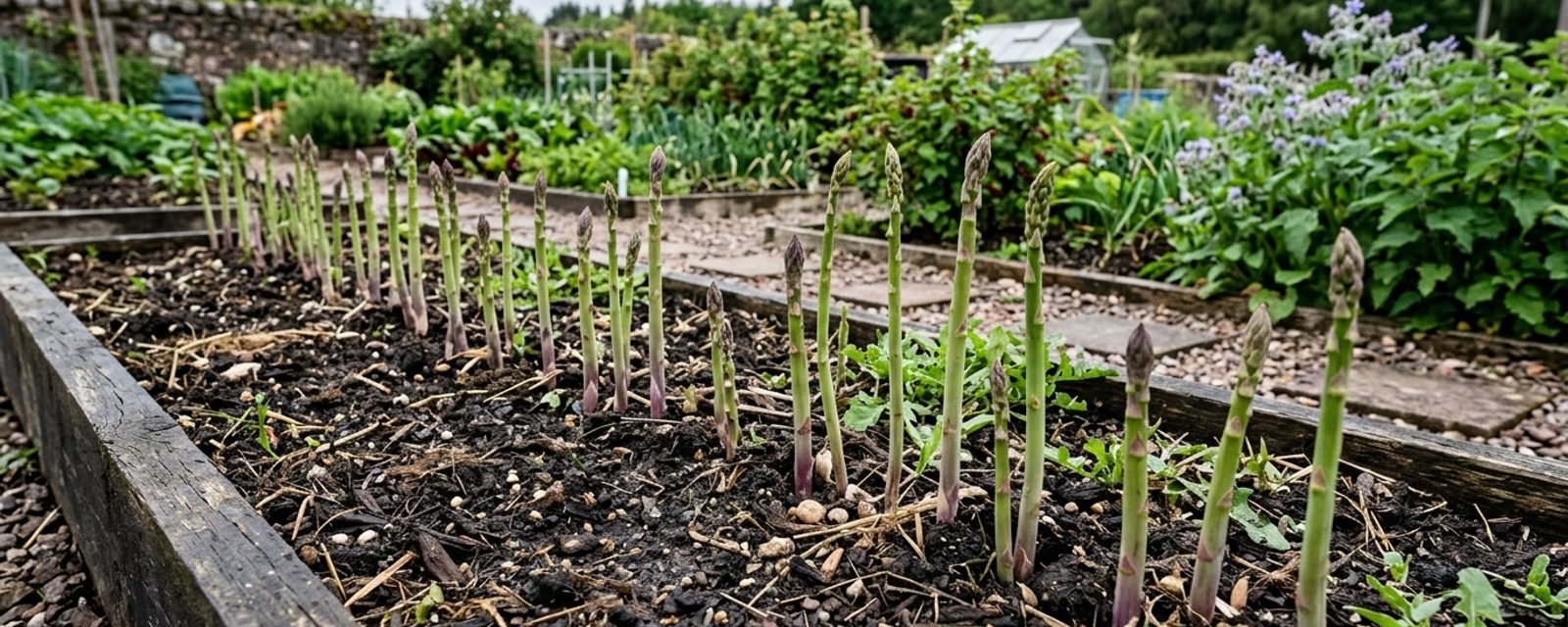
Asparagus is one of the only vegetables grown as a genuine long-term perennial in a Scottish garden, a bed planted this year can still be cropping in fifteen to twenty years' time. That timescale changes what "variety choice" means: this isn't picking a tomato for one season, it's choosing what a fixed patch of ground will produce for the next two decades. The single biggest lever on how much it produces isn't soil or feeding, it's sex. Asparagus plants are either male or female, and female plants spend a chunk of their season's energy setting berries and self-seeding rather than building spear crownsThe base of a perennial plant where roots and shoots meet, often sold and planted as a ready-made dormant plant rather than grown from seed. Full definition →, and the resulting seedlings turn into a weedy mess between the rows. All-male varieties, bred specifically to remove that drain, are why modern asparagus breeding has become mostly a question of which all-male cultivarA plant variety that arose or was bred under cultivation and is kept true by deliberate propagation, rather than a naturally occurring wild species. Full definition → to grow rather than whether to grow one at all.
Quick answer
Gijnlim remains the strongest all-round pick for Scotland: all-male, holds the Award of Garden Merit (AGMThe RHS's Award of Garden Merit: a UK-wide trials award for reliable performance, not a Scotland-specific recommendation. Full definition →), and the earliest into crop on a short season. Where hardiness matters more than earliness, an exposed or upland site, Pacific 2000 and Mondeo are worth serious consideration, both rated H5 (hardy through severe UK winters) against Gijnlim's H4The RHS's H1a–H7 scale for how much cold a plant can survive outdoors, H1a being tender indoor-only and H7 hardy anywhere in the UK. Full definition →, with Mondeo offering disease resistance without an AGM and Pacific 2000 disputed between two RHS pages over whether it's genuinely all-male.
What actually separates these varieties
Cold hardiness is the factor most worth weighing on an exposed or upland Scottish site: winter lows that some varieties are rated to survive, others aren't, and that's a real, measurable difference on the standard hardiness scale, H4 (hardy through most of the UK, down to -5°C) against H5 (hardy through severe winters, down to -15°C), not a marginal one.
Soil drainage adds to that. Asparagus growth is restricted below pH 5.9, and root rot follows damp, poorly drained soil, so a site that holds water needs raising into a bed or improving before planting rather than after, a bed is in the ground for up to twenty years, and that's not a mistake worth living with.
All of the varieties below are planted the same way, as dormant one-year-old crowns rather than seed, in March, with crowns settled into a mounded trench about 20cm deep. Spacing, soil prep and harvest technique are covered in the full growing guide, which this piece doesn't repeat.
The varieties compared
| Variety | Sex | AGM | Hardiness | Notable |
|---|---|---|---|---|
| Gijnlim | All-male | Yes | H4 (-10 to -5°C) | Earliest cropping window; current top all-rounder |
| Guelph Millennium | All-male | Disputed, see below | H5 (-15 to -10°C) | Very vigorousHow much a fruit tree's rootstock limits or allows its eventual size, from extremely dwarfing (smallest) through to very vigorous (largest). Full definition →, abundant harvests; Canadian-bred |
| Connover's Colossal | Sets seed (heritage) | Yes | H4 (-10 to -5°C) | Exceptionally large crop; needs seedling weeding |
| Pacific 2000 | Disputed, see below | No | H5 (-15 to -10°C) | Own RHS page contradicts the general page on sex |
| Mondeo | All-male | No | H5 (-15 to -10°C) | "Highly resistant to disease"; prefers sheltered, south-facing spot |
| Backlim | All-male | Yes | H4 (-10 to -5°C) | Duplicates Gijnlim's all-male trait later in the season, no hardiness gain |
| Vittorio | Not stated | No | Not stated | Only variety here producing white asparagus (earthed up) |
Jersey Knight isn't in the table above: there's no cultivation data on it beyond basic taxonomy, and the only trait description found, "a very heavy cropper with good disease resistance," is a single, unverified line.
Best overall: Gijnlim
Gijnlim stays the strongest default choice for a Scottish garden. It combines the all-male productivity advantage with the earliest cropping window of any variety here, useful on a crop whose harvest window is fixed and short regardless of variety, and it carries an AGM. Its H4 hardiness rating covers most of the country, though not the most exposed sites.
Best for an exposed or upland site: Pacific 2000 or Mondeo
Both Pacific 2000 and Mondeo are rated H5, hardy through severe UK winters, a step up from Gijnlim, Backlim and Connover's Colossal, which are all H4 only. That difference is worth real weight on an exposed or upland Scottish plot.
Pacific 2000 has no AGM, but its case is stronger than that alone suggests. The general grow-your-own summary describes it as producing plants that "can be either male or female," the reason it's often passed over in favour of a confirmed all-male variety. Pacific 2000's own dedicated listing says something different: "a vigorous, all male, herbaceous perennial," with superior flavour and a stringless texture named alongside it. Two current RHS pages disagree on a basic point of fact about the same cultivar. Combined with the H5 hardiness rating, this is a variety worth a second look, not the write-off a "no benefit over the all-male picks already grown" verdict suggests.
Mondeo carries no AGM and doesn't appear on the general grow-your-own summary at all, but it has its own dedicated listing, and it's substantive: all-male, H5 hardy, and explicitly "highly resistant to disease," a disease-resistance claim none of Gijnlim, Backlim, or Connover's Colossal carry. It crops in late spring and does best on a south-facing, sheltered aspect. For a grower prioritising hardiness and disease resistance over an AGM label, Mondeo earns its place on its own merits.
The rest, briefly
Guelph Millennium is already a well-established pick for vigour and abundant harvests, all-male and H5 hardy. Its AGM status is unclear: the general grow-your-own page tags it AGM, but its dedicated listing carries no AGM trophy anywhere on it, two current RHS pages disagreeing on the same cultivar.
Connover's Colossal is the heritage choice: an exceptionally large crop and an AGM, but it sets seed, which means watching for and pulling up volunteer seedlings from female plants each year, a maintenance job the all-male varieties don't create.
Backlim carries an AGM and is all-male, but its own plant data doesn't turn up a reason to prefer it over Gijnlim, same H4 hardiness, and mid-to-late season is a shorter remaining window within the fixed spring harvest than Gijnlim's early start gives. It largely repeats what Gijnlim already does, later.
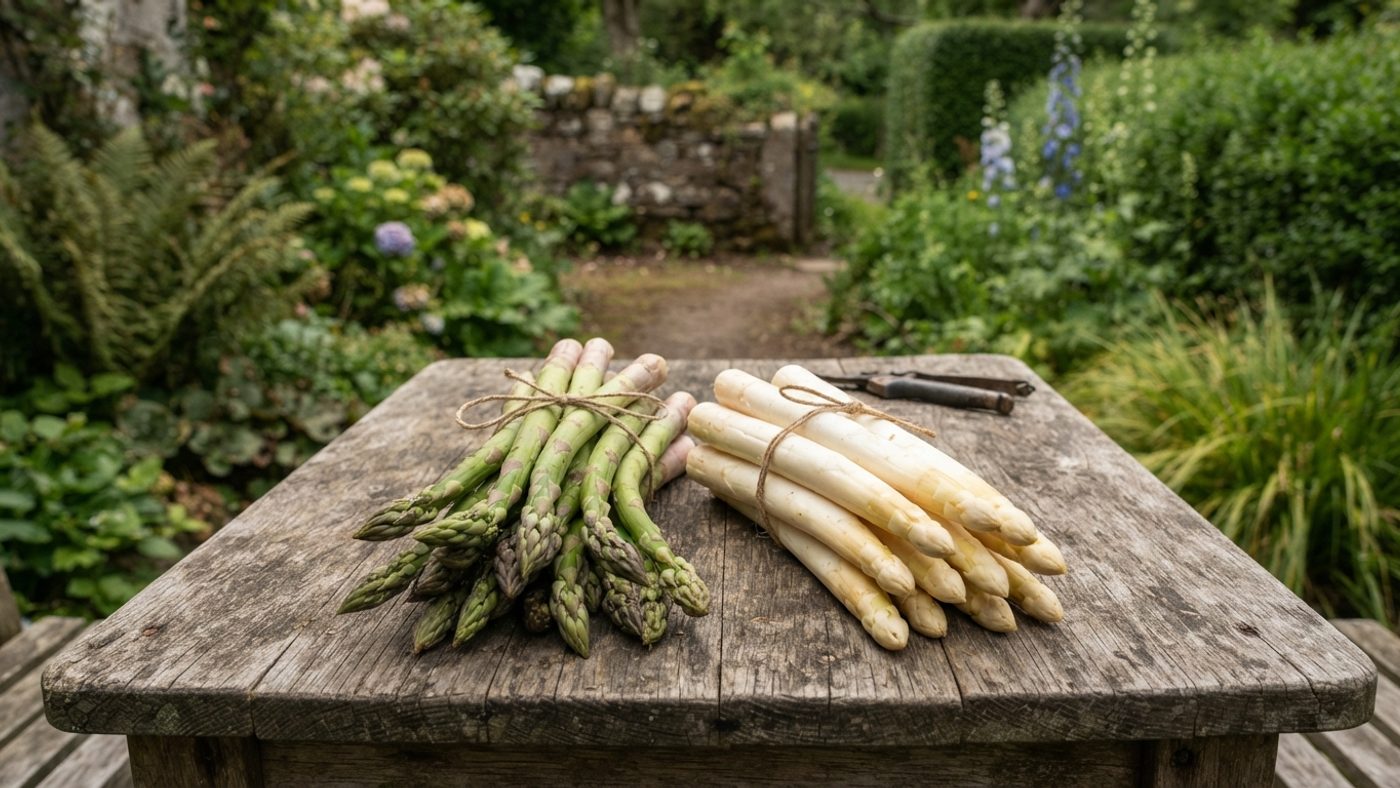
Vittorio is doing something genuinely different: it's earthed up during growth to produce blanched white spears rather than green ones, a real and distinct choice for a grower who wants that specific product. Its own record, though, is a bare taxonomy listing with no hardiness rating, no disease data, and no AGM, named here for the white-spear trait alone, since no performance data exists to back up anything more.
Jersey Knight has the thinnest evidence of any variety here: a single unverified claim of heavy cropping and good disease resistance, no real cultivation data.
Common pests to plan for regardless of variety
None of the varieties above are marketed with resistance to the two main asparagus pests. Slugs target young spears at soil level, and the asparagus beetle attacks foliage through summer, weakening the crown for the following year. Root rot follows damp, poorly drained soil rather than any variety's own weakness, the site and bed preparation covered in the growing guide matter more here than which cultivar is planted.
Frost is worth weighing alongside earliness specifically. Gijnlim's whole appeal is its early cropping window, but young spears are frost-tender, so an early start on an exposed or frost-prone site trades a longer season for more exposure to a cold snap while spears are actually emerging. A later-cropping variety such as Backlim or Pacific 2000 sidesteps that risk at the cost of a shorter harvest window.
Common questions
Is an all-male variety always better than a mixed-sex one?
For productivity, yes, male plants put their energy into spear growth rather than berries and seed, and mixed-sex heritage varieties like Connover's Colossal need seedling weeding as a result of self-seeding. The exception is where the specific traits of a heritage variety (crop size, established performance) outweigh that maintenance cost.
Does an AGM award matter more than hardiness rating for a Scottish garden?
Not necessarily. AGM reflects general garden merit under UK trial conditions; hardiness rating (H4 vs H5) is a more direct measure of whether a plant survives a severe winter on an exposed site. Pacific 2000 and Mondeo carry no AGM but are rated H5, a genuine hardiness step up from AGM-rated H4 varieties like Gijnlim and Backlim.
Can I grow white asparagus in Scotland?
Yes, in principle, Vittorio is grown the same way as any other variety but earthed up to block light and produce blanched white spears instead of green ones. No hardiness or disease-resistance data is available for it, so it's a flavour/product choice rather than a performance one.
Is Pacific 2000 male or female?
Unresolved between two RHS pages: the general grow-your-own page describes it as producing plants that can be either male or female, while its own individual plant page states directly that it's all male. Worth knowing before ruling it out as a mixed-sex variety.
Sources
11 sources, recorded with what each was used for
- Asparagus: Grow Your Own: Variety list, AGM tags on the summary page, Pacific 2000's 'either male or female' claim
- Asparagus officinalis 'Backlim': Sex, hardiness, season, maturity
- Asparagus officinalis 'Pacific 2000': All-male claim, hardiness, flavour/texture
- Asparagus officinalis 'Guelph Millennium': Sex, hardiness, absence of AGM trophy
- Asparagus officinalis 'Mondeo': Sex, hardiness, disease resistance, aspect, harvest timing
- Asparagus officinalis 'Vittorio': Confirms absence of cultivation data
- Asparagus officinalis 'Jersey Knight': Confirms absence of cultivation data
- Asparagus officinalis 'Gijnlim': Sex, AGM, hardiness, spear character
- Asparagus officinalis 'Connover's Colossal': AGM, seeding habit, spear character
- How to Grow Asparagus: Vittorio blanching detail, Jersey Knight and Mondeo disease-resistance claims, variety naming
- A Guide to Vegetable Growing (9th Edition): pH restriction below 5.9