
Red Spider Mite is a common pest that affects aubergines, cucumbers and peppers in Scotland. Here is what it looks like, how to spot the damage, and which controls have been tested.
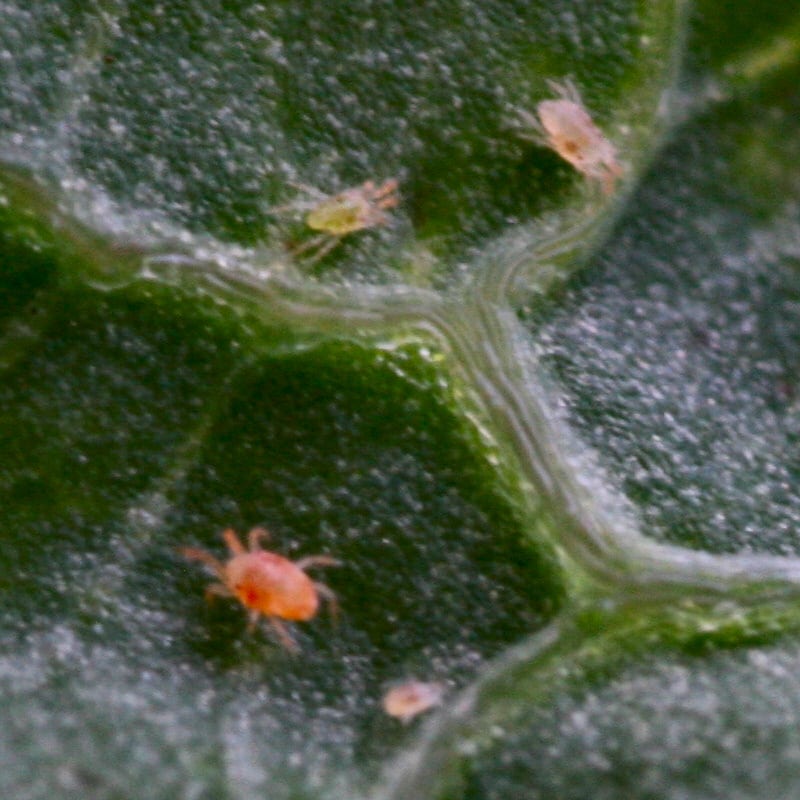
What does it look like?
Active mites are barely visible without a hand lens: yellowish-green with a pair of darker markings, under 1mm long. The reddish-orange colour the common name promises is a resting colour, not a feeding one, developing in autumn as mites stop feeding and prepare to overwinterKeeping a plant alive and intact through the cold months, whether left outdoors, moved under cover, or stored dormant. Full definition →. Garden Organic: 'only red coloured when they are inactive during the winter'.
Check the leaf underside itself with a hand lens for the mites, pale cast skins and spherical eggs, and check the oldest leaves first, since damage shows there before it spreads to new growth. If you are not sure what you are looking at, shake a suspect leaf over a sheet of white paper: moving specks confirm mites rather than dust or old webbing. Fine silk webbing across the leaf, visible once numbers build, is the sign that is unmistakable even without a lens. This is a different species from the red spider mite found on fruit trees (Panonychus ulmi), which despite the shared common name is not the same pest and is not covered on this page.
What causes it
Warm, dry air is what this mite needs to build a damaging population fast. RHS: 'severe damage can quickly develop in warm dry conditions which favour rapid reproduction.'
Both sources point at the same trigger from different angles: RHS frames it as a reproduction-rate effect, Garden Organic as a straightforward preference for dry glasshouse conditions. It's one mechanism either way.
Is this pest active now?
Usually only a problem from March to October outdoors and in an unheated glasshouse. A heated glasshouse removes the cold that would otherwise stop it, so damage can occur at other times of year wherever that applies.
🌱 Plants at risk
Red Spider Mite also affects these crops:
Symptoms
Feeding first shows as fine pale mottling on the upper leaf surface, or as tiny yellow-brown puncture dots, depending which source you read. Left unchecked, leaves lose most of their green colour, dry up and fall, with fine silk webbing visible on badly affected plants.
Life cycle
Temperature sets the pace almost entirely: a full generation takes 55 days at 10°C against just 12 days at 21°C, and breeding can run continuously from March to October in a heated glasshouse.
Overwinters: Mated, dormant orange-red females spend winter sheltering in cracks and crevices, including glasshouse frames, canes, stakes, soil and plant debris, emerging from around late March.
Why this matters in Scotland
A pest of the greenhouse and polytunnel Scotland relies on, more than of the open ground.
The crops most affected by this mite are dominated by ones that need cover to crop reliably this far north: tomatoes, cucumbers, peppers and aubergines all depend on the warmth a glasshouse or polytunnel provides. That same warmth, especially if it runs dry, is exactly what lets this mite breed fast enough to do real damage: the protection the crop needs doubles as the cover the mite needs. Outdoors, it is a smaller problem: it can also feed on garden plants during summer, and runner beans are the one outdoor Scottish crop it is named against, but a summer hot and dry enough for that to matter is the exception in Scotland, not the rule. Strawberries are the awkward case: they don't need cover to grow in Scotland the way tomatoes or aubergines do, but growing them under cover for an earlier crop is a common enough choice that it puts the same warm, dry, dusty conditions back into play.
Controls: what actually works
Not every method here works equally well: some are backed by real evidence, others are simply traditional and untested.
Phytoseiulus persimilis: a predatory mite, released as biological control
The most established biological control for this pest: dispatched as nymphs and adults, released in sheltered spots directly on infested plants, and preying on all life stages of the mite. Timing matters too: wait until damage is actually visible before releasing it, and only once the glasshouse is at 15°C or above, since it will not establish in cooler conditions.
Feltiella acarisuga: a predatory midge, released as biological control
A native British species whose larvae prey on the mite. It works best used in spring, before a heavy infestation has developed, and is less likely to work in hot dry conditions during the summer, the exact conditions the mite itself thrives in, so timing this one early matters more than with Phytoseiulus.
Cultural: raising humidity through misting and damping down
RHS: 'regular syringing and spraying of plants with water, and maintaining high humidity, reduce the risk, but will not, on its own, control this mite.' The practical version of the same idea is misting plants and damping down the glasshouse floor in sunny weather, one part of a routine rather than a fix by itself.
Raising humidity to slow this mite pulls against a different risk: grey mould thrives in exactly the same damp, still air, and a cool, poorly ventilated Scottish glasshouse is more prone to it than a warm, dry one. Ventilate as well as mist, rather than misting alone.
Cultural: clearing debris and disinfecting the glasshouse over winter
Clearing plant debris and cleaning pots, canes and stakes with biodegradable soap or a citrus-based disinfectant over winter targets exactly the crevices where mated females spend the winter dormant, so the reasoning behind it holds up even though the control itself comes from one source.
Remove affected leaves as soon as you see them
Removing affected leaves promptly while damage is still limited to only one or two, before the mites spread further across the plant, is a simple, no-cost first response while deciding whether a fuller biological control programme is needed.
Plug plants and bedding bought in over spring and summer are a real way this mite arrives in the first place, not just the crevices it overwinters in already on site. Turn a few leaves over and look before anything new goes in among established plants, especially if it's going straight under cover.
Chemical: horticultural oil sprays
Horticultural plant oil-based sprays, applied directly onto the mites, are an organic chemical option.
Every crop this mite is named against here is edible. Any product actually bought and used needs its own label checked for a harvest interval before picking, not just for whether it is approved for the crop.
Frequently asked questions
What should I do first if I find red spider mite in my garden?
Start with phytoseiulus persimilis. After that, feltiella acarisuga. Work through the rest in order of how well-evidenced they are if the first two aren’t enough on their own.
Will red spider mite kill my plants?
They rarely kill established plants. The damage is usually cosmetic on outer leaves, and natural predators often bring numbers under control without you doing anything.
When are red spider mite most active in Scotland?
Check the seasonal activity section above. Scottish timings can run a few weeks behind the UK-generic figures.
Should I just leave red spider mite alone?
In most gardens, yes. red spider mite are food for birds, wasps and predatory insects, and a healthy garden carries some without trouble. Tolerance is also RHS's official position now, for that same reason.
Sources
5 sources, recorded with what each was used for
- RHS1: identification and colour change, symptoms and webbing, warm-dry conditions driving rapid reproduction, temperature-dependent generation length, overwintering sites and emergence timing, March–October activity window, host plants under cover and outdoors in summer, Phytoseiulus persimilis and Feltiella acarisuga as biological controls, humidity's limited effect, absence of a chemical recommendation
- Garden Organic8: resting colour clarification, symptom description at close range, host plant susceptibility, Phytoseiulus release timing and 15°C threshold, misting and damping-down practice, winter glasshouse hygiene, removing affected leaves promptly, horticultural oil sprays as an organic chemical option
- Pacific Northwest Extension18: strawberries as a host, and confirming dry conditions drive infestation there too. Not used for its US chemical-control list or for anything Scotland-specific, per this source's Tier 2 restriction.
- UC IPM16: the mite's documented history of developing resistance to miticides quickly under repeated use, and the recommendation to alternate modes of action or favour biological control for that reason. Not used for anything Scotland-specific.
- UC IPM16: the shake-onto-white-paper method for checking mites more closely. Not used for anything Scotland-specific.