
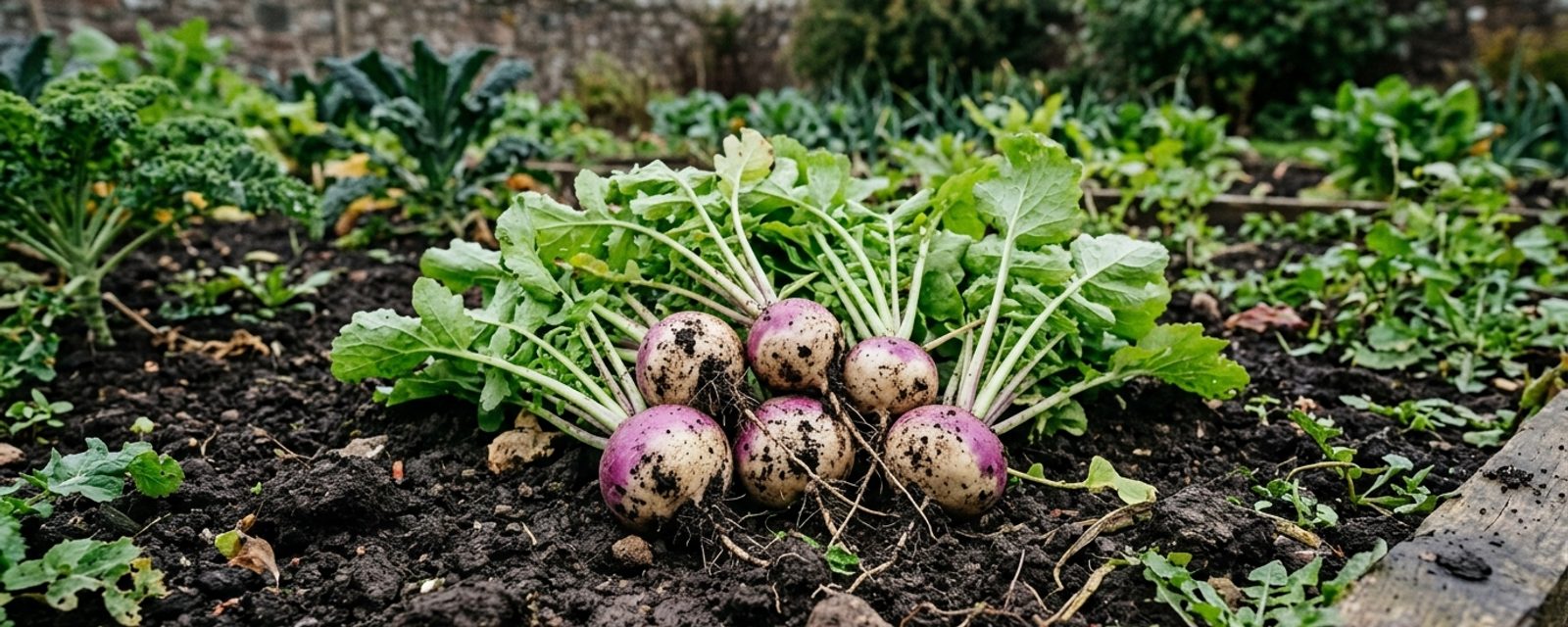
Turnip is sown in a narrow window that most seed packets gloss over: March to mid-August in the UK generally, but a Scottish plot loses weeks at both ends compared with the south, and a turnip sown too late in a cold, wet autumn won't bulk up before growth stalls. That squeeze matters more for turnip than for most vegetables, because the crop is deliberately grown in small, repeated batches every few weeks rather than one big sowing, and which variety you choose changes how forgiving that succession-sowing routine is.
Quick answer
For most Scottish gardens, Oasis, which holds the RHS Award of Garden Merit (AGMThe RHS's Award of Garden Merit: a UK-wide trials award for reliable performance, not a Scotland-specific recommendation. Full definition →), is the best all-round choice: a Japanese-type turnip that's genuinely slow to bolt, which matters when a run of dry weather in the middle of a sowing sequence would otherwise send other varieties to seed. Choose Tokyo Cross or Temari Red (both AGM) instead if you want the fastest possible turnaround for baby salad roots between successive sowings, or Atlantic (AGM) if you want an early, purple-topped classic sized more like a traditional turnip than a salad one.
Squeeze more sowings into a shorter season, or bulk up fewer roots for later use, the two goals pull towards different varieties, and the recommended list of turnips splits fairly cleanly along that line.
Why sowing timing drives the variety choice here
In a Scottish growing season that starts later and closes down earlier than further south, every sowing window is worth more, and a variety that bolts (runs to flower) partway through, usually triggered by a dry spell rather than by cold, wastes an entire slot. That's the practical reason bolt resistance, not just flavour or colour, is worth weighing before choosing what to sow.
| Sowing type | Sow | Harvest | Roughly |
|---|---|---|---|
| Early (under clochesA small, portable clear cover placed over an individual plant or short row to trap warmth and keep off wind, rain and pests. Full definition →) | February | May onwards | 6 weeks |
| Early, open ground | March–August, in batches | May–September | 6 weeks |
| MaincropThe main, usually latest-sown and longest-growing type of a crop, grown for bulk and storage rather than an early harvest. Full definition →-style | Later in the same window | From October | 10 weeks |
No frost tolerance figure is stated for the roots themselves once they're in the ground, so treat those harvest windows as the safe pull-by point rather than leaving a crop out through a hard frost.
Soil pH matters too: turnip growth is restricted below pH 5.4, according to general vegetable-growing guidance; no pH figure is published for turnip specifically. If a soil test comes back below that, garden lime raises pH, follow the product's own application rate rather than guessing. The same acidic soil raises clubroot risk in brassicasThe cabbage family: cabbage, kale, broccoli, cauliflower, Brussels sprouts, kohlrabi, swede, turnip and more, sharing the same pests, diseases and rotation rules. Full definition → generally, turnip included; rotationMoving each crop family to different ground each year, on a multi-year cycle, so pests and diseases that build up in soil don't get a repeat host. Full definition →, and liming where clubrootA soil-borne fungal disease of the brassica family that swells and distorts roots, and survives in soil for years. Full definition → has been a problem before, are the standard defence.
And a naming warning before you order seed: in everyday Scots usage, "neep" or "turnip" often means what an English seed catalogue calls swede (Brassica napus, a different plant with a six-month growing season) rather than the fast Brassica rapa turnip this article covers. Check the Latin name on the packet if there's any doubt, the full turnip growing guide has more on the naming overlap, plus the sowing method, spacing, and raising instructions in step-by-step detail.
Salad-type vs traditional turnip: a real distinction, verified variety by variety
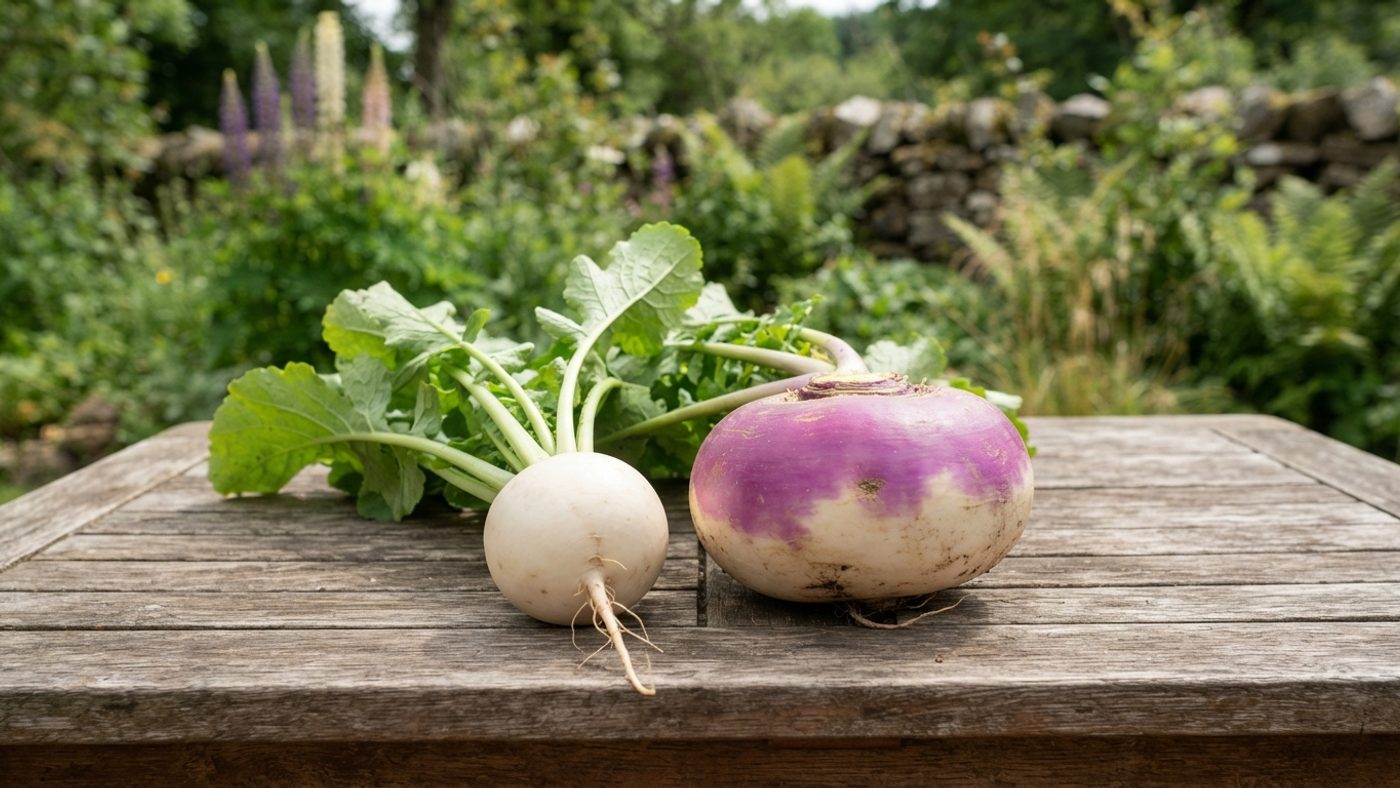
"Japanese type" and "maincrop" aren't just packet marketing, they describe genuinely different plants. Japanese-type turnips (also sold as salad turnips) are bred to be pulled young: smaller, faster, milder, often eaten raw. Traditional turnips are the classic purple-topped root, typically left longer to size up. This comparison sticks to the currently AGM-listed varieties, since that's the only place UK-wide performance is independently trialled rather than just claimed; older heritage turnips exist too, but without that kind of verification behind them they're outside what a comparison like this can responsibly stand behind. Here's how the five stack up:
| Variety | AGM | Type | Hardiness | Days/harvest window | Notable trait |
|---|---|---|---|---|---|
| Atlantic | Yes | Purple-topped, described for baby veg and containers | H6The RHS's H1a–H7 scale for how much cold a plant can survive outdoors, H1a being tender indoor-only and H7 hardy anywhere in the UK. Full definition → | Not stated in days; classic early turnip | Early, compact root, suited to containers |
| Oasis | Yes | "White, semi-globe, Japanese type" | H3 | Harvested late summer to autumn | Explicitly "slow to bolt (flower) or turn woody" on the general variety list (see note below) |
| Temari Red | Yes | "A biennialA plant that completes its life cycle over two years: growth in year one, then flowering, seeding and dying in year two. Full definition → japanese variety of salad turnip" | H3 | June–Sept or Oct–Nov, depending on sowing | Scarlet skin, white flesh with a red blush |
| Tokyo Cross | Yes | Fast-growing white semi-globe, not explicitly labelled "Japanese" on its own record but sold and bred as a salad type | H3 | 35–60 days from sowing | One of the fastest turnips available |
| Sweetbell | No | Salad turnip, harvested small | H5 | Not stated in days | Leaves also edible stir-fried, alongside the root |
Note that the AGM is a UK-wide trial result, not a Scotland-specific recommendation, it's still a reasonable filter, since AGM turnips have at least been trialled and judged to perform reliably, but it isn't proof of Scottish suitability on its own. The hardiness (H) ratings above matter less than they would for a perennial: turnip is grown as a fast annual and lifted well within the harvest windows given, long before any of these ratings would come into play, so treat that column as background rather than a reason to favour one variety over another.
Worth being precise about Oasis specifically: its bolt-resistance claim and AGM status come from the general variety list, but its own individual plant record doesn't repeat either the badge or the wording, Tokyo Cross's own page, by contrast, does show its badge directly, so this looks like a gap specific to Oasis's page rather than a crop-wide pattern. The claim itself is real and clearly sourced, just worth knowing which page it actually lives on.
Four of the five carry the AGM. Oasis, Temari Red and Tokyo Cross are explicitly salad/ Japanese types; Atlantic is the outlier, described for baby veg and containers rather than as a storage root, and none of this shortlist is billed as a long-storage maincrop turnip in the traditional sense. One practical result of that: a bolt-prone batch costs less when it's a quick 6-week crop than a 10-week one, so the fast salad types absorb Scotland's succession-sowing risk better than a slower sowing would.
Growing-season length varies across Scotland, the frost-dates page has the regional breakdown, which is worth checking if you're deciding how many successive batches you can realistically fit in before autumn closes things down.
Best overall pick, and the situational alternatives
Best overall: Oasis. It carries the AGM, and its variety description explicitly flags bolt resistance, "slow to bolt (flower) or turn woody", the trait that most directly protects a repeated small-batch sowing plan from a bad week of weather. It's also described as delicately flavoured rather than purely a speed-grown baby root, so it holds up reasonably well if a sowing gets left a little longer than planned, which happens on a real allotment.
For fastest turnaround / tightest succession sowing: Tokyo Cross. At 35–60 days from sowing it's the quickest of the group, useful for squeezing an extra batch or two into a short Scottish season, particularly for a late-summer sowing that needs to finish before the weather turns. Temari Red is the alternative here if you want the same salad-turnip speed with a different colour and flavour note on the plate.
For a more traditional-sized root: Atlantic. It's the one variety in this set not billed as a Japanese/salad type, an early purple-topped turnip suited to containers as well as open ground. It won't give you a genuine winter-storage maincrop in the way an old-fashioned heavy turnip would, but among the AGM-verified options it's the closest to the classic shape and size gardeners expect from the name "turnip".
Whichever type you choose, boltingA plant switching early into flowering and seed production, usually triggered by stress, after which leaves, roots or bulbs turn bitter or unusable. Full page → is the shared risk worth watching for, and the bolting guide covers the wider triggers and fixes beyond variety choice. Scotland's damp climate suits slugs, which go for seedlings early on, and because turnip is a brassica it also carries the usual brassica pest load: flea beetle riddles young leaves with small holes in warm, dry spells, a fine insect mesh laid from sowing keeps it off, useful for the earliest cloche-started batch in particular, plus cabbage root fly, the cabbage white caterpillar, and clubroot, whose risk rises on the same acidic ground mentioned above if brassicas have been grown on the same ground recently. All of these are covered on their own pest pages here and are worth checking regardless of which variety ends up in the ground. If you're growing Atlantic or another maincrop-style variety through to October, the growing guide also covers storing the lifted roots in moist sand through winter.
Common questions
Are Japanese turnips the same as salad turnips?
Yes, effectively, varieties like Temari Red are described as "a biennial japanese variety of salad turnip," and the terms are used interchangeably for turnips bred to be harvested small, young and mild rather than left to size up.
Does AGM mean a variety is good for Scotland specifically?
No. The Award of Garden Merit reflects UK-wide trial performance, not a Scottish climate assessment, so it's a useful starting filter rather than a guarantee.
Which turnip variety is least likely to bolt?
Of the varieties checked here, Oasis is the only one described as slow to bolt, though that claim comes from the general variety list rather than being repeated on its own individual plant page. Bolting is generally triggered by dry conditions rather than cold, so watering little and often through any dry spell, rather than waiting until the plants look stressed, matters as much as variety choice.
Can I eat turnip leaves as well as the root?
Yes, turnip tops are a genuine second harvest, edible cooked like spinach, and Sweetbell's own description specifically notes its leaves can be stir-fried alongside the root. The full growing guide covers how to harvest tops without ruining the root crop.
What soil pH does turnip need?
There's no RHS-stated figure for turnip specifically, but general vegetable-growing guidance puts restricted growth below pH 5.4, which is worth checking on acidic ground before it becomes the limiting factor rather than variety choice.
Sources
7 sources, recorded with what each was used for
- Turnips: Grow Your Own: The sowing/harvest timing windows, the recommended-variety list, and each variety's short official description (including the "Japanese type" and "slow to bolt" wording for Oasis, and confirmation of which varieties carry the AGM)
- Brassica rapa 'Atlantic': Hardiness rating (H6) and confirming no storage/bolt-resistance claim is made for this variety
- Brassica rapa 'Oasis': Hardiness rating (H3) and harvest-window description; confirms no AGM badge or bolt-resistance claim on this specific page, unlike the general variety list
- Brassica rapa 'Temari Red': The "biennial japanese variety of salad turnip" classification, hardiness (H3), and harvest window
- Brassica rapa 'Tokyo Cross': Confirms the AGM award directly on the plant's own page, hardiness (H3), and the 35–60 day maturity figure
- Brassica rapa 'Sweetbell': Confirms this variety carries no AGM, hardiness (H5), and the note that its leaves are edible stir-fried
- A Guide to Vegetable Growing (9th edition): The soil pH 5.4 growth-restriction figure, since the general turnip page states no pH figure of its own