
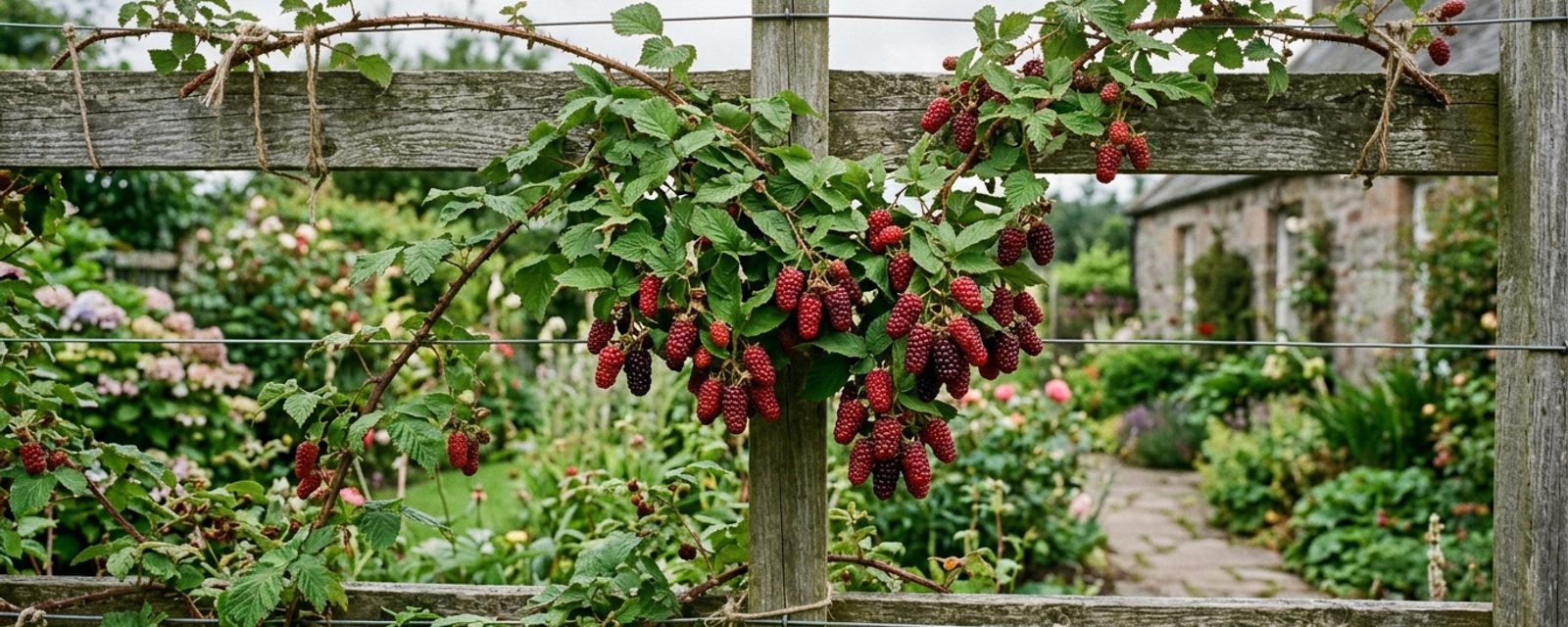
Rubus × loganobaccus
A loganberry is a distinct raspberry-blackberry cross, not a stand-in for a tayberry. Thorns, hardiness and vigour trade off differently across its three named cultivarsA plant variety that arose or was bred under cultivation and is kept true by deliberate propagation, rather than a naturally occurring wild species. Full definition →.
Grown the same way as blackberries: trained onto wires rather than left to scramble, cut back hard after fruiting each year, and easy to keep going once established.
Site and planting
Choose a sunny, sheltered site; fertile, well-drained soil suits it best, tolerating a wide pH range. Plant November to March while dormant for bare-rootA plant, usually a fruit tree or hedging, sold with its roots exposed rather than in a pot, and only available while dormant. Full definition → canes; pot-grown canes can go in during spring or summer. Space plants 2-3.5m apart depending on vigour, though a single plant is often enough for a small garden. Soak bare roots in a bucket of water for a couple of hours before planting, and position at the same depth the plant was previously growing. In a container, use one at least 45cm wide and deep with loam-based compost.
Training and support
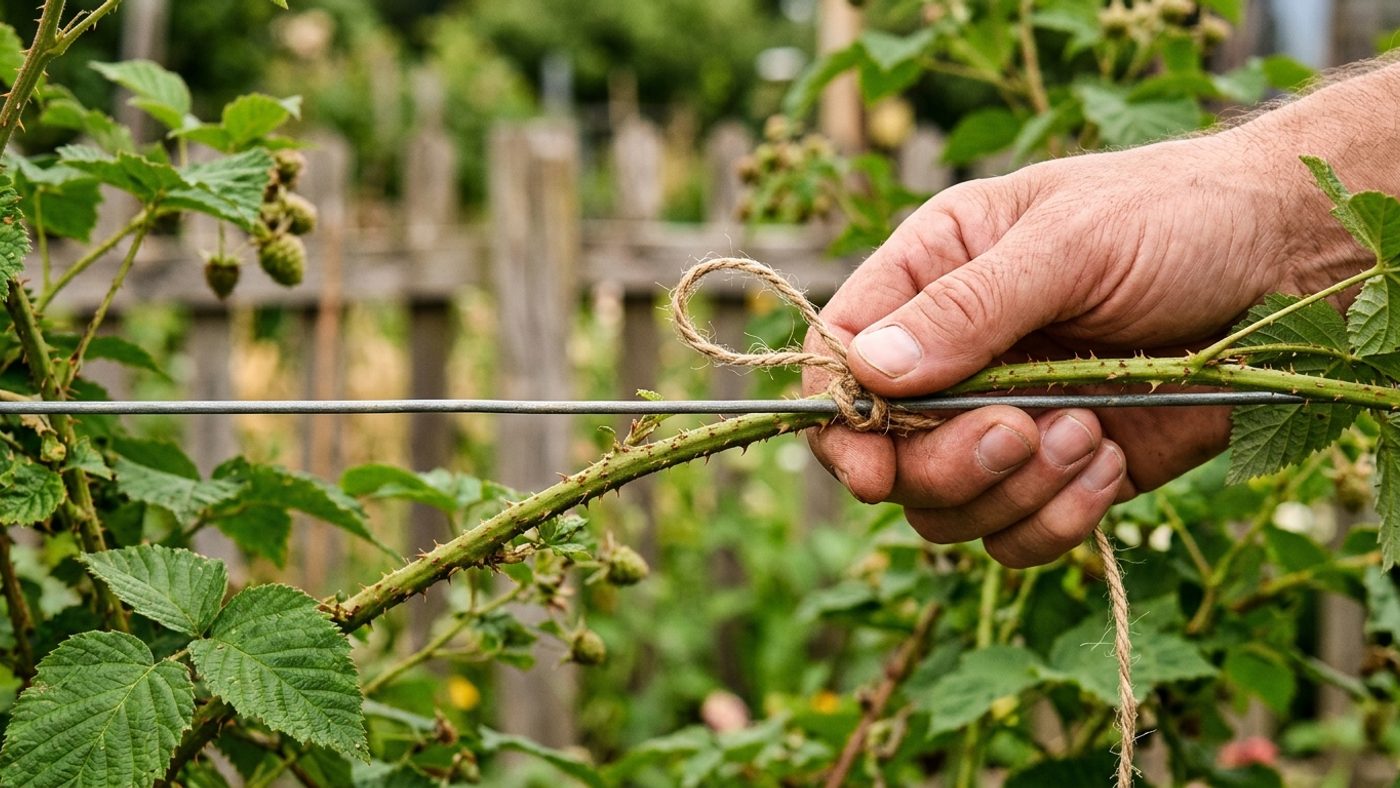
The standard variety reaches 1.5-2.5m in height and spread once mature, a useful figure for sizing the wire framework before planting rather than after. Set up horizontal wires beforehand, about 45cm apart with the lowest wire roughly 45cm above the ground, against a wall, fence or posts. Loganberries are usually fan-trainedA fruit tree or bush trained flat with branches radiating out from a low point, the standard shape for wall-grown stone fruit. Full definition →, tying in canes as they grow to keep old and new woodWhether a plant fruits on stems grown the previous year (young wood) or on older, established branches (old wood), which decides how it's pruned. Full definition → separate: worth doing carefully on the thorny standard variety especially, since a loose cane is easy to catch a hand or sleeve on while working nearby.
Care
Water well through the first growing season and any prolonged dry spell after; established plants shouldn't need routine extra watering. MulchA layer of material spread over the soil around plants to suppress weeds, retain moisture, and improve soil structure as it breaks down. Full definition → each spring with well-rotted manure or garden compost, which generally covers feeding; if a harvest disappoints or growth looks short of nutrients, apply an organic granular general fertiliser the following spring instead. New plants are easy to produce yourself: root the tip of a vigorous young stem into the ground in mid-to-late spring, a technique called tip-layeringPropagating a new plant by pinning a low, flexible stem into the soil while still attached to the parent, so it roots before being cut free. Full definition →, rather than buying a second cane if one plant is already established.
Pruning
Once established, prune in late summer or autumn, after fruiting: cut the old, fruited canes down to the base, and tie in the pale green new canes that grew over summer, since these carry next year's crop.
Varieties
Three named cultivars: the standard species, and two later selections, Ly 59 and Ly 654. Ly 59 keeps the standard species' thorns but not its hardiness, rated H5The RHS's H1a–H7 scale for how much cold a plant can survive outdoors, H1a being tender indoor-only and H7 hardy anywhere in the UK. Full definition → like the thornless Ly 654.
★ Our pick for Scotland
Loganberry (standard)
Thorny canes · H7 · dark red fruit
Large, dark red fruit, sharper-flavoured than a raspberry.
Why this one: H5, the rating both named cultivars carry, already covers most garden sites in Scotland. H7 gives extra margin on an exposed or inland site. No AGMThe RHS's Award of Garden Merit: a UK-wide trials award for reliable performance, not a Scotland-specific recommendation. Full definition → on this variety, unlike Ly 654.
Also worth considering
Ly 59
Thorny canes · H5 · moderately vigorous
Still thorny, and two hardiness bands below the standard variety, without Ly 654's AGM or smaller size.
Ly 654AGM
Thornless · H5 · sweet fruit · suits smaller gardens
Thornless, a real practical advantage on a naturally spiny plant, and less vigorous than Ly 59, so suits a smaller garden too.
Best Loganberry Varieties for Scotland → compares all named loganberry varieties head-to-head, with the practical detail that doesn't fit in a summary card.
Harvesting
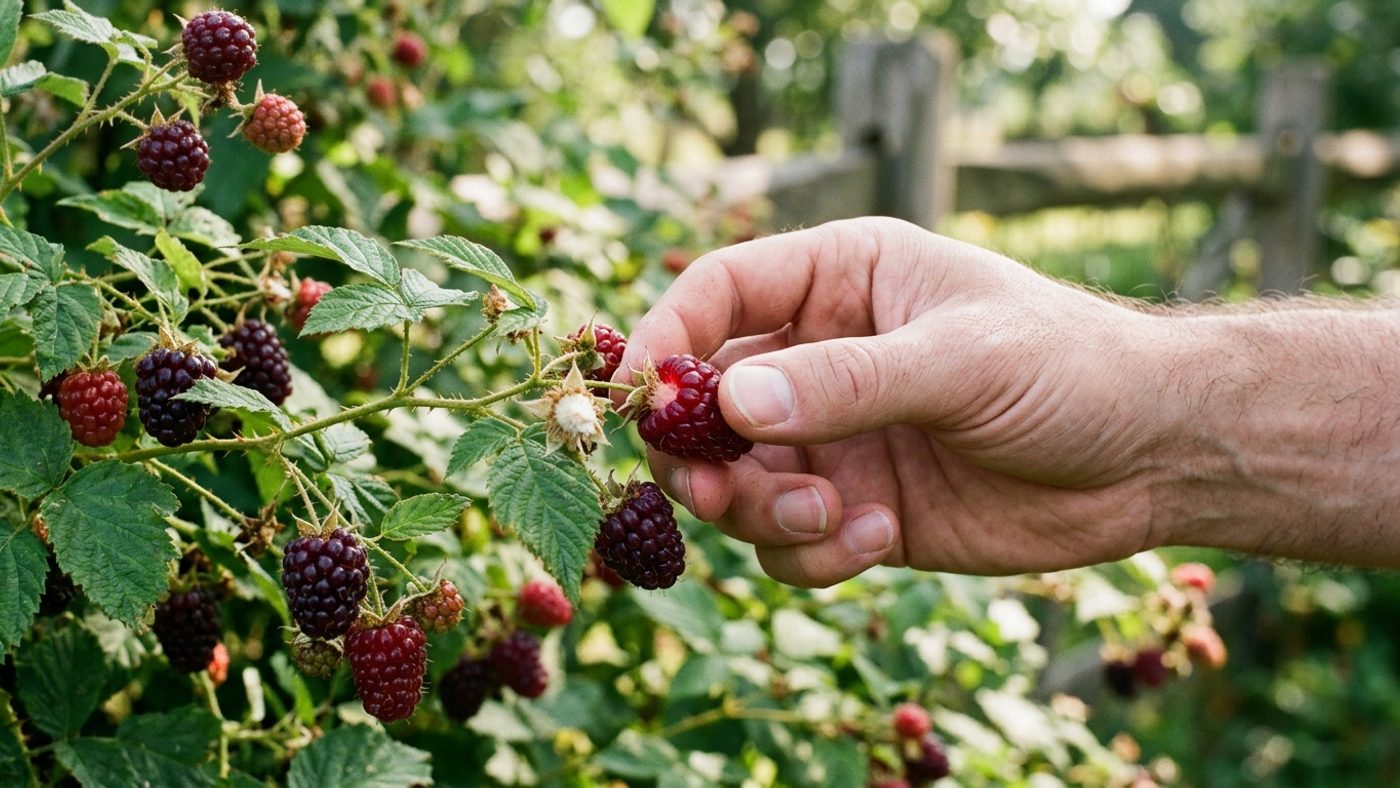
Ready over a long stretch, roughly July to September. Fruit turns deep red to almost purple when ripe, and comes away from its white central core with a gentle tug; a berry that resists isn't ready yet. Fruit doesn't ripen further once picked, so check by colour and feel before cutting.
Common problems
- Birds take ripening fruit; net plants raised on a framework rather than draped directly over the canes.
- Aphids distort new growth and shoots.
- Raspberry beetle larvae feed inside ripening fruit.
See more problems
- Grey mould affects fruit and canes in damp conditions; good airflow from correct training helps prevent it.
- Raspberry viruses cause weak growth and poor cropping with no cure; buy certified virus-free stock.
- Raspberry leaf and bud mite and red berry mite can cause poor fruit set and uneven ripening.
- Honey fungus is a rare but serious root disease with no cure; remove and destroy an affected plant.
Common questions
Is a loganberry the same thing as a tayberry?
No, they're two distinct hybrids. A loganberry crosses a raspberry with a blackberry; a tayberry crosses a loganberry with a black raspberry, one generation on. Grown the same basic way, trained onto wires, but they're separately bred cultivars, not two names for one plant.
Do I have to choose a thornless variety?
No. Ly 654 is thornless but two hardiness bands below the standard variety, H5 against H7, so it's a deliberate trade rather than a straightforward upgrade.
How do I know when a loganberry is ripe?
Colour and a gentle tug: deep red to almost purple, coming away easily. It won't ripen further once picked.
When should I prune a loganberry?
After fruiting, once established: late summer or autumn, not the dead of winter the way some fruit is pruned.
Sources
5 sources, and what each was used for
- RHS: shared cultivation routine with blackberries and other hybrid berries: site and soil, planting timing and spacing, wire training, pruning method and timing, container growing, feeding, propagation by tip-layering, and the group-level problems list. Names Ly 654 as its one AGM loganberry variety.
- RHS: the standard species: H7 hardiness, thorny canes, ultimate height and spread, flower and fruit description, sun/site and soil preferences, floricane fruiting habit
- RHS: Ly 59: H5 hardiness, thorny canes, moderate vigour, grey mould and rare honey fungus susceptibility
- RHS: Ly 654: thornless habit, H5 hardiness, AGM, sweet fruit, lower vigour than Ly 59 and suitability for smaller gardens
- gardenersworld.com: planting timing, a 2m minimum spacing, support and pruning method, the ripeness tug-test (fruit comes away from its white core when ready), and birds as a named risk