
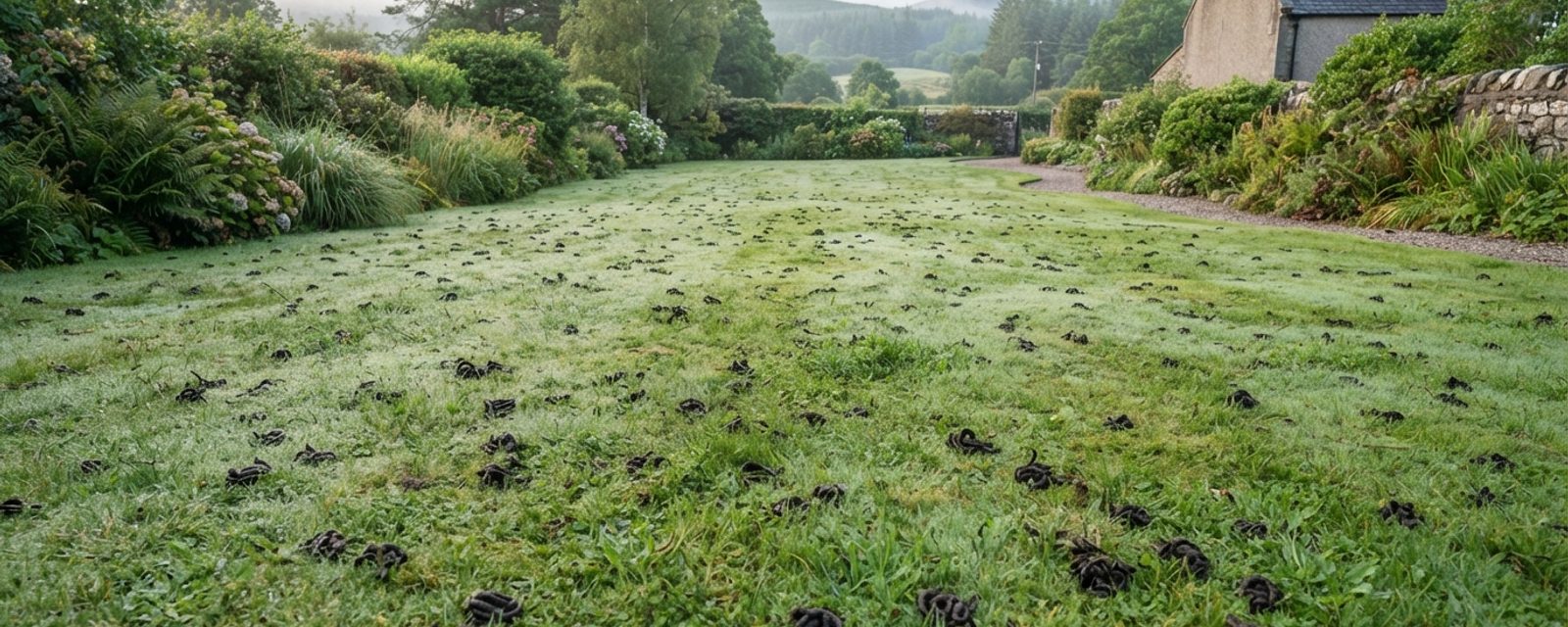
You're about to get the mower out after a mild, wet night, and the lawn is covered in small heaps of dark, sticky mud, dozens of them, dotted across the grass like something's been at it overnight. Nothing's eaten the grass. Nothing's dug it up. Push a finger into one and it's just soil, fine, worked, slightly gritty. Mow over them now and you'll know it: the blades smear them into muddy streaks, and the mower picks up a sour, earthy smell that clings to the underside of the deck for days.
That's a worm cast lawn, and the first thing worth knowing is that nothing has gone wrong.
What worm casts actually are
A worm cast is soil that's already been through an earthworm. Deep-burrowing species such as Lumbricus terrestris, which live in permanent vertical tunnels reaching well below the surface, feed by dragging leaves and other plant debris down into those burrows and ingesting a certain amount of soil along with it. What comes back out, deposited at the burrow entrance on the surface, is that soil, re-worked, and it has a distinctively fine, muddy texture because of what it's passed through. It isn't a sign of pest damage, disease, or anything eating the lawn from below. It's digestion, happening exactly where it's meant to.
It's easy to mistake for a molehill at a glance, especially a scatter of small ones, but the two look different close up. A worm cast is a loose, fine-textured heap a few centimetres across, sitting flush on the grass with no hole visible underneath. A molehill is bigger, coarser, and sits over a real excavated tunnel, often with a clear entrance hole at the centre once the heap is brushed aside.
A sign of healthy soil, not a lawn problem
Worm activity actually works against thatch rather than causing it: earthworms consume the dead grass and organic debris that would otherwise build up at the base of the grass, so a lawn with a healthy worm population tends to carry less thatch, not more.
Casts themselves aren't a hazard. They're just soil, not a chemical residue or anything harmful to touch, so there's no reason to keep children or pets off a cast-covered lawn beyond the ordinary annoyance of muddy paws or shoes.
Earthworms are genuinely good for the soil under your lawn. Their burrowing opens channels that let water and air move through ground that would otherwise compact and waterlog, and the organic matter they process gets broken down and mixed back into the soil rather than sitting inert on top of it. A cast itself isn't waste in any meaningful sense, it's soil that comes back out carrying substantially more nitrogen, phosphorus and beneficial bacteria than it went in with, a genuine boost on the leached, acidic soil found in pockets across Scotland, and on heavy clay ground, where the aeration from worm burrows matters more than it would on an already free-drainingSoil that lets water pass through quickly rather than pooling, so roots aren't sitting in wet ground after rain. Full definition → soil. A lawn with a healthy population of these worms is a lawn with soil that's doing its job.
That's also why there's no chemical route to dealing with them, not because none has been invented, but because the products that once existed for exactly this purpose have been withdrawn from use over the past several decades and nothing pesticide-based has replaced them. What's sold now, sulphur-based lawn treatments marketed as worm cast deterrents, work by lowering soil pH to make conditions less favourable, and explicitly don't kill the worms; results from that approach are mixed, since how much pH actually shifts depends on the soil's existing buffering and how consistently the treatment is reapplied, and it needs repeat applications to have any effect at all. There is no approved pesticide for controlling earthworms on a UK lawn, and looking for one is a dead end. Tolerance, not elimination, is the advice that actually applies here, and worth bearing in mind before reaching for a lime or pH-raising lawn treatment for another reason too, since raising the pH of already-marginal acidic soil to suppress worms undoes the same soil-health benefit that healthy worm activity provides.
The real nuisance
None of that means casts are pleasant to deal with. The genuine, practical problem is what happens when they get walked on or run over before they've dried: fresh casts are wet and easily flattened, and mower wheels or feet smear them across the surface into a muddy film rather than leaving neat little heaps. On a lawn cut fine and short, that smearing creates patches that look and feel poor, and the flattened, disturbed ground it leaves behind is exactly the kind of gap that moss and weeds are quick to move into. Casts also carry whatever weed seeds happened to be in the soil the worm passed, back up to the surface where they can germinateA seed sprouting: breaking dormancy and putting out its first root and shoot, given the right warmth and moisture. Full definition →.
Managing worm casts
The management that works is simple and physical.
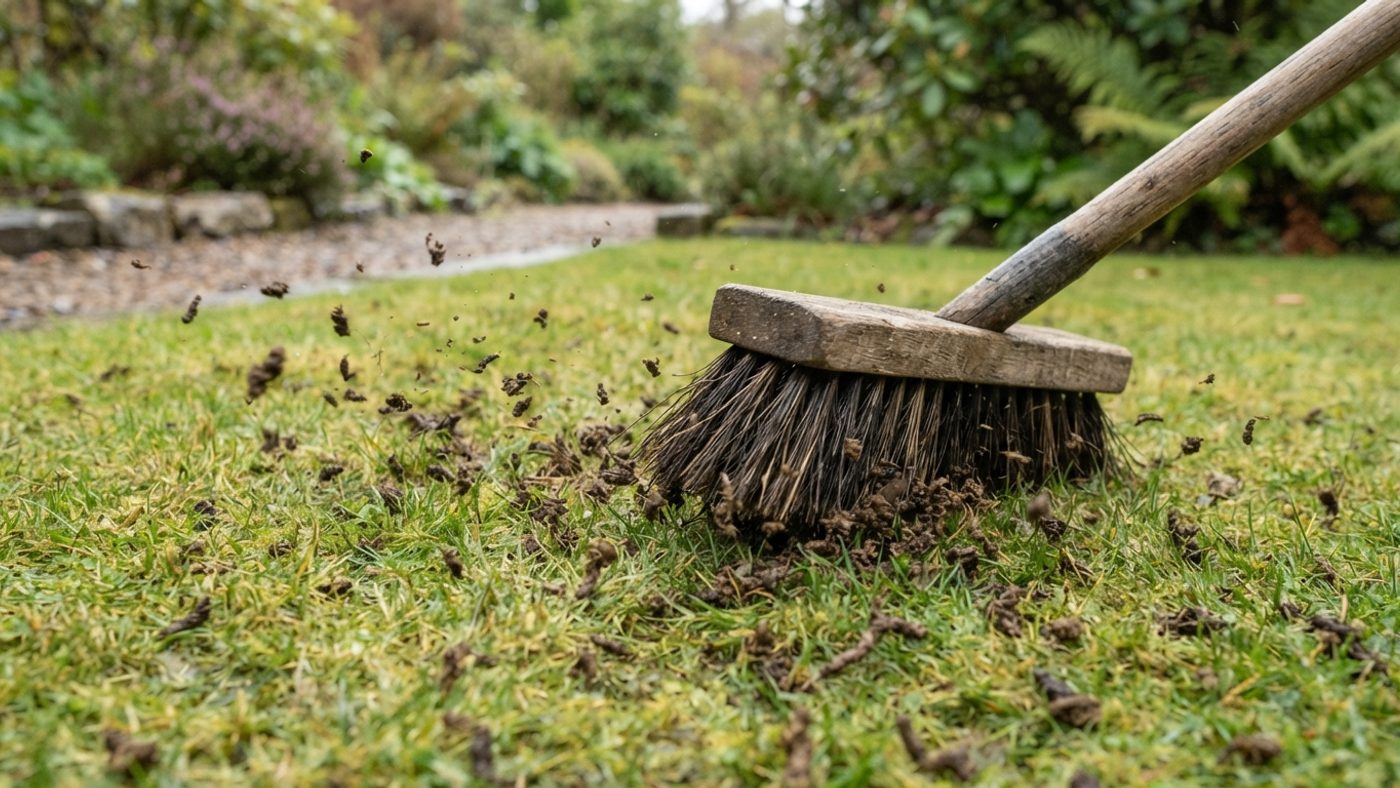
- Wait until the casts have dried, then brush or lightly rake them off the surface. Wet casts smear; dry ones break up and scatter cleanly with a stiff brush or the back of a rake.
- Do this before mowing, not after. Mowing over undispersed casts is what causes the smearing and the poor cut in the first place; clearing them first avoids the problem rather than cleaning up from it.
- Raise the mower height slightly during the main casting months if casts are a recurring irritation. A higher cut is less likely to scalp into flattened, smeared patches than a close, fine cut is, worth doing for longer on a west-coast lawn than an east-coast one, given how much more of the year the west spends in cast-favouring damp soil (see the rainfall comparison below).
- Time it around dry spells where you can. Casts that have had a day or two of drier weather to firm up come apart with a light brush; casts from an overnight downpour often need another day before they're worth touching.
- A robotic mower makes this harder to manage, since it cuts far more often and shorter than a weekly pass with a push mower, giving fresh casts less time to dry before they're driven over. Brushing the lawn by hand before a robotic mower's scheduled cut, rather than relying on it to cope, avoids the smearing it would otherwise cause.
- Leave the rest alone. Once brushed off, that's the job done. There's no follow-up chemical step and no need to treat the lawn for anything.
When casts show up, and why
Worm casting has a clear seasonal shape: it runs mainly from September through to April, peaking in autumn and again in early spring, and in a mild winter it can continue right through rather than stopping. That window lines up with when the soil is at its most reliably damp and the temperature hasn't dropped low enough to push the worms into dormancy. Earthworms need moist ground to move through and mild-enough soil temperatures to stay active near the surface; hot, dry conditions or a hard freeze send them deeper down and casting drops off until conditions ease again.
Scotland's climate and why casts show up here
Within Scotland itself, the west sees noticeably more of the damp-soil conditions that keep earthworms casting near the surface than the east does. 30-year averages (1991-2020) for two stations either side of the central belt show the gap in how many days of the year actually see rain, not just how much falls overall:
| Station | Region | Days of rain ≥1mm per year | Annual days of air frost |
|---|---|---|---|
| Glasgow, Bishopton | West-central Scotland | 181.22 | 45.57 |
| Edinburgh, Gogarbank | East-central Scotland | 137.43 | 48.01 |
That's a difference of roughly six weeks' worth of extra wet days a year in the west, on stations barely 70km apart, while the frost figures for the two are close to identical. Earthworms need damp soil to stay active near the surface and cast, so the west's extra wet days, not any real difference in winter mildness between the two stations, are the likely reason a west-coast lawn tends to cast for more of the year than an east-coast one. Both sides of the country sit well within the range where worms stay active for most of the year rather than shutting down for long stretches; it's a matter of degree, not one region casting and the other not.
Nobody has run a study directly counting worm casts on Scottish lawns, so this is the likely mechanism rather than a measured result. If your lawn casts for more of the year than a friend's on the drier side of the country, that's the kind of difference the rainfall pattern above would predict.
Why worm activity is worth valuing here specifically
There's a second reason casts are worth reading as good news on a Scottish lawn. Acidic soils are found in pockets right across the UK, including south-western England and Wales, and Scotland is another part of the country where they're common, driven by the underlying bedrock rather than anything a gardener has done. Earthworms, in turn, are scarce in soils that are extremely acidic. Put those two facts together and a lawn showing plenty of worm-cast activity, on ground with a real chance of being on the acidic side, is a lawn where the soil chemistry and biology are working in the worm's favour rather than against it. A cheap soil pH testing kit from a garden centre, used on a sample from your own lawn, confirms whether that applies to your ground specifically rather than leaving it as a regional guess.
Common questions
Should I try to get rid of the worms in my lawn?
No. There’s no approved pesticide for it in the UK, and the worms themselves are doing more for your soil’s structure and fertility than the casts cost you in mess. Manage the casts, not the worms.
Why did the casts appear suddenly after a wet night?
Damp soil and mild temperatures are exactly the conditions that keep deep-burrowing earthworms active near the surface. A wet spell after a dry stretch often brings a visible burst of casting because conditions have just turned favourable again.
Is there a product I can buy that stops worm casts?
Sulphur-based lawn treatments exist and work by lowering soil pH to make conditions less attractive to worms, but they don’t kill them and results are inconsistent; repeat applications are needed for any effect. There’s no pesticide licensed to control earthworms on UK lawns.
Do worm casts mean my lawn has thatch, disease, or some other problem?
No. Thatch is a springy, fibrous brown layer of dead grass and roots sitting at soil level, and lawn diseases usually show as discoloured rings or patches in the grass itself, both quite different in texture and appearance from a small, loose heap of dark soil sitting on top of the grass. If what you’re seeing doesn’t match a fine, muddy soil heap, check it against thatch or disease separately rather than assuming it’s cast-related.
Can I do anything useful with the casts I brush off?
Some gardeners collect them for use as a potting or seed-sowing medium, since it’s already fine, worked soil. It isn’t necessary, just an option if you’d rather not just discard what you sweep up.
Dealing with a different lawn problem? See moss in your lawn, mushrooms and fairy rings, red thread, chafer grubs, drought or the dog, iron sulphate overuse, and moles.
Sources
6 sources, recorded with what each was used for
- RHS: Worm Casts in Lawns: What worm casts are, the earthworm species and burrow type responsible, seasonal timing (September-April, peaking autumn and early spring), the tolerance-over-removal framing, raking/brushing management, and the sulphur-based deterrent products (non-lethal, mixed results)
- RHS: Earthworms: Earthworm benefits to soil structure and fertility, UK species count, the "encourage rather than introduce" framing, and that earthworms are scarce in extremely acidic or waterlogged soils
- RHS: Acid Soil Planting Ideas: That acidic soils are more generally found in south-western England, Wales and Scotland, caused by the underlying bedrock
- Garden Organic: Earthworms - Everything You Need to Know: Earthworm species types, soil aeration/drainage and organic matter benefits, and the nutrient content of worm casts relative to surrounding soil
- Met Office: Glasgow, Bishopton location-specific long-term averages: West-Scotland annual days of rain ≥1mm (181.22) and annual air frost days (45.57), 1991-2020
- Met Office: Edinburgh, Gogarbank location-specific long-term averages: East-Scotland annual days of rain ≥1mm (137.43) and annual air frost days (48.01), 1991-2020