

You're standing over an irregular brown patch that wasn't there a fortnight ago, and there are three plausible explanations running through your head at once. It could be a dry spell finally catching up with the lawn. It could be the dog, who does have a favourite corner. Or it could be something living under the turf, which is the one that makes people reach for their phone. The patch itself won't tell you which, not at a glance, but a couple of minutes on your knees will.
Three causes, one lawn
Brown or dead patches in a lawn are rarely a single, easily-named disease the way red thread or fusarium patch are. Three genuinely different problems cause most of them, each with its own fix: root damage from chafer beetle grubs feeding underground, general drought stress in dry, thin, or sandy soil, and scorch from concentrated dog urine.
Chafer grubs: the one living under the lawn
Chafer grubs are the larvae of chafer beetles, and in UK lawns the damage is usually down to one of two species: the garden chafer (Phyllopertha horticola), a roughly 9mm beetle with a metallic green head and thorax and light brown wing cases, and the Welsh chafer (Hoplia philanthus), similar in size with a black head and thorax and reddish-brown wing cases, often found in sandier soils. Adults emerge from the turf in large numbers at dusk from late May into June, lay eggs in the grass, and the grubs that hatch a few weeks later spend the summer feeding on organic matter in the soil without doing much visible harm. It's from early autumn that the damage shows, once the grubs are larger and feeding harder on grass roots, severing enough of them that the turf above starts to yellow and thin in irregular patches.
The grubs themselves are creamy-white, curved into a C-shape, with three pairs of legs and a light brown head, up to about 18mm long by the time they're doing real damage.
Both species turn up right across Britain, in Scottish gardens as much as English ones, so there's no need to work out which one you've got before treating the problem, the same nematode treatment below deals with either. The part that actually alarms people is usually the secondary damage rather than the grubs themselves. Where grub numbers are high enough, by autumn they can have severed most of the roots in a patch, and that makes it easy for birds, particularly crow-family species: jays, magpies, rooks, crows, and starlings, along with badgers and foxes, to rip the turf up wholesale hunting for a meal. A neat, if unnerving, irregular brown patch can turn into a shredded, forked-over mess overnight, and that overnight destruction is frequently more visually dramatic than the grub feeding that caused it in the first place.
Not the only thing living under the lawn: leatherjackets
Crane fly larvae, leatherjackets, cause strikingly similar damage and get mistaken for chafer grubs constantly. The grub itself gives it away: a leatherjacket is legless, grey-brown, and tube-shaped, up to about 30mm long, quite unlike the creamy-white, C-shaped, clearly-legged chafer grub. Crows, magpies, rooks, and starlings hunt leatherjackets the same way they hunt chafer grubs, tearing small round holes in the turf, so torn-up grass alone doesn't distinguish the two; it's the grub itself, once you've pulled back the turf, that tells you which pest you're actually dealing with. Nematodes treat both, but not the same species: chafer grubs need Heterorhabditis bacteriophora, leatherjackets need Steinernema feltiae or S. carpocapsae, applied in September to early October rather than chafer's July-to-September window. Check the pack is labelled for the pest actually found under the turf before buying.
Drought stress: the boring, uniform one
Dry weather browns lawns too, and it's the most straightforward of the three to picture: general, often fairly even browning across a wider area rather than scattered irregular patches, worse where soil is thin, sandy, or where tree roots are competing hard for the same moisture. Unlike grub damage, drought-stressed turf recovers on its own once rain returns or the lawn is watered properly, it isn't a repair job, just a waiting one.
Dog urine: small, circular, and easy to misread
A dog's urine, concentrated in one spot, delivers enough nitrogen to scorch the grass at the centre of the patch while lightly fertilising the ring around it, which is why dog urine damage has a genuinely distinctive shape: small, roughly circular dead or bright yellow patches, often with a ring of noticeably darker, greener growth around the edge where the diluted urine acted as a feed rather than a scorch. Damage tends to be worse from female dogs, and worse still on a lawn a dog uses regularly, since the same few spots take repeated hits. It's commonly mistaken for the early stages of grub damage or a fungal disease, since both can also start as small discrete patches, but the ring pattern is the tell.
Telling them apart
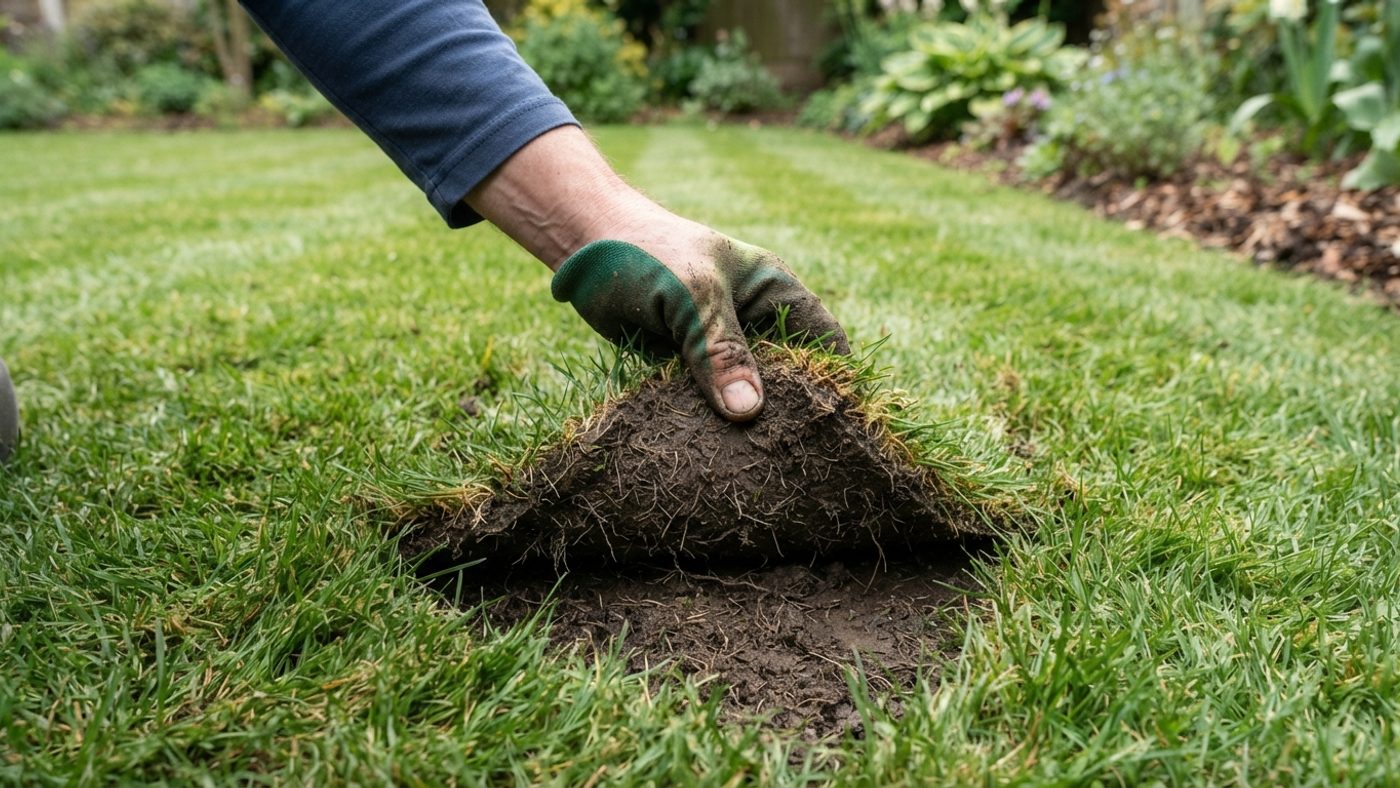
The single most useful diagnostic move for a suspicious patch is a pull test: get a firm grip on the grass at the edge of the dead area and pull. If it comes away easily, like a loose rug lifting off the ground with no roots holding it down, that's chafer damage, the grubs have already eaten through the root system, so there's nothing left anchoring the turf. Have a look in the soil underneath while you're at it; the C-shaped grubs themselves are usually visible if that's what's going on. Drought-stressed and urine-scorched grass, by contrast, stays rooted and firm even though it's brown, because in both cases the roots are intact and the damage is to the leaf, not the root system.
| Chafer grubs | Drought stress | Dog urine | |
|---|---|---|---|
| Shape | Irregular, spreading patches | Diffuse, more even browning over a wider area | Small, roughly circular patches |
| Pull test | Lifts away like loose carpet, no roots, grubs often visible underneath | Stays rooted and firm | Stays rooted and firm |
| Ring pattern | None | None | Dark green ring around a dead or yellow centre |
| Worst timing | Early autumn, once grubs are larger | Prolonged dry spells, especially in thin/sandy soil | Whenever the dog uses that spot |
| Other signs | Torn-up turf from birds, foxes, or badgers hunting the grubs | Recovers with rain or watering, no digging | Repeats in the same one or two spots if a dog has a favourite corner |
Treating chafer grubs: nematodes, timed properly
Where the pull test and visible grubs confirm chafer damage, the standard treatment is a pathogenic nematode, usually sold as Heterorhabditis bacteriophora, which kills the larvae by infecting them with a fatal bacterial disease. It's watered into the moist lawn, targeting the ground around the edge of affected patches as well as the obvious dead area, since grubs spread out from these "hot spots" as they feed. Two conditions matter for it to actually work: the soil needs to be moist before and after application, and soil temperature needs to sit between 12°C and 20°C, with application best done in late summer to early autumn (broadly July to September). Buy from a supplier and apply as soon as possible after it arrives, following that supplier's own instructions on rate and coverage.
That temperature window is UK-wide guidance rather than one adjusted for Scotland specifically. A cooler, later-warming garden, upland or Highland ground especially, may not reach a reliable 12°C as early as the general date range assumes, a reasonable expectation from how soil warming generally works. The practical fix either way is the same: check with a soil thermometer pushed a few centimetres in rather than treating "July to September" as a fixed calendar deadline. The same caution applies to the whole chafer lifecycle: adult flight, egg-laying and the shift to root damage in early autumn all run on a general UK calendar, and a cooler garden may lag behind it at every stage, not only when applying nematodes.
Where turf is already badly damaged, repair by re-sowing with grass seed or laying new turf in mid-to-late spring, once the surviving grubs have moved deeper into the soil to pupate and stopped actively feeding on roots.
Treating drought stress: water, don't panic
Drought-browned grass generally isn't dead, just dormant, and it greens up again once it gets enough water, whether that's rainfall or watering by hand. There's no repair product involved, the fix is simply keeping the lawn adequately watered through a dry spell rather than assuming a genuinely uniform, whole-lawn browning needs anything more drastic.
Treating dog urine patches: dilute, and consider redirecting the dog
For an isolated patch, flooding the area with water as soon as possible after the dog urinates dilutes the nitrogen concentration before it scorches the grass, and doing this consistently is the most reliable way to stop new patches forming in the first place. For a lawn with a repeat-offender dog that consistently favours the same one or two spots, training the dog toward a dedicated toileting area, a gravel patch or a corner of hardier ground rather than the main lawn, deals with the pattern at the source rather than chasing individual patches after the fact.
Why Scotland's brown patch is more likely dog or grub than drought
Scotland's rainfall doesn't make it immune to dry spells, but it does shift the odds. Even two of the driest parts of the country get noticeably more rain a year than a genuinely dry part of England:
| Station | Region | Annual average rainfall (1991-2020) |
|---|---|---|
| Charterhall | Scottish Borders (one of Scotland's drier areas) | 746.37 mm |
| Inverness | Highlands | 755.02 mm |
| Cambridge (NIAB) | East Anglia (a genuinely dry English reference point) | 559.37 mm |
That's roughly a third more annual rainfall even at Scotland's drier stations than one of England's driest. It doesn't rule drought out anywhere in Scotland, particularly on light or sandy soil that drains fast regardless of regional rainfall, but it does mean a Scottish lawn is statistically less likely to be looking at straightforward drought stress than a lawn in one of England's drier regions would be. That's not a claim that grubs or dog urine happen more often in Scotland, just that drought earns less benefit of the doubt here as the default explanation, worth ruling out the other two properly with the pull test rather than reaching for the hose first.
Putting it together
Once the pull test and the table above have told you which of the three is going on, the rest is just following through: nematodes and a soil thermometer for grubs, patience and a hose for drought, dilution and a redirected dog for urine scorch. A lawn with a genuinely mixed patch, some grub damage, a dry corner, a favourite dog spot, usually needs all three treatments running at once rather than one covering the whole thing.
Not every autumn patch is one of these three. Pink or rust-coloured patches with a faint gelatinous fuzz on the blades, rather than dead brown ground, are red thread, a feeding problem rather than a root one. A ring or arc of unusually dark, lush grass, sometimes with mushrooms along it, is a fairy ring. Both look nothing like a chafer, drought, or urine patch once you know what to check for, and are worth ruling out first if the pull test comes back clean and there's no ring pattern either.
Common questions
How many chafer grubs is actually a problem, versus a normal background level?
There’s no fixed number worth memorising. The practical test is the pull test itself: if turf lifts away with no roots holding it and grubs are visible underneath, that’s enough evidence to treat, whatever the exact count turns out to be.
How do I know if it’s chafer grubs or leatherjackets under the lawn?
Pull back a patch of the damaged turf and look at the grub itself. Chafer grubs are creamy-white, C-shaped, and have three pairs of legs. Leatherjackets are legless, grey-brown, and tube-shaped, up to about 30mm long. Both attract the same bird and mammal predators and cause similar surface damage, so the grub is the only reliable way to tell them apart, and the nematode species used to treat them differs.
Can I use nematodes and re-seed at the same time?
No. Nematodes need to be watered into the lawn while grubs are still actively feeding near the surface, in the July-to-September window with the soil warm enough; re-seeding or re-turfing is a separate, later step done in mid-to-late spring once the remaining grubs have moved deeper into the soil to pupate and stopped damaging roots.
My lawn is badly torn up by birds or a badger overnight, is that separate from the grub problem?
No, it’s usually the same problem in a more dramatic form. Birds, particularly crow-family species, along with badgers and foxes, tear up turf specifically to reach chafer grubs underneath once grub numbers are high enough to make it worth their effort, treating the grubs is what stops the digging, not repairing the turf on its own.
Is it worth testing soil temperature before applying nematodes, or is the general July-to-September window good enough on its own?
Testing directly is the safer approach. The 12-20°C range is UK-wide guidance rather than one adjusted for regional soil temperature, and a cooler, later-warming garden may not reach 12°C as early as that window assumes, a soil thermometer removes the guesswork the calendar dates alone can’t answer.
Dealing with a different lawn problem? See moss in your lawn, mushrooms and fairy rings, red thread, worm casts, and moles.
Sources
7 sources, recorded with what each was used for
- RHS: Chafer grubs in lawns: Species identification (garden chafer, Welsh chafer, and the less common brown and summer chafer), adult beetle flight timing (late May-June), grub lifecycle and the shift to root damage in early autumn, grub appearance, secondary damage from birds (crow family), badgers, and foxes, nematode product name and general timing, and spring re-turfing/re-seeding advice
- RHS: Biological Control in the Garden: Heterorhabditis bacteriophora nematode application timing (late summer to early autumn) and the 12-20°C soil temperature requirement for chafer grub treatment
- RHS: Dead Patches in Lawns: Drought/dry-weather patch description (irregular, worse over tree roots or sandy soil), dog urine identification (circular patches with bright green margins, worse from female dogs, watering as remedy), and the bird-activity-plus-rapid-spread cue for insect root damage
- RHS: Leatherjackets: Leatherjacket grub appearance and identification, its similarity to chafer-grub bird/mammal predation, and the Steinernema feltiae/S. carpocapsae nematode species, September-to-early-October timing, and 12°C minimum soil temperature for leatherjacket treatment specifically
- Met Office: Charterhall location-specific long-term averages: 1991-2020 annual rainfall average for a drier eastern-Scotland station (746.37mm)
- Met Office: Inverness location-specific long-term averages: 1991-2020 annual rainfall average for a northern-Scotland station (755.02mm)
- Met Office: Cambridge, NIAB location-specific long-term averages: 1991-2020 annual rainfall average for a dry East Anglian reference station (559.37mm), used as the England-drought comparison point