
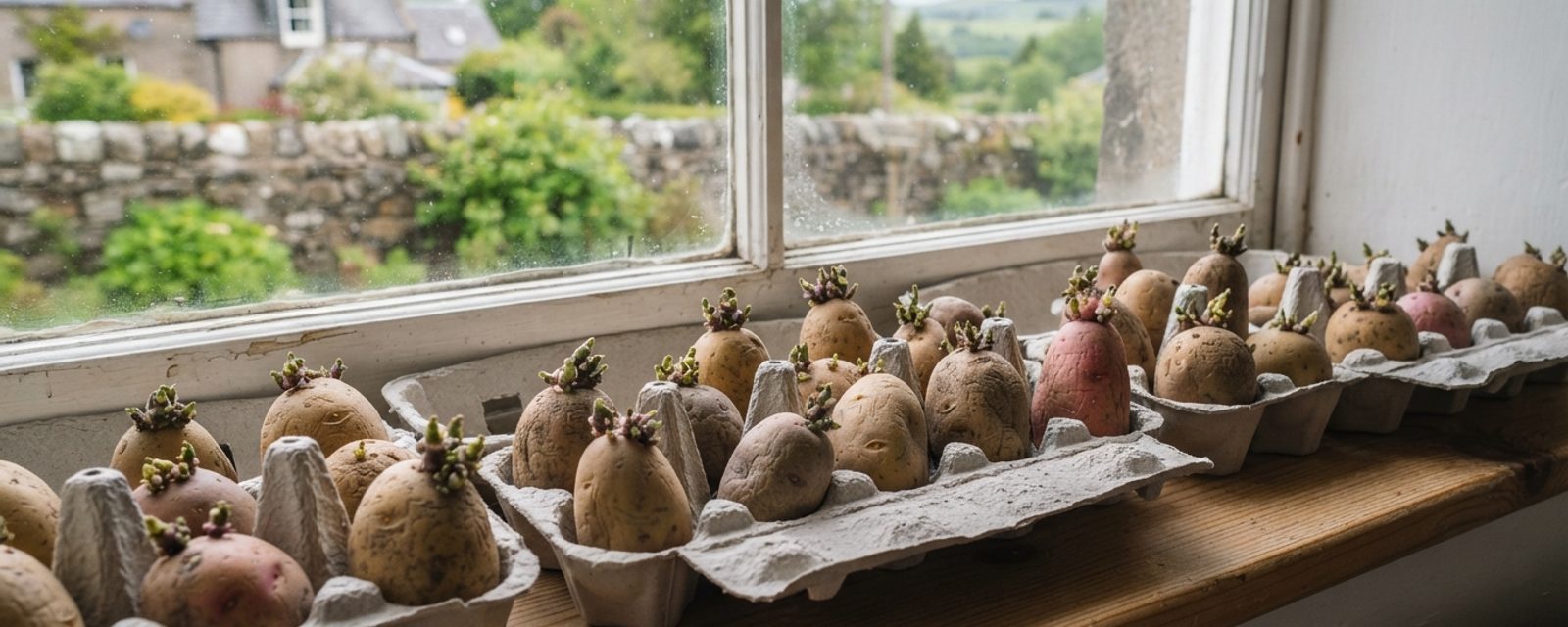
A seed potato is not inert. Each "eye" is a dormant bud, and the whole tuberA swollen underground stem or root a plant uses to store energy, which can also grow into a new plant, the classic example being a potato. Full definition → operates under a botanical rule called apical dominance: the strongest buds, usually those nearest the rose end, where the potato was last attached to its parent plant, suppress the growth of the others by controlling the tuber's internal hormone balance. Left in a dark, warm cupboard, that dominance breaks down in an uncontrolled way. One or two buds surge ahead, starved of light, and stretch rapidly upward searching for it. The result is the pale, brittle, spaghetti-like growth most gardeners recognise as a potato that has "gone over" in the vegetable rack.
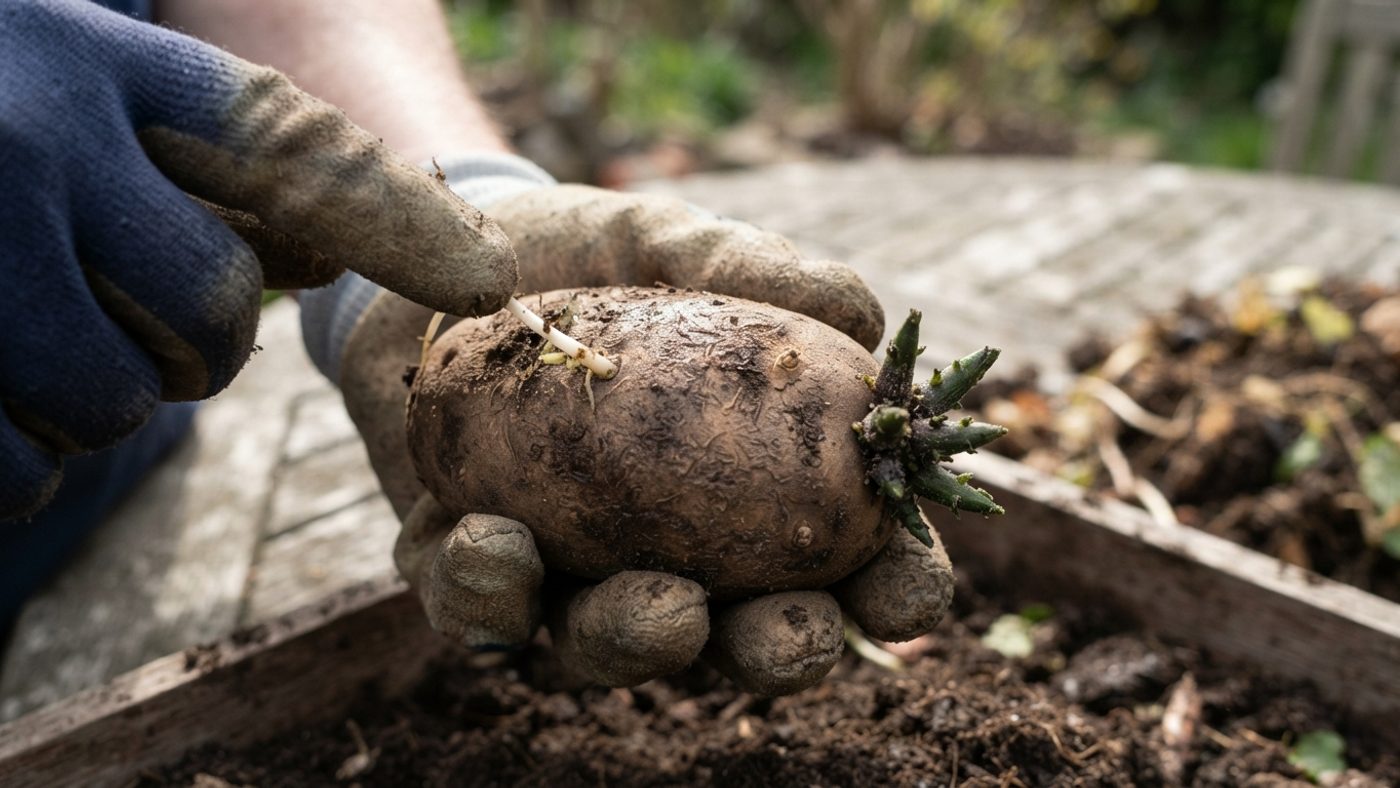
ChittingPre-sprouting seed potatoes in a light, cool, frost-free place before planting, so they go in the ground with short sturdy shoots already growing. Full definition → is simply a way of breaking that dormancy on purpose, under conditions that produce a useful result instead of a wasted one. Standing the tubers rose-end up in a cool, bright spot does two things at once. Cool temperatures slow the rate of growth right down, so the buds don't bolt. Light, meanwhile, keeps the shoots short and stops that upward stretching response, the same mechanism that keeps any seedling stocky when it isn't light-starved. Light also triggers chlorophyll and anthocyanin, the same purple pigment found in red cabbage and beetroot, production in the shoot tissue, which is why a well-chitted sprout looks green or purple-tinged and feels firm rather than white and rubbery. That colouring isn't decorative, it's a sign the shoot has hardened enough to survive handling and planting without snapping off.
RHS describes the cumulative effect of this as an increase in the tuber's "physiological age": a chitted seed potato behaves, from the moment it goes in the ground, as though it is already a few weeks further into its growing cycle. It breaks ground faster, forms tubers sooner, and bulks them up earlier, because the plant isn't starting that developmental clock from zero at planting time.
It's worth being precise about what that buys you. Chitting is optional, not essential. An unchitted early potato still grows perfectly well, it simply takes a few weeks longer to crop. What chitting buys is time, not a better plant. That distinction matters more than it might seem, because in Scotland, time is the one thing the growing season is short on.
Why the head start matters more here than further south
Scotland's last frosts fall later than most of England's, see the full regional breakdown on the Scottish frost dates page, which covers the lowland-to-upland spread station by station. First early potatoes are planted with one eye on that local frost date and the other on the calendar, and the growing season simply has less slack at both ends than it does further south. A technique that reliably pulls the harvest forward by two to three weeks isn't a cosmetic bonus in that context; it's a way of clawing back some of the season length a Scottish gardener doesn't otherwise have. For a maincropThe main, usually latest-sown and longest-growing type of a crop, grown for bulk and storage rather than an early harvest. Full definition → potato, which has the whole summer to bulk up regardless, that same head start barely registers. For a first early racing the frost-free window, it's the difference between a July harvest and one squeezed into a narrower gap later in the season.
How to chit: the method
- Source good seed potatoes. Certified seed stock is grown specifically to be virus-free, which matters here because a home-saved tuber or a supermarket potato can carry a virus with no visible symptoms until the plant it grows underperforms; certified stock avoids that risk and gives chitting something worth working with, a shrivelled or diseased tuber won't chit well no matter how it's handled. Scotland is a major producer of the UK's certified seed potatoes, so certified stock bought here has often been grown in the same climate it's about to be planted into.
- Stand them rose end up. The rose end is the end with the most eyes (small dents) clustered together, usually the end opposite where the tuber attached to the old plant's stem. Standing them this way concentrates the strongest sprouts where you want them.
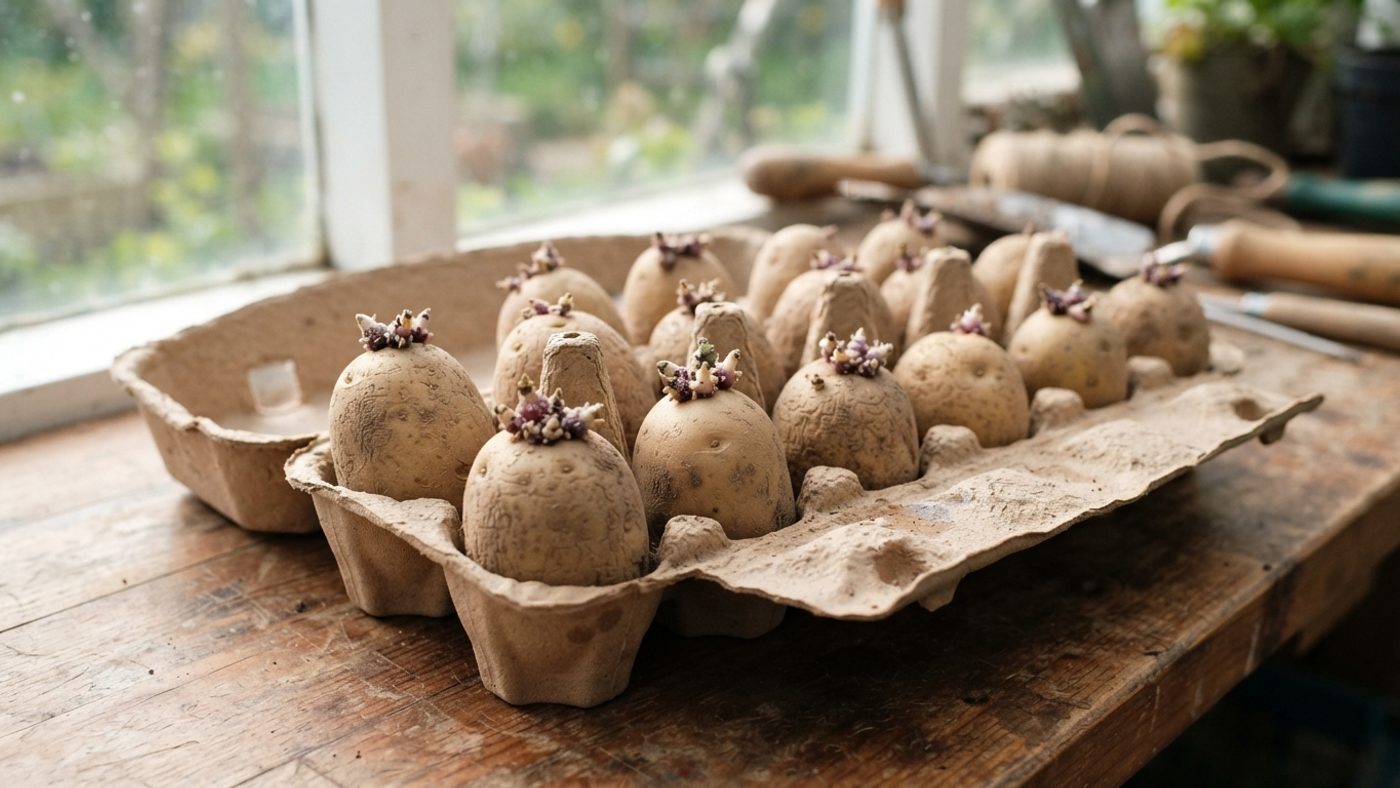
- Use something that holds them upright. Egg boxes are the classic choice for good reason, each cup holds one tuber steady without touching its neighbours, which matters for airflow. Seed trays work equally well.
- Place them somewhere cool, bright, and frost-free. A porch, an unheated spare room, a garage with a window, or a windowsill out of direct radiator heat are all suitable. Avoid anywhere warm, an airing cupboard or a spot near a heat source will produce the same weak, stretched growth that untended tubers get in dark storage, defeating the purpose entirely.
- Leave them for four to six weeks. This is the consistent window across UK growing advice, and it holds for Scotland too, though when to start is where it's worth adjusting (see below).
- Reduce to the strongest shoots on early varieties. Once shoots are visible, rub off all but the four strongest per tuber, leaving those nearest the rose end. This channels the tuber's stored energy into fewer, stronger growing points rather than spreading it thin across many weak ones. Second earlies and maincrop don't need this step.
- Plant once shoots reach 2-3cm and the ground and weather allow. For planting depth, spacing by type, and earthing upDrawing soil up around a plant's base as it grows, most often potatoes, to keep light off developing tubers and support tall stems. Full definition →, see the full potato growing guide.
Timing: when to start in Scotland
Generic UK advice suggests starting in late January in milder areas and into February or March further north or in colder gardens. For most of Scotland, starting in February rather than January is the more realistic call, since the planting-out date it's working toward also falls later here, see the Scottish frost dates page for how much later, by region. Starting chitting doesn't commit you to planting on any fixed date, sprouted tubers can sit and wait a little if a cold snap delays planting, as long as they stay frost-free, but starting too early with nowhere frost-free to plant them out into simply means managing longer, more fragile shoots for longer.
Light and temperature in detail
The conditions that produce a good chit are narrower than "somewhere light" suggests:
| Condition | Target | What goes wrong outside it |
|---|---|---|
| Light | Bright, indirect daylight (north-facing windowsill, unheated porch) | Full south-facing sun can overheat tubers on a mild day; too little light and shoots stretch pale and thin, the same failure as darkness |
| Temperature | Roughly 7-10°C | Above this, growth speeds up but produces the same weak, leggyDescribes a plant that's grown tall, thin and sparse rather than bushy, usually from too little light or not being pinched out. Full definition → shoots as darkness does; below about 4-5°C, growth essentially stalls |
| Frost | None, without exception | A frosted shoot blackens and dies back; the tuber may need to regrow from a secondary eye, losing much of the head start chitting was meant to buy in a season already short on it |
| Airflow | Open, not packed or bagged | Tubers packed tightly together or left in a plastic bag can develop soft, damp patches |
If nothing has sprouted after three or four weeks, the room is more likely too cold than too dark, check the temperature before assuming the tubers are simply slow. Shorter winter daylight hours further north in Scotland also make the single brightest spot in the house worth prioritising over a merely convenient one, since there's less daylight overall to work with during a typical February start.
Good sprout vs bad sprout
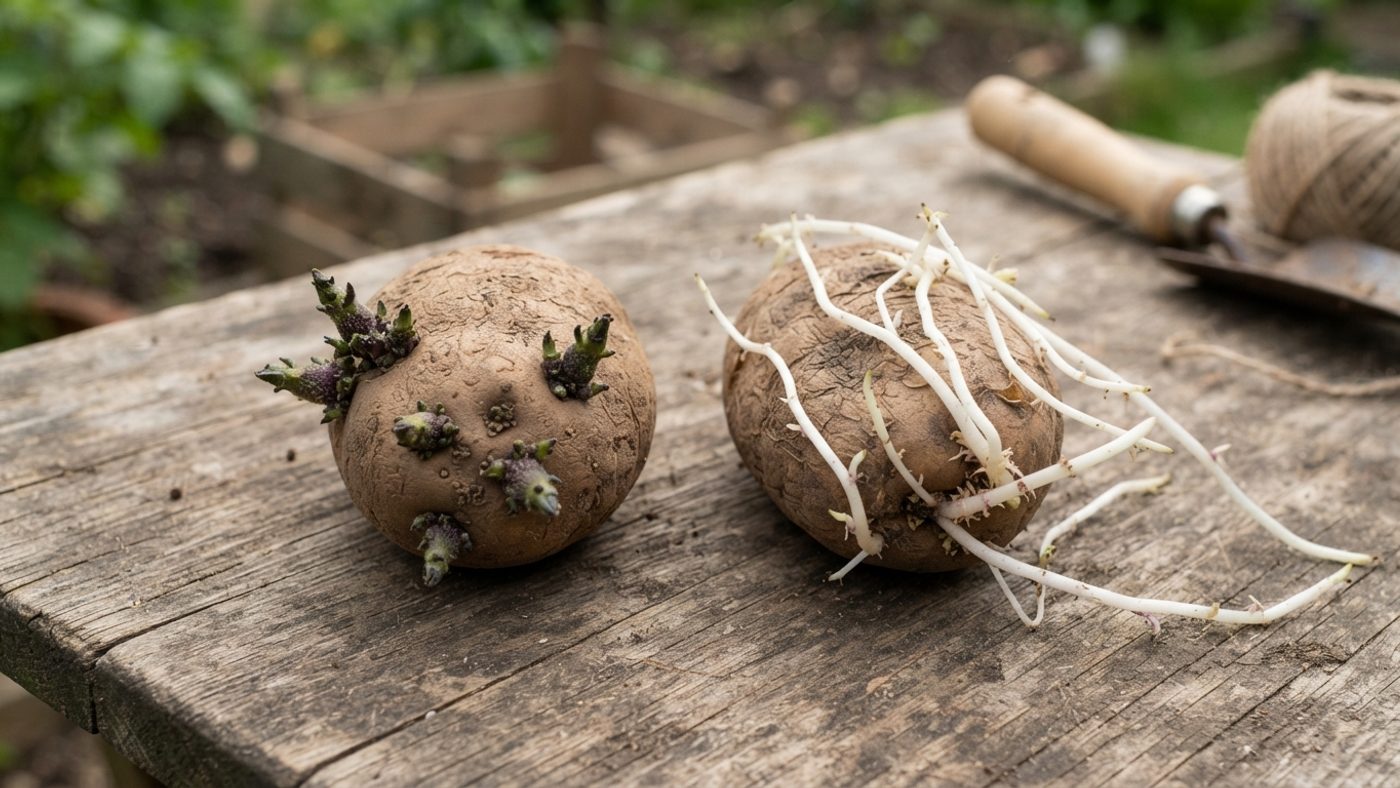
| Good chit | Poor chit | |
|---|---|---|
| Colour | Green or purple-tinged | Pale, white, or yellowish |
| Length at planting | 2-3cm | Longer than 3-4cm, often much more |
| Texture | Firm, slightly knobbly | Thin, soft, rubbery or brittle |
| Growth habitA plant's characteristic shape and manner of growth, such as upright, spreading, creeping or bushy. Full definition → | Short, stubby, upright | Long, thread-like, prone to snapping |
A shoot that has snapped off during handling isn't necessarily fatal to the tuber, a healthy seed potato usually has other eyes that can take over, but it does erase most of the time advantage chitting was meant to provide, since the replacement growth starts from behind.
Which potato types actually benefit
First earlies get the clearest return, for the reasons above: they're the type most directly racing the frost-free window, so the head start goes straight into an earlier crop rather than being absorbed by a season that had time to spare anyway.
Second earlies benefit to a lesser but real degree, worth doing if you're chitting the first earlies anyway and have space, less critical if time is short. For named early varieties that suit Scotland's shorter season, see Best Potato Varieties for Scotland, which compares them head-to-head.
Maincrop varieties see no meaningful yield advantage from chitting, unlike a first early. Some growers still chit maincrop tubers on the reasoning that a shorter time in the ground means less exposure to blight and slug pressure later in the season, but that's a secondary argument about disease timing, not about yield or the core rationale for chitting. See potato blight if that's the reasoning behind chitting a maincrop.
| Type | Benefits from chitting | Typical duration | Scottish relevance |
|---|---|---|---|
| First early | Yes — clearly | 4-6 weeks | High — directly extends the usable cropping window against a later frost date |
| Second early | Somewhat | 4-6 weeks | Moderate — useful if already chitting earlies |
| Maincrop | Minimal | Not usually done | Low — full season available regardless |
Troubleshooting
- Shoots are long, white, and thin. The tubers have been kept somewhere too warm, too dark, or both. Move them to a cooler, brighter spot immediately, this won't reverse growth already made, but it will slow further stretching. At planting, handle these shoots very gently; expect some breakage.
- No sprouts after several weeks. Check the temperature isn't too cold, see the table above. Move them somewhere a little warmer but still cool and bright rather than assuming the tubers are simply slow. Also check the tubers weren't treated with a sprout suppressant, sometimes applied to potatoes sold for eating rather than as certified seed stock.
- Sprouts have gone soft, dark, or smell off. This is rot, not slow chitting, and usually starts from a damaged or diseased tuber. Discard the affected tuber rather than risk it spreading to others in the same box.
- Shoots snapped during planting. Plant the tuber anyway. A seed potato normally has more dormant eyes that will take over, though the crop from that tuber will be a little behind the others.
- A late frost threatens tubers still chitting indoors. Move them further from windows or glass, or into an unheated room rather than a porch, until the risk passes, the point is to avoid frost, not necessarily to keep them in the brightest possible spot at all costs. A late cold snap is a real risk in a Scottish spring, given how late the last frost can fall here.
- Chitted tubers are ready before the ground or weather is. This is common in Scotland, where chitting finishes on schedule but planting conditions lag. Sprouted tubers can be held for a couple of extra weeks in the same cool, bright, frost-free spot without much harm, though very long delays risk the shoots overgrowing and becoming brittle.
Common questions
Does chitting increase how many potatoes I get, not just how early?
Not on its own. Chitting's proven effect is on timing rather than total yield, an unchitted early potato reaches much the same result, just later. The one indirect route to a yield effect is disease: a maincrop lifted a little earlier after an early-season head start spends less time exposed to blight and slugs later on, which can protect yield rather than increase it.
Can I chit potatoes in the dark if I don't have a bright spot?
It's possible, but the shoots that result are typically longer, paler, and more fragile than light-grown ones, and more prone to snapping at planting. If a genuinely bright, cool spot isn't available, an unheated room is still far better than a dark cupboard, even if it's dim.
Do I need to chit second earlies and maincrop as well as first earlies?
Second earlies see some benefit and are worth chitting if you're already doing the earlies. Maincrop varieties see little advantage, since they're in the ground for the full season regardless of a head start at planting.
What if my seed potatoes already have long shoots when they arrive?
Rub off the longest, weakest growth and let the tuber re-sprout in proper cool, bright conditions, you'll get a shorter delay than trying to plant with overgrown, brittle shoots that are likely to break.
When should I start chitting in Scotland specifically?
February is a realistic starting point for most of Scotland, rather than the late-January start sometimes suggested for milder parts of the UK, the four-to-six-week process still applies, but starting a little later avoids ending up with fully chitted tubers waiting weeks past their prime for frost-safe planting conditions.
Sources
6 sources, recorded with what each was used for
- RHS: How to grow potatoes: The physiological age concept, chitting timing (February-March start, 4-6 weeks), egg box/rose-end method, 3cm sprout length target, and rubbing off weak shoots to leave four per tuber
- RHS: Growing potatoes, secrets of success: Confirmation of the physiological age concept, "not essential" framing, and the point that maincrop harvested earlier can see reduced slug and blight exposure
- Garden Organic: How to grow potatoes: Timing (January start, March-April planting), 4-6 week duration, cool-light-place guidance, storing unchitted tubers in cool dark conditions, and the statement that maincrop varieties see no real advantage from chitting
- Garden Organic: It's time to chit your potatoes!: The disease-exposure rationale (less time in the ground) and confirmation that chitting is not essential except for earlier maturity in early varieties
- Gardeners' World: How to grow potatoes: North-facing-windowsill guidance, avoiding heat sources such as radiators, the sprout description, and rubbing back to three or four strongest shoots
- SASA (Science and Advice for Scottish Agriculture): Scottish Seed Potato Classification Scheme: Scotland's standing as a major producer of certified seed potatoes, and the existence of the classification scheme certified stock is grown under